
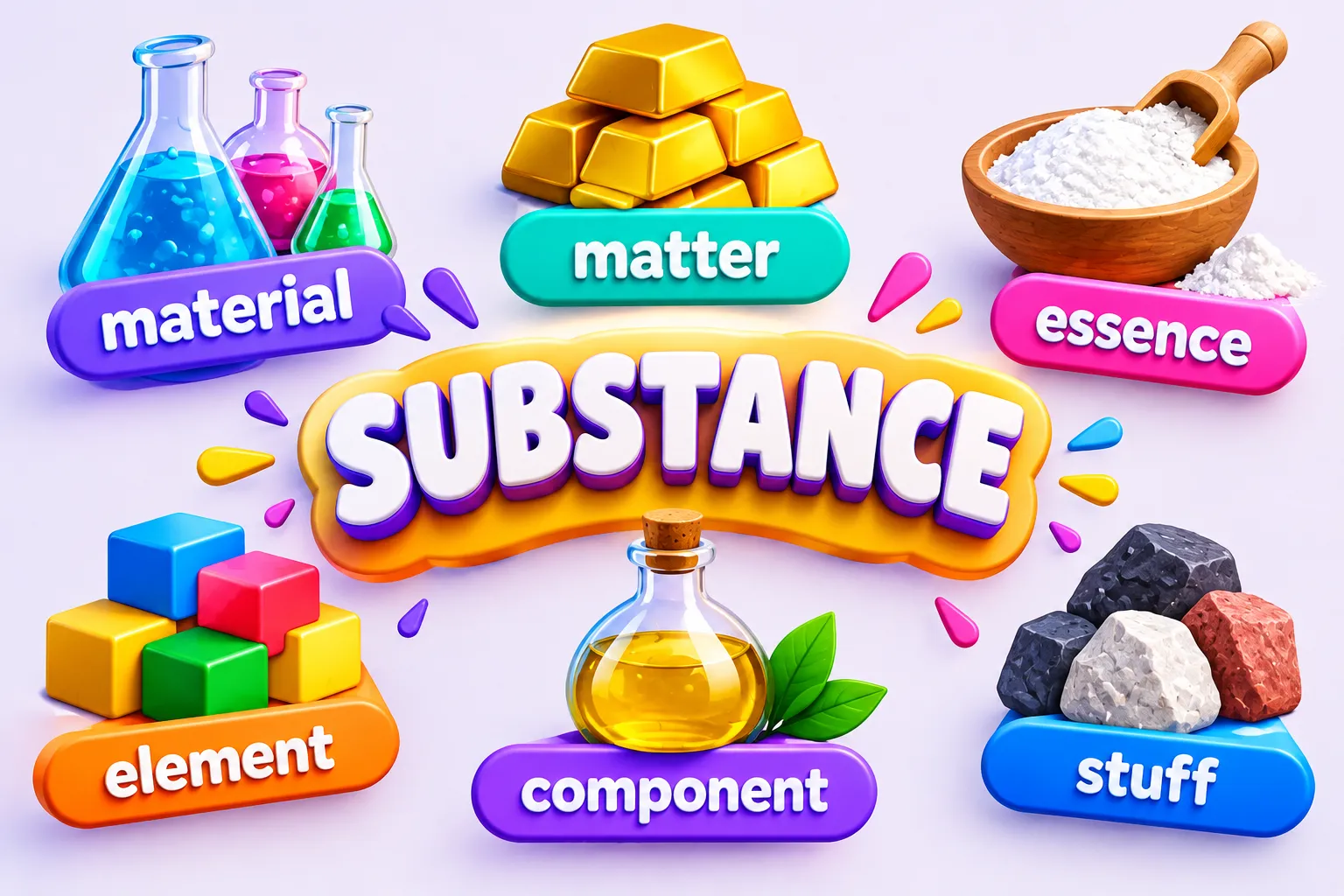
Useful synonyms include material, matter, element, compound, essence, content, meaning, reality, nature, body, and core. The best synonym depends on the context because “substance” has several different meanings.
Substance is a common word that can describe a physical material, the main part of an idea, or the essential nature of something. For example, when a science student studies water, they may describe it as a substance. In writing, someone may say that an argument has “little substance” when it lacks useful ideas or facts. The word is widely used in science, education, medicine, law, business, and everyday English. Learning synonyms for substance helps English learners understand these different meanings and choose more precise words. It also helps writers avoid repetition. In this guide, we explore 30 alternatives with simple meanings and examples. We will also cover the word’s grammar, connotation, etymology, pronunciation, word formation, prototype meaning, semantic groups, antonyms, and common questions.
Meaning of Substance
Definition
Substance (Noun): A particular type of physical material, or the essential matter, meaning, or quality of something.
Examples
- Water is a common substance found in nature.
- Her speech had real substance and useful information.
Connotative Meaning
- Positive tone: It can suggest importance, depth, value, or meaningful content.
- Negative tone: In some contexts, it can refer to an illegal or harmful drug.
- Neutral tone: It can simply describe a material, matter, or essential part of something.
(Connotation means the feeling or idea that a word suggests beyond its basic meaning.)
Etymology
The word substance comes from Latin substantia, meaning “being, essence, or that which stands beneath.” It entered English through Old French and developed several meanings related to material existence, essential nature, and meaningful content.
| English Period | Development |
| Old English (450–1100) | The modern word substance was not established in Old English. Ideas of material, being, and matter were expressed through native Germanic words. |
| Middle English (1100–1500) | Substance entered English through Old French from Latin substantia, referring to essential nature, being, or material existence. |
| Modern English (1500–Present) | Substance developed its modern meanings of material, essential quality, meaningful content, and, in some contexts, a drug. |
Pronunciation (IPA)
- IPA: /ˈsʌbstəns/
- Syllables: sub-stance
Affixation Pattern of “Substance”
- Root: subst- from Latin substantia, related to substare, meaning “to stand beneath.”
- Prefix: sub- — meaning “under” or “beneath” in the Latin formation.
- Suffix: -ance — forming a noun.
- Word formations:
- substance — noun
- substantial — adjective
- substantially — adverb
- substantiate — verb
- substantiation — noun
- substantive — adjective/noun
- substantively — adverb
28 Synonyms of Substance With Meaning & Examples
1. Material (Noun)
Meaning: A physical matter used to make, build, or create something.
Examples:
- Wood is a useful building material.
- The scientist tested the material in the laboratory.
2. Matter (Noun)
Meaning: Physical material that has mass and takes up space.
Examples:
- Water is a form of matter.
- Scientists study how matter behaves.
3. Element (Noun)
Meaning: A basic chemical substance made of one type of atom.
Examples:
- Oxygen is an important element.
- Gold is a naturally occurring element.
4. Compound (Noun)
Meaning: A substance formed when two or more elements chemically combine.
Examples:
- Water is a chemical compound.
- The scientist identified the compound in the sample.
5. Chemical (Noun)
Meaning: A substance with a particular chemical composition.
Examples:
- The laboratory stored the chemical safely.
- This chemical reacts with water.
6. Essence (Noun)
Meaning: The most important or basic quality of something.
Examples:
- Kindness is the essence of her character.
- The book captures the essence of the culture.
7. Core (Noun)
Meaning: The central or most important part of something.
Examples:
- Trust is at the core of their friendship.
- The core of the problem is poor communication.
8. Content (Noun)
Meaning: The ideas or information contained in something.
Examples:
- The article has useful content.
- The teacher checked the content of the essay.
9. Meaning (Noun)
Meaning: The idea or message expressed by something.
Examples:
- We discussed the meaning of the poem.
- Her words had a deeper meaning.
10. Significance (Noun)
Meaning: The importance or meaning of something.
Examples:
- The discovery has great scientific significance.
- He explained the significance of the event.
11. Nature (Noun)
Meaning: The basic character or qualities of something.
Examples:
- We need to understand the nature of the problem.
- The nature of the material makes it useful.
12. Reality (Noun)
Meaning: The true state or actual condition of something.
Examples:
- The report revealed the reality of the situation.
- We must face the reality of the problem.
13. Being (Noun)
Meaning: Existence or the state of existing.
Examples:
- Philosophers have studied the nature of being.
- The book explores human being and identity.
14. Bulk (Noun)
Meaning: The main or greater part of something.
Examples:
- The bulk of the work is already finished.
- The bulk of the material was stored outside.
15. Body (Noun)
Meaning: A substantial or organized amount of material, information, or work.
Examples:
- The report contains a large body of evidence.
- Researchers examined a body of scientific work.
16. Core Idea (Noun Phrase)
Meaning: The main idea at the center of a subject or argument.
Examples:
- The core idea of the lesson is simple.
- She explained the core idea clearly.
17. Content Matter (Noun Phrase)
Meaning: The information or ideas contained in a subject or work.
Examples:
- The teacher reviewed the content matter.
- The content matter was suitable for beginners.
18. Gist (Noun)
Meaning: The main point or general meaning of something.
Examples:
- I understood the gist of his argument.
- She explained the gist of the article.
19. Substance Matter (Noun Phrase)
Meaning: The important material or subject contained in something.
Examples:
- The discussion focused on the substance matter.
- The document contains important substance matter.
20. Foundation (Noun)
Meaning: The basic support or underlying basis of something.
Examples:
- Education is the foundation of progress.
- Trust forms the foundation of a strong relationship.
21. Basis (Noun)
Meaning: The main reason, support, or starting point for something.
Examples:
- Evidence formed the basis of the argument.
- The decision was made on the basis of facts.
22. Core Content (Noun Phrase)
Meaning: The most important information in a subject or document.
Examples:
- Students must understand the core content.
- The course focuses on core content.
23. Depth (Noun)
Meaning: The amount of detail, thought, or seriousness in something.
Examples:
- Her essay showed great depth.
- The book explores the depth of human emotions.
24. Weight (Noun)
Meaning: Importance, seriousness, or influence given to an idea or statement.
Examples:
- His argument carries considerable weight.
- The evidence gives weight to her claim.
25. Importance (Noun)
Meaning: The quality of having significant value or effect.
Examples:
- The teacher explained the importance of exercise.
- The discovery has great importance for science.
26. Substance Abuse (Noun Phrase)
Meaning: Harmful or excessive use of drugs or other substances.
Examples:
- The program helps people affected by substance abuse.
- Schools teach students about the dangers of substance abuse.
27. Drug (Noun)
Meaning: A chemical substance used as medicine or, in some contexts, taken for its effects on the body or mind.
Examples:
- The doctor prescribed a new drug.
- The illegal drug was removed from the market.
28. Extract (Noun)
Meaning: A substance or concentrated part taken from another material.
Examples:
- The researchers used a plant extract.
- Vanilla extract is used in many recipes.
Prototype Meaning
The most typical meaning of substance is a particular kind of physical material, especially in science. People may imagine water, salt, oxygen, chemicals, or another material when they hear the word. However, substance can also mean the essential part or meaningful content of an idea, argument, or situation. Its exact meaning depends strongly on context.
Prototype Categorization
- Physical materials: material, matter, chemical, element, compound, extract — useful in science, medicine, and everyday descriptions.
- Essential qualities: essence, core, nature, being, depth — useful when discussing the basic character of something.
- Ideas and information: content, meaning, gist, core idea, core content — useful for writing, education, and communication.
- Importance and support: significance, importance, weight, basis, foundation — useful when describing the value or strength of an idea.
- Parts and amounts: bulk, body, component, ingredient — useful when describing parts, mixtures, or large amounts.
- Drug-related meanings: drug, substance abuse — used specifically in medical, health, and social contexts.
This grouping helps writers select a synonym based on the exact meaning of substance they want to express.
Antonyms of “Substance”
| Antonym | Part of Speech | Meaning |
| Nothingness | Noun | A state of having no thing or existence. |
| Emptiness | Noun | A lack of content, meaning, or material. |
| Void | Noun | An empty space or complete absence of something. |
| Insignificance | Noun | A lack of importance or meaning. |
| Superficiality | Noun | A focus on surface appearance rather than depth. |
| Appearance | Noun | The way something looks rather than what it truly is. |
| Form | Noun | The visible or external shape of something, especially when contrasted with substance. |
| Triviality | Noun | A lack of importance or seriousness. |
Short Questions and Answers
What does “substance” mean?
Substance can mean a physical material, the essential nature of something, its meaningful content, or a drug, depending on context.
When should “substance” be used?
Use substance when discussing material, essential qualities, meaningful content, or certain chemical and drug-related contexts.
Is “substance” positive or negative?
Substance is usually neutral. It can have a positive meaning when it suggests depth or importance and a negative meaning when it refers to harmful drugs.
How is it different from similar words?
Material usually refers to physical matter. Essence focuses on the most important quality. Content refers to information or ideas, while matter can refer to physical material or a subject of concern.
Conclusion
Learning synonyms for substance helps English learners understand a word with several important meanings. Words such as material, matter, element, compound, essence, content, core, gist, basis, and component can replace substance in specific situations. Some alternatives describe physical materials, while others focus on ideas, importance, essential qualities, or parts of a whole. Choosing the right synonym makes writing clearer and reduces repetition. These words are useful in academic writing, science, business, education, and everyday communication. To improve your vocabulary, practice each word in a simple sentence and compare it with the original word. Regular reading and writing will help you understand subtle differences between related words. With daily practice, you can make your English more precise, natural, and confident.
Read More:
Synonyms for external: 30 Powerful Words for Confidence

I’m Falak Naaz, an SEO writer at SynonymsInstant.com focused on creating clear, engaging, and search-friendly English content. I specialize in vocabulary, synonyms, antonyms, word usage, and language guides. I combine careful research with practical writing to deliver trustworthy content that helps readers choose the right words and improve their English with confidence.