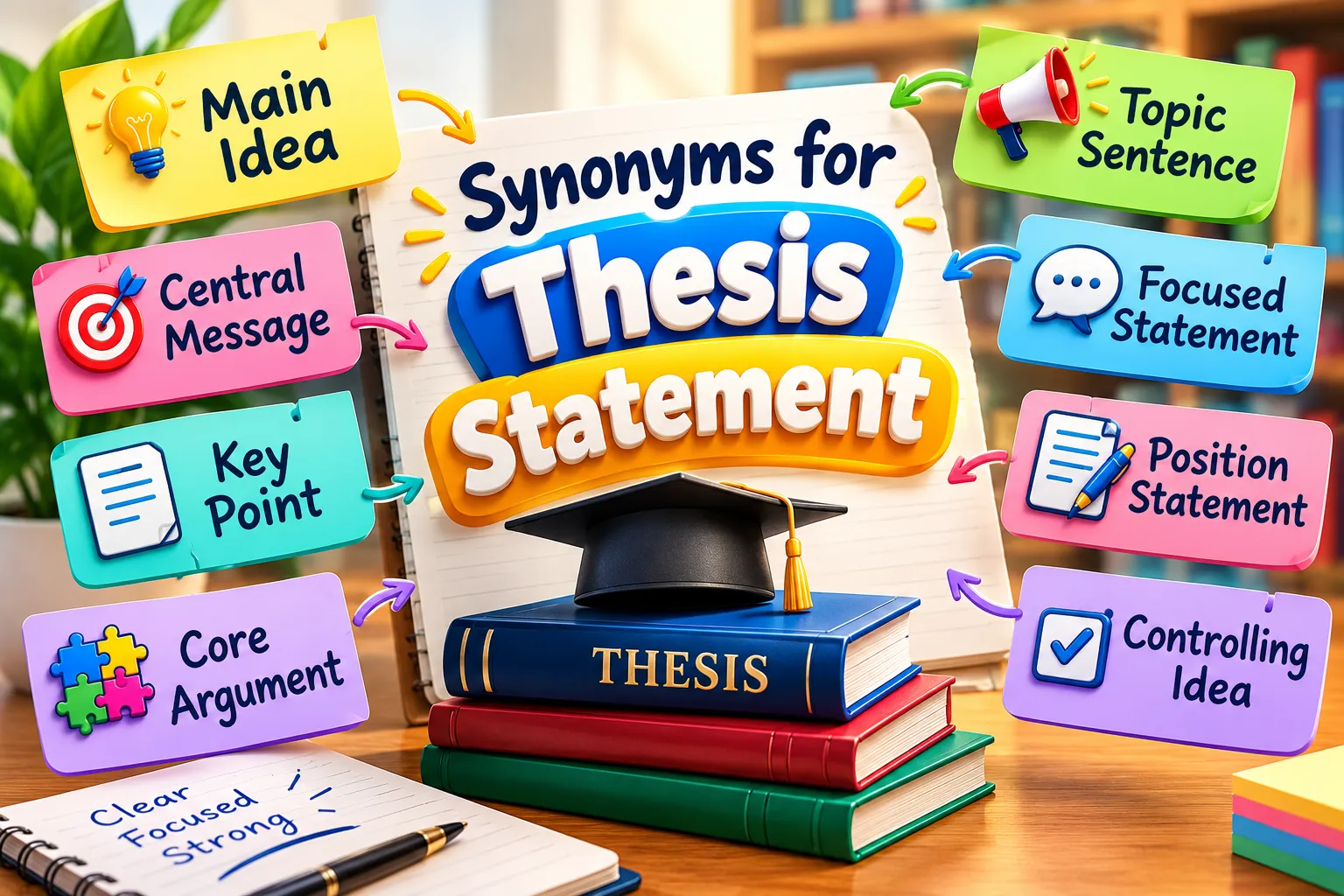
Useful synonyms and related phrases include main argument, central argument, main claim, central claim, main idea, central idea, key argument, core argument, main proposition, central proposition, research claim, position statement, controlling idea, focus statement, guiding idea, central point, main point, key point, primary argument, primary claim, core idea, central position, essay claim, research position, and argumentative claim. The best choice depends on context: main argument works well for argumentative writing, main idea for general writing, research claim for academic studies, and controlling idea for organizing an essay.
A thesis statement is the main idea or central claim of an essay, research paper, or academic piece of writing. For example, when a student writes an essay about online learning, the thesis statement tells the reader what the essay will argue or explain. The term is common in academic writing because it helps organize ideas and gives the reader a clear direction. However, writers may sometimes need similar words or phrases to avoid repetition or explain the concept in a different way. Learning synonyms for thesis statement can improve vocabulary, academic writing, and communication skills. In this guide, we will explore the meaning, examples, connotations, history, pronunciation, word formation, and 26 useful alternatives. We will also group these terms into semantic categories so writers can choose the most suitable expression for each context.
Meaning of Thesis Statement
Definition
Thesis statement (Noun):
A thesis statement is a clear sentence that presents the main idea, argument, or claim of an essay or research paper.
Examples
- My thesis statement explains why students should learn digital skills.
- The introduction ends with a clear thesis statement.
Connotative Meaning
Connotation means the feeling or idea associated with a word beyond its basic meaning.
- Positive tone: A strong thesis statement suggests clarity, confidence, focus, and good organization.
- Negative tone: A weak or unclear thesis statement may suggest confusion or poor organization.
- Neutral tone: In academic writing, thesis statement is usually a neutral technical term.
Etymology
The phrase thesis statement combines two words with Greek and Latin histories.
- Old English (450–1100): The modern word thesis was not part of Old English. Academic terminology later entered English through Latin and Greek.
- Middle English (1100–1500): Thesis entered English through Medieval Latin from Greek thésis, meaning “a placing” or “a proposition.”
- Modern English (1500–Present): Thesis developed the meaning of a proposition or central argument. Thesis statement became a common academic term for the sentence that clearly states the main argument of a paper.
Pronunciation (IPA)
- IPA: /ˈθiːsɪs ˈsteɪtmənt/
- Syllables: the-sis state-ment
Affixation Pattern of Thesis Statement
- Root: thesis + statement
- Prefix: None
- Suffix: -is in thesis; -ment in statement
- Word formations:
- thesis — noun
- theses — plural noun
- state — verb/noun
- statement — noun
- stateable — adjective
- thesis statement — noun phrase
- thesis-driven — adjective
26 Synonyms of Thesis Statement With Meaning & Examples
Note: “Thesis statement” is a specific academic term, so many of the following are contextual alternatives or closely related expressions, rather than exact synonyms.
1. Main Argument (Noun Phrase)
Meaning: The main argument is the central point a writer tries to prove.
Examples:
- The main argument appears at the end of the introduction.
- Her main argument is easy to understand.
2. Central Argument (Noun Phrase)
Meaning: The central argument is the primary argument of a piece of writing.
Examples:
- The central argument supports environmental protection.
- The writer clearly explains the central argument.
3. Main Claim (Noun Phrase)
Meaning: A main claim is the key idea that a writer presents as true or valid.
Examples:
- The main claim needs strong evidence.
- His main claim is clearly stated.
4. Central Claim (Noun Phrase)
Meaning: A central claim is the most important claim in an essay or paper.
Examples:
- The evidence supports the central claim.
- The author introduces the central claim early.
5. Main Idea (Noun Phrase)
Meaning: The main idea is the most important thought or message.
Examples:
- The main idea of the essay is easy to identify.
- Each paragraph supports the main idea.
6. Central Idea (Noun Phrase)
Meaning: The central idea is the core thought of a written work.
Examples:
- The central idea connects all the paragraphs.
- Students should identify the central idea first.
7. Key Argument (Noun Phrase)
Meaning: A key argument is an important point used to support a position.
Examples:
- The key argument focuses on education.
- The writer gives evidence for the key argument.
8. Key Claim (Noun Phrase)
Meaning: A key claim is an important statement that a writer wants readers to accept.
Examples:
- The key claim appears in the introduction.
- The researcher supports the key claim with data.
9. Core Argument (Noun Phrase)
Meaning: The core argument is the basic argument around which the writing is built.
Examples:
- The core argument remains clear throughout the essay.
- Every section supports the core argument.
10. Core Claim (Noun Phrase)
Meaning: A core claim is the main proposition of an argument.
Examples:
- The core claim needs more evidence.
- The researcher explains the core claim clearly.
11. Main Proposition (Noun Phrase)
Meaning: A main proposition is a central statement presented for discussion or proof.
Examples:
- The main proposition is stated in the first section.
- Evidence supports the main proposition.
12. Central Proposition (Noun Phrase)
Meaning: A central proposition is the principal idea being argued or examined.
Examples:
- The central proposition guides the research.
- The paper develops the central proposition carefully.
13. Research Claim (Noun Phrase)
Meaning: A research claim is a statement that a research paper attempts to support.
Examples:
- The research claim is based on recent evidence.
- The study tests the research claim.
14. Academic Claim (Noun Phrase)
Meaning: An academic claim is a reasoned statement made in scholarly writing.
Examples:
- The academic claim requires reliable sources.
- She supported her academic claim with research.
15. Argument Statement (Noun Phrase)
Meaning: An argument statement expresses the main position of a written argument.
Examples:
- The argument statement is clear and focused.
- Students should revise their argument statement.
16. Position Statement (Noun Phrase)
Meaning: A position statement explains the writer’s position on an issue.
Examples:
- The essay begins with a strong position statement.
- Her position statement explains her view.
17. Controlling Idea (Noun Phrase)
Meaning: A controlling idea is the main idea that guides a piece of writing.
Examples:
- The controlling idea keeps the essay focused.
- Every paragraph connects to the controlling idea.
18. Focus Statement (Noun Phrase)
Meaning: A focus statement tells readers the main focus of a piece of writing.
Examples:
- The focus statement gives direction to the essay.
- His focus statement is short and clear.
19. Guiding Idea (Noun Phrase)
Meaning: A guiding idea is an idea that directs the development of a text.
Examples:
- The guiding idea appears in the introduction.
- The writer uses the guiding idea to organize the paper.
20. Central Point (Noun Phrase)
Meaning: The central point is the most important point being discussed.
Examples:
- The central point should be easy to find.
- The introduction presents the central point.
21. Main Point (Noun Phrase)
Meaning: The main point is the most important idea in a discussion or text.
Examples:
- The main point is clearly explained.
- The writer repeats the main point in the conclusion.
22. Key Point (Noun Phrase)
Meaning: A key point is an important idea or detail.
Examples:
- The key point supports the essay’s argument.
- Students should identify each key point.
23. Primary Argument (Noun Phrase)
Meaning: A primary argument is the most important argument in a paper.
Examples:
- The primary argument is supported by several studies.
- The writer explains the primary argument clearly.
24. Primary Claim (Noun Phrase)
Meaning: A primary claim is the main statement that a writer tries to support.
Examples:
- The primary claim needs additional evidence.
- The research supports the primary claim.
25. Core Idea (Noun Phrase)
Meaning: A core idea is the basic or central thought of a text.
Examples:
- The core idea is introduced early.
- All examples support the core idea.
26. Central Position (Noun Phrase)
Meaning: A central position is the main viewpoint taken by a writer.
Examples:
- The central position is supported by evidence.
- The author explains the central position in the introduction.
Prototype Meaning
The prototype meaning of thesis statement is a short, clear sentence that tells readers the main argument or central idea of an academic paper. When people hear this term, they usually imagine a sentence near the end of an essay introduction that tells the reader what the paper will explain, prove, or argue.
Prototype Categorization
The related terms can be grouped into useful semantic categories:
- Argument-focused terms: main argument, central argument, key argument, core argument, primary argument, argumentative claim. These work best when the writer is defending a position.
- Claim-focused terms: main claim, central claim, key claim, core claim, research claim, academic claim, primary claim. These emphasize a statement that needs support.
- Idea-focused terms: main idea, central idea, core idea, guiding idea, controlling idea. These are useful when discussing the central thought rather than a strong argument.
- Point-focused terms: main point, central point, key point. These are simple and useful in general academic explanations.
- Position-focused terms: position statement, central position, research position. These emphasize the writer’s viewpoint.
- Focus-related terms: focus statement and controlling idea. These highlight the direction or focus of the writing.
This categorization helps writers choose a precise alternative instead of using thesis statement repeatedly.
Antonyms of Thesis Statement
There is no exact antonym for thesis statement, because it is a specific academic writing term. However, these expressions can describe an absence of a clear thesis:
1. Lack of Focus (Noun Phrase)
Meaning: Writing that does not have a clear central direction.
2. Unfocused Idea (Noun Phrase)
Meaning: An idea that lacks a clear purpose or direction.
3. Vague Statement (Noun Phrase)
Meaning: A statement that is not clear or specific.
4. Unsupported Claim (Noun Phrase)
Meaning: A claim that does not have enough evidence or reasoning.
Short Questions and Answers
What does thesis statement mean?
A thesis statement is a clear sentence that presents the main idea or argument of an essay or research paper.
When should thesis statement be used?
Use thesis statement when discussing the central claim or purpose of academic writing, especially essays, research papers, and argumentative texts.
Is thesis statement positive or negative?
It is a neutral academic term. A strong thesis statement has a positive association with clear and organized writing, while a weak one may be unclear or too broad.
How is it different from similar words?
A thesis statement is usually a specific sentence that states the central argument. Terms such as main idea, central point, and controlling idea can be broader and do not always express an argument.
Conclusion
Learning synonyms for thesis statement can help students, researchers, teachers, and content writers communicate academic ideas more clearly. While not every alternative is an exact synonym, terms such as main argument, central claim, main idea, controlling idea, position statement, and central point can be useful in different contexts. Knowing the difference between these expressions helps writers select words that match their purpose. It also reduces repetition and makes academic writing more natural. A clear thesis statement gives an essay direction and helps readers understand the writer’s main purpose. English learners can improve their vocabulary by studying these terms and using them in their own sentences. Regular vocabulary practice can make writing clearer, more precise, and more confident.
Read More:
Synonyms for shoe: 27 Useful Words and Alternatives

I am Rubab content specialist focused on creating accurate, user-friendly, and search-optimized language resources. Through Synonyminstant, I help readers find synonyms, antonyms, meanings, and vocabulary with ease. Every article is carefully researched and optimized to provide reliable information, clear explanations, and an excellent user experience.