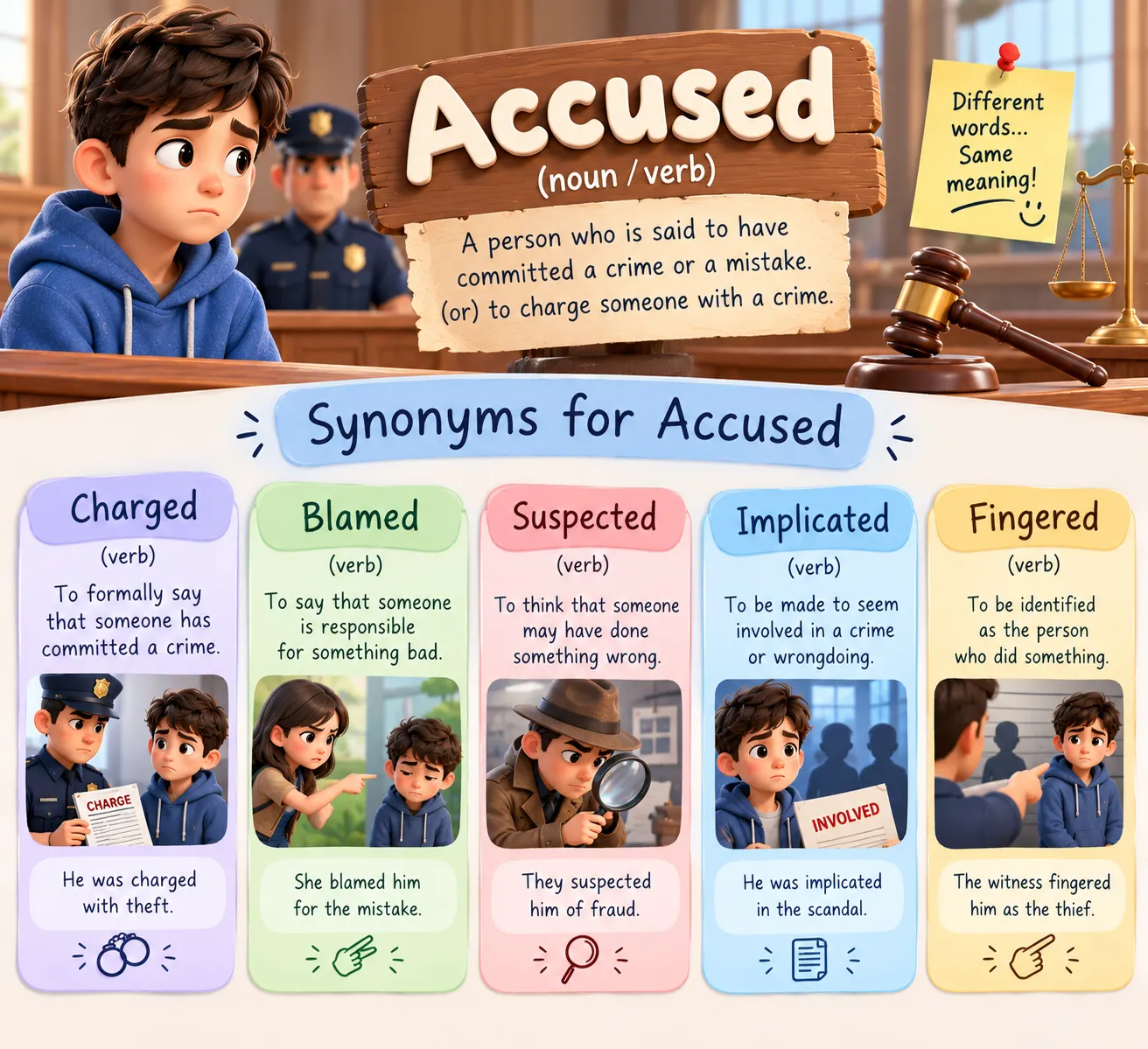
The word accused describes someone who faces a claim of wrongdoing or a formal legal charge. Common synonyms for accused include charged, blamed, suspected, alleged, indicted, and implicated. However, each word has a slightly different meaning. For example, charged usually refers to a formal legal accusation, whereas blamed often describes responsibility for a mistake.
Understanding these differences can help you choose the right word in essays, conversations, news reports, and professional writing. Moreover, using the correct synonym makes your sentences clearer and more precise.
In this guide, you will learn 30 synonyms and related expressions for accused. You will also explore their meanings, examples, pronunciation, word forms, and antonyms. By the end, you will know how to use these words confidently in different situations.
Meaning of Accused
Definition of Accused
Accused means that someone has been said to have done something wrong or has faced a formal charge.
It comes from the verb accuse, which means to claim that someone has done something wrong. In addition, accused can describe a person who faces an allegation.
Examples of Accused in Sentences
Here are four examples from everyday and formal English:
- The accused man denied taking the money.
- Someone accused Sarah of breaking the classroom window.
- The manager accused an employee of sharing confidential information.
- The accused appeared in court to answer the charges.
These examples show how people use accused in different situations. However, remember that an accusation does not prove guilt.
Connotative Meaning of Accused
Connotation refers to the feelings or ideas that a word suggests beyond its basic meaning.
Negative connotation: The word often suggests blame, suspicion, or possible wrongdoing.
Example: The manager accused him of stealing company property.
Neutral connotation: News reports and legal documents often use accused to describe an allegation without treating it as a proven fact.
Example: The accused appeared before the judge.
Positive context: Although the word itself is not usually positive, writers can use it when discussing fairness and legal rights.
Example: The accused received a fair opportunity to present a defense.
Important: Being accused does not mean being guilty. Investigators and courts must assess the available evidence before reaching a conclusion.
Etymology of Accused
The word accused comes from the verb accuse. English adopted this verb through Old French and Anglo-French, which derived it from the Latin accūsāre. The Latin word referred to calling someone to account or charging someone with a fault.
The following table summarizes the word’s development.
| Period | Development |
|---|---|
| Old English (450–1100) | English used other words and expressions to describe blame or wrongdoing. |
| Middle English (1100–1500) | The verb accuse entered English through French. |
| Modern English (1500–present) | People increasingly used accused in everyday communication, legal writing, and news reports. |
Pronunciation of Accused (IPA)
Correct pronunciation can help you use this word confidently.
- IPA: /əˈkjuːzd/
- Syllables: ac-cused
- Syllable count: 2
- Word stress: The second syllable receives the main stress.
To improve your pronunciation, say the word slowly first. Then, use it in a complete sentence. Regular practice will help you pronounce it more naturally.
Affixation Pattern of Accused
The word accused comes from the verb accuse. The suffix -ed forms its past tense and past participle.
- Base word: Accuse — to say that someone has done something wrong.
- Prefix: None.
- Suffix: -ed — marks the past tense or past participle of the verb.
Word Forms of Accused
Learning related word forms can expand your vocabulary. Here are the most useful forms.
| Word | Part of Speech | Meaning |
|---|---|---|
| Accuse | Verb | To claim that someone has done something wrong |
| Accuses | Verb | Makes a claim of wrongdoing |
| Accused | Verb, adjective, or noun | Blamed or charged with wrongdoing; a person facing an accusation |
| Accusing | Verb or adjective | Suggesting blame or wrongdoing |
| Accusation | Noun | A claim that someone has done something wrong |
| Accusations | Plural noun | Claims of wrongdoing |
| Accuser | Noun | A person who makes an accusation |
| Accusers | Plural noun | People who make accusations |
| Accusatory | Adjective | Expressing blame or suggesting guilt |
| Accusingly | Adverb | In a way that suggests blame |
30 Synonyms for Accused With Meanings and Examples
The best synonym for accused depends on the context. Some alternatives describe everyday blame, while others refer to suspicion or legal action.
However, not all 30 expressions below are exact synonyms. Some describe a person, a legal status, or an action related to an accusation. Therefore, check each word’s meaning before using it.
1. Charged
Meaning: Formally accused of breaking a law or rule.
Examples:
- The police charged him with theft.
- The authorities charged the driver after the investigation.
Usage tip: Use charged when someone faces a formal accusation, especially in a legal context.
2. Blamed
Meaning: Held responsible for a mistake, problem, or negative result.
Examples:
- Sarah blamed John for the delay.
- The manager blamed the team for the error.
Usage tip: Unlike charged, blamed often refers to everyday situations rather than formal legal proceedings.
3. Suspected
Meaning: Believed to be involved in wrongdoing, although the facts remain uncertain.
Examples:
- Investigators questioned the suspected thief.
- The manager suspected him of sharing confidential information.
Usage tip: Use suspected when someone may have done something wrong, but the evidence has not established responsibility.
4. Alleged
Meaning: Claimed to be true but not yet proved.
Examples:
- The report describes an alleged act of fraud.
- Investigators examined the alleged theft.
Usage tip: Writers often use alleged in news reports and formal documents to distinguish claims from established facts.
5. Implicated
Meaning: Connected to wrongdoing through evidence or information.
Examples:
- The new evidence implicated two employees.
- The documents implicated her in the financial scandal.
Usage tip: Use implicated when information suggests a person’s connection to wrongdoing. However, it does not automatically establish guilt.
6. Indicted
Meaning: Formally accused of a serious crime through a legal process, particularly in the United States.
Examples:
- A grand jury indicted the businessman for fraud.
- Prosecutors indicted two officials after the investigation.
Usage tip: Indicted has a specific legal meaning. Its use depends on the legal system.
7. Prosecuted
Meaning: Subjected to legal proceedings for an alleged offense.
Examples:
- The authorities prosecuted him for fraud.
- The government prosecuted the company for breaking safety laws.
Usage tip: This word describes legal action against someone rather than the accusation itself.
8. Suspect
Meaning: A person believed to be involved in a crime or wrongdoing.
Examples:
- Police questioned a suspect.
- Investigators identified a suspect in the case.
Usage tip: Use suspect as a noun when referring to someone who may have committed an offense.
9. Defendant
Meaning: A person or organization facing a legal case in court.
Examples:
- The defendant denied the charge.
- The judge questioned the defendant during the hearing.
Usage tip: A defendant faces a legal case, but that status does not mean the person is guilty.
10. Culprit
Meaning: A person responsible for a mistake, crime, or harmful act.
Examples:
- Investigators worked to identify the culprit.
- The culprit left before anyone noticed.
Usage tip: Culprit usually suggests responsibility. Therefore, avoid using it as a neutral substitute for accused when guilt remains uncertain.
11. Offender
Meaning: A person who has committed an offense or broken a rule or law.
Examples:
- The offender received a legal penalty.
- The program helps young offenders return to school.
Usage tip: Use offender when the context establishes wrongdoing rather than merely suggesting an accusation.
12. Wrongdoer
Meaning: A person who acts dishonestly, harmfully, or unfairly.
Examples:
- The organization tried to identify the wrongdoer.
- New rules helped prevent wrongdoers from exploiting the system.
Usage tip: This word emphasizes improper behavior rather than the act of making an accusation.
13. Perpetrator
Meaning: A person who carries out a crime or harmful act.
Examples:
- The police searched for the perpetrator.
- Investigators identified the perpetrator of the attack.
Usage tip: Use perpetrator for the person who carried out an act. Do not assume that an accused person is the perpetrator.
14. Suspect in
Meaning: A phrase describing someone believed to be connected to a particular incident.
Examples:
- He was a suspect in the robbery.
- She became a suspect in the data leak.
Usage tip: Use this expression to describe possible involvement in a specific incident.
15. Accused Person
Meaning: A person who faces an allegation or formal accusation.
Examples:
- The accused person denied the allegation.
- The accused person sought legal advice.
Usage tip: This phrase describes someone’s status without suggesting that the accusation is true.
16. Charged Person
Meaning: A person who has received a formal charge.
Examples:
- The person charged with the offense appeared in court.
- The person charged with theft requested more time to prepare a defense.
Usage tip: In formal writing, person charged with an offense usually sounds more natural than charged person.
17. Alleged Offender
Meaning: A person said to have committed an offense, although the claim has not been proved.
Examples:
- Investigators questioned the alleged offender.
- The report did not identify the alleged offender.
Usage tip: This expression helps you avoid presenting an allegation as an established fact.
18. Person Under Suspicion
Meaning: Someone believed to be possibly involved in wrongdoing.
Examples:
- The person under suspicion agreed to answer questions.
- Investigators interviewed several people under suspicion.
Usage tip: Use this phrase when an investigation continues and responsibility remains uncertain.
19. Suspected Offender
Meaning: A person believed to have committed an offense, although responsibility remains unproved.
Examples:
- Police questioned the suspected offender about the incident.
- Investigators searched for the suspected offender.
Usage tip: This phrase works well in reports about ongoing investigations.
20. Incriminated
Meaning: Connected to evidence that suggests involvement in a crime or wrongdoing.
Examples:
- The documents incriminated the official.
- His messages could incriminate him.
Usage tip: Incriminated focuses on evidence that suggests wrongdoing. It does not necessarily mean that someone has received a formal charge.
21. Called to Account
Meaning: Required to explain or answer for an action or decision.
Examples:
- The board called the manager to account for the missing funds.
- The public called officials to account for their decisions.
Usage tip: Use this expression when someone must explain their conduct or accept responsibility.
22. Accused of Wrongdoing
Meaning: Said to have acted improperly, dishonestly, or unfairly.
Examples:
- The company faced claims that it had engaged in wrongdoing.
- Someone accused him of wrongdoing, but he denied the claim.
Usage tip: This expression works when you want to describe an allegation without naming a specific crime.
23. Held Responsible
Meaning: Considered responsible for an action, mistake, or result.
Examples:
- The supervisor held Mark responsible for the error.
- The company held the contractor responsible for the damage.
Usage tip: Use this expression when responsibility matters more than a formal accusation.
24. Charged With
Meaning: Formally accused of a specific offense.
Examples:
- Prosecutors charged him with burglary.
- The authorities charged the driver with reckless driving.
Usage tip: This phrase usually takes the name of an offense after with.
25. Accused of a Crime
Meaning: Said to have committed an act that breaks the law.
Examples:
- Someone accused him of a crime he said he did not commit.
- The woman faced an accusation of a crime and hired a lawyer.
Usage tip: This expression describes a criminal allegation without stating that the person is guilty.
26. At Fault
Meaning: Responsible for a mistake, failure, or problem.
Examples:
- The driver caused the accident and was at fault.
- Neither employee was clearly at fault.
Usage tip: Use at fault when discussing accidents, disagreements, or mistakes. It does not necessarily describe a legal accusation.
27. Involved
Meaning: Connected with an event, activity, or situation.
Examples:
- Three people took part in the investigation.
- The report examined everyone involved in the incident.
Usage tip: Involved is a broad term. Someone can be involved in an investigation without facing an accusation.
28. Questioned
Meaning: Asked questions about an event, action, or possible wrongdoing.
Examples:
- Police questioned the man about the missing bag.
- Investigators questioned several employees during the inquiry.
Usage tip: Being questioned does not mean that someone has been accused or charged with an offense.
29. Reproached
Meaning: Expressed disapproval of someone because of their behavior or actions.
Examples:
- Sarah reproached him for ignoring the warning.
- The teacher reproached the student for damaging the book.
Usage tip: Use reproached when someone expresses disappointment or criticism. It is not a direct synonym for a legal accusation.
30. Accosted
Meaning: Approached or confronted someone suddenly, often in an aggressive or unwelcome way.
Examples:
- A reporter accosted the official outside the building.
- The stranger accosted him with angry questions.
Usage tip: Accosted describes how someone approaches another person. It does not mean that the person was accused of wrongdoing.
How to Choose the Right Synonym for Accused
Choosing the right synonym depends on the situation. Although these words relate to accusations, they are not interchangeable.
Here is a quick guide:
- Charged: Use it for a formal legal accusation.
- Blamed: Use it when someone holds another person responsible for a mistake.
- Suspected: Use it when possible involvement remains unproved.
- Alleged: Use it when describing a claim that has not been established as fact.
- Implicated: Use it when evidence suggests a connection to wrongdoing.
- Defendant: Use it for someone facing a legal case.
- Cleared: Use it when an investigation finds that someone is not responsible or no longer treats them as a suspect.
- Acquitted: Use it when a court finds someone not guilty of a specific charge.
- Exonerated: Use it when evidence or a decision clears someone of blame or wrongdoing.
For example, investigators may first suspect a person of theft. Later, authorities may charge that person with an offense. If the case goes to court, the person may become a defendant. Finally, the court may acquit the defendant of the charge.
Each term describes a different stage or aspect of the situation. Therefore, choosing the right word makes your writing more accurate and professional.
Core Meaning of Accused
The central meaning of accused is that someone has been blamed or said to have done something wrong.
For example, someone may accuse a student of cheating or accuse an employee of breaking a workplace rule. In a legal situation, the accusation may lead to a formal charge.
However, an accusation alone does not establish guilt. The person may deny the claim, respond to the evidence, or receive clearance after an investigation or legal process.
In short, accused focuses on an allegation rather than proven responsibility. This distinction matters when writing about legal cases, school incidents, workplace disputes, and news events.
Categories of Accused Synonyms
Grouping related words by meaning makes them easier to understand. It also helps you select the right expression for each situation.
1. Formal Legal Accusations
Examples: Charged, indicted, prosecuted, defendant, and person charged with an offense.
These terms relate to legal procedures. However, their meanings differ. Charged refers to a formal accusation, whereas prosecuted describes legal action against someone.
2. Claims and Allegations
Examples: Alleged, accused person, alleged offender, accused of wrongdoing, and accused of a crime.
These expressions describe claims that someone has done something wrong. Therefore, they are useful when the allegation has not been established as fact.
3. Suspicion and Possible Involvement
Examples: Suspected, suspect, suspect in, person under suspicion, and suspected offender.
These terms suggest that someone may be connected to wrongdoing. Use them when investigators have not yet established the facts.
4. Evidence Linking Someone to Wrongdoing
Examples: Implicated and incriminated.
These words suggest that evidence or information connects someone to a particular act. Nevertheless, neither word automatically means that the person is guilty.
5. Responsibility and Blame
Examples: Blamed, held responsible, at fault, and called to account.
These expressions focus on responsibility for an action, mistake, or outcome. As a result, they often appear in workplace discussions and everyday communication.
6. People Who Commit Wrongdoing
Examples: Culprit, offender, wrongdoer, and perpetrator.
These words describe people responsible for improper or harmful actions. Use them carefully when investigators have not established responsibility.
7. Related Actions and Descriptions
Examples: Questioned, reproached, accosted, and involved.
These words may appear in situations involving accusations, but their meanings differ. For example, police can question someone during an investigation without accusing that person of a crime.
Understanding these categories helps you distinguish suspicion, accusation, and proven guilt.
Antonyms of Accused
There is no single perfect antonym for accused. The best choice depends on whether you mean facing an allegation, receiving blame, or facing a formal charge.
The following table lists words that express contrasting ideas.
| Contrasting Word | Part of Speech | Meaning | Example |
|---|---|---|---|
| Exonerated | Verb or adjective | Cleared of blame or wrongdoing | New evidence exonerated the employee. |
| Acquitted | Verb or adjective | Found not guilty of a specific charge by a court | The court acquitted the defendant. |
| Cleared | Verb or adjective | Shown not to be responsible or no longer treated as a suspect | Investigators cleared her after the inquiry. |
| Vindicated | Verb or adjective | Shown to have been right or justified after doubt or criticism | The records vindicated the employee. |
| Innocent | Adjective | Not guilty of the act in question | He maintained that he was innocent. |
| Unaccused | Adjective | Not accused of wrongdoing | The report distinguished the accused staff from those who faced no allegations. |
| Praised | Verb or adjective | Expressed approval of someone’s actions | The teacher praised the student for being honest. |
| Commended | Verb or adjective | Formally praised someone for good work or conduct | The officer received praise for her service. |
| Defended | Verb or adjective | Supported someone against criticism or blame | His colleague defended him against the allegation. |
| Applauded | Verb or adjective | Showed strong approval of someone’s actions | The public applauded her honest response. |
Important distinction: Acquitted and exonerated do not mean exactly the same thing. Acquitted generally refers to a court finding a person not guilty of a specific charge. In contrast, exonerated means cleared of blame or wrongdoing. The precise meaning depends on the context.
Frequently Asked Questions About Accused
What does accused mean?
Accused means that someone has been said to have done something wrong or has faced a formal charge. However, it does not mean that the person is guilty.
What are the most common synonyms for accused?
Common alternatives include charged, blamed, suspected, alleged, and implicated. The best choice depends on whether the situation involves everyday blame, suspicion, or a formal legal process.
When should I use accused?
Use accused when someone faces an allegation of wrongdoing.
For example: “Someone accused him of taking the missing phone.”
Is accused a positive or negative word?
The word usually has a negative association because it suggests blame or possible wrongdoing. Nevertheless, writers can use it neutrally in factual reports about allegations and legal cases.
What is the difference between accused and charged?
Accused is a broad term for someone said to have done something wrong. By comparison, charged usually refers to a formal legal accusation. The precise legal meaning of charged depends on the jurisdiction.
What is the difference between accused and suspected?
Accused means someone has made a claim of wrongdoing against a person. Suspected means someone believes that person may be involved in wrongdoing, although the facts may remain unclear.
What is the opposite of accused?
There is no single direct opposite. Depending on the situation, words such as cleared, exonerated, and acquitted may express the opposite idea.
Conclusion
Learning synonyms for accused can expand your vocabulary and help you communicate more clearly. Words such as charged, suspected, alleged, blamed, and implicated are related, but each has a different meaning.
For example, charged usually refers to a formal legal accusation, while blamed often describes responsibility for a mistake. Similarly, suspected suggests possible involvement without proving wrongdoing.
Understanding these differences is useful when writing essays, preparing reports, discussing legal matters, or reading the news. Most importantly, remember that an accusation does not establish guilt. Choose words that reflect the available facts, and avoid presenting an allegation as a proven conclusion.
With regular practice, you can choose more precise synonyms, reduce unnecessary repetition, and make your English writing clearer and more natural.
Read More:
Synonyms for Chronic: 29 Useful Alternatives with Examples

I’m Ayesha Haram, an English content and SEO writer at SynonymsInstant.com. I focus on creating helpful vocabulary resources, word guides, and practical English content that readers can understand quickly. I combine language research, clear explanations, and SEO-focused writing to produce reliable content that supports learners, writers, and everyday English users.