
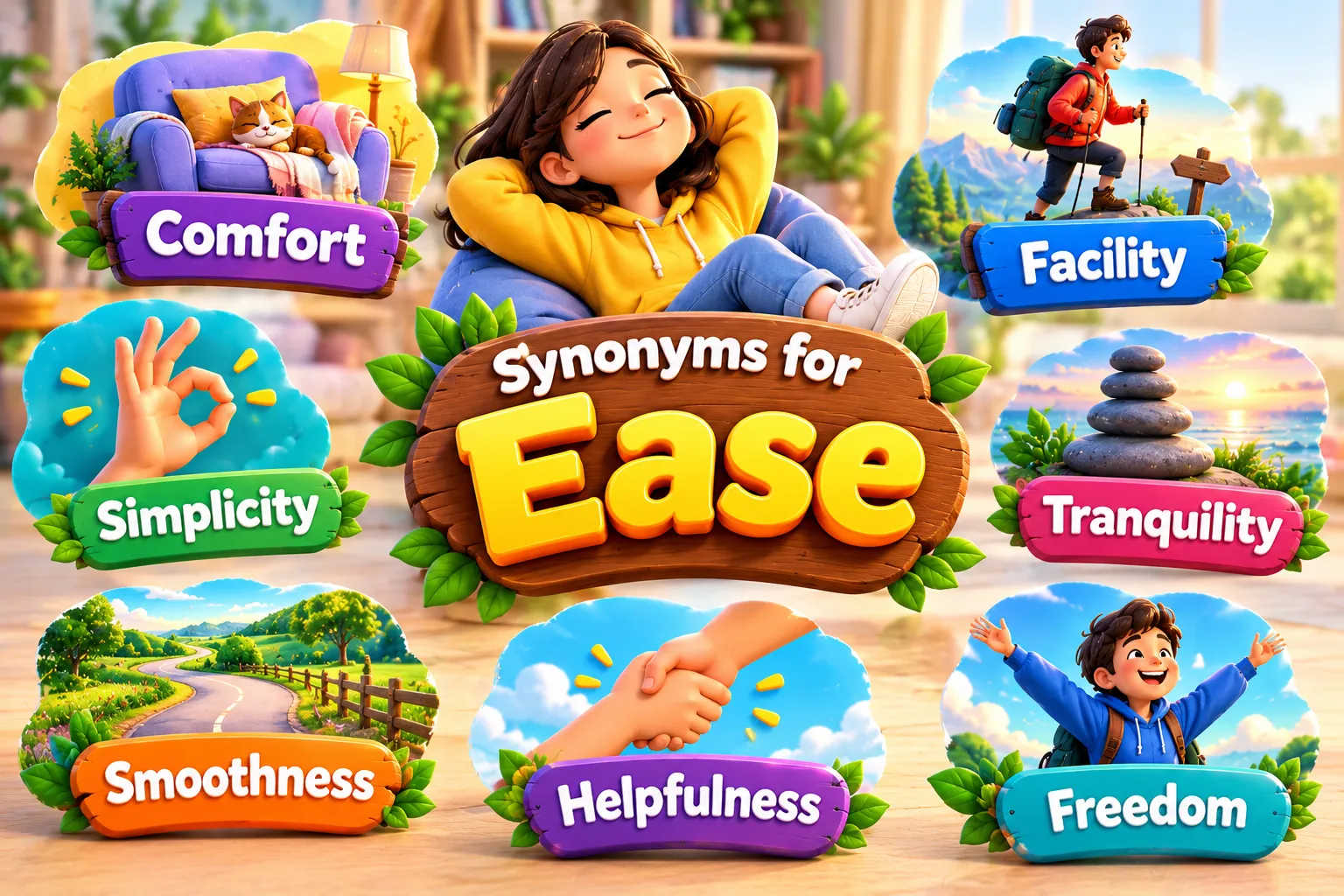
Synonyms for ease include comfort, relief, simplicity, convenience, relaxation, effortlessness, and freedom. The best alternative depends on the meaning. Ease can describe a state of comfort, the absence of difficulty, or the act of making something less painful or hard. For example, a soft chair provides comfort, while a clear guide makes a task simpler.
Ease means comfort, freedom from worry, or the lack of difficulty. Imagine a student who finds a hard lesson easier after a teacher explains it in simple words. The student feels less stress and can learn with ease. This word is common in daily talks, schoolwork, business, and writing because it describes both comfort and simplicity. Learning synonyms for ease helps English learners express ideas more clearly and avoid using the same word again and again. It also helps writers choose words that match the meaning they want to share. Some synonyms focus on comfort, while others describe relief, convenience, or a task that needs little effort. This guide explains the meaning, history, pronunciation, and word forms of ease. It also presents 26 related words with examples to help you build a stronger vocabulary.
Meaning of Ease
Definition
Ease (Noun and Verb): As a noun, ease means comfort or freedom from difficulty, pain, or worry. As a verb, it means to make something less painful, tense, or difficult.
Examples
- She completed the task with ease.
- A warm bath helped ease his sore muscles.
Connotative Meaning
Connotation is the feeling or idea that a word suggests beyond its basic meaning.
- Positive tone: Ease can suggest comfort, calm, relief, and simplicity.
- Negative tone: In some contexts, ease may suggest a lack of effort or carelessness, as in taking the easy way out.
- Neutral tone: Ease can simply describe how simple an action is or how something becomes less tense.
Etymology of Ease
The word ease entered English through Old French aise, meaning comfort, well-being, or opportunity. Its deeper origin is uncertain.
| Period | Development |
| Old English (450–1100) | Ease was not a common native Old English word. English used other words to express comfort, rest, and freedom from hardship. |
| Middle English (1100–1500) | Ease entered English through Old French aise. It referred to comfort, well-being, and freedom from difficulty. |
| Modern English (1500–Present) | Ease developed its familiar meanings of comfort, simplicity, and freedom from pain or worry. As a verb, it also means to reduce pressure, pain, tension, or difficulty. |
Pronunciation (IPA)
- IPA: /iːz/
- Syllables: ease
- Number of syllables: 1
- Stress: The word has one syllable, so the whole word is stressed.
Affixation Pattern of Ease
- Root/base word: Ease
- Prefix: None
- Suffix: None in the base word ease. The suffixes in related forms create new grammatical forms.
Word Formations
| Word | Part of Speech | Meaning |
| Ease | Noun | Comfort or freedom from difficulty. |
| Ease | Verb | To make something less painful, tense, or difficult. |
| Eases | Verb | Makes something less difficult or painful; also the present-tense form used with a singular subject. |
| Eased | Verb | Made something less painful, tense, or difficult. |
| Easing | Verb/Noun | Making something less difficult, painful, or tense. |
| Easy | Adjective | Not difficult to do or understand. |
| Easily | Adverb | Without much difficulty or effort. |
| Easier | Comparative adjective/adverb | Less difficult than something else. |
| Easiest | Superlative adjective/adverb | The least difficult. |
| Uneasy | Adjective | Worried, uncomfortable, or nervous. |
| Uneasily | Adverb | In a worried or uncomfortable way. |
| Uneasiness | Noun | A feeling of worry or discomfort. |
26 Synonyms of Ease With Meaning and Examples
Note: Ease has several meanings, so not every synonym fits every sentence. Some words describe comfort or relief, while others describe simplicity or a lack of effort.
1. Comfort (Noun)
Meaning: A state of physical or mental ease.
Examples:
- The soft chair gave me great comfort.
- She enjoys the comfort of her home.
2. Relief (Noun)
Meaning: A feeling of comfort after pain, worry, or trouble becomes less severe.
Examples:
- He felt relief after passing the exam.
- The medicine brought relief from the pain.
3. Simplicity (Noun)
Meaning: The quality of being easy to understand or use.
Examples:
- The simplicity of the lesson helped the children learn.
- I like the simplicity of this design.
4. Convenience (Noun)
Meaning: The quality of being easy and practical to use.
Examples:
- Online shopping offers great convenience.
- The hotel is close to the station for added convenience.
5. Effortlessness (Noun)
Meaning: The quality of requiring little or no effort.
Examples:
- She performed the dance with effortlessness.
- He solved the puzzle with apparent effortlessness.
6. Relaxation (Noun)
Meaning: A state of being calm and free from tension.
Examples:
- Reading helps me find relaxation after work.
- The quiet garden is a place for relaxation.
7. Leisure (Noun)
Meaning: Free time when a person does not have to work.
Examples:
- She enjoys reading during her leisure time.
- The park offers a peaceful place for leisure.
8. Calm (Noun)
Meaning: A peaceful state without worry or excitement.
Examples:
- He regained his calm before the meeting.
- The sound of rain brought calm to the room.
9. Tranquility (Noun)
Meaning: A state of deep peace and quiet.
Examples:
- We enjoyed the tranquility of the countryside.
- The garden offers tranquility after a busy day.
10. Serenity (Noun)
Meaning: A feeling or state of peacefulness.
Examples:
- The lake filled her with serenity.
- He found serenity in quiet morning walks.
11. Repose (Noun)
Meaning: A state of rest or relaxation.
Examples:
- She sat in repose under the tree.
- The quiet room provided a place of repose.
12. Well-being (Noun)
Meaning: A state of being healthy, comfortable, and happy.
Examples:
- Regular exercise can improve your well-being.
- The program supports the well-being of students.
13. Uncomplicatedness (Noun)
Meaning: The quality of being simple and not complex.
Examples:
- The uncomplicatedness of the process made it easy to follow.
- She liked the uncomplicatedness of the plan.
14. Facility (Noun)
Meaning: The ability to do something easily and skillfully.
Examples:
- He speaks French with great facility.
- Her facility with numbers helped her solve the problem.
15. Readiness (Noun)
Meaning: The state of being prepared or willing to act.
Examples:
- The team showed readiness for the match.
- Her readiness to help made the task easier.
16. Smoothness (Noun)
Meaning: The quality of happening or working without problems.
Examples:
- The smoothness of the process impressed everyone.
- Good planning improved the smoothness of the event.
17. Effortlessness (Noun)
Meaning: The quality of doing something without seeming to struggle.
Examples:
- The pianist played with effortlessness.
- She moved with effortlessness across the stage.
18. Freedom (Noun)
Meaning: The state of being free from limits, control, or restrictions.
Examples:
- Flexible hours give workers more freedom.
- He enjoyed the freedom to choose his own path.
19. Unburdening (Noun)
Meaning: The act of removing a worry, responsibility, or emotional weight.
Examples:
- Talking to a friend felt like an unburdening.
- Writing in her journal gave her a sense of unburdening.
20. Mitigation (Noun)
Meaning: The act of making something less harmful, severe, or difficult.
Examples:
- The new rules help with the mitigation of traffic risks.
- Early action can support the mitigation of stress.
21. Alleviation (Noun)
Meaning: The act of reducing pain, worry, or hardship.
Examples:
- The treatment brought alleviation of her symptoms.
- The charity works for the alleviation of poverty.
22. Reduction (Noun)
Meaning: The act of making something smaller or less severe.
Examples:
- The new system led to a reduction in errors.
- A short break helped with the reduction of stress.
23. Easing (Noun)
Meaning: The process of making pain, pressure, or difficulty less severe.
Examples:
- The easing of traffic made the journey faster.
- The easing of tension helped the team work together.
24. Lightening (Noun)
Meaning: The act of making a burden, mood, or task less heavy or serious.
Examples:
- Sharing the work brought a lightening of her load.
- His joke caused a lightening of the mood.
25. Comfortableness (Noun)
Meaning: The state of being comfortable and free from discomfort.
Examples:
- The comfortableness of the bed helped her sleep.
- The room’s comfortableness made guests feel welcome.
26. Manageability (Noun)
Meaning: The quality of being easy to control, handle, or deal with.
Examples:
- Breaking the project into small steps improved its manageability.
- The teacher adjusted the workload for better manageability.
Prototype Meaning
The most common meaning of ease is a state of comfort or freedom from difficulty, pain, or worry. People may imagine relaxing on a comfortable sofa, finishing a task without trouble, or feeling better after a stressful event. The word can also describe an action that makes something less difficult. For example, a clear set of instructions can ease a person’s work, while a kind conversation can ease worry. The exact meaning depends on the sentence. In general, ease suggests that something feels comfortable, simple, manageable, or less stressful.
Prototype Categorization
The synonyms and related words can be grouped by their main meanings. These categories help writers choose words that match the context.
- Comfort and peacefulness: Comfort, relaxation, leisure, calm, tranquility, serenity, repose, well-being, comfortableness. Use these words when describing rest, comfort, or peace of mind.
- Simplicity and low effort: Simplicity, effortlessness, facility, smoothness, uncomplicatedness. Use these when a task is easy to do or understand.
- Practical use and handling: Convenience, manageability, workability. These words describe something that is easy to use, control, or complete.
- Relief from difficulty: Relief, alleviation, mitigation, reduction, easing, lightening, unburdening. Use these when pain, worry, pressure, or hardship becomes less severe.
- Freedom and readiness: Freedom, readiness, unrestraint. These terms describe fewer limits or being prepared to act.
- Friendly interaction: Approachability. This word fits situations where someone is easy to talk to or approach.
These categories are useful because synonyms are not always interchangeable. Comfort describes a pleasant state, while relief often follows a problem. Convenience focuses on practical benefits, and simplicity means something is not complex. Choosing the right word makes writing clearer and more precise.
Antonyms of Ease
Antonyms are words with opposite or contrasting meanings. The correct opposite depends on whether ease refers to comfort, simplicity, or reducing difficulty.
| Antonym | Part of Speech | Meaning |
| Difficulty | Noun | The state of being hard to do or understand. |
| Discomfort | Noun | A state of physical or mental unease. |
| Pain | Noun | Physical or emotional suffering. |
| Stress | Noun | Mental or emotional strain. |
| Tension | Noun | A state of worry, strain, or tightness. |
| Hardship | Noun | A condition of suffering or difficulty. |
| Complexity | Noun | The quality of being complicated or hard to understand. |
| Struggle | Noun | A hard effort to do or achieve something. |
| Inconvenience | Noun | A problem that makes something less easy or practical. |
| Aggravation | Noun | The act of making a problem or condition worse. |
| Complicate | Verb | To make something more difficult. |
| Intensify | Verb | To make something stronger or more severe. |
Short Questions and Answers
What does ease mean?
Ease means comfort, freedom from difficulty, or the act of making something less painful or hard.
When should ease be used?
Use ease when describing comfort, a simple task, or a reduction in pain, worry, or pressure. For example, a clear guide can make a task easier, and a short break can ease stress.
Is ease positive or negative?
Ease is usually positive because it suggests comfort, relief, or simplicity. However, it can sound negative when it suggests avoiding effort or taking shortcuts.
How is ease different from similar words?
Comfort focuses on a pleasant state, relief often follows pain or worry, and convenience means something is practical to use. Ease can refer to all these ideas, depending on the context.
Conclusion
Learning synonyms for ease helps you express comfort, relief, and simplicity in a more precise way. Words such as comfort, tranquility, and serenity describe peaceful feelings, while convenience, simplicity, and effortlessness focus on tasks that are easy to manage. Other words, such as alleviation and mitigation, describe making pain or problems less severe. Knowing these differences helps you avoid repetition and improve your English writing and speaking. It also helps you choose the right word for each situation. Try learning one new synonym every day and using it in a sentence. With regular practice, you can build a stronger vocabulary and communicate your ideas with greater confidence.
Read More:
Synonyms for Elegance: 27 Beautiful Alternatives

I’m Ayesha Haram, an English content and SEO writer at SynonymsInstant.com. I focus on creating helpful vocabulary resources, word guides, and practical English content that readers can understand quickly. I combine language research, clear explanations, and SEO-focused writing to produce reliable content that supports learners, writers, and everyday English users.