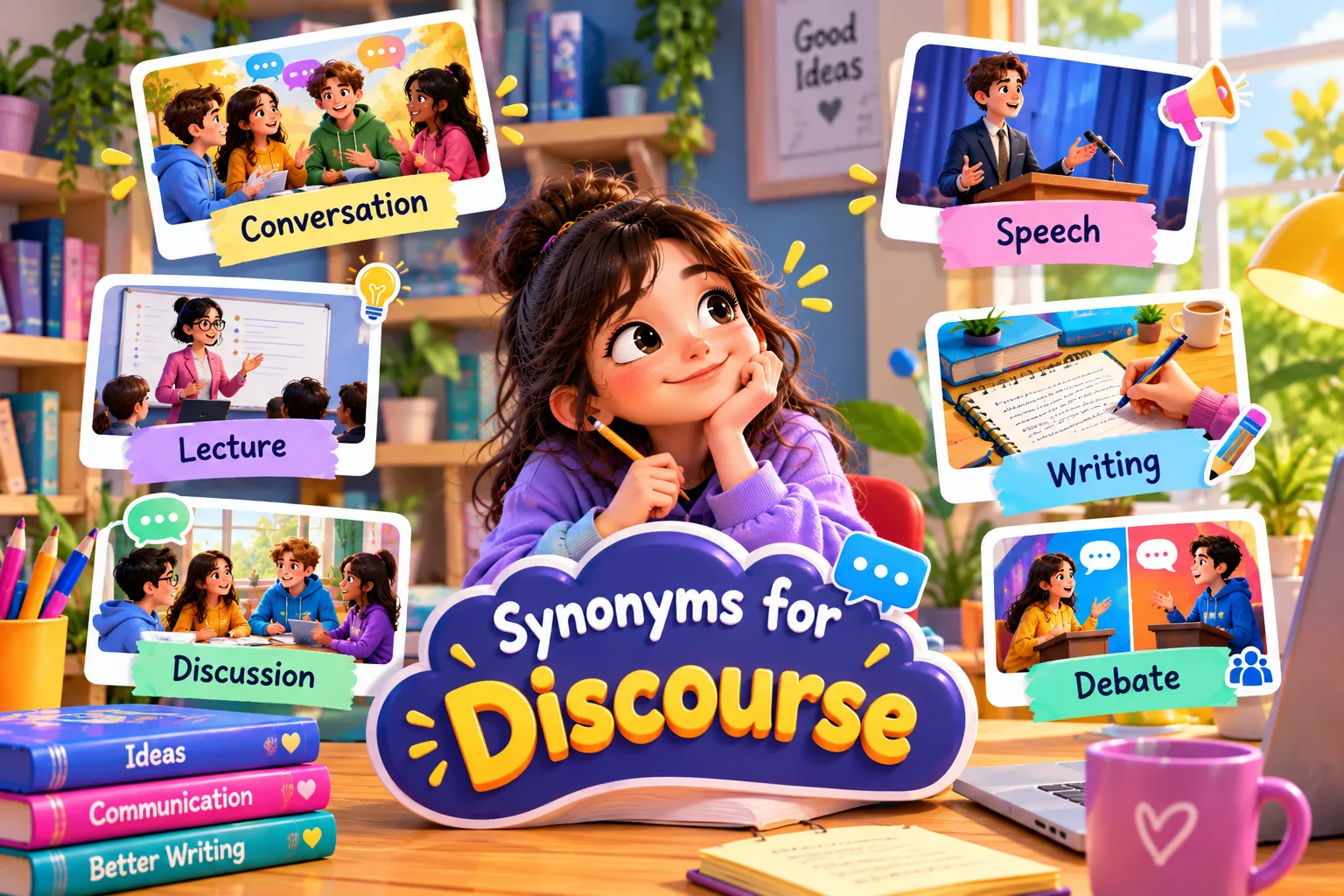
Common synonyms and related words include discussion, conversation, dialogue, debate, communication, talk, speech, address, lecture, presentation, exchange, consultation, deliberation, argument, reasoning, commentary, narration, statement, expression, rhetoric, prose, writing, oratory, and treatise. The best word depends on the context—for example, conversation is informal, debate involves opposing views, lecture is used for teaching, dialogue focuses on an exchange of ideas, and treatise refers to detailed academic writing.
Discourse means a serious or organized way of talking or writing about a topic. For example, a teacher may lead a discourse about education, while students share ideas and ask questions. The word is common in academic, social, political, and professional writing because it describes communication about ideas, issues, or subjects. Learning synonyms for discourse helps English learners avoid using the same word again and again. It also helps writers choose a word that fits the exact situation. In this guide, we will explore the meaning of discourse, its common uses, history, pronunciation, grammar, and 29 useful synonyms. We will also look at the different meanings of these words and group them into semantic categories. This makes it easier to choose the right word for speaking and writing.
Meaning of Discourse
Definition
Discourse (Noun): A formal or organized way of speaking or writing about a particular subject.
Examples
- The professor gave a discourse on modern education.
- Public discourse about technology has changed greatly.
Connotative Meaning
- Positive tone: May suggest thoughtful, meaningful, or intelligent communication.
- Negative tone: Can sometimes suggest overly formal or complicated discussion.
- Neutral tone: Simply refers to spoken or written communication about a subject.
(Connotation: the feeling or idea that a word suggests beyond its basic meaning.)
Etymology
The word discourse comes from Latin roots and developed through French before entering English.
- Old English (450–1100): The modern word discourse was not commonly used in Old English. English had other words for speaking, talking, and conversation.
- Middle English (1100–1500): Discourse entered English through Old French discours, from Latin discursus, meaning “a running about” or “a conversation.”
- Modern English (1500–Present): The word developed meanings related to formal speech, writing, discussion, and communication about ideas.
Pronunciation (IPA)
- IPA: /ˈdɪskɔːrs/
- Syllables: dis-course
Affixation Pattern of Discourse
- Root: course
- Prefix: dis-
- Suffix: None
- Word formations:
- discourse — noun/verb
- discourses — noun/verb
- discoursed — verb
- discoursing — verb
- discursive — adjective
- discursively — adverb
- discursiveness — noun
- discursion — noun, rare
29 Synonyms of Discourse With Meaning & Examples
1. Discussion (Noun)
Meaning: A talk in which people share ideas about a subject.
Examples:
- We had a discussion about climate change.
- The discussion lasted for an hour.
2. Conversation (Noun)
Meaning: An informal talk between two or more people.
Examples:
- We had a long conversation about school.
- Their conversation was friendly and relaxed.
3. Dialogue (Noun)
Meaning: A conversation between people or groups.
Examples:
- The leaders began a dialogue about peace.
- Open dialogue can solve many problems.
4. Debate (Noun)
Meaning: A formal discussion in which people present different views.
Examples:
- The students held a debate about education.
- The debate became very interesting.
5. Communication (Noun)
Meaning: The process of sharing information, ideas, or feelings.
Examples:
- Good communication helps teams work together.
- Communication is important in every relationship.
6. Talk (Noun)
Meaning: A spoken discussion or presentation about a topic.
Examples:
- She gave a talk about healthy living.
- His talk was easy to understand.
7. Speech (Noun)
Meaning: A formal spoken presentation given to an audience.
Examples:
- The teacher gave a speech about honesty.
- Her speech inspired the students.
8. Address (Noun)
Meaning: A formal speech given to a group of people.
Examples:
- The president gave an address to the nation.
- The principal delivered an address at the ceremony.
9. Lecture (Noun)
Meaning: A formal talk given to teach people about a subject.
Examples:
- The professor gave a lecture on history.
- I attended a lecture about language.
10. Presentation (Noun)
Meaning: A formal explanation of a topic to an audience.
Examples:
- She prepared a presentation about technology.
- His presentation was clear and useful.
11. Conversation (Noun)
Meaning: An exchange of spoken ideas or information.
Examples:
- Their conversation focused on education.
- I enjoyed our conversation yesterday.
12. Exchange (Noun)
Meaning: A sharing of ideas, words, or opinions between people.
Examples:
- The meeting included an exchange of ideas.
- Their exchange was respectful.
13. Communication (Noun)
Meaning: The sharing of thoughts, information, or messages.
Examples:
- Clear communication prevents confusion.
- Digital communication is now very common.
14. Consultation (Noun)
Meaning: A discussion in which people seek advice or information.
Examples:
- The doctor had a consultation with the patient.
- The company held a consultation with its workers.
15. Deliberation (Noun)
Meaning: Careful discussion before making a decision.
Examples:
- The committee held a long deliberation.
- After careful deliberation, they made a decision.
16. Argument (Noun)
Meaning: A set of reasons used to support an idea or position.
Examples:
- She presented a strong argument.
- His argument was based on evidence.
17. Reasoning (Noun)
Meaning: The process of using logic to develop or explain an idea.
Examples:
- His reasoning was easy to follow.
- Good reasoning helps people make better decisions.
18. Commentary (Noun)
Meaning: Spoken or written explanation or opinion about a subject.
Examples:
- The article provides useful commentary on society.
- His commentary helped explain the event.
19. Narration (Noun)
Meaning: The act of telling a story or describing events.
Examples:
- The documentary uses narration to explain the history.
- Her narration made the story more interesting.
20. Statement (Noun)
Meaning: Something said or written clearly to express an idea or opinion.
Examples:
- The organization released a statement.
- His statement explained the situation.
21. Expression (Noun)
Meaning: The act of showing or communicating an idea or feeling.
Examples:
- Writing is a form of self-expression.
- Her expression of concern was sincere.
22. Communication (Noun)
Meaning: The act of conveying information or ideas to others.
Examples:
- Effective communication is important at work.
- Language is a major form of communication.
23. Rhetoric (Noun)
Meaning: The art of using language effectively to influence or communicate.
Examples:
- The speaker used powerful rhetoric.
- Political rhetoric can shape public opinion.
24. Prose (Noun)
Meaning: Ordinary written or spoken language rather than poetry.
Examples:
- The book is written in simple prose.
- His prose is clear and direct.
25. Writing (Noun)
Meaning: Words put into written form to communicate ideas or information.
Examples:
- Academic writing often uses formal discourse.
- Her writing is clear and organized.
26. Oratory (Noun)
Meaning: The skill or practice of giving powerful formal speeches.
Examples:
- His oratory impressed the audience.
- The course teaches public speaking and oratory.
27. Treatise (Noun)
Meaning: A formal written work that examines a subject in detail.
Examples:
- He wrote a treatise on philosophy.
- The treatise discusses several social issues.
28. Dialogue (Noun)
Meaning: An exchange of ideas or views between people or groups.
Examples:
- The two groups started a dialogue.
- Dialogue can help build understanding.
29. Debate (Noun)
Meaning: A structured discussion involving opposing views.
Examples:
- The debate focused on education reform.
- Students practiced debate in class.
Prototype Meaning
The most typical meaning of discourse is organized communication about a particular topic. When people hear this word, they often imagine a serious discussion, academic writing, public conversation, or exchange of ideas. It is commonly used when the topic is larger than an everyday casual chat.
Prototype Categorization
The 29 words above can be grouped into several semantic categories:
- General communication: communication, conversation, talk, exchange, expression describe the sharing of information or ideas.
- Formal speaking: speech, address, lecture, presentation, oratory are useful for formal spoken situations.
- Idea-based discussion: discussion, dialogue, debate, consultation, deliberation focus on people sharing or examining ideas.
- Logical and persuasive language: argument, reasoning, rhetoric, commentary are useful when ideas, reasons, or opinions are being presented.
- Written communication: writing, prose, treatise, statement relate more closely to written language.
- Story and explanation: narration focuses on telling or describing events.
This grouping helps writers choose a more exact word. For example, debate fits opposing views, lecture fits teaching, conversation fits informal talk, and treatise fits detailed academic writing.
Antonyms of Discourse
- Silence (Noun): The absence of speech or sound.
- Quiet (Noun/Adjective): A state with little or no communication or noise.
- Monologue (Noun): Speech by one person without an exchange of ideas.
- Noncommunication (Noun): A lack of communication between people.
- Secrecy (Noun): The practice of keeping information hidden.
- Suppression (Noun): The act of preventing information or ideas from being expressed.
Short Questions and Answers
What does discourse mean?
Discourse means organized or formal speech or writing about a particular topic.
When should discourse be used?
Use discourse when discussing organized communication, especially in academic, professional, social, or intellectual contexts.
Is discourse positive or negative?
Discourse is usually neutral. Its tone depends on the subject and context. It can describe useful discussion or complicated communication.
How is it different from similar words?
Discourse is broad and often formal. Conversation is usually more informal, debate involves opposing views, lecture is mainly for teaching, and dialogue emphasizes an exchange between people or groups.
Conclusion
Learning the meaning and synonyms of discourse can make your English stronger and more flexible. The word usually refers to organized speech, writing, or discussion about a topic. Its synonyms do not all have exactly the same meaning. Words such as conversation, debate, dialogue, lecture, presentation, argument, and treatise fit different situations. Knowing these differences helps you choose clearer and more natural words. It also helps English learners avoid repetition in speaking and writing. Content writers can use these alternatives to make articles more varied and precise. Practice one new synonym each day and use it in your own sentence. With regular practice, you can build a stronger vocabulary and feel more confident when communicating in English.
Read More:
Synonyms for hallucination: 25 Useful Alternatives

I’m Falak Naaz, an SEO writer at SynonymsInstant.com focused on creating clear, engaging, and search-friendly English content. I specialize in vocabulary, synonyms, antonyms, word usage, and language guides. I combine careful research with practical writing to deliver trustworthy content that helps readers choose the right words and improve their English with confidence.