
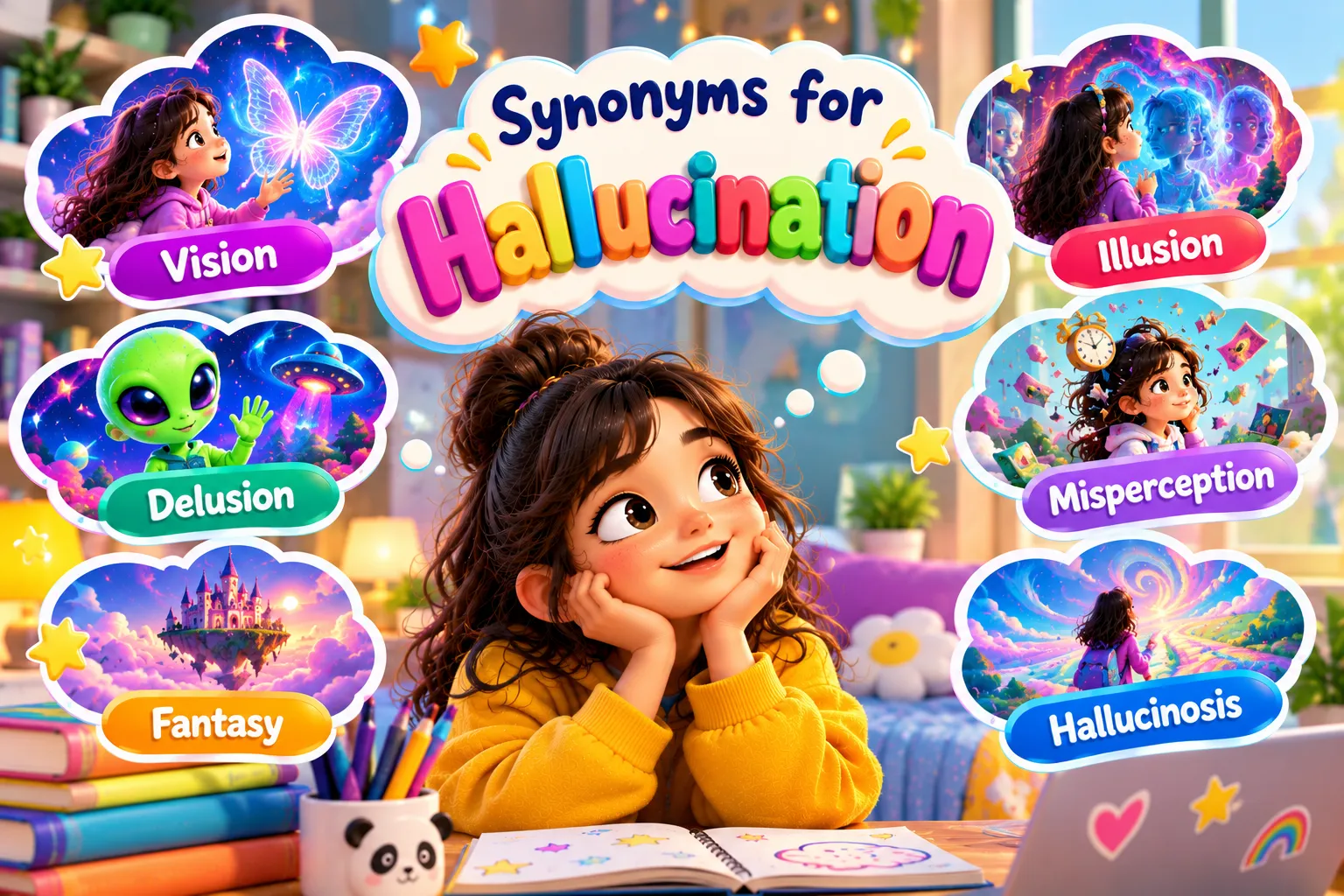
Common synonyms and related words include vision, apparition, illusion, delusion, mirage, phantasm, phantom, specter, ghost, image, mental image, fantasy, daydream, dream, nightmare, reverie, misperception, false perception, unreal experience, imaginary experience, phantom image, false vision, ghostly image, apparent perception, imagined sight, imagined sound, perceptual distortion, and apparent vision. The best word depends on the context—for example, illusion involves a mistaken perception of something present, while delusion is a false belief, and apparition usually describes a mysterious or ghostlike figure.
Hallucination means experiencing something that seems real even though there is no matching external stimulus. For example, a person may hear a voice when no one is speaking or see something that others cannot see. The word is also used in writing, medicine, psychology, and everyday discussions. Because hallucination can describe different kinds of unusual experiences, choosing the right related word is important. Learning synonyms helps English learners and writers explain ideas clearly and avoid repeating the same word. Some alternatives focus on false perceptions, while others describe dreams, visions, illusions, or imagined experiences. In this article, we will explore the meaning of hallucination, its examples, history, pronunciation, word formation, and 25 related words. We will also group these words by meaning so you can choose the most suitable term for each situation.
Meaning of Hallucination
Definition
Hallucination (Noun):
A perception or experience that seems real but occurs without a corresponding external stimulus.
Examples
- He reported seeing a strange figure that was not actually there.
- The patient described hearing voices that no one else could hear.
Connotative Meaning
Connotation means the feeling or idea associated with a word beyond its basic meaning.
- Positive tone: In creative or artistic contexts, it may suggest vivid imagination or unusual vision.
- Negative tone: It can suggest confusion, fear, or an unwanted experience.
- Neutral tone: It can simply describe a perception without an external source.
Etymology
The word hallucination comes from Latin hallucinari, meaning “to wander in mind” or “to be mistaken.”
- Old English (450–1100): The modern word hallucination was not part of Old English vocabulary. Similar ideas were expressed with words related to dreams, visions, or mistaken perception.
- Middle English (1100–1500): The Latin-rooted term entered English much later than the Middle English period, through learned medical and scholarly language.
- Modern English (1500–Present): Hallucination developed from Latin hallucinatio and became established as a term for an apparent perception without an external cause.
Pronunciation (IPA)
- IPA: /həˌluːsɪˈneɪʃən/
- Syllables: hal-lu-ci-na-tion
Affixation Pattern of Hallucination
- Root: hallucinate
- Prefix: None
- Suffix: -ion
- Word formations:
- hallucinate — verb
- hallucinated — verb/adjective
- hallucinating — verb/adjective
- hallucination — noun
- hallucinatory — adjective
- hallucinator — noun
- hallucinogen — noun
- hallucinogenic — adjective
25 Synonyms of Hallucination With Meaning & Examples
Note: Hallucination has few exact synonyms. Many words below are related terms or alternatives that fit specific contexts.
1. Vision (Noun)
Meaning: An image or experience that someone seems to see, sometimes without an external object.
Examples:
- He described a strange vision during the night.
- The vision seemed completely real to him.
2. Apparition (Noun)
Meaning: A mysterious figure or image that appears unexpectedly.
Examples:
- She thought she saw an apparition in the hallway.
- The old story describes an apparition at midnight.
3. Illusion (Noun)
Meaning: A false or misleading perception of something.
Examples:
- The image was an optical illusion.
- What he saw may have been an illusion.
4. Delusion (Noun)
Meaning: A strongly held false belief that is not supported by reality.
Examples:
- He had a fixed delusion about being watched.
- The belief was described as a delusion.
5. Mirage (Noun)
Meaning: An optical effect that makes something appear to exist or appear somewhere else.
Examples:
- The travelers saw a mirage in the desert.
- The distant water was only a mirage.
6. Phantasm (Noun)
Meaning: An imagined or unreal figure or image.
Examples:
- The story was filled with strange phantasms.
- He wondered whether the figure was a phantasm.
7. Phantom (Noun)
Meaning: An apparent or imagined figure that seems to be present.
Examples:
- He thought a phantom was standing near the door.
- The novel describes a mysterious phantom.
8. Specter (Noun)
Meaning: A frightening or ghostlike figure or image.
Examples:
- A specter seemed to appear in the old house.
- The story describes a dark specter.
9. Ghost (Noun)
Meaning: A supposed spirit of a dead person.
Examples:
- They claimed to see a ghost.
- The house was said to be haunted by a ghost.
10. Image (Noun)
Meaning: A picture or mental representation of something.
Examples:
- He described an image that appeared before him.
- The image disappeared after a few seconds.
11. Mental Image (Noun Phrase)
Meaning: A picture formed in the mind rather than directly seen outside.
Examples:
- She created a mental image of the place.
- The mental image felt unusually vivid.
12. Fantasy (Noun)
Meaning: An imagined situation or experience that may not be real.
Examples:
- The story blends reality with fantasy.
- His fantasy involved traveling to another world.
13. Daydream (Noun)
Meaning: A pleasant series of thoughts or images while awake.
Examples:
- She drifted into a daydream during class.
- His daydream was interrupted by the teacher.
14. Dream (Noun)
Meaning: A series of experiences or images that occur during sleep.
Examples:
- She had a vivid dream last night.
- The dream seemed completely real.
15. Nightmare (Noun)
Meaning: A frightening dream or disturbing experience.
Examples:
- He woke from a terrible nightmare.
- The nightmare felt extremely vivid.
16. Reverie (Noun)
Meaning: A state of being pleasantly lost in thought or imagination.
Examples:
- She sat in a quiet reverie.
- His reverie lasted for several minutes.
17. Imagining (Noun)
Meaning: The act of forming ideas or pictures in the mind.
Examples:
- He was imagining a different ending.
- Imagining the scene helped her write the story.
18. Misperception (Noun)
Meaning: An incorrect understanding or perception of something.
Examples:
- The event may have resulted from a misperception.
- A misperception can make an object seem different.
19. False Perception (Noun Phrase)
Meaning: A perception that does not match an external reality.
Examples:
- The experience was described as a false perception.
- A false perception can seem very convincing.
20. Unreal Experience (Noun Phrase)
Meaning: An experience that feels real but does not match ordinary reality.
Examples:
- He described the event as an unreal experience.
- The strange episode felt like an unreal experience.
21. Imaginary Experience (Noun Phrase)
Meaning: An experience created or experienced in the mind rather than caused by an external event.
Examples:
- The character had an imaginary experience.
- The story explores imaginary experiences.
22. Phantom Image (Noun Phrase)
Meaning: An image that appears to have no physical source.
Examples:
- He reported seeing a phantom image.
- The phantom image disappeared quickly.
23. False Vision (Noun Phrase)
Meaning: A vision that does not correspond to an external object.
Examples:
- The figure may have been a false vision.
- She described the experience as a false vision.
24. Ghostly Image (Noun Phrase)
Meaning: An image that appears ghostlike or unreal.
Examples:
- A ghostly image appeared in the photograph.
- He described seeing a ghostly image.
25. Apparent Perception (Noun Phrase)
Meaning: Something that seems to be perceived even though its source is uncertain or absent.
Examples:
- The apparent perception lasted only a few moments.
- Doctors carefully discussed the apparent perception.
Prototype Meaning
The most typical meaning of hallucination is a perception that seems real even though there is no corresponding external stimulus. People often associate it with seeing, hearing, or sensing something that others do not perceive. The experience can be visual, auditory, or involve other senses. The word is commonly used in medical, psychological, and everyday descriptions.
Prototype Categorization
- Perception-related terms: vision, illusion, misperception, false perception, perceptual distortion — useful when focusing on how something is seen, heard, or sensed.
- Ghostlike terms: apparition, phantom, specter, ghost, phantasm — useful in stories or descriptions involving mysterious figures.
- Imagination terms: fantasy, daydream, reverie, imagining, imaginary experience — useful when discussing imagined thoughts or experiences.
- Dream-related terms: dream, nightmare, dreamlike experience — useful when the experience is connected with sleep or dream-like feelings.
- Unreal-image terms: phantom image, false vision, ghostly image, apparent vision — useful when describing an unusual visual experience.
- General descriptive terms: image, mental image, unreal experience, extraordinary perception — useful when the exact nature of the experience is unclear.
These categories help writers choose a word that matches the exact meaning instead of treating every related term as a perfect synonym.
Antonyms of Hallucination
Reality (Noun)
- The actual state of things rather than an imagined perception.
Reality-Based Perception (Noun Phrase)
- Perception that matches an external object or event.
Fact (Noun)
- Something that is true and can be supported by evidence.
Awareness (Noun)
- Clear understanding of what is happening around you.
Certainty (Noun)
- A state of being sure that something is true.
Short Questions and Answers
What does hallucination mean?
A hallucination is a perception that seems real but occurs without a corresponding external stimulus.
When should hallucination be used?
Use hallucination when describing an apparent sensory experience that does not have a matching external source. It is especially common in medical and psychological contexts.
Is hallucination positive or negative?
The word is usually neutral in technical use, but it can have a negative tone in everyday contexts because hallucinations may be confusing or frightening.
How is hallucination different from similar words?
A hallucination is a perception without a corresponding external stimulus. An illusion involves misinterpreting something that is actually present, while a delusion is a false belief rather than a sensory perception.
Conclusion
Learning hallucination and its related words can improve vocabulary and help writers describe unusual experiences more precisely. Words such as vision, apparition, illusion, phantom, mirage, misperception, and false perception have different meanings and should be chosen carefully. A hallucination is not the same as an illusion or delusion, so understanding these differences is important. These terms can be useful in academic writing, psychology, medicine, fiction, and everyday English. English learners can improve their speaking and writing by studying each word in context rather than memorizing long word lists. Practice using new vocabulary in simple sentences, and compare similar words to learn their small differences. With regular practice, you can communicate ideas more clearly and confidently.
Read More:
Synonyms for dreamy: 29 Beautiful Alternatives

I’m Ayesha Haram, an English content and SEO writer at SynonymsInstant.com. I focus on creating helpful vocabulary resources, word guides, and practical English content that readers can understand quickly. I combine language research, clear explanations, and SEO-focused writing to produce reliable content that supports learners, writers, and everyday English users.