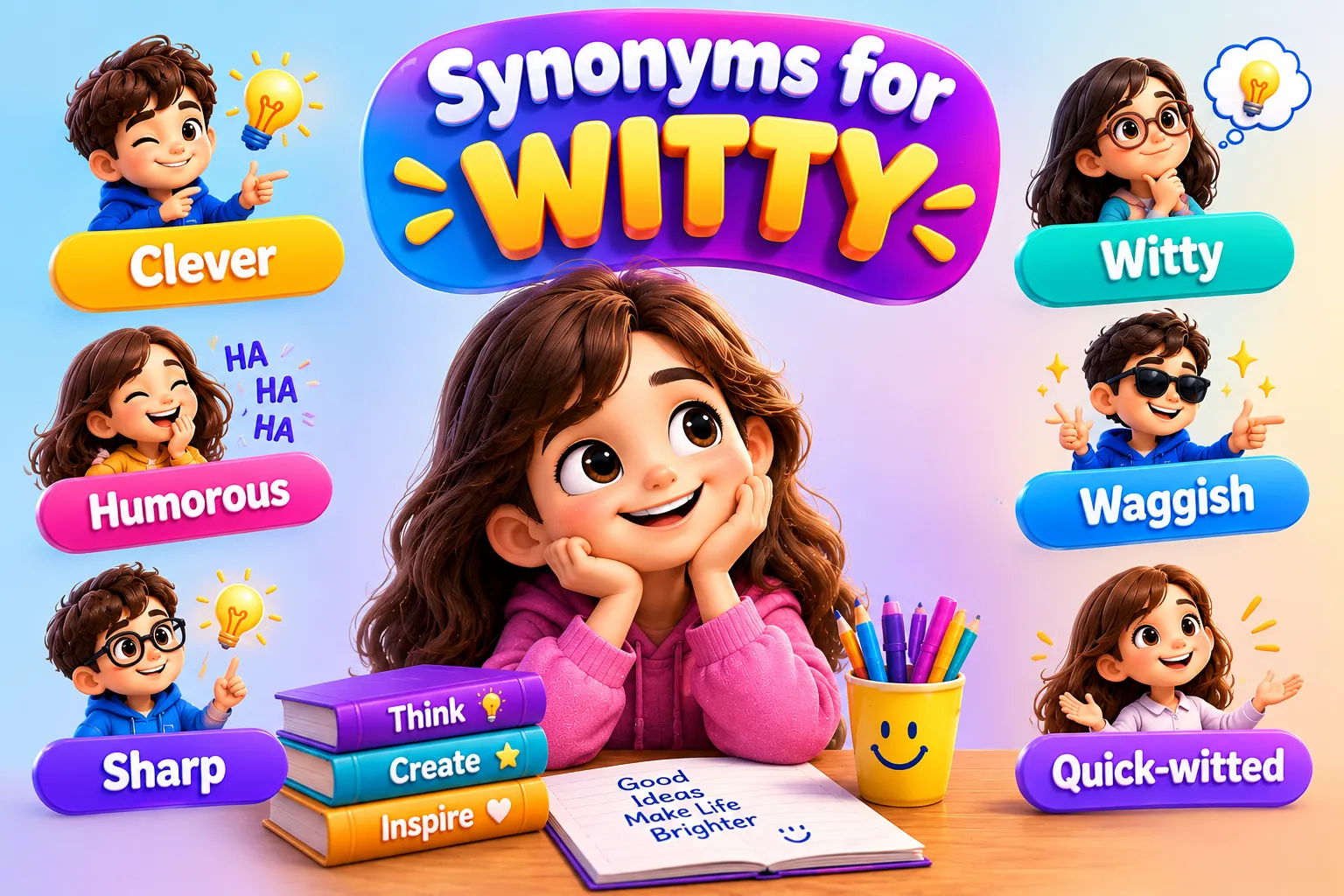
Common synonyms include clever, humorous, funny, amusing, quick-witted, sharp, smart, playful, ingenious, droll, jocular, entertaining, brilliant, inventive, and sharp-witted. The best synonym depends on the context: quick-witted highlights fast thinking, humorous focuses on being funny, clever highlights intelligence, and playful suggests light and friendly humor.
| Section | Details |
| Meaning | Witty means clever and funny, especially in a quick and smart way. |
| Real-Life Example | Imagine a friend who always has the perfect funny reply during a conversation. |
| Effect | Their quick humor may make everyone laugh without being rude. |
| Common Use | The word is common in everyday English, books, speeches, reviews, and social conversations. |
| Why Learn Synonyms? | Synonyms help English learners describe humor with more detail and avoid repeating the same word. |
| For Content Writers | They help writers choose the right word for different types of humor. |
| What This Guide Covers | The guide explains the meaning, examples, grammar, history, pronunciation, word forms, and 27 synonyms for witty. |
| Semantic Categories | The synonyms are grouped by meaning to help readers understand when each word works best. |
Meaning of Witty
Definition
Witty (Adjective):
Someone who is witty uses clever, quick, and amusing ideas or words to make people laugh or think.
Examples
- Sarah gave a witty answer to the difficult question.
- His witty comments made everyone at the dinner table laugh.
Connotative Meaning
Connotation: The feelings or ideas that a word suggests beyond its basic meaning.
- Positive tone: Clever, amusing, intelligent, sharp, entertaining.
- Negative tone: Sometimes it can suggest that someone is trying too hard to be clever or funny.
- Neutral tone: Simply describing a person, comment, or style as clever and amusing.
Etymology
The word witty comes from the older English word wit, which was connected with knowledge, understanding, and mental ability.
- Old English (450–1100): Wit came from Old English witt, meaning knowledge, understanding, or mental ability.
- Middle English (1100–1500): Wit developed meanings connected with intelligence, cleverness, and good judgment. The adjective witty began to describe someone showing cleverness.
- Modern English (1500–Present): Witty became strongly associated with clever and amusing speech, writing, comments, and humor.
Pronunciation (IPA)
- IPA: /ˈwɪti/
- Syllables: wit-ty
Affixation Pattern of Witty
- Root: wit
- Prefix: None
- Suffix: -y, meaning “characterized by” or “full of”
- Word formations:
- wit — noun/verb
- witty — adjective
- wittily — adverb
- wittiness — noun
- witless — adjective
- witlessly — adverb
- witlessness — noun
27 Synonyms of Witty With Meaning & Examples
Note: Some words below are close alternatives rather than exact synonyms. The best choice depends on the type of cleverness or humor you want to describe.
1. Clever (Adjective)
Meaning: Quick to understand things and produce smart ideas.
Examples:
- She gave a clever answer.
- That was a clever way to solve the problem.
2. Humorous (Adjective)
Meaning: Funny or able to make people laugh.
Examples:
- He wrote a humorous story.
- Her speech was both useful and humorous.
3. Funny (Adjective)
Meaning: Making people laugh or causing amusement.
Examples:
- His funny comment made everyone smile.
- She told a funny story at lunch.
4. Amusing (Adjective)
Meaning: Entertaining or pleasantly funny.
Examples:
- We watched an amusing video.
- His amusing remarks made the meeting more enjoyable.
5. Comical (Adjective)
Meaning: Funny in a way that makes something seem amusing or silly.
Examples:
- His reaction was comical.
- The movie has many comical scenes.
6. Quick-witted (Adjective)
Meaning: Able to think and respond quickly in a clever way.
Examples:
- Maria is very quick-witted.
- His quick-witted reply surprised everyone.
7. Sharp (Adjective)
Meaning: Showing quick intelligence and clear thinking.
Examples:
- She has a sharp sense of humor.
- His sharp reply showed that he understood the situation.
8. Sharp-witted (Adjective)
Meaning: Very clever and quick at understanding or responding.
Examples:
- The sharp-witted student answered immediately.
- He is known for his sharp-witted comments.
9. Clever-minded (Adjective)
Meaning: Having a clever and active mind.
Examples:
- She is a clever-minded writer.
- The character is intelligent and clever-minded.
10. Smart (Adjective)
Meaning: Intelligent or showing good judgment.
Examples:
- That was a smart response.
- He made a smart joke about the situation.
11. Ingenious (Adjective)
Meaning: Very clever and creative in solving a problem.
Examples:
- She found an ingenious solution.
- His ingenious idea saved the project.
12. Humorous-minded (Adjective)
Meaning: Naturally inclined to notice or create humor.
Examples:
- He is very humorous-minded.
- Her humorous-minded approach keeps the team relaxed.
13. Playful (Adjective)
Meaning: Light, fun, and not serious in a pleasant way.
Examples:
- She made a playful comment.
- His playful humor made the conversation friendly.
14. Jocular (Adjective)
Meaning: Characterized by joking and light humor.
Examples:
- He made a jocular remark.
- Her jocular tone made everyone comfortable.
15. Facetious (Adjective)
Meaning: Treating a serious subject with deliberately inappropriate humor.
Examples:
- His facetious comment annoyed his teacher.
- She made a facetious remark during the serious discussion.
16. Droll (Adjective)
Meaning: Amusing in an unusual, dry, or slightly strange way.
Examples:
- His droll humor is easy to recognize.
- She made a droll observation about the situation.
17. Sparkling (Adjective)
Meaning: Lively, brilliant, and highly entertaining.
Examples:
- The author has a sparkling sense of humor.
- His sparkling conversation attracted everyone’s attention.
18. Entertaining (Adjective)
Meaning: Interesting or amusing enough to hold attention.
Examples:
- She gave an entertaining speech.
- His stories are always entertaining.
19. Lighthearted (Adjective)
Meaning: Cheerful and free from serious worry.
Examples:
- He made a lighthearted joke.
- The article has a lighthearted style.
20. Saucy (Adjective)
Meaning: Bold and slightly cheeky or amusing.
Examples:
- The child gave a saucy reply.
- Her saucy comment made her friends laugh.
21. Ingenious (Adjective)
Meaning: Showing unusual creativity and cleverness.
Examples:
- His ingenious joke used a clever wordplay.
- She created an ingenious way to entertain the audience.
22. Brainy (Adjective)
Meaning: Very intelligent or smart.
Examples:
- He is a brainy student.
- Her brainy answer impressed the class.
23. Astute (Adjective)
Meaning: Very good at understanding situations and making smart judgments.
Examples:
- She made an astute observation.
- His astute comment showed deep understanding.
24. Shrewd (Adjective)
Meaning: Clever at judging situations and making practical decisions.
Examples:
- He is a shrewd businessman.
- Her shrewd comment revealed the hidden problem.
25. Resourceful (Adjective)
Meaning: Good at finding clever ways to solve problems.
Examples:
- She is a resourceful teacher.
- His resourceful thinking helped the team succeed.
26. Inventive (Adjective)
Meaning: Good at creating new and clever ideas.
Examples:
- She has an inventive sense of humor.
- His inventive writing keeps readers interested.
27. Sarcastic (Adjective)
Meaning: Using sharp or mocking remarks, often to express humor or criticism.
Examples:
- His sarcastic comment made everyone laugh.
- She has a sarcastic sense of humor.
Prototype Meaning
The most typical meaning of witty is clever and amusing in speech or writing. When people hear “witty,” they often imagine someone who can quickly think of a smart joke, funny reply, or clever observation. A witty person does not simply tell jokes; they often use intelligence, timing, wordplay, and quick thinking to create humor.
Prototype Categorization
The 27 alternatives can be grouped into several semantic categories:
- Cleverness and intelligence: clever, smart, brainy, astute, shrewd, ingenious, inventive, resourceful. These work when the focus is on mental ability.
- Humor and amusement: humorous, funny, amusing, comical, entertaining, brilliant. These focus mainly on making people laugh or enjoy something.
- Quick responses: quick-witted, sharp, sharp-witted. These are useful when someone responds quickly and intelligently.
- Light and playful humor: playful, jocular, lighthearted, sparkling, zingy. These suggest friendly and enjoyable humor.
- Dry or unusual humor: droll, facetious, sarcastic. These describe more specific styles of humor and may carry a negative or critical tone.
- Bold or cheeky expression: saucy. This is useful when humor is slightly bold or cheeky.
This grouping helps writers select a word based on the exact type of cleverness or humor they want to express.
Antonyms of Witty
| Antonym | Part of Speech | Simple Meaning |
| Dull | Adjective | Lacking excitement, cleverness, or interest. |
| Boring | Adjective | Not interesting or entertaining. |
| Unfunny | Adjective | Not amusing or not causing laughter. |
| Serious | Adjective | Focused on important matters rather than humor. |
| Slow-witted | Adjective | Not quick at understanding or responding. |
| Dull-minded | Adjective | Showing limited mental sharpness or creativity. |
| Humorless | Adjective | Lacking a sense of humor. |
| Unimaginative | Adjective | Not showing creative or original ideas. |
Short Questions and Answers
What does witty mean?
Witty means clever and amusing, especially in a quick and intelligent way.
When should witty be used?
Use witty when describing clever humor, smart comments, funny replies, or entertaining writing.
Is witty positive or negative?
Witty is usually positive because it suggests intelligence and humor. However, some related forms of humor, such as sarcasm or facetiousness, can have a negative effect depending on the situation.
How is it different from similar words?
Witty combines cleverness and humor. “Funny” mainly means amusing, while “clever” mainly means intelligent. “Quick-witted” adds the idea of responding quickly.
Conclusion
Learning witty and its synonyms can make your English more expressive and flexible. Instead of using only “funny” or “clever,” you can choose words such as amusing, humorous, quick-witted, playful, ingenious, sharp, droll, or brilliant based on the meaning you want. These words help you describe different kinds of humor and intelligence more clearly. They can improve both speaking and writing by adding variety and reducing repetition. English learners can also use these words to understand books, movies, conversations, and online content more easily. Content writers can choose precise vocabulary to create stronger descriptions and engaging sentences. Practice one or two new words each day, write your own examples, and use them in real conversations. With regular practice, your vocabulary and English confidence will grow.
Read More:
Synonyms for special person: 30 Meaningful Words

I’m Pinki, an SEO writer at SynonymsInstant.com, specializing in synonyms, antonyms, vocabulary, word meanings, grammar, and English usage. I create accurate, well-researched, reader-friendly content that combines language expertise with SEO best practices. My goal is to make English vocabulary simple, useful, and accessible for students, writers, professionals, and English learners.