
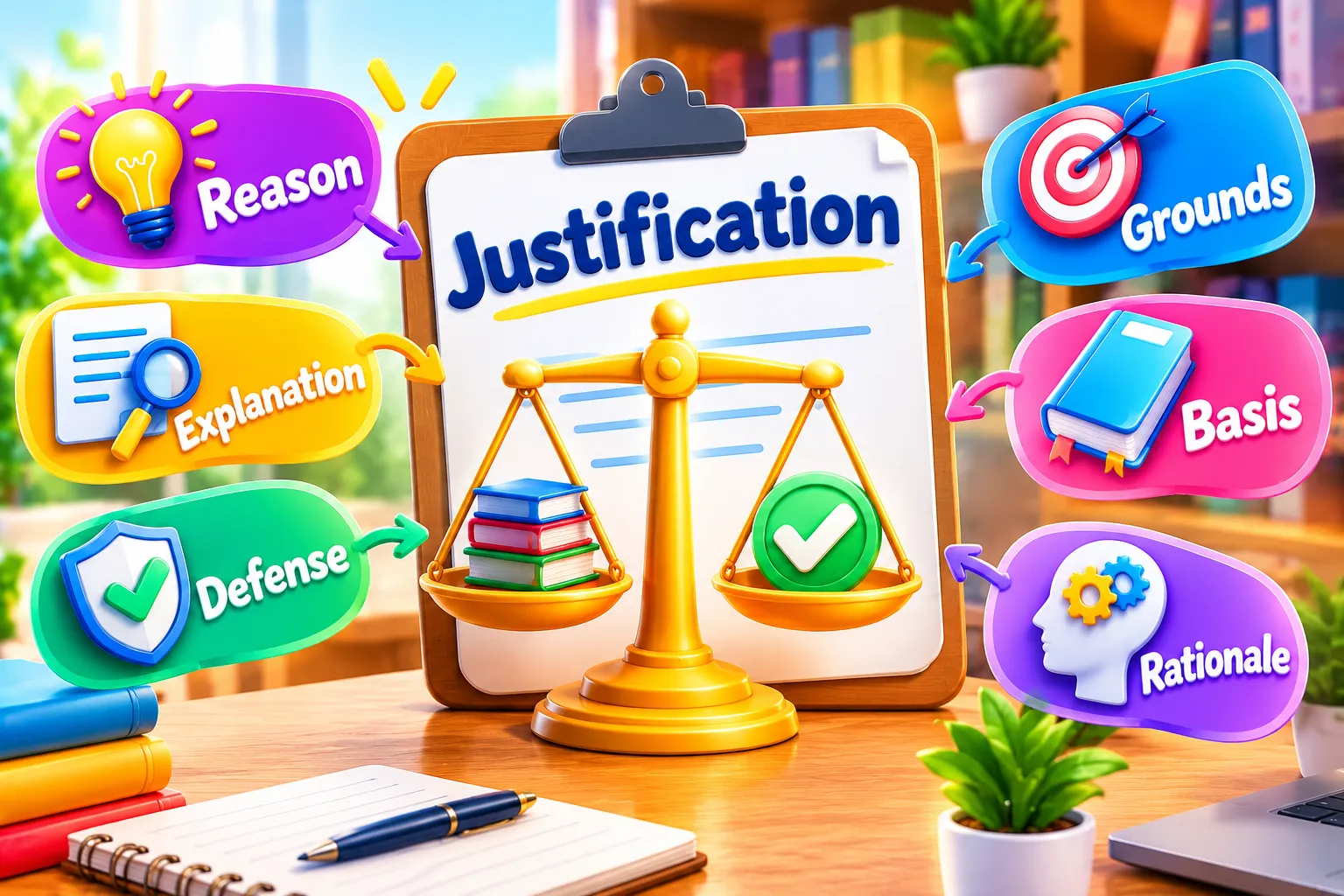
Common synonyms and related words include reason, explanation, rationale, defense, excuse, evidence, support, basis, grounds, cause, motive, argument, case, validation, vindication, proof, warrant, reasoning, logic, clarification, account, authorization, and certification. The best word depends on the context—for example, rationale focuses on the logic behind a decision, evidence supports a claim with facts, reason explains why something happened, and excuse is often used to defend a mistake or action.
Justification means a reason, explanation, or evidence that shows why something is reasonable or acceptable. For example, if a student misses class, the teacher may ask for a justification. The student might explain that they were sick or had an important reason. The word is common in school, work, law, writing, and daily communication. Learning synonyms for justification helps English learners choose clearer words and avoid repeating the same term. It also helps writers explain reasons, support opinions, and present arguments more effectively. In this article, we will explore the meaning of justification, its synonyms, examples, grammar, history, pronunciation, word formation, and semantic categories. You will also learn how words such as reason, explanation, defense, evidence, and rationale differ in meaning and use.
Meaning of Justification
Definition
Justification (Noun):
A reason, explanation, or evidence that shows why something is reasonable, correct, or acceptable.
Examples
- She gave a clear justification for her decision.
- The manager asked for a justification for the extra expense.
Connotative Meaning
- Positive tone: A reasonable and convincing explanation.
- Negative tone: An excuse used to defend questionable behavior.
- Neutral tone: A reason or explanation supporting an action or decision.
(Connotation means the feeling or idea that a word suggests beyond its basic meaning.)
Etymology
- Old English (450–1100): The modern word justification was not used in Old English. Its roots come from Latin justificare, meaning “to make just or righteous.”
- Middle English (1100–1500): The word entered English through Old French and Latin forms related to justification. It was often used in religious and legal contexts.
- Modern English (1500–Present): Justification developed broader meanings, including a reason or explanation that supports an action, decision, belief, or argument.
Pronunciation (IPA)
- IPA: /ˌdʒʌstɪfɪˈkeɪʃən/
- Syllables: jus-ti-fi-ca-tion
Affixation Pattern of Justification
- Root: just
- Prefix: None
- Suffix: -ification
- Word formations:
- just — adjective/noun
- justify — verb
- justified — adjective/verb
- justification — noun
- justifiable — adjective
- justifiably — adverb
- unjustified — adjective
- unjustifiably — adverb
26 Synonyms of Justification With Meaning & Examples
1. Reason (Noun)
Meaning: A cause or explanation for an action or decision.
Examples:
- Give me a good reason for your choice.
- She explained her reason for leaving.
2. Explanation (Noun)
Meaning: Information that makes something clear or understandable.
Examples:
- He gave an explanation for the delay.
- Her explanation was easy to understand.
3. Rationale (Noun)
Meaning: The main reason or logical basis behind a decision.
Examples:
- The manager explained the rationale behind the new policy.
- We need to understand the rationale for this plan.
4. Defense (Noun)
Meaning: A statement or argument that supports a person, action, or idea.
Examples:
- He offered a strong defense of his decision.
- The lawyer prepared a defense for her client.
5. Excuse (Noun)
Meaning: A reason given to explain or defend an action, especially a mistake.
Examples:
- He gave an excuse for being late.
- She did not accept his excuse.
6. Evidence (Noun)
Meaning: Facts or information that support a claim or decision.
Examples:
- There was evidence to support the argument.
- The report provides evidence for the decision.
7. Support (Noun)
Meaning: Information or reasons that help prove or strengthen an idea.
Examples:
- The writer provided support for her opinion.
- We need more support for this claim.
8. Basis (Noun)
Meaning: The main foundation or reason on which something is based.
Examples:
- What is the basis for your decision?
- The report provides a basis for further discussion.
9. Ground (Noun)
Meaning: A reason or cause used to support an action or decision.
Examples:
- He was dismissed on legal grounds.
- There were good grounds for the complaint.
10. Cause (Noun)
Meaning: The person, thing, or reason that produces an effect.
Examples:
- Lack of sleep was the cause of his tiredness.
- They discussed the cause of the problem.
11. Motive (Noun)
Meaning: A reason that causes someone to act in a particular way.
Examples:
- The police investigated his motive.
- Her main motive was to help others.
12. Argument (Noun)
Meaning: A reason or set of reasons used to support an idea.
Examples:
- She presented a strong argument.
- His argument supported the proposed change.
13. Case (Noun)
Meaning: A set of facts or reasons used to support a position.
Examples:
- They made a strong case for the new plan.
- The evidence strengthened his case.
14. Defense (Noun)
Meaning: The act of protecting or supporting a person, idea, or action against criticism.
Examples:
- She gave a defense of the new policy.
- His defense was based on clear facts.
15. Validation (Noun)
Meaning: Evidence or confirmation that something is correct or acceptable.
Examples:
- The results provided validation for the theory.
- She needed validation for her approach.
16. Vindication (Noun)
Meaning: Proof that someone was right or not responsible for a wrong action.
Examples:
- The new evidence brought vindication.
- The decision gave him a sense of vindication.
17. Proof (Noun)
Meaning: Facts or evidence that show something is true.
Examples:
- The document provided proof of ownership.
- We need proof before making a decision.
18. Justifying Reason (Noun Phrase)
Meaning: A reason that makes an action or decision seem reasonable.
Examples:
- There was no justifying reason for the action.
- She gave a justifying reason for the change.
19. Grounds (Noun)
Meaning: Facts or reasons that provide a basis for an action.
Examples:
- They had sufficient grounds for the complaint.
- The decision was made on solid grounds.
20. Warrant (Noun)
Meaning: A reason or fact that makes an action reasonable or necessary.
Examples:
- There was no warrant for such a response.
- The evidence provided a warrant for further investigation.
21. Sanction (Noun)
Meaning: Official approval or permission for an action.
Examples:
- The project received official sanction.
- The plan cannot continue without proper sanction.
22. Authorization (Noun)
Meaning: Official permission to do something.
Examples:
- The manager gave authorization for the purchase.
- We need written authorization.
23. Certification (Noun)
Meaning: Official confirmation that something meets a required standard.
Examples:
- The product received safety certification.
- The certificate provided certification of quality.
24. Defense Argument (Noun Phrase)
Meaning: A reason or argument used to defend an action or position.
Examples:
- The lawyer presented a strong defense argument.
- His defense argument focused on the available evidence.
25. Reasoning (Noun)
Meaning: The process of using reasons to reach a conclusion.
Examples:
- Her reasoning was clear and logical.
- I understand the reasoning behind the decision.
26. Logic (Noun)
Meaning: A clear system of reasoning that connects ideas.
Examples:
- There was logic behind his decision.
- Her argument followed simple logic.
Prototype Meaning
The most typical meaning of justification is a reason or explanation that shows why an action, decision, belief, or opinion is reasonable. When people hear this word, they often imagine someone explaining and supporting a choice with facts, logic, or evidence.
Prototype Categorization
The synonyms can be grouped into useful semantic categories:
- Reasons and causes: reason, cause, motive, and ground explain why something happened or was done.
- Logical support: rationale, reasoning, logic, basis, and argument show the thinking behind an idea or decision.
- Evidence and proof: evidence, proof, validation, and certification provide information that supports a claim.
- Defense and protection: defense, defense argument, and defense case focus on supporting a person, action, or position.
- Permission and approval: sanction and authorization show official approval rather than simply giving a reason.
- Explanation and clarity: explanation, clarification, and account help make an action or situation understandable.
- Formal support: grounds, case, warrant, and justification statement are often useful in formal, academic, legal, or professional writing.
This grouping helps writers choose the right word. For example, rationale works well for a decision, evidence supports a claim, grounds fits formal writing, and excuse is more common when defending a mistake.
Antonyms of Justification
1. Injustice (Noun)
Unfair or wrong treatment.
2. Unreasonableness (Noun)
A lack of good sense or logical support.
3. Invalidity (Noun)
The state of not being valid or acceptable.
4. Unjustification (Noun)
A lack of a good reason or support for something.
5. Condemnation (Noun)
Strong disapproval of an action or idea.
6. Refutation (Noun)
Evidence or reasoning that shows a claim is wrong.
Short Questions and Answers
What does justification mean?
Justification means a reason, explanation, or evidence that shows why something is reasonable, correct, or acceptable.
When should justification be used?
Use justification when you need to explain or support an action, decision, opinion, claim, or request.
Is justification positive or negative?
Justification is usually neutral. It can have a positive meaning when the reason is strong and reasonable, but it may sound negative when someone is seen as making excuses for questionable behavior.
How is it different from similar words?
Justification supports why something is reasonable. Reason simply explains why something happened, while evidence provides facts that support a claim. Excuse often explains or defends a mistake and may sound less convincing.
Conclusion
Learning justification and its synonyms can make your English more precise and effective. The word is useful when explaining why an action, decision, opinion, or claim is reasonable. Related words such as reason, rationale, basis, evidence, reasoning, defense, and grounds help express different types of support. Choosing the right synonym can strengthen academic writing, professional communication, and everyday speech while reducing repetition. English learners can improve their confidence by practicing these words in short sentences and real-life situations. Try to learn a few related words each day and notice how native speakers use them. With regular practice, you can explain your ideas more clearly and choose vocabulary that fits each situation naturally.
Read More:
Synonyms for meet up: 29 Useful Alternatives

I am Rubab content specialist focused on creating accurate, user-friendly, and search-optimized language resources. Through Synonyminstant, I help readers find synonyms, antonyms, meanings, and vocabulary with ease. Every article is carefully researched and optimized to provide reliable information, clear explanations, and an excellent user experience.