
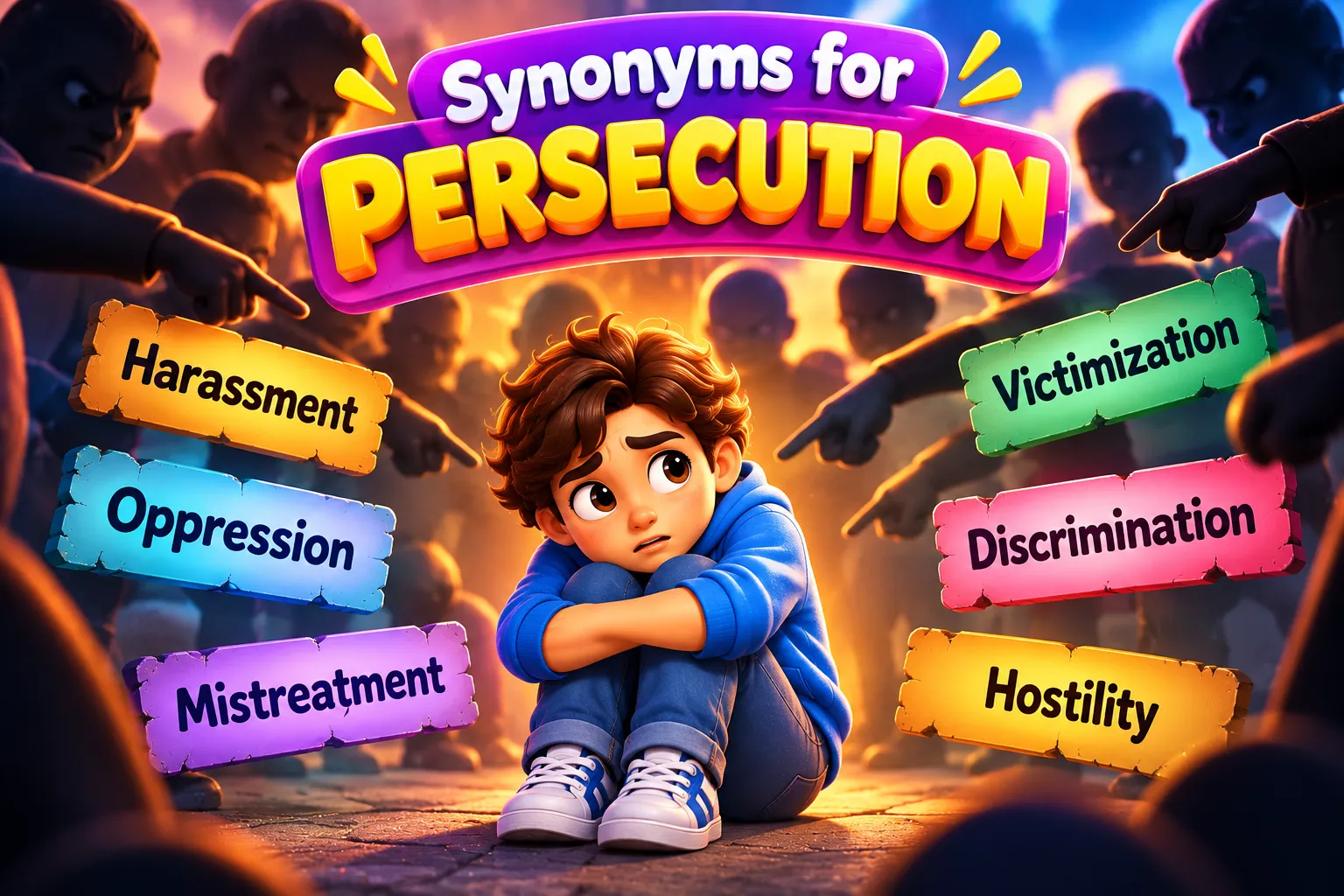
Common synonyms and related words include oppression, harassment, discrimination, mistreatment, victimization, abuse, repression, suppression, intolerance, intimidation, cruelty, and tyranny. The best word depends on the context: oppression focuses on harsh control, discrimination on unfair treatment, harassment on repeated unwanted behavior, and repression on restricting freedom or expression. Learning these alternatives helps English learners improve vocabulary, avoid repetition, and describe different forms of unfair treatment more precisely.
Persecution means treating a person or group unfairly, cruelly, or violently because of their religion, race, beliefs, identity, or other protected characteristics. Imagine a person being repeatedly threatened or punished because of their religious beliefs. This is a clear example of persecution. The word is common in history, law, politics, human rights, and social studies. Learning synonyms for persecution helps English learners understand different levels and forms of unfair treatment. It also helps writers avoid repeating the same word. However, not every alternative has exactly the same meaning. Some describe physical harm, while others focus on discrimination, pressure, fear, or unfair treatment. This guide explains the meaning, grammar, history, pronunciation, word formation, and 25 synonyms and closely related alternatives with simple examples and semantic categories.
Meaning of Persecution
Definition
Persecution (Noun):
Persecution is the cruel, unfair, or hostile treatment of a person or group because of their beliefs, identity, religion, race, or other characteristics.
Examples
- The community faced persecution because of its religious beliefs.
- Many people left the country to escape persecution.
Connotative Meaning
Connotation means the feeling or idea that a word suggests beyond its basic meaning.
- Positive tone: Persecution normally has no positive meaning, although resistance to persecution can have a positive context.
- Negative tone: It strongly suggests cruelty, injustice, suffering, fear, or oppression.
- Neutral tone: In historical or academic writing, it can be used as a factual term to describe documented treatment.
Etymology
The word persecution comes from Latin persecution, meaning “a following after” or “pursuit.” It developed from the Latin verb persequi, meaning “to follow closely, pursue, or chase.” Over time, the word gained the stronger sense of pursuing someone with hostility or punishment.
| Period | Development |
| Old English (450–1100) | The modern English word persecution was not established in Old English. |
| Middle English (1100–1500) | English adopted forms related to persecucion/persecution through Anglo-French and Old French, from Latin persecutio. |
| Modern English (1500–Present) | Persecution developed its familiar meaning of cruel or hostile treatment, especially toward people because of their beliefs or identity. |
Pronunciation (IPA)
- IPA: /ˌpɜːrsɪˈkjuːʃən/
- Syllables: per-se-cu-tion
Affixation Pattern of Persecution
- Root: Latin sequ-/secut-, connected with the idea of following or pursuing
- Prefix: per-, meaning “through” or “thoroughly” in the Latin formation
- Suffix: -ion, forming a noun that describes an action or process
Word Formations
- Persecute — Verb: to treat someone cruelly or unfairly, especially because of their beliefs or identity.
- Persecution — Noun: cruel or hostile treatment of a person or group.
- Persecuted — Adjective/verb form: treated cruelly or unfairly.
- Persecuting — Present participle: actively treating someone with hostility or cruelty.
- Persecutor — Noun: a person who persecutes another person or group.
- Persecutory — Adjective: involving or relating to persecution.
25 Synonyms of Persecution With Meaning & Examples
Note: Some words below are close synonyms rather than exact replacements. The best choice depends on the situation.
1. Oppression (Noun)
Meaning: Cruel or unfair control over a person or group.
Examples:
- The people suffered under political oppression.
- Education helped them speak against oppression.
2. Harassment (Noun)
Meaning: Repeated unwanted behavior that causes fear, stress, or harm.
Examples:
- The workers reported repeated harassment.
- Online harassment can seriously affect people.
3. Mistreatment (Noun)
Meaning: Bad, unfair, or cruel treatment of someone.
Examples:
- The report described the mistreatment of prisoners.
- The organization works to prevent mistreatment.
4. Victimization (Noun)
Meaning: Treating someone unfairly or making them a victim.
Examples:
- The law protects people from victimization.
- She spoke about the victimization of minority groups.
5. Abuse (Noun)
Meaning: Cruel, harmful, or improper treatment of a person.
Examples:
- The investigation found evidence of abuse.
- The group raised awareness about abuse.
6. Cruelty (Noun)
Meaning: Deliberate behavior that causes pain or suffering.
Examples:
- The victims described the cruelty they experienced.
- The law aims to prevent unnecessary cruelty.
7. Torment (Noun)
Meaning: Severe physical or emotional suffering.
Examples:
- The prisoners lived through years of torment.
- Fear became a constant source of torment.
8. Tyranny (Noun)
Meaning: Cruel and unfair use of power or authority.
Examples:
- The people protested against tyranny.
- The novel describes life under tyranny.
9. Repression (Noun)
Meaning: The use of force or control to stop people from expressing themselves or acting freely.
Examples:
- The government faced criticism for political repression.
- Repression can prevent people from speaking openly.
10. Suppression (Noun)
Meaning: The act of stopping something through force or control.
Examples:
- The suppression of peaceful protests caused concern.
- The book discusses the suppression of free speech.
11. Discrimination (Noun)
Meaning: Unfair treatment of people because they belong to a particular group.
Examples:
- The law prohibits religious discrimination.
- The organization works against workplace discrimination.
12. Intimidation (Noun)
Meaning: Using fear or threats to control someone.
Examples:
- The witnesses reported intimidation.
- Intimidation prevented some people from speaking.
13. Bullying (Noun)
Meaning: Repeatedly hurting, threatening, or frightening someone who may be less powerful.
Examples:
- The school has a policy against bullying.
- Online bullying can happen through social media.
14. Hostility (Noun)
Meaning: Unfriendly or aggressive behavior toward someone.
Examples:
- The group faced hostility because of its beliefs.
- Religious hostility can divide communities.
15. Rejection (Noun)
Meaning: Refusing to accept or support someone.
Examples:
- Social rejection can cause emotional pain.
- The community faced rejection because of its traditions.
16. Marginalization (Noun)
Meaning: Pushing a person or group to the edge of society and limiting their opportunities.
Examples:
- The report focuses on the marginalization of poor communities.
- Education can help reduce social marginalization.
17. Exclusion (Noun)
Meaning: Keeping someone out of a group, activity, or society.
Examples:
- The policy resulted in the exclusion of certain groups.
- Social exclusion can affect a person’s opportunities.
18. Subjugation (Noun)
Meaning: Bringing people under harsh control.
Examples:
- The people resisted foreign subjugation.
- The history book describes years of subjugation.
19. Subjection (Noun)
Meaning: The condition of being controlled or ruled by another.
Examples:
- The population lived under political subjection.
- The movement opposed the subjection of local communities.
20. Hounding (Noun)
Meaning: Repeatedly pursuing, criticizing, or troubling someone.
Examples:
- The journalist faced constant hounding from critics.
- The family experienced years of public hounding.
21. Targeting (Noun)
Meaning: Deliberately selecting a person or group for special attention, attack, or unfair treatment.
Examples:
- The report describes the targeting of minority communities.
- The group accused officials of targeting activists.
22. Maltreatment (Noun)
Meaning: Cruel or harmful treatment.
Examples:
- The investigation uncovered maltreatment of detainees.
- The organization protects children from maltreatment.
23. Ill-treatment (Noun)
Meaning: Bad, cruel, or unfair treatment.
Examples:
- The report documented the ill-treatment of prisoners.
- They demanded an end to the ill-treatment of civilians.
24. Intolerance (Noun)
Meaning: Lack of acceptance of people with different beliefs or ways of life.
Examples:
- Religious intolerance can lead to conflict.
- Education can help reduce intolerance.
25. Hostigamiento (Noun)
Meaning: A term used in Spanish for harassment or repeated hostile treatment.
Examples:
- The report used the term hostigamienton when discussing repeated harassment.
- Hostigamiento may involve threats or pressure.
Prototype Meaning
The most typical meaning of persecution is repeated and serious mistreatment of a person or group because of who they are, what they believe, or the group they belong to. People often imagine a minority group being threatened, punished, excluded, imprisoned, or harmed because of its religion, race, beliefs, or identity. The word usually suggests a pattern of hostile treatment rather than one isolated unfair action.
Prototype Categorization
The 25 alternatives can be grouped by their main meaning:
- Cruel or harmful treatment: mistreatment, maltreatment, ill-treatment, abuse, cruelty, torment.
- Power and control: oppression, tyranny, repression, suppression, subjugation, subjection.
- Unfair social treatment: discrimination, marginalization, exclusion, victimization, intolerance.
- Fear and pressure: harassment, intimidation, bullying, hounding, hostility.
- Deliberate selection or attack: targeting, systematic abuse.
- Specific forms: religious oppression, political repression, religious intolerance, persecution of believers.
This grouping helps writers choose the right word. For example, oppression fits harsh control, while harassment suggests repeated unwanted behavior. Discrimination focuses on unfair treatment, while intimidation focuses on fear or threats.
Antonyms of Persecution
- Protection (Noun): Keeping someone safe from harm or danger.
- Acceptance (Noun): Willingness to accept someone or something without unfair rejection.
- Tolerance (Noun): Respecting people with different beliefs or ways of life.
- Equality (Noun): Treating people with the same rights and opportunities.
- Justice (Noun): Fair treatment according to principles or law.
- Freedom (Noun): The ability to live or act without unfair control.
- Inclusion (Noun): Making sure people can participate and belong.
- Respect (Noun): Showing proper regard for another person or group.
- Support (Noun): Giving help, protection, or encouragement.
- Fairness (Noun): Treating people in an impartial and reasonable way.
Short Questions and Answers
What does persecution mean?
Persecution means cruel, hostile, or unfair treatment of a person or group, often because of their religion, beliefs, identity, or group membership.
When should persecution be used?
Use persecution when describing serious or repeated hostile treatment, especially when a person or group is targeted because of a particular identity, belief, or characteristic.
Is persecution positive or negative?
Persecution has a strongly negative meaning because it describes suffering, injustice, hostility, or cruelty.
How is it different from similar words?
Persecution usually suggests repeated or serious targeting. Harassment often means repeated unwanted behavior, discrimination focuses on unequal treatment, and oppression focuses on harsh control or domination.
Conclusion
Learning persecution and its related synonyms can greatly improve English vocabulary. The word is especially useful in history, law, human rights, social studies, and news writing. Words such as oppression, harassment, discrimination, repression, victimization, and mistreatment can describe different forms or aspects of unfair treatment. However, they are not always exact substitutes. Choosing the right word helps writers express their ideas clearly and avoid repetition. English learners can improve their speaking and writing by studying each word with its meaning, grammar, pronunciation, and examples. Daily vocabulary practice also makes it easier to remember new words and use them naturally. Understanding these differences can build stronger vocabulary, clearer communication, and greater confidence in English.
Read More:
Synonyms for back and forth: 29 Useful Alternatives

I am Rubab content specialist focused on creating accurate, user-friendly, and search-optimized language resources. Through Synonyminstant, I help readers find synonyms, antonyms, meanings, and vocabulary with ease. Every article is carefully researched and optimized to provide reliable information, clear explanations, and an excellent user experience.