
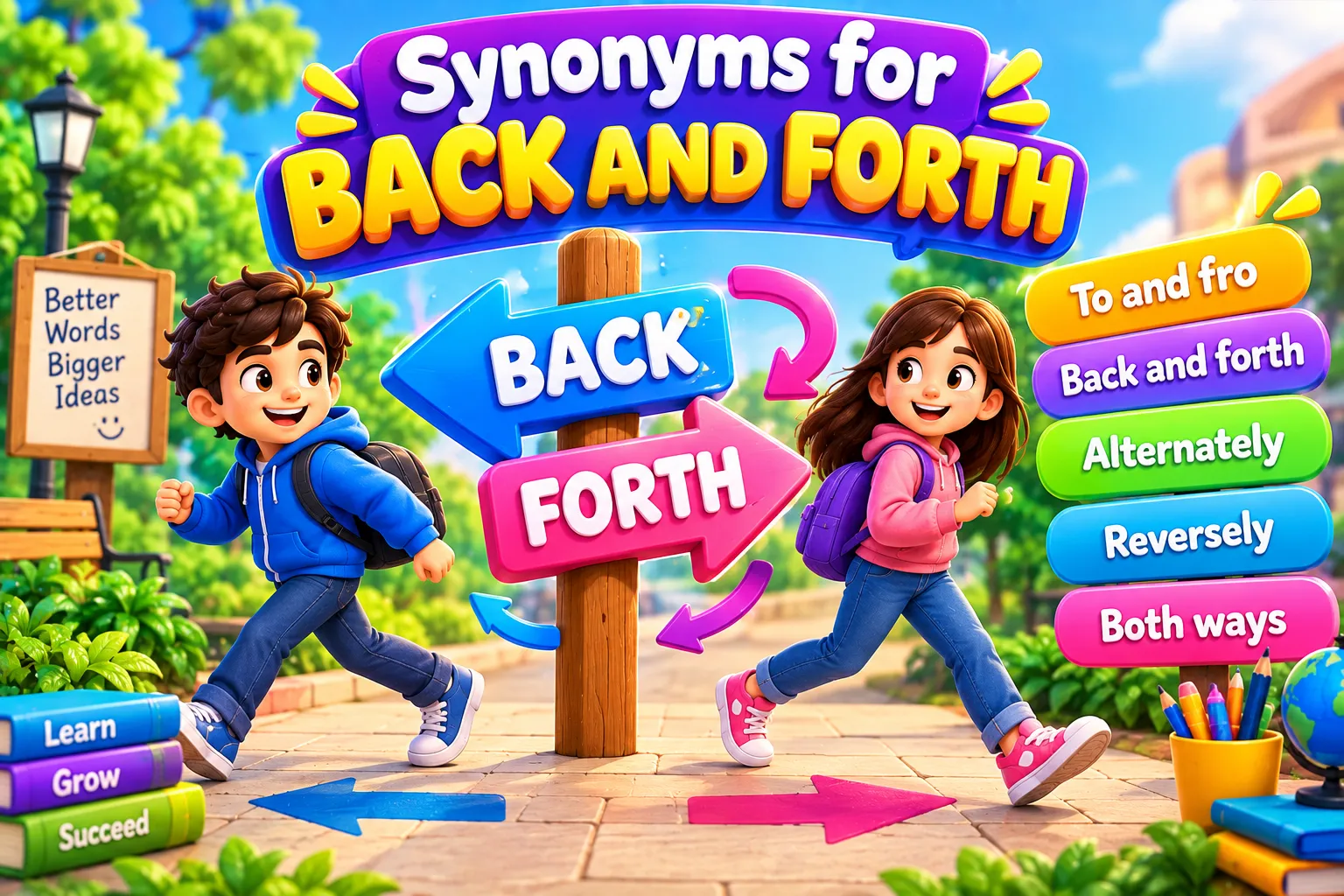
Common synonyms and related phrases include to and fro, backward and forward, here and there, from side to side, shuttling, alternating, switching, exchanging, interchanging, give-and-take, dialogue, discussion, and debate. The best choice depends on the context: shuttling is useful for repeated travel, alternating describes repeated changes, and give-and-take describes an exchange between people. Learning these alternatives helps English learners avoid repetition and describe movement, communication, and repeated actions more clearly.
Back and forth describes movement, action, or communication that goes in one direction and then returns in the opposite direction. Imagine someone walking from one side of a room to the other again and again. You could say, “He walked back and forth while waiting.” The phrase is also common when people exchange messages, ideas, or arguments. For example, two friends may go back and forth in a discussion. Learning synonyms for back and forth helps English learners describe repeated movement and exchange in more precise ways. It also helps writers avoid repetition. In this guide, we explore the meaning, grammar, history, pronunciation, word formation, and 29 useful alternatives. We also explain their different meanings and show simple examples.
Meaning of Back and Forth
Definition
Back and forth (Adverbial Phrase): Moving, changing, or happening repeatedly between two directions, places, people, or ideas.
Examples
- She walked back and forth across the room.
- They went back and forth during the discussion.
Connotative Meaning
Connotation means the feeling or idea suggested by a word or phrase beyond its basic meaning.
- Positive tone: It can suggest active communication, cooperation, or lively discussion.
- Negative tone: It may suggest indecision, repetition, conflict, or wasted movement.
- Neutral tone: It can simply describe repeated movement between two points.
Etymology
Back and forth is an English phrase made from the words back and forth. Both words have very old Germanic roots.
| Period | Development |
| Old English (450–1100) | Back developed from Old English bæc, meaning the rear part of the body. Forth came from Old English forþ, meaning forward or onward. |
| Middle English (1100–1500) | Back and forth continued to describe direction and movement. Their use together gradually became a common way to describe movement in opposite directions. |
| Modern English (1500–Present) | Back and forth became a common phrase for repeated movement, exchange, discussion, or change between two sides. |
Pronunciation (IPA)
- IPA: /ˌbæk ən ˈfɔːrθ/
- Syllables: back-and-forth
Affixation Pattern of Back and Forth
- Root: back + forth
- Prefix: None
- Suffix: None
- Word formations:
- back — noun/adverb/adjective/verb: the rear part; toward the rear; supporting; to move backward
- forth — adverb: forward or onward
- backward — adverb/adjective: toward the back
- forward — adverb/adjective: toward the front or ahead
- back-and-forth — adjective/noun: involving repeated movement or exchange between two sides
29 Synonyms of Back and Forth With Meaning & Examples
1. To and Fro (Adverbial Phrase)
Meaning: Moving repeatedly in one direction and then the opposite direction.
Examples:
- The children ran to and fro in the garden.
- She walked to and fro while thinking.
2. Backward and Forward (Adverbial Phrase)
Meaning: Moving toward the back and then toward the front repeatedly.
Examples:
- The machine moves backward and forward.
- He rocked backward and forward in his chair.
3. Here and There (Adverbial Phrase)
Meaning: Moving or being in different places repeatedly.
Examples:
- We traveled here and there during the holiday.
- He looked here and there for his keys.
4. From Side to Side (Adverbial Phrase)
Meaning: Moving repeatedly between two sides.
Examples:
- The child moved from side to side.
- The boat rocked from side to side.
5. To and From (Prepositional Phrase)
Meaning: Moving between one place and another.
Examples:
- Buses travel to and from the city.
- She drove to and from work every day.
6. Alternately (Adverb)
Meaning: Taking turns between two actions or choices.
Examples:
- The lights flashed alternately.
- They spoke alternately during the meeting.
7. Repeatedly (Adverb)
Meaning: Happening again and again.
Examples:
- He called repeatedly.
- The door opened and closed repeatedly.
8. Reciprocally (Adverb)
Meaning: In a way that involves action or response between two sides.
Examples:
- The two groups worked reciprocally.
- They supported each other reciprocally.
9. Alternatingly (Adverb)
Meaning: Happening by changing from one person, thing, or direction to another.
Examples:
- The players moved alternatingly.
- The lights appeared alternatingly.
10. In Turn (Adverbial Phrase)
Meaning: One after another in a repeated order.
Examples:
- The students answered in turn.
- They spoke in turn during the meeting.
11. Oscillating (Adjective)
Meaning: Moving repeatedly between two positions or points.
Examples:
- The fan has an oscillating motion.
- The needle kept oscillating between two points.
12. Oscillation (Noun)
Meaning: Repeated movement between two positions.
Examples:
- The machine produces a regular oscillation.
- The oscillation continued for several minutes.
13. Shuttling (Verb/Adjective)
Meaning: Moving repeatedly between two places.
Examples:
- She spent the morning shuttling between offices.
- The bus is shuttling passengers between the stations.
14. Alternation (Noun)
Meaning: A repeated change between two things or states.
Examples:
- The alternation of light and dark was clear.
- The pattern uses alternation between two colors.
15. Switching (Noun/Verb)
Meaning: Changing repeatedly from one thing or position to another.
Examples:
- He kept switching between two tasks.
- Switching between languages can be difficult.
16. Trading Places (Phrase)
Meaning: Changing positions or places with another person.
Examples:
- The players were trading places.
- They kept trading places during the game.
17. Exchanging (Verb)
Meaning: Giving and receiving something between two people or groups.
Examples:
- They were exchanging ideas.
- The two teams were exchanging messages.
18. Interchanging (Verb)
Meaning: Changing or exchanging things between two sides.
Examples:
- The two parts are interchanging positions.
- They were interchanging ideas.
19. Reciprocal (Adjective)
Meaning: Shared or given by two sides to each other.
Examples:
- They have a reciprocal agreement.
- The relationship is based on reciprocal respect.
20. Give-and-Take (Noun)
Meaning: An exchange in which both sides make contributions or compromises.
Examples:
- Good teamwork requires give-and-take.
- Their discussion involved a lot of give-and-take.
21. Exchange (Noun)
Meaning: A process in which two people or groups give and receive something.
Examples:
- The meeting involved an exchange of ideas.
- Their email exchange lasted all afternoon.
22. Dialogue (Noun)
Meaning: A conversation between two or more people.
Examples:
- The two sides began a dialogue.
- Their dialogue continued for hours.
23. Discussion (Noun)
Meaning: A conversation in which people share ideas or opinions.
Examples:
- We had a long discussion about the plan.
- The discussion went on for an hour.
24. Debate (Noun)
Meaning: A formal or informal exchange of different views.
Examples:
- The two students had a lively debate.
- Their debate continued throughout the evening.
25. Ping-Pong (Noun/Adjective)
Meaning: A rapid exchange between two people, ideas, or actions.
Examples:
- We had a ping-pong exchange of emails.
- Their questions created a ping-pong conversation.
26. Alternating (Adjective)
Meaning: Changing repeatedly between two or more things.
Examples:
- The machine uses an alternating motion.
- They followed an alternating pattern.
27. Cyclic (Adjective)
Meaning: Happening in a repeated cycle.
Examples:
- The process is cyclic.
- The system follows a cyclic pattern.
28. Reversible (Adjective)
Meaning: Able to change from one state or direction to another.
Examples:
- The process is reversible.
- The machine allows reversible movement.
29. Moving Between (Phrase)
Meaning: Changing position repeatedly between two places or points.
Examples:
- She was moving between the two rooms.
- He kept moving between different tasks.
Prototype Meaning
The most typical meaning of back and forth is repeated movement between two places or directions. People often imagine someone walking from one side to another and then returning. The phrase can also describe communication, such as two people exchanging messages, ideas, or arguments. Its exact meaning depends on the context.
Prototype Categorization
The 29 alternatives can be grouped into useful semantic categories:
- Physical movement: to and fro, backward and forward, from side to side, shuttling, moving between, going between — useful for describing repeated movement.
- Repeated change: alternately, alternatingly, alternation, alternating, switching, cyclic — useful when something changes between states or choices.
- Exchange and interaction: exchanging, interchanging, reciprocal, reciprocal exchange, give-and-take, exchange — useful for communication or shared actions.
- Conversation and disagreement: dialogue, discussion, debate, ping-pong — useful when describing verbal exchanges.
- Repeated action: repeatedly, oscillating, oscillation, in turn — useful when an action happens again and again.
This grouping helps writers choose the most accurate alternative. For example, shuttling works well for physical travel, while debate is better for an exchange of opposing opinions.
Antonyms of Back and Forth
| Antonym | Part of Speech | Meaning |
| Still | Adjective/Adverb | Not moving |
| Stationary | Adjective | Staying in one place |
| Fixed | Adjective | Remaining in the same position |
| Constant | Adjective | Staying unchanged |
| One-way | Adjective | Moving or operating in only one direction |
| Direct | Adjective/Adverb | Going straight toward one point without returning |
| Unchanging | Adjective | Not changing or moving between states |
| Motionless | Adjective | Completely without movement |
Short Questions and Answers
What does back and forth mean?
Back and forth means moving, changing, or communicating repeatedly between two directions, places, people, or ideas.
When should back and forth be used?
Use back and forth when something repeatedly moves between two points or when two people or groups exchange ideas, messages, or arguments.
Is back and forth positive or negative?
It is neutral by itself. It can be positive when describing active communication, but it can suggest confusion or repetition in some contexts.
How is it different from similar words?
Back and forth is a broad phrase. To and fro usually describes movement, shuttling suggests repeated travel between places, and give-and-take focuses on an exchange between people.
Conclusion
Learning synonyms for back and forth helps English learners describe movement, communication, and repeated change more accurately. Words and phrases such as to and fro, shuttling, alternating, exchanging, dialogue, discussion, debate, and give-and-take have different uses. Some describe physical movement, while others describe conversations or exchanges between people. Choosing the right alternative can make your writing clearer and more natural. It also helps you avoid repeating the same phrase in essays, articles, stories, and everyday conversations. Practice these words in simple sentences to understand their differences. Try using one new alternative each day. With regular practice, you can build a stronger vocabulary, improve your writing style, and speak English with greater confidence.
Read More:
Synonyms for humid: 30 Powerful Alternatives

I’m Ayesha Haram, an English content and SEO writer at SynonymsInstant.com. I focus on creating helpful vocabulary resources, word guides, and practical English content that readers can understand quickly. I combine language research, clear explanations, and SEO-focused writing to produce reliable content that supports learners, writers, and everyday English users.