
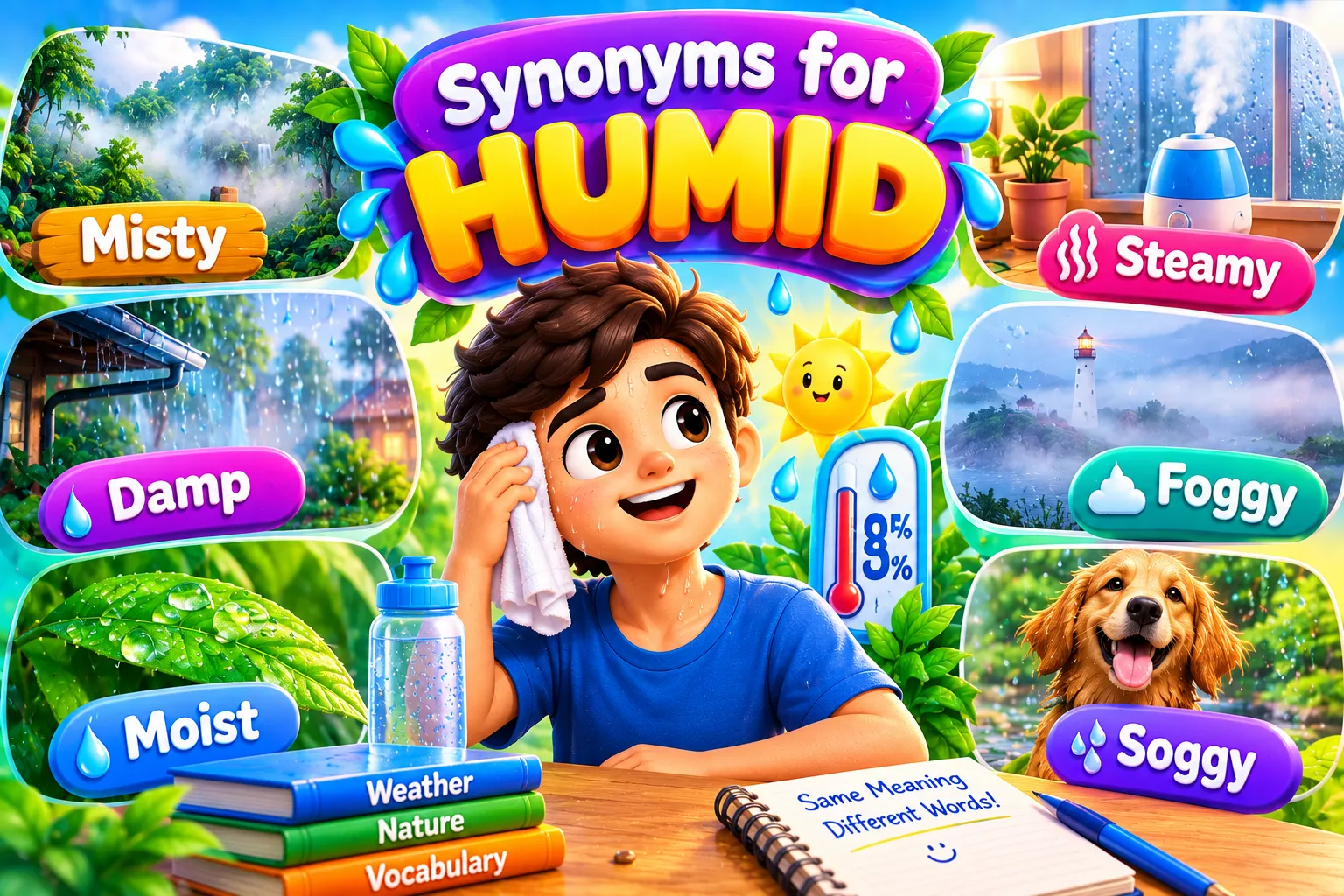
Common synonyms and related words include muggy, damp, moist, sticky, clammy, sultry, steamy, saturated, vaporous, and moisture-laden. The best word depends on the context: muggy describes hot and uncomfortable humid weather, damp means slightly wet, moist suggests a gentle amount of moisture, and clammy describes an unpleasant damp feeling. Learning these synonyms helps English learners describe weather and air more clearly, avoid repetition, and make their speaking and writing more natural.
Humid describes air that contains a lot of moisture. Imagine walking outside on a hot summer day and feeling your skin become sticky. The air feels heavy, and sweat does not dry quickly. You might say, “It is very humid today.” The word is common in weather reports, travel writing, science, and everyday conversation. Learning synonyms for humid helps English learners describe weather and air more clearly. It also helps content writers avoid using the same word again and again. However, not every synonym has exactly the same meaning. Some words focus on moisture, while others describe heat, stickiness, or discomfort. This guide explains the meaning, grammar, history, pronunciation, word forms, and 30 useful alternatives to humid, with simple examples and semantic categories.
Meaning of Humid
Definition
Humid (Adjective): Having a high amount of water vapor or moisture in the air.
Examples
- The weather is very humid today.
- It was hot and humid inside the room.
Connotative Meaning
Connotation means the feeling or idea that a word suggests beyond its basic meaning.
- Positive tone: Humid can suggest a warm, tropical, or lush environment in some contexts.
- Negative tone: It often suggests uncomfortable, sticky, heavy, or sweaty weather.
- Neutral tone: In weather and science, it simply describes air with a high level of moisture.
Etymology
The word humid comes from Latin humidus, meaning “moist” or “wet.” It entered English through French and has been used to describe moisture in the air and other things.
| Period | Development |
| Old English (450–1100) | Humid was not a native Old English word. English commonly used other words related to wetness and moisture. |
| Middle English (1100–1500) | Humid entered English through Anglo-French/Old French forms related to Latin humidus, meaning “moist” or “wet.” |
| Modern English (1500–Present) | Humid became a common adjective for air or weather containing a high level of moisture. |
Pronunciation (IPA)
- IPA: /ˈhjuːmɪd/ (UK), /ˈhjuːmɪd/ (US)
- Syllables: hu-mid
Affixation Pattern of Humid
- Root: humid / hum- — related to moisture or wetness
- Prefix: None
- Suffix: -id
- Word formations:
- humid — adjective: containing a lot of moisture
- humidity — noun: the amount of moisture in the air
- humidify — verb: to make something more humid
- humidified — adjective/verb: made more humid
- humidifier — noun: a device that adds moisture to the air
- humidification — noun: the process of adding moisture to air
30 Synonyms of Humid With Meaning & Examples
1. Muggy (Adjective)
Meaning: Uncomfortably warm and damp because the air contains a lot of moisture.
Examples:
- It was a muggy afternoon.
- The room felt hot and muggy.
2. Damp (Adjective)
Meaning: Slightly wet or affected by moisture.
Examples:
- The basement was cold and damp.
- The damp air made the clothes feel wet.
3. Moist (Adjective)
Meaning: Containing or covered with a small amount of water.
Examples:
- The soil is warm and moist.
- The air remained moist after the rain.
4. Wet (Adjective)
Meaning: Covered or filled with water or moisture.
Examples:
- The ground was wet after the storm.
- The morning air felt wet and heavy.
5. Sticky (Adjective)
Meaning: Uncomfortably damp so that the skin feels slightly wet or tacky.
Examples:
- The sticky weather made everyone uncomfortable.
- My skin felt sticky after walking outside.
6. Clammy (Adjective)
Meaning: Unpleasantly damp and slightly cold to the touch.
Examples:
- His hands felt clammy.
- The room had a cold, clammy atmosphere.
7. Sultry (Adjective)
Meaning: Very hot and humid, often in an uncomfortable way.
Examples:
- It was a sultry summer evening.
- The sultry weather made outdoor work difficult.
8. Steamy (Adjective)
Meaning: Filled with warm moisture or steam.
Examples:
- The bathroom became steamy after the shower.
- The tropical air felt steamy.
9. Moisture-Laden (Adjective)
Meaning: Carrying or containing a large amount of moisture.
Examples:
- Moisture-laden air moved across the coast.
- The clouds were filled with moisture-laden air.
10. Moisture-Rich (Adjective)
Meaning: Containing a high amount of moisture.
Examples:
- The region has moisture-rich air.
- Plants grow well in moisture-rich conditions.
11. Moisture-Filled (Adjective)
Meaning: Containing a noticeable amount of moisture.
Examples:
- Moisture-filled air covered the valley.
- The room had moisture-filled air after the rain.
12. Dampish (Adjective)
Meaning: Somewhat damp or slightly moist.
Examples:
- The morning air was dampish.
- The walls felt dampish after the storm.
13. Moistish (Adjective)
Meaning: Slightly moist or somewhat wet.
Examples:
- The air felt moistish near the lake.
- The soil was moistish after the rain.
14. Wetish (Adjective)
Meaning: Somewhat wet or slightly affected by moisture.
Examples:
- The ground was wetish after the light rain.
- The air felt wetish near the sea.
15. Vaporous (Adjective)
Meaning: Containing or resembling water vapor.
Examples:
- A vaporous mist covered the hills.
- The morning looked vaporous after heavy rain.
16. Moisturized (Adjective)
Meaning: Having moisture added to or retained in something.
Examples:
- The skin felt moisturized after using the cream.
- The soil remained moisturized after watering.
17. Saturated (Adjective)
Meaning: Completely filled or heavily loaded with moisture.
Examples:
- The air was saturated with water vapor.
- The soil became saturated after days of rain.
18. Waterlogged (Adjective)
Meaning: Filled or soaked with too much water.
Examples:
- The field became waterlogged after the storm.
- The waterlogged ground was difficult to walk on.
19. Hydrated (Adjective)
Meaning: Containing or supplied with enough water.
Examples:
- The plants remained well hydrated.
- The soil was properly hydrated after watering.
20. Moisture-Laden Air (Noun Phrase)
Meaning: Air carrying a large amount of water vapor.
Examples:
- Moisture-laden air moved inland from the ocean.
- The moisture-laden air caused thick clouds.
21. Close (Adjective)
Meaning: Describing air that feels hot, damp, and lacking fresh movement.
Examples:
- The classroom felt close after the windows were shut.
- It was a hot and close evening.
22. Oppressive (Adjective)
Meaning: Extremely hot, humid, or heavy in a way that feels uncomfortable.
Examples:
- The oppressive summer heat lasted for days.
- The weather was hot and oppressive.
23. Heavy (Adjective)
Meaning: Describing air that feels thick and difficult to breathe because of moisture or heat.
Examples:
- The air felt heavy before the storm.
- We walked through heavy, humid air.
24. Airless (Adjective)
Meaning: Having little fresh or moving air and often feeling warm or uncomfortable.
Examples:
- The small room felt airless.
- The airless office became uncomfortable in summer.
25. Tropical (Adjective)
Meaning: Relating to warm regions that often have high humidity.
Examples:
- The island has a tropical climate.
- We enjoyed the tropical weather near the coast.
26. Rainy (Adjective)
Meaning: Characterized by frequent or heavy rain, which can often increase moisture in the air.
Examples:
- The rainy season brings high humidity.
- We had a warm and rainy week.
27. Muggy-Feeling (Adjective)
Meaning: Feeling warm, damp, and uncomfortable because of moisture in the air.
Examples:
- The room had a muggy-feeling atmosphere.
- The weather was hot and muggy-feeling.
28. Moisture-Heavy (Adjective)
Meaning: Containing or carrying a high level of moisture.
Examples:
- Moisture-heavy air covered the region.
- The wind brought moisture-heavy clouds.
29. Humidity-Laden (Adjective)
Meaning: Carrying a large amount of moisture or humidity.
Examples:
- Humidity-laden air moved over the city.
- The humidity-laden wind came from the sea.
30. Damp and Warm (Adjective Phrase)
Meaning: Describing conditions that are both warm and noticeably moist.
Examples:
- The morning was damp and warm.
- We experienced damp and warm weather near the coast.
Prototype Meaning
The most typical meaning of humid is air or weather containing a high amount of moisture. When people hear the word, they often imagine a warm day when the air feels heavy and their skin feels sticky. Humid weather is common in tropical, coastal, and rainy regions. Unlike wet, which usually means something has water on it, humid specifically describes moisture in the air.
Prototype Categorization
The 30 alternatives can be grouped into useful semantic categories:
- Direct moisture words: damp, moist, dampish, moistish, wetish — these focus mainly on the presence of moisture.
- Hot and uncomfortable air: muggy, sticky, sultry, close, oppressive — these emphasize how humid weather feels.
- Water-vapor terms: vaporous, moisture-laden, moisture-rich, moisture-filled, saturated, humidity-laden — these are useful for weather and scientific descriptions.
- Wetness and water terms: wet, waterlogged, hydrated, moisturized — these relate to water or moisture but are not always direct synonyms for humid.
- Climate and weather terms: tropical, rainy, heavy, airless — these describe conditions that can be associated with humidity.
- Descriptive phrases: moisture-heavy, muggy-feeling, damp and warm — these provide more detailed descriptions.
This grouping helps writers choose a word based on the exact idea they want to express. For example, muggy is useful for uncomfortable weather, while moist is better for a gentle or neutral description of moisture.
Antonyms of Humid
| Antonym | Part of Speech | Meaning |
| Dry | Adjective | Having little or no moisture |
| Arid | Adjective | Extremely dry, especially describing a climate or region |
| Parched | Adjective | Extremely dry because of a lack of water |
| Dehydrated | Adjective | Having lost a large amount of water or moisture |
| Desiccated | Adjective | Completely or extremely dried out |
| Moistureless | Adjective | Having no moisture |
| Barren | Adjective | Too dry or poor in moisture to support much plant life |
| Dusty | Adjective | Covered with or containing dry particles of dust |
Short Questions and Answers
What does humid mean?
Humid means that the air contains a high amount of water vapor or moisture.
When should humid be used?
Use humid when describing air or weather that contains a lot of moisture, especially when talking about climate and weather conditions.
Is humid positive or negative?
Humid is usually neutral as a weather term, but it often has a negative feeling when it describes hot, sticky, or uncomfortable conditions.
How is it different from similar words?
Humid specifically describes moisture in the air. Damp usually describes something slightly wet, while muggy suggests warm, humid, and uncomfortable air. Moist is a broader word for something containing some water.
Conclusion
Learning humid and its synonyms helps English learners describe weather, air, and moisture with greater accuracy. Words such as muggy, damp, moist, sticky, sultry, steamy, and saturated can add different details to your writing. Some words describe the amount of moisture, while others focus on heat, discomfort, or wetness. This makes it important to choose a synonym that fits the exact situation. Using a wider range of words also makes your speaking and writing more natural and interesting. Regular vocabulary practice can help you remember these alternatives and use them with confidence. Try choosing one new synonym each day and writing two simple sentences with it. Over time, this small habit can build a stronger English vocabulary and improve your communication skills.
Read More:
Synonyms for coaching: 25 Powerful Alternatives

I’m Pinki, an SEO writer at SynonymsInstant.com, specializing in synonyms, antonyms, vocabulary, word meanings, grammar, and English usage. I create accurate, well-researched, reader-friendly content that combines language expertise with SEO best practices. My goal is to make English vocabulary simple, useful, and accessible for students, writers, professionals, and English learners.