
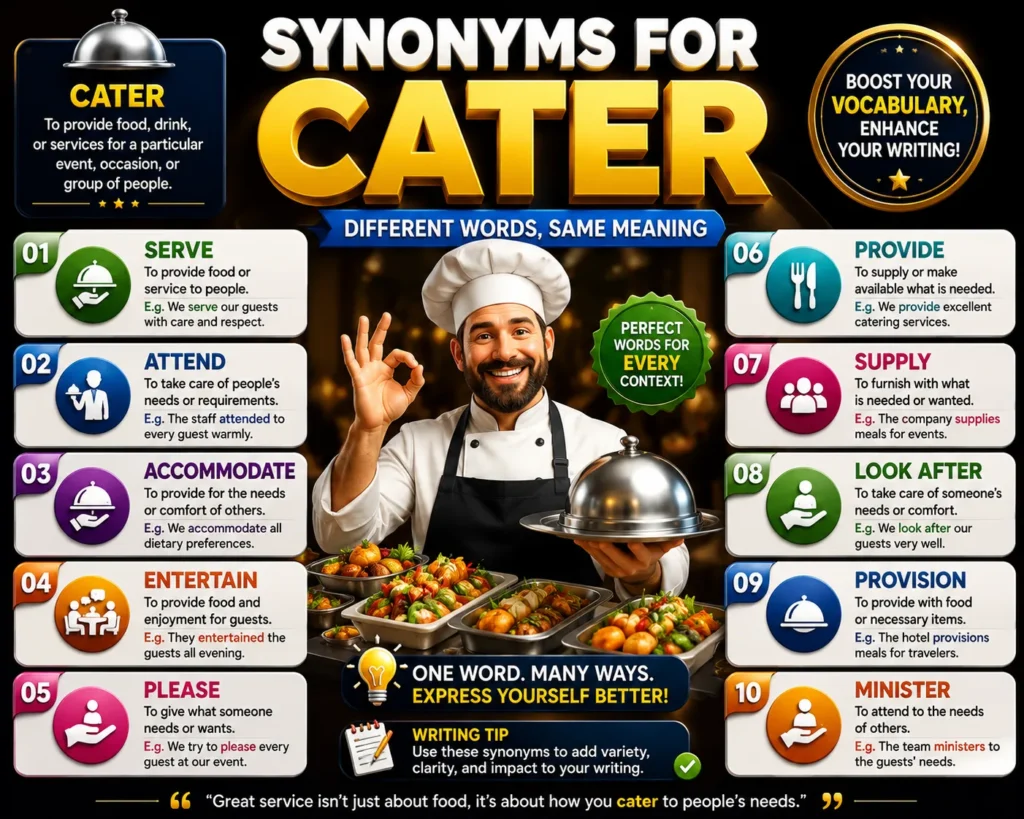
The word cater means to provide food, services, or what people need. Common synonyms for cater include serve, provide, supply, furnish, accommodate, satisfy, meet, offer, support, and attend to. The best synonym depends on the context. For example, “The restaurant caters to large groups” can be rewritten as “The restaurant serves or accommodates large groups.”
Cater means to provide food, services, or something that meets the needs of a person or group. Imagine a wedding where a catering team prepares meals, serves guests, and considers different food preferences. That is a common use of cater. The word is also used more broadly, as in “The course caters to beginners,” meaning it is designed to meet their needs. Learning synonyms for cater helps English learners build a stronger vocabulary and helps writers avoid repeating the same word. Different synonyms can show slightly different ideas, such as providing food, meeting needs, offering support, or pleasing preferences. In this guide, you will learn the meaning, grammar, history, pronunciation, and word forms of cater. You will also explore 30 useful synonyms, their meanings, examples, and semantic categories.
Meaning of Synonyms for Cater
Definition
Cater (Verb):
To provide food, services, or what a person or group needs, wants, or prefers.
Examples
- The restaurant caters to large family events.
- This course caters to learners at different skill levels.
Connotative Meaning
Connotation means the feeling or idea a word suggests beyond its basic meaning.
- Positive tone: Helpful, flexible, thoughtful, and responsive.
- Negative tone: Can suggest trying too hard to satisfy someone’s demands.
- Neutral tone: Simply providing food, services, or suitable conditions.
Etymology
The word cater comes from French and Middle English forms related to buying or providing food and supplies.
- Old English (450–1100): The modern verb cater was not an established Old English word.
- Middle English (1100–1500): Forms related to caterer referred to someone who bought or supplied provisions.
- Modern English (1500–Present): Cater developed its modern meanings of providing food and meeting the needs or preferences of people.
Pronunciation (IPA)
- IPA: /ˈkeɪtər/
- Syllables: ca-ter
Affixation Pattern of Cater
- Root: cater
- Prefix: None
- Suffix: None in the basic verb
Word formations
- cater — verb
- caters — verb
- catered — verb
- catering — noun/verb form
- caterer — noun
30 Synonyms for Cater With Meaning & Examples
1. Provide (Verb)
Meaning: To give someone something they need or want.
Examples:
- The hotel provides meals for its guests.
- The website provides useful learning resources.
2. Supply (Verb)
Meaning: To give or make something available when it is needed.
Examples:
- The company supplies food to local schools.
- Farmers supply fresh produce to markets.
3. Serve (Verb)
Meaning: To provide food, help, or a service.
Examples:
- The restaurant serves hundreds of customers daily.
- The staff served dinner at seven o’clock.
4. Feed (Verb)
Meaning: To give food to someone or something.
Examples:
- Volunteers feed families in the community.
- The restaurant feeds many guests each evening.
5. Accommodate (Verb)
Meaning: To meet someone’s needs or make suitable arrangements.
Examples:
- The hotel can accommodate large groups.
- The program accommodates learners with different needs.
6. Meet (Verb)
Meaning: To satisfy a need, demand, or requirement.
Examples:
- The service meets customer needs.
- This course meets the needs of new learners.
7. Fulfill (Verb)
Meaning: To satisfy a need, request, or requirement.
Examples:
- The company fulfills customer orders quickly.
- The service fulfills different client requirements.
8. Satisfy (Verb)
Meaning: To provide enough to meet a need or desire.
Examples:
- The meal satisfied all the guests.
- The course satisfies the needs of many learners.
9. Attend to (Phrasal Verb)
Meaning: To give attention or care to someone or something.
Examples:
- The waiter attended to every guest.
- Staff attended to customer requests promptly.
10. Look After (Phrasal Verb)
Meaning: To take care of someone or something.
Examples:
- The staff looked after the guests.
- She looks after the needs of her clients.
11. Care for (Verb)
Meaning: To provide care, attention, or support.
Examples:
- The center cares for older adults.
- The team cares for its customers.
12. Support (Verb)
Meaning: To help someone by providing what they need.
Examples:
- The program supports small businesses.
- The organization supports local communities.
13. Assist (Verb)
Meaning: To help someone with a task or need.
Examples:
- Staff assist customers with their orders.
- Volunteers assist visitors during the event.
14. Help (Verb)
Meaning: To make something easier by giving support.
Examples:
- The service helps busy families.
- This guide helps English learners.
15. Address (Verb)
Meaning: To deal with or respond to a need or concern.
Examples:
- The program addresses learner needs.
- The company addressed customer concerns.
16. Respond to (Verb Phrase)
Meaning: To react to and deal with a need or request.
Examples:
- The business responds to customer requests.
- The hotel responds to dietary requirements.
17. Provision (Verb)
Meaning: To provide necessary supplies or services.
Examples:
- The company provisions ships with fresh food.
- The team provisions remote camps with supplies.
18. Outfit (Verb)
Meaning: To provide the equipment needed for a purpose.
Examples:
- The company outfits offices with modern equipment.
- They outfitted the kitchen with new appliances.
19. Indulge (Verb)
Meaning: To satisfy someone’s wishes or desires generously.
Examples:
- The resort indulges guests with special treats.
- She indulged her family with their favorite dishes.
20. Pamper (Verb)
Meaning: To treat someone with extra comfort and attention.
Examples:
- The spa pampers its clients.
- The resort pampers guests with excellent service.
21. Please (Verb)
Meaning: To make someone happy by giving them what they want.
Examples:
- The chef tries to please every guest.
- The store offers many choices to please customers.
22. Oblige (Verb)
Meaning: To help someone by doing what they ask.
Examples:
- The staff gladly obliged the guests.
- The manager obliged the customer’s request.
23. Pander to (Phrasal Verb)
Meaning: To satisfy someone’s desires or weaknesses, often in a negative way.
Examples:
- The advertisement panders to people’s fears.
- Leaders should not pander to every demand.
24. Entertain (Verb)
Meaning: To provide amusement or enjoyment.
Examples:
- The band entertained the wedding guests.
- The host entertained visitors throughout the evening.
25. Host (Verb)
Meaning: To organize an event and provide a place for people.
Examples:
- The hotel hosted a large wedding.
- The restaurant hosted a business dinner.
26. Serve the Needs of (Verb Phrase)
Meaning: To provide what a particular group needs.
Examples:
- The school serves the needs of local learners.
- The website serves the needs of English students.
27. Accommodate the Preferences of (Verb Phrase)
Meaning: To adjust something to suit people’s choices or preferences.
Examples:
- The chef accommodates guests’ food preferences.
- The program accommodates different learning preferences.
28. Take Care of (Phrasal Verb)
Meaning: To deal with someone’s needs or provide care.
Examples:
- The staff took care of the guests.
- The team takes care of customer requests.
29. Provide for (Phrasal Verb)
Meaning: To supply what someone needs.
Examples:
- The organization provides for families in need.
- The service provides for different customer requirements.
30. Adapt to (Phrasal Verb)
Meaning: To change something so it suits a particular need or situation.
Examples:
- The course adapts to different learning levels.
- The service adapts to changing customer needs.
Prototype Meaning
The most typical meaning of cater is to provide food or services for a particular group of people. When people hear the word, they may think of a restaurant, wedding, party, conference, or catering company preparing and serving food. In the wider expression cater to, the word means to meet the needs, interests, preferences, or expectations of a person or group.
Prototype Categorization
The 30 synonyms can be grouped by their main meanings:
- Food and service: provide, supply, serve, feed, provision — best for meals, supplies, and direct services.
- Meeting needs: accommodate, meet, fulfill, satisfy, address, adapt to — useful for requirements, preferences, and expectations.
- Care and support: attend to, look after, care for, support, assist, help, take care of — suitable when people receive care or practical help.
- Customer service: serve, respond to, provide for, serve the needs of — useful for businesses, organizations, and services.
- Comfort and pleasure: indulge, pamper, please, oblige — focuses on satisfying wishes or providing extra comfort.
- Negative satisfaction: pander to — suggests excessive or improper attempts to satisfy someone’s desires.
- Events and entertainment: host, entertain — suitable when discussing events, guests, and enjoyment.
- Equipment and preparation: outfit — means providing the equipment or resources needed for a purpose.
This grouping helps writers choose a synonym that matches the exact meaning and tone they want.
Antonyms of Cater
1. Withhold (Verb)
Meaning: To refuse to provide something that is needed or expected.
2. Deny (Verb)
Meaning: To refuse someone a request, service, or opportunity.
3. Neglect (Verb)
Meaning: To fail to give someone or something proper care or attention.
4. Ignore (Verb)
Meaning: To give no attention to a need or request.
5. Refuse (Verb)
Meaning: To say no to a request or demand.
6. Disregard (Verb)
Meaning: To ignore something or treat it as unimportant.
7. Reject (Verb)
Meaning: To refuse to accept a request, idea, or demand.
8. Abandon (Verb)
Meaning: To leave someone or something without expected care or support.
Short Questions and Answers
What does cater mean?
Cater means to provide food, services, or something that meets the needs or preferences of a person or group.
When should cater be used?
Use cater when talking about providing food or services or meeting particular needs. For example, “The restaurant caters to large groups.”
Is cater positive or negative?
Cater is usually neutral or positive. However, cater to can have a negative meaning when it suggests excessive attention to someone’s demands.
How is it different from similar words?
Provide means to give something needed, while serve often refers to food or services. Accommodate focuses on adjusting to needs, while pamper suggests extra comfort. Pander to usually has a negative meaning.
Conclusion
Learning cater and its synonyms can make your English more flexible and precise. Words such as provide, serve, accommodate, support, satisfy, assist, pamper, and address can replace cater in different situations. Choosing the right synonym helps you express your meaning clearly and avoid repetition in writing and speech. It also helps you understand the difference between providing a service, meeting a need, offering support, and satisfying a preference. For English learners, practicing synonyms can build vocabulary and improve communication skills. For content writers, varied word choices can make articles smoother and more engaging. Try learning a few synonyms each day and create your own sentences with them. With regular practice, selecting the right word becomes easier and your English confidence grows.
Read More:
Synonyms for crazy person: 30 Powerful Alternatives

I’m Pinki, an SEO writer at SynonymsInstant.com, specializing in synonyms, antonyms, vocabulary, word meanings, grammar, and English usage. I create accurate, well-researched, reader-friendly content that combines language expertise with SEO best practices. My goal is to make English vocabulary simple, useful, and accessible for students, writers, professionals, and English learners.