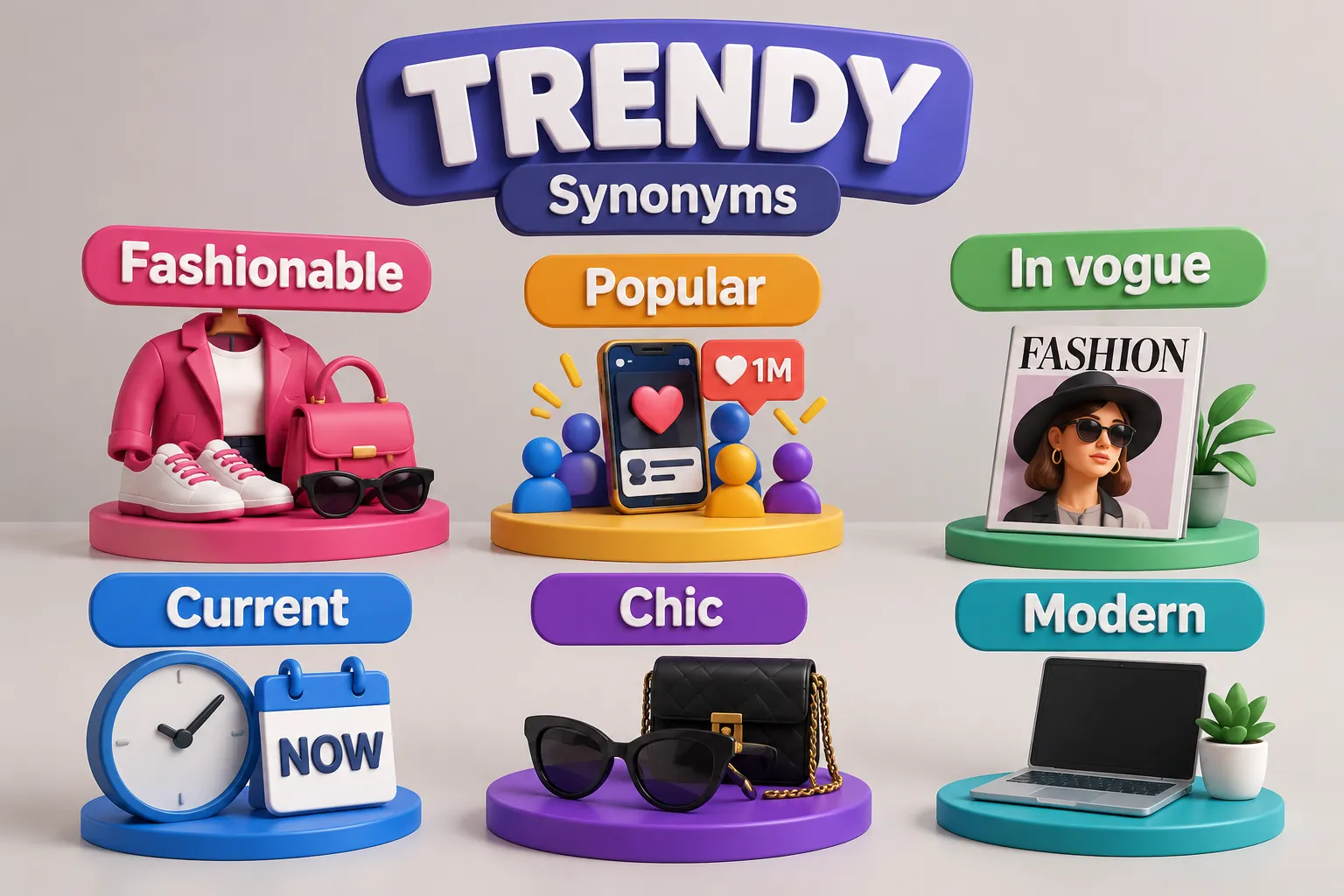
Synonyms for trendy include fashionable, stylish, popular, modern, chic, hip, current, and up-to-date. These words describe people, clothes, ideas, or things that match current styles and tastes.
Trendy means popular or fashionable at a particular time. For example, a student may wear trendy shoes that many people admire, or a shop may sell trendy clothes that match the latest styles. The word is common in fashion, social media, music, and everyday talk. However, using the same word again and again can make your writing feel dull. Learning synonyms for trendy helps you express ideas in fresh and clear ways. English learners can use these words to build vocabulary and speak with more confidence. Content writers can also use them to create engaging articles, product descriptions, and social media posts. In this guide, you will learn the meaning, pronunciation, history, word forms, and 30 synonyms for trendy, along with simple meanings and examples.
Meaning of Trendy
Definition
Trendy (Adjective): Popular or fashionable at a particular time.
Examples
- She bought a trendy jacket for the party.
- This café is known for its trendy design and modern menu.
Connotative Meaning
Connotation (the feeling or idea a word suggests beyond its basic meaning) can change with context.
- Positive tone: Stylish, fresh, modern, and fashionable.
- Negative tone: Trying too hard to follow every new fashion or trend.
- Neutral tone: Popular or in style at a certain time.
Etymology of Trendy
| Period | Origin and Development |
| Old English (450–1100) | The modern word trendy was not in use. The related word trend developed much later. |
| Middle English (1100–1500) | Trend emerged later in the history of English, with roots linked to turning or changing direction. The adjective trendy was not yet established. |
| Modern English (1500–Present) | Trend came to mean a general direction or fashion. Trendy later developed from trend and the suffix -y, meaning fashionable or following current styles. |
Pronunciation (IPA)
- IPA: /ˈtren.di/
- Syllables: trend-y (2 syllables)
Affixation Pattern of Trendy
- Root: Trend
- Prefix: None
- Suffix: -y, which forms an adjective meaning characterized by or associated with something.
Word Formations
| Word | Grammatical Category | Meaning |
| Trend | Noun | A general direction or popular style |
| Trendy | Adjective | Popular or fashionable |
| Trendier | Comparative adjective | More fashionable or popular |
| Trendiest | Superlative adjective | Most fashionable or popular |
| Trendily | Adverb | In a trendy or fashionable way |
| Trendiness | Noun | The quality of being trendy |
| Trending | Verb form/adjective | Becoming popular or receiving attention |
| Trendsetter | Noun | A person who starts or influences trends |
| Trendsetting | Adjective | Influencing or starting new trends |
| Trend-following | Adjective | Following an existing trend |
30 Synonyms for Trendy With Meanings and Examples
Note: Not every word below is an exact synonym. Some describe fashion, while others refer to popularity, modern design, or current interest. Choose the word that best fits your sentence.
1. Fashionable (Adjective)
Meaning: Popular in clothing, style, or appearance at a particular time.
Examples:
- She wore a fashionable dress to the event.
- Fashionable shoes can complete a simple outfit.
2. Stylish (Adjective)
Meaning: Attractive and well-designed in appearance.
Examples:
- He bought a stylish jacket for winter.
- The new restaurant has a stylish interior.
3. Chic (Adjective)
Meaning: Elegantly fashionable and attractive.
Examples:
- She carried a chic handbag to work.
- The hotel has a chic and modern design.
4. Modern (Adjective)
Meaning: Related to the present time or using current ideas and styles.
Examples:
- They live in a modern apartment.
- The shop sells modern furniture.
5. Popular (Adjective)
Meaning: Liked or enjoyed by many people.
Examples:
- That hairstyle is popular among teenagers.
- The singer released a popular new song.
6. Hip (Adjective)
Meaning: Informal for fashionable, modern, or culturally popular.
Examples:
- They opened a hip café downtown.
- He likes wearing hip streetwear.
7. Current (Adjective)
Meaning: Happening or existing at the present time.
Examples:
- She follows current fashion trends.
- The magazine covers current design ideas.
8. Up-to-date (Adjective)
Meaning: Including the latest information, styles, or features.
Examples:
- Her wardrobe is full of up-to-date styles.
- The website has an up-to-date design.
9. In-vogue (Adjective)
Meaning: Popular or fashionable at a particular time.
Examples:
- Bright colors are in-vogue this season.
- That style became in-vogue after the show.
10. Trendsetting (Adjective)
Meaning: Starting new trends that other people may follow.
Examples:
- The designer is known for trendsetting collections.
- Their campaign introduced a trendsetting idea.
11. Contemporary (Adjective)
Meaning: Belonging to the present time or reflecting current styles.
Examples:
- The gallery displays contemporary art.
- They decorated the room in a contemporary style.
12. Cutting-edge (Adjective)
Meaning: Using the newest ideas, methods, or technology.
Examples:
- The company develops cutting-edge products.
- The building features cutting-edge design.
13. Fashion-forward (Adjective)
Meaning: Willing to try new styles and follow emerging fashion ideas.
Examples:
- She is known for her fashion-forward outfits.
- The brand creates fashion-forward clothing.
14. Sleek (Adjective)
Meaning: Smooth, neat, and stylish in appearance.
Examples:
- He bought a sleek black car.
- The phone has a sleek design.
15. Swanky (Adjective)
Meaning: Stylish, expensive-looking, or luxurious.
Examples:
- They ate at a swanky restaurant.
- The hotel has a swanky rooftop lounge.
16. Glamorous (Adjective)
Meaning: Attractive and exciting in a stylish or luxurious way.
Examples:
- She wore a glamorous gown.
- The event had a glamorous atmosphere.
17. Trend-conscious (Adjective)
Meaning: Aware of and interested in current trends.
Examples:
- Trend-conscious shoppers often explore new collections.
- The brand targets trend-conscious customers.
18. Stylishly Modern (Adjective Phrase)
Meaning: Modern in a way that looks attractive and fashionable.
Examples:
- The office is stylishly modern.
- They chose a stylishly modern kitchen design.
19. Fashionable-looking (Adjective)
Meaning: Having an appearance that matches current fashion.
Examples:
- He wore a fashionable-looking coat.
- The store displayed fashionable-looking accessories.
20. On-trend (Adjective)
Meaning: Matching what is popular or fashionable at the moment.
Examples:
- These colors are on-trend this year.
- She chose an on-trend outfit for the party.
21. Fresh (Adjective)
Meaning: New, different, or appealing in style or approach.
Examples:
- The designer introduced a fresh look.
- The new collection feels fresh and exciting.
22. Innovative (Adjective)
Meaning: Introducing new ideas, methods, or designs.
Examples:
- The company launched an innovative product.
- Her innovative approach changed the project.
23. Avant-garde (Adjective)
Meaning: Very new, experimental, or unconventional in art and fashion.
Examples:
- The designer showed avant-garde clothing.
- The gallery features avant-garde artwork.
24. Fashionable Now (Adjective Phrase)
Meaning: Popular in fashion at the present time.
Examples:
- Wide-leg trousers are fashionable now.
- This color is fashionable now among young shoppers.
25. In Style (Adjective Phrase)
Meaning: Considered fashionable or attractive at a particular time.
Examples:
- Oversized jackets are in style this season.
- Simple jewelry is always in style for her.
26. Well-liked (Adjective)
Meaning: Liked by many people.
Examples:
- The well-liked brand released a new collection.
- Her designs are well-liked by local shoppers.
27. Mainstream (Adjective)
Meaning: Accepted or followed by a large part of society.
Examples:
- Streetwear has become mainstream fashion.
- The music style is now part of mainstream culture.
28. Hot (Adjective)
Meaning: Informally, very popular or attracting a lot of attention.
Examples:
- That new sneaker brand is hot right now.
- The film became a hot topic online.
29. In-Demand (Adjective)
Meaning: Wanted or needed by many people.
Examples:
- These trendy bags are in-demand this season.
- The designer’s new collection is in-demand.
30. Hipster (Noun)
Meaning: A person associated with alternative fashion, music, or lifestyle trends.
Examples:
- The café attracts hipsters and artists.
- A hipster walked into the shop wearing vintage clothes.
Usage note: “Hipster” describes a person, not a style itself, so it is not a direct replacement for “trendy” in every sentence.
Prototype Meaning
The most typical meaning of trendy is fashionable or popular at the present time. When people hear this word, they often imagine modern clothes, stylish shoes, popular hairstyles, attractive cafés, or products seen on social media. A trendy item usually reflects what many people currently like or want. However, trends can change quickly. Something that is trendy today may look old-fashioned in a few years. The word can describe more than clothing; it can also refer to music, technology, home design, language, and lifestyle choices.
Prototype Categorization
The synonyms for trendy can be grouped by meaning. These groups help writers select the best word for each situation.
- Fashion and style: Fashionable, stylish, chic, in-vogue, fashion-forward, on-trend, fashionable-looking, in style, and fashionable now. Use these words for clothing, accessories, and personal appearance.
- Modern design and ideas: Modern, contemporary, cutting-edge, sleek, fresh, innovative, and avant-garde. These work well for products, buildings, art, and new ideas.
- Popularity and public interest: Popular, hip, hot, mainstream, well-liked, and in-demand. Use these when many people like or want something.
- Starting or following trends: Trendsetting, trend-conscious, and hipster. These relate to people, brands, or groups that influence or follow particular styles.
- Luxury and appearance: Swanky and glamorous. These words suggest an elegant, expensive, or exciting look.
- Present-day relevance: Current and up-to-date. These emphasize what is happening now or whether something includes the latest information.
Choosing the right category makes writing more precise and avoids using trendy in every sentence.
Antonyms of Trendy
There is no single opposite of trendy in every context. The best antonym depends on whether you mean old-fashioned style, lack of popularity, or resistance to change.
| Antonym | Part of Speech | Meaning |
| Old-fashioned | Adjective | No longer considered modern or fashionable |
| Outdated | Adjective | No longer useful, current, or in style |
| Unfashionable | Adjective | Not considered fashionable |
| Unstylish | Adjective | Lacking style or good taste |
| Out-of-date | Adjective | No longer current or modern |
| Obsolete | Adjective | No longer used because something newer has replaced it |
| Dated | Adjective | Looking as if it belongs to an earlier period |
| Unpopular | Adjective | Not liked or supported by many people |
| Traditional | Adjective | Based on long-established customs or practices |
| Conservative | Adjective | Preferring established styles or avoiding major changes |
Short Questions and Answers
What does trendy mean?
Trendy means popular, fashionable, or in style at a particular time.
When should trendy be used?
Use trendy when describing clothes, products, places, ideas, or activities that match current styles or attract attention.
Is trendy positive or negative?
Trendy is usually positive or neutral. It can sound negative when it suggests that someone follows every new fashion without personal choice.
How is trendy different from similar words?
Trendy often refers to what is popular right now. Fashionable focuses on style, stylish describes an attractive appearance, and modern refers to the present time or newer ideas.
Conclusion
Learning synonyms for trendy helps you express ideas in clear and interesting ways. Words such as fashionable, stylish, chic, modern, and contemporary can make your writing more precise. Other terms, such as popular, in-demand, and mainstream, focus on how many people like or follow something. The best choice depends on the subject and the meaning you want to share. Using different words can improve your vocabulary, strengthen your speaking and writing, and reduce repetition. It can also help English learners feel more confident in daily conversations and formal writing. Try learning a few new words each day and using them in your own sentences. With regular practice, you can build stronger vocabulary skills and communicate your ideas more naturally.
Read More:
Synonyms for Outer Space: 25 Cosmic Alternatives
I’m Pinki, an SEO writer at SynonymsInstant.com, specializing in synonyms, antonyms, vocabulary, word meanings, grammar, and English usage. I create accurate, well-researched, reader-friendly content that combines language expertise with SEO best practices. My goal is to make English vocabulary simple, useful, and accessible for students, writers, professionals, and English learners.