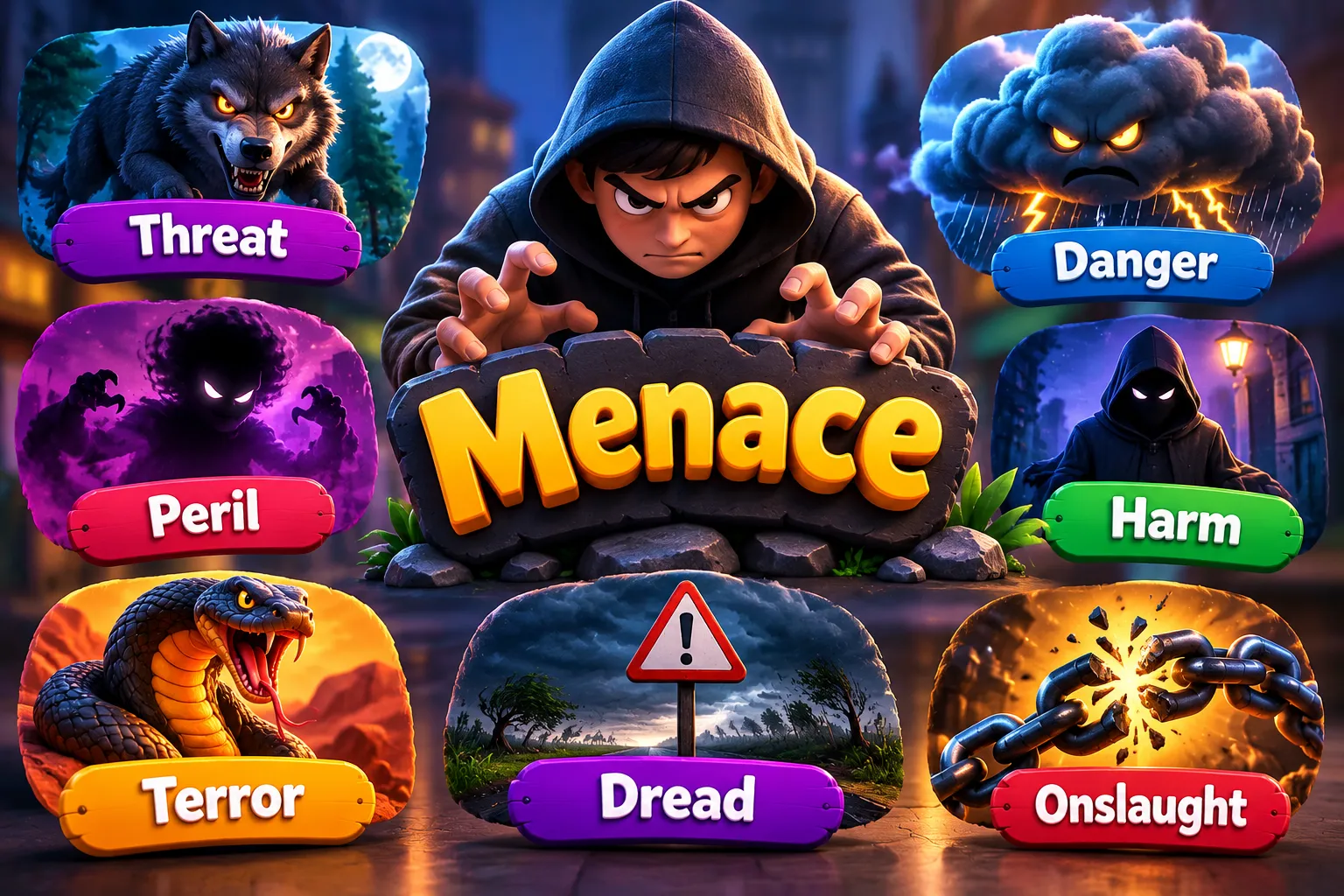
Synonyms for menace include threat, danger, peril, risk, hazard, intimidation, terror, alarm, warning, and jeopardy. Menace can mean a person or thing that causes harm or danger. It can also mean a threat or an act of threatening someone. The best synonym depends on the context.
A menace is someone or something that causes fear, danger, or trouble. Imagine a storm moving toward a town. People may call it a menace because it could damage homes and put lives at risk. The word can also describe a person who threatens or harms others. Menace is often used in daily conversations, news reports, stories, and formal writing. Learning synonyms for menace helps English learners express danger and fear in more precise ways. It also helps writers avoid repeating the same word and choose language that fits the situation. In this guide, you will learn the meaning, pronunciation, history, and grammar of menace. You will also explore 26 related words with simple meanings and examples, along with antonyms and useful semantic categories.
Meaning of Menace
Definition
Menace (Noun and Verb):
As a noun, menace means a person or thing that causes danger, fear, or trouble.
As a verb, menace means to threaten someone or make them feel that harm may happen.
Examples
- The rising flood became a menace to the nearby villages.
- The stranger tried to menace the shopkeeper with threats.
Connotative Meaning
Connotation is the feeling or idea that a word suggests beyond its basic meaning.
- Positive tone: Menace rarely has a positive meaning, but it can describe a fictional villain who seems powerful or exciting.
- Negative tone: It often suggests fear, danger, harm, or a threat.
- Neutral tone: In factual reports, it may simply describe a source of danger, such as a disease or severe storm.
Etymology of Menace
The word menace entered English through French and ultimately comes from Latin minaciae, meaning threats. Its history reflects the idea of threatening or creating fear.
| Period | Development |
| Old English (450–1100) | Menace was not a standard Old English word. English used other words to express threats and danger. |
| Middle English (1100–1500) | The word entered English through Old French menace, meaning a threat or threatening act. |
| Modern English (1500–Present) | Menace developed into a noun meaning a threat or source of danger and a verb meaning to threaten. |
Pronunciation of Menace
- IPA: /ˈmen.əs/
- Syllables: Men-ace
- Part of speech: Noun and verb
Affixation Pattern of Menace
- Root: Menace
- Prefix: None
- Suffix: None in the base word
Word Formations
- Menace (noun): A source of danger or threat.
Example: The criminal was a menace to the neighborhood. - Menace (verb): To threaten or put someone in fear.
Example: Dark clouds menaced the coastline. - Menacing (adjective): Appearing threatening or dangerous.
Example: He gave her a menacing look. - Menacingly (adverb): In a threatening way.
Example: The dog growled menacingly. - Menaced (verb, past tense and past participle): Threatened or placed in danger.
Example: The village was menaced by a wildfire. - Menaces (verb, third-person singular): Threatens or causes danger.
Example: The disease menaces public health.
26 Synonyms of Menace With Meaning and Examples
The word menace has several related meanings. Some synonyms describe danger, some refer to a threat, and others describe fear or intimidation. These words are related, but they are not interchangeable in every sentence.
1. Threat (Noun)
Meaning: A statement, action, or situation that suggests harm may happen.
Examples:
- The message contained a serious threat.
- Pollution is a threat to clean water.
2. Danger (Noun)
Meaning: The possibility of harm, injury, or loss.
Examples:
- The road is dangerous during heavy rain.
- The firefighters warned us about the danger.
3. Peril (Noun)
Meaning: Serious or immediate danger.
Examples:
- The hikers were in great peril during the storm.
- The rescue team helped people escape peril.
4. Hazard (Noun)
Meaning: Something that may cause harm or an accident.
Examples:
- Wet floors are a slipping hazard.
- The factory removed the chemical hazard.
5. Risk (Noun)
Meaning: The chance that something harmful or unwanted may happen.
Examples:
- Driving too fast increases the risk of an accident.
- Smoking can raise the risk of illness.
6. Jeopardy (Noun)
Meaning: A state in which someone or something is at risk of harm or loss.
Examples:
- The mistake put the project in jeopardy.
- The fire placed many homes in jeopardy.
7. Intimidation (Noun)
Meaning: The act of frightening someone to control or influence them.
Examples:
- The witness refused to give in to intimidation.
- Intimidation has no place in a healthy workplace.
8. Terror (Noun)
Meaning: Extreme fear caused by danger or a frightening event.
Examples:
- The sudden explosion filled the crowd with terror.
- The children felt terror during the severe storm.
9. Alarm (Noun)
Meaning: A feeling of fear or concern caused by possible danger.
Examples:
- The strange noise caused alarm among the residents.
- The warning raised the alarm about the rising river.
10. Warning (Noun)
Meaning: A message that tells someone about possible danger or trouble.
Examples:
- The weather service issued a storm warning.
- She ignored the warning and entered the unsafe area.
11. Menacing Presence (Noun Phrase)
Meaning: A person or thing that seems threatening simply by being present.
Examples:
- The large guard had a menacing presence.
- The dark building had a menacing presence at night.
12. Scourge (Noun)
Meaning: A person or thing that causes great suffering or widespread harm.
Examples:
- Malaria remains a scourge in some regions.
- The town worked together to fight the scourge of drug abuse.
13. Nuisance (Noun)
Meaning: A person or thing that causes trouble, annoyance, or inconvenience.
Examples:
- The loud noise became a nuisance to the neighbors.
- Mosquitoes can be a nuisance in summer.
14. Pest (Noun)
Meaning: A person or animal that causes trouble or annoyance.
Examples:
- The insects became a pest in the garden.
- His classmates called him a pest because he kept interrupting.
15. Menace to Society (Noun Phrase)
Meaning: A person or thing believed to create serious danger for the public.
Examples:
- The judge described the violent criminal as a menace to society.
- Reckless driving can become a menace to society.
16. Aggressor (Noun)
Meaning: A person or group that starts an attack or acts aggressively.
Examples:
- The aggressor was removed from the building.
- The report identified the aggressor in the conflict.
17. Bully (Noun)
Meaning: A person who uses fear or force to hurt or control others.
Examples:
- The teacher spoke to the bully after class.
- The bully tried to frighten the younger students.
18. Tormentor (Noun)
Meaning: A person who repeatedly causes another person pain or distress.
Examples:
- The child finally reported his tormentor.
- The story follows a hero who faces a cruel tormentor.
19. Oppressor (Noun)
Meaning: A person or group that treats others cruelly or unfairly and limits their freedom.
Examples:
- The people stood up to their oppressor.
- The novel tells the story of a ruler who became an oppressor.
20. Persecutor (Noun)
Meaning: A person who repeatedly harms or treats someone unfairly because of who they are or what they believe.
Examples:
- The persecutor tried to silence the speaker.
- The film tells the story of a victim who escapes her persecutor.
21. Antagonist (Noun)
Meaning: A character or person who opposes another, especially in a story.
Examples:
- The antagonist threatened the hero.
- The writer created a clever antagonist for the novel.
22. Menace (Noun: Person)
Meaning: A person who causes trouble, harm, or fear.
Examples:
- The reckless driver was a menace on the road.
- The teacher warned the student not to act like a menace in class.
23. Threatening Act (Noun Phrase)
Meaning: An action that makes someone fear possible harm.
Examples:
- The police investigated the threatening act.
- His angry gesture was seen as a threatening act.
24. Coercion (Noun)
Meaning: The use of threats or pressure to force someone to do something.
Examples:
- The agreement was signed under coercion.
- The law protects people from coercion and abuse.
25. Harassment (Noun)
Meaning: Repeated behavior that troubles, frightens, or upsets someone.
Examples:
- The company has a policy against workplace harassment.
- She reported the harassment to her manager.
26. Aggression (Noun)
Meaning: Hostile behavior or actions intended to attack or hurt others.
Examples:
- The coach taught the players to control their aggression.
- The dog’s aggression frightened the visitors.
Prototype Meaning of Menace
The typical meaning of menace is a threat or source of danger that makes people feel worried or afraid. People may imagine a threatening person, a violent criminal, a dangerous animal, or a storm that could cause harm. The word can refer to a real danger or to something that seems likely to cause trouble. It is often used in news reports, fiction, and everyday speech. When used to describe a person, menace suggests that the person causes problems or puts others at risk.
Prototype Categorization of Menace
The synonyms for menace can be grouped according to the kind of danger, fear, or trouble they describe.
- Danger and possible harm: Threat, danger, peril, hazard, risk, and jeopardy describe situations where harm may occur.
- Fear and concern: Terror, alarm, dread, and foreboding describe feelings caused by a threat or the expectation of danger.
- Threatening behavior: Intimidation, coercion, aggression, hostility, and threatening act describe actions or behavior that may frighten or pressure others.
- People who cause harm: Aggressor, bully, tormentor, oppressor, and persecutor describe people who attack, threaten, or mistreat others.
- Trouble and widespread harm: Scourge, nuisance, pest, and menace to society describe people or things that cause repeated problems or broader harm.
- Conflict and opposition: Antagonist describes someone who opposes another person, especially in a story. It does not always mean that the person is dangerous.
- Signs of possible danger: Warning helps alert people to a possible threat, while menacing presence describes someone or something that seems threatening.
These groups help writers choose words that match the intended meaning. For example, use hazard for a physical danger, intimidation for threatening behavior, and dread for a feeling of fear. This makes writing more accurate and clear.
Antonyms of Menace
Antonyms are words with opposite or contrasting meanings. The best antonym depends on whether menace means a threat, a dangerous person, or an act of threatening.
| Antonym | Part of Speech | Meaning |
| Safety | Noun | The state of being protected from danger. |
| Security | Noun | Protection from harm, danger, or attack. |
| Peace | Noun | A state without violence, conflict, or fear. |
| Protection | Noun | The act of keeping someone or something safe. |
| Comfort | Noun | A state of ease without distress or worry. |
| Reassurance | Noun | Words or actions that help someone feel less afraid. |
| Friend | Noun | A person who cares about or supports another person. |
| Ally | Noun | A person or group that offers help and support. |
| Helper | Noun | Someone who gives help or support. |
| Reassure | Verb | To make someone feel less worried or afraid. |
Short Questions and Answers
What does menace mean?
Menace means a threat, a source of danger, or a person or thing that causes fear or trouble. As a verb, it means to threaten someone or something.
When should menace be used?
Use menace when describing a serious threat, a source of danger, or behavior that makes others feel unsafe. It can be used as both a noun and a verb.
Is menace positive or negative?
Menace usually has a negative meaning because it suggests danger, fear, or trouble. In fiction, however, a menacing character may seem exciting or powerful to readers.
How is menace different from similar words?
Menace can describe a threat or the source of danger. Hazard usually refers to something that may cause harm, intimidation refers to using fear to control someone, and nuisance usually describes something annoying or troublesome rather than seriously dangerous.
Conclusion
Learning synonyms for menace helps you describe threats, danger, fear, and harmful behavior more clearly. Words such as threat, peril, and hazard focus on danger, while intimidation and coercion describe ways people may frighten or pressure others. Words such as dread and foreboding express feelings of fear. Understanding these differences helps you choose the right word for essays, stories, reports, and everyday conversations. It also makes your writing more precise and reduces repetition. To improve your English, practice learning a few synonyms each day and use them in your own sentences. Pay attention to the situation and meaning before replacing one word with another. With regular practice, you can build your vocabulary, strengthen your writing, and speak with greater confidence.
Read More:
Synonyms for Flashy: 30 Beautiful Alternatives to Learn

I’m Pinki, an SEO writer at SynonymsInstant.com, specializing in synonyms, antonyms, vocabulary, word meanings, grammar, and English usage. I create accurate, well-researched, reader-friendly content that combines language expertise with SEO best practices. My goal is to make English vocabulary simple, useful, and accessible for students, writers, professionals, and English learners.