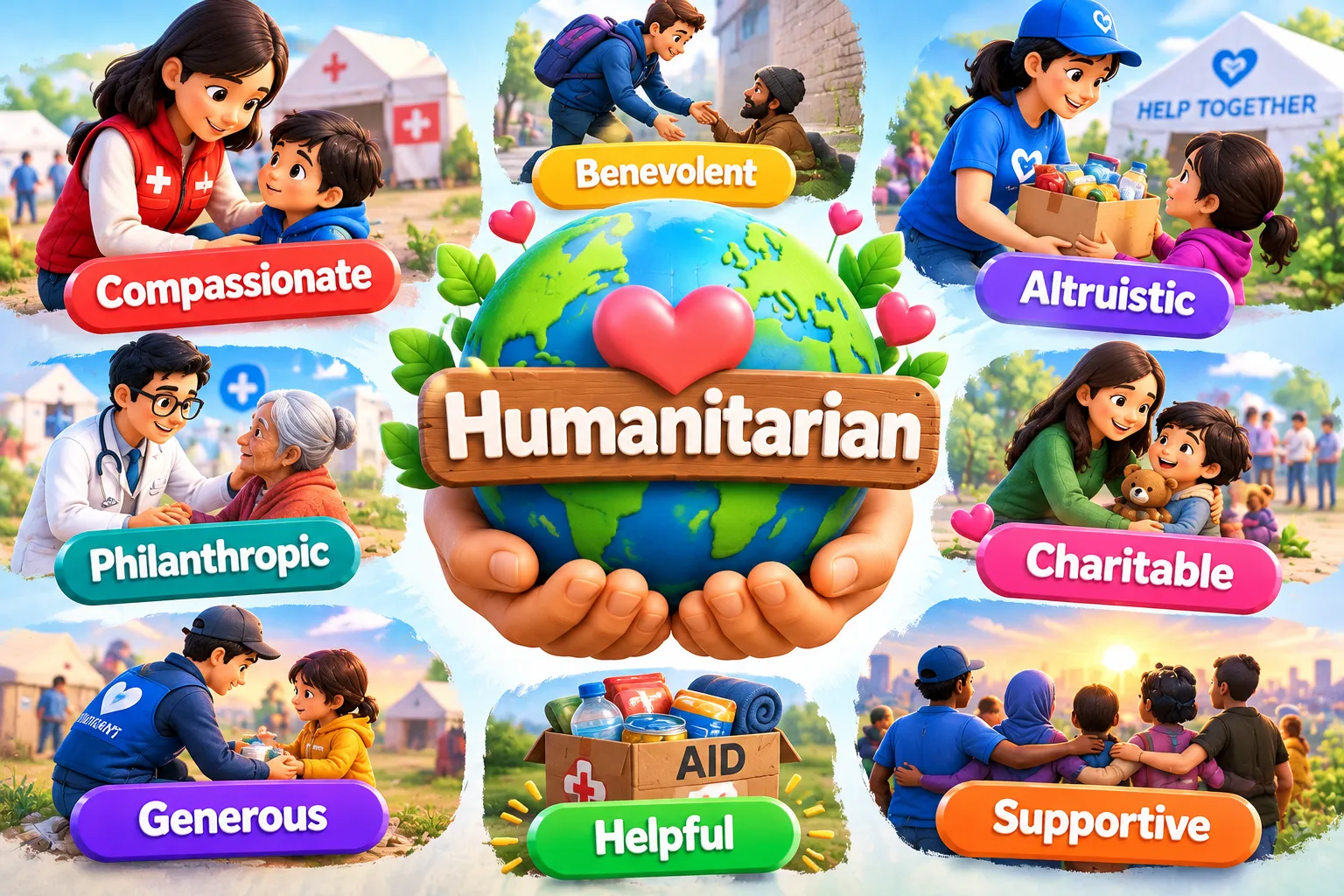
Synonyms for humanitarian include philanthropist, humanist, altruist, benefactor, volunteer, relief worker, and advocate. A humanitarian is someone who cares about human welfare and works to reduce suffering. The best alternative depends on the person’s actions. For example, a philanthropist donates money to good causes, while a relief worker provides practical help during emergencies. Understanding these differences helps you choose the right word, improve your vocabulary, and express ideas more clearly.
A humanitarian is someone who cares about others and works to make the world a better place. Imagine a flood destroying homes in a small town. Volunteers arrive with food, clean water, clothing, and medicine to support affected families. Their efforts demonstrate humanitarian values because they help people facing difficult circumstances.
The word humanitarian often appears in news reports, charity campaigns, disaster relief efforts, and discussions about human rights. However, using the same word repeatedly can make your writing sound repetitive. Learning synonyms for humanitarian gives you more ways to describe kindness, generosity, and social responsibility.
Some alternatives emphasize financial support, while others describe direct assistance, compassion, or efforts to improve society. In this guide, you will explore 28 related words, their meanings, and practical examples. You will also learn about the word’s pronunciation, origin, grammatical forms, and antonyms. These explanations will help you expand your vocabulary and choose more precise words for everyday conversations, academic assignments, and professional writing.
Meaning of Humanitarian
Definition
Humanitarian (noun and adjective):
As a noun, a humanitarian is a person who works to improve human welfare and reduce suffering.
As an adjective, humanitarian describes actions, assistance, or ideas intended to protect human life, meet basic needs, and improve people’s well-being.
Examples
- The humanitarian helped families who lost their homes in the flood.
- The charity delivered humanitarian aid to people affected by the war.
In the first sentence, humanitarian describes a person who helps others. In the second, it describes aid intended to support people facing hardship.
Connotative Meaning of Humanitarian
Connotation refers to the feelings or ideas a word suggests beyond its basic definition.
The word humanitarian generally has a positive connotation because it is associated with compassion, generosity, and concern for others. However, its meaning can vary depending on the context.
- Positive connotation: The word suggests kindness, empathy, and a willingness to help people in need.
Example: Her humanitarian work brought hope to families affected by the disaster. - Negative context: The word itself is usually positive, but claims of humanitarian work may be criticized when the actions behind them are dishonest or harmful.
Example: The organization faced criticism over its claims of humanitarian support. - Neutral connotation: In news reports, the word may simply describe aid, relief programs, or activities designed to meet basic human needs.
Example: The government announced a humanitarian relief program for displaced families.
Understanding these different uses helps you interpret the word accurately and use it appropriately.
Etymology of Humanitarian
The word humanitarian is formed from human and the suffix -itarian. The word human entered English through French and ultimately comes from the Latin word humanus, meaning human or humane.
Humanitarian became established in English during the early nineteenth century. It was used to describe people, beliefs, and activities concerned with improving human welfare and reducing suffering.
| Historical Period | Word Development |
|---|---|
| Old English (approximately 450–1100) | The modern word humanitarian did not yet exist. Other words expressed related ideas about people and kindness. |
| Middle English (approximately 1100–1500) | The word human entered English through Anglo-French and Old French, ultimately deriving from Latin humanus. |
| Modern English (1500–present) | Humanitarian developed in the early nineteenth century to describe people and ideas concerned with human welfare and the relief of suffering. |
Today, humanitarian is widely used in discussions about disaster relief, poverty, public health, human rights, and international aid.
Pronunciation of Humanitarian
- Word: Humanitarian
- British English IPA: /hjuːˌmæn.ɪˈteə.ri.ən/
- American English IPA: /hjuːˌmæn.ɪˈter.i.ən/
- Syllables: Hu-man-i-tar-i-an
- Part of speech: Noun and adjective
The word has six syllables, and the main stress falls on the tar or ter syllable, depending on the accent.
Affixation Pattern of Humanitarian
Understanding word formation can help you recognize related words and expand your vocabulary.
- Base word: Human
- Prefix: The word humanitarian has no commonly recognized productive prefix.
- Suffix: The ending -itarian forms humanitarian, a word associated with human welfare and related beliefs or activities.
Related Word Forms
The following words share a connection with human or express related ideas.
| Word | Part of Speech | Meaning | Example |
|---|---|---|---|
| Human | Noun/adjective | A person or something relating to people. | Every human deserves respect. |
| Humanity | Noun | People as a whole or the quality of being compassionate. | The volunteers showed great humanity. |
| Humane | Adjective | Kind and considerate toward people or animals. | The shelter provides humane care for animals. |
| Humanely | Adverb | In a kind and considerate manner. | The animals were treated humanely. |
| Humaneness | Noun | The quality of showing kindness and compassion. | Her humaneness was clear in the way she helped others. |
| Humanitarian | Noun/adjective | A person who works to improve human welfare, or something related to that work. | The humanitarian team delivered food and medicine. |
| Humanitarianism | Noun | The belief that people should work to reduce suffering and improve human welfare. | Humanitarianism inspired the group to help refugees. |
| Inhuman | Adjective | Cruel or lacking compassion. | The prisoners suffered inhuman treatment. |
| Inhumanity | Noun | Cruelty or a lack of compassion. | The report described acts of inhumanity. |
Learning these related forms helps you describe human behavior, compassion, and social responsibility more precisely.
28 Synonyms for Humanitarian With Meanings and Examples
The word humanitarian has several related terms, but they do not all mean exactly the same thing. Some describe people who donate money, while others refer to those who provide practical assistance, defend human rights, or work to improve society.
Here are 28 alternatives, along with their meanings and example sentences.
1. Philanthropist (Noun)
Meaning: A person who donates money, time, or resources to support charitable causes and improve people’s lives.
Examples:
- The philanthropist donated money to build a school.
- A local philanthropist funded free medical care for low-income families.
Usage tip: Use philanthropist when emphasizing charitable giving, especially financial donations.
2. Humanist (Noun)
Meaning: A person who values human dignity, welfare, and potential.
Examples:
- The humanist believed that everyone deserved respect.
- As a humanist, she supported equal access to education.
Usage tip: A humanist is not necessarily a humanitarian worker. Humanism can refer to several philosophical traditions that emphasize human values and potential.
3. Altruist (Noun)
Meaning: A person who cares about others and acts to support their well-being, often without expecting anything in return.
Examples:
- The altruist volunteered to support people living alone.
- She is an altruist who regularly helps her neighbors.
Usage tip: Use altruist when emphasizing selflessness and concern for others.
4. Benefactor (Noun)
Meaning: A person who provides financial assistance, resources, or other support to someone or a cause.
Examples:
- A generous benefactor paid for the children’s books.
- The hospital thanked its main benefactor for funding new equipment.
Usage tip: A benefactor is especially suitable when someone provides valuable support to an individual or organization.
5. Do-Gooder (Noun)
Meaning: A person who tries to help others or improve society.
Examples:
- The do-gooder organized a food drive for struggling families.
- Some people called him a do-gooder, but his efforts helped many people.
Usage tip: This informal term can sound dismissive or mocking. In formal writing, volunteer, activist, or humanitarian may be more appropriate.
6. Philanthropic Person (Noun Phrase)
Meaning: Someone who gives money, resources, or support to improve people’s lives.
Examples:
- The philanthropic person funded a shelter for homeless families.
- A philanthropic business owner donated school supplies to local children.
Usage tip: This phrase emphasizes generosity and charitable giving. In most cases, philanthropist is the more natural and concise choice.
7. Relief Worker (Noun)
Meaning: A person who provides emergency assistance to people affected by disasters, wars, or other crises.
Examples:
- The relief worker delivered clean water after the flood.
- Relief workers helped displaced families find safe shelter.
Usage tip: Use relief worker when referring to people who provide practical help during emergencies.
8. Aid Worker (Noun)
Meaning: A person who provides practical assistance to people experiencing hardship.
Examples:
- The aid worker helped refugees find food and housing.
- Aid workers arrived in the affected region after the earthquake.
Usage tip: An aid worker may provide emergency relief or support longer-term development projects.
9. Volunteer (Noun)
Meaning: A person who freely gives time or effort to help others without expecting payment.
Examples:
- The volunteer served meals at the homeless shelter.
- Many volunteers helped clean the park after the storm.
Usage tip: Use volunteer when emphasizing unpaid service. Volunteers may support humanitarian causes, but not every volunteer performs humanitarian work.
10. Advocate (Noun)
Meaning: A person who publicly supports a cause or speaks up for others.
Examples:
- She is an advocate for children’s rights.
- The advocate called for better access to health care.
Usage tip: An advocate focuses on supporting a cause, raising awareness, or influencing decisions.
11. Activist (Noun)
Meaning: A person who campaigns for social, political, or environmental change.
Examples:
- The activist campaigned for equal rights.
- Local activists urged the government to improve public services.
Usage tip: Use activist when someone actively campaigns to change policies, practices, or social conditions.
12. Human Rights Advocate (Noun Phrase)
Meaning: A person who works to protect people’s fundamental rights and freedoms.
Examples:
- The human rights advocate defended people facing unfair treatment.
- A human rights advocate spoke out against discrimination.
Usage tip: This phrase is especially useful when discussing equality, justice, freedom, and protection from abuse.
13. Social Reformer (Noun)
Meaning: A person who works to improve society by changing unfair systems, policies, or practices.
Examples:
- The social reformer campaigned for better working conditions.
- A social reformer worked to improve access to education.
Usage tip: Use social reformer when emphasizing efforts to bring lasting improvements to society.
14. Charitable Person (Noun Phrase)
Meaning: Someone who willingly gives money, time, or assistance to people in need.
Examples:
- The charitable person donated warm clothes during winter.
- A charitable person helped the family pay for groceries.
Usage tip: This phrase highlights generosity and a willingness to support others.
15. Good Samaritan (Noun)
Meaning: A person who helps someone in trouble, often without being asked or expecting a reward.
Examples:
- A good Samaritan helped the injured cyclist.
- The good Samaritan called an ambulance after witnessing the accident.
Usage tip: Use good Samaritan when describing someone who offers kind, unexpected assistance.
16. Samaritan (Noun)
Meaning: A person who helps someone experiencing difficulty or distress.
Examples:
- A kind Samaritan helped the lost child find her parents.
- The Samaritan offered food to a hungry traveler.
Usage tip: Good Samaritan is the more familiar expression in everyday English.
17. Compassionate Person (Noun Phrase)
Meaning: Someone who understands or cares about other people’s suffering and wants to help.
Examples:
- The compassionate person listened carefully to the family’s concerns.
- A compassionate person offered comfort to the grieving child.
Usage tip: This phrase emphasizes empathy, kindness, and emotional support.
18. Empath (Noun)
Meaning: A person who is highly sensitive to other people’s emotions and feelings.
Examples:
- As an empath, she quickly noticed when her friend felt upset.
- The empath listened carefully to everyone’s concerns.
Usage tip: Empath is often used informally to describe emotional sensitivity. It does not necessarily mean that someone takes humanitarian action.
19. Caregiver (Noun)
Meaning: A person who looks after someone who needs help, support, or daily care.
Examples:
- The caregiver helped the elderly man with his daily tasks.
- A caring caregiver helped the patient feel safe and comfortable.
Usage tip: Use caregiver when describing someone who provides personal care, especially to children, older adults, or people with health needs.
20. Samaritan Worker (Noun Phrase)
Meaning: A person who provides practical assistance to people in need.
Examples:
- The Samaritan worker distributed food to homeless families.
- A Samaritan worker helped older residents during the heatwave.
Usage tip: This phrase is uncommon in standard English. Volunteer, aid worker, or relief worker will usually sound more natural.
21. Human Welfare Worker (Noun Phrase)
Meaning: A person who works to improve people’s living conditions and overall well-being.
Examples:
- The human welfare worker helped families access community support.
- Human welfare workers visited the community after the disaster.
Usage tip: This phrase emphasizes efforts to improve people’s quality of life. Depending on the role, social worker or aid worker may be more precise.
22. Social Worker (Noun)
Meaning: A trained professional who helps individuals and families manage social, emotional, and practical challenges.
Examples:
- The social worker helped the family find suitable housing.
- A social worker connected the child with support services.
Usage tip: A social worker often provides professional support, advocacy, and access to essential services. Not all social workers perform humanitarian work.
23. Altruistic Person (Noun Phrase)
Meaning: Someone who puts other people’s needs before personal gain.
Examples:
- The altruistic person gave up a free afternoon to help a neighbor.
- Her altruistic actions inspired the entire team.
Usage tip: This phrase emphasizes selflessness and a willingness to help others.
24. Public Servant (Noun)
Meaning: A person who works in public service, often for a government organization, to serve the community.
Examples:
- The public servant helped residents apply for financial assistance.
- A dedicated public servant worked to improve local services.
Usage tip: A public servant may help improve people’s lives, but the term does not automatically imply humanitarian work.
25. Humanitarian Volunteer (Noun Phrase)
Meaning: A volunteer who helps people facing hardship, emergencies, or disasters.
Examples:
- The humanitarian volunteer packed food for displaced families.
- Humanitarian volunteers helped rebuild the damaged school.
Usage tip: Use this phrase when describing volunteers who support humanitarian projects or emergency relief efforts.
26. Peacebuilder (Noun)
Meaning: A person who helps prevent conflict, strengthen relationships, and promote lasting peace.
Examples:
- The peacebuilder brought both sides together for talks.
- Local peacebuilders helped reduce tension between community groups.
Usage tip: A peacebuilder focuses on preventing conflict and creating conditions for peaceful cooperation.
27. Mediator (Noun)
Meaning: A person who helps people resolve disagreements and reach an agreement.
Examples:
- The mediator helped the two groups reach an agreement.
- A skilled mediator listened carefully to both sides.
Usage tip: A mediator supports communication and conflict resolution. The role may contribute to humanitarian goals, but mediation is not always humanitarian work.
28. Defender (Noun)
Meaning: A person who protects someone or something from harm, unfair treatment, or attack.
Examples:
- She became a defender of children’s rights.
- The defender spoke up for people whose concerns were being ignored.
Usage tip: Use defender when emphasizing protection, support, or standing up for others.
Prototype Meaning of Humanitarian
The central meaning of humanitarian is a person or action focused on improving human welfare and reducing suffering. When people hear this word, they may imagine aid workers delivering food after a disaster, doctors treating people during a crisis, or volunteers helping families who have lost their homes.
However, humanitarian work extends beyond emergency assistance. It can also include improving access to health care, supporting education, protecting human rights, and helping vulnerable communities achieve better living conditions.
The word usually carries a positive meaning because it is associated with compassion, dignity, fairness, and service. Its defining feature is a concern for human welfare and a desire to address people’s needs.
Prototype Categorization of Humanitarian
The synonyms for humanitarian can be grouped according to the type of help, support, or social contribution they describe.
1. Giving and Charity
These words describe people who donate money, resources, or other forms of support to help others.
Examples: Philanthropist, benefactor, philanthropic person, charitable person.
Example sentence: The philanthropist donated money to provide free education for children.
2. Direct Help and Emergency Relief
These terms describe people who provide practical assistance to individuals and communities facing hardship.
Examples: Relief worker, aid worker, volunteer, humanitarian volunteer, caregiver, human welfare worker.
Example sentence: Relief workers delivered food and clean water to families affected by the flood.
3. Compassion and Selflessness
These words emphasize kindness, empathy, and a willingness to put others’ needs first.
Examples: Altruist, altruistic person, compassionate person, empath, good Samaritan.
Example sentence: The altruist spent the weekend helping families in need.
4. Human Rights and Social Change
These terms describe people who defend rights, challenge injustice, or work to improve society.
Examples: Advocate, activist, human rights advocate, social reformer, defender.
Example sentence: The human rights advocate campaigned for equal treatment and justice.
5. Community and Public Service
These words describe people who support individuals, families, or communities through professional or public roles.
Examples: Social worker, public servant.
Example sentence: The social worker helped the family access essential support services.
6. Peace and Conflict Resolution
These terms describe people who work to reduce conflict, encourage cooperation, or help others resolve disagreements.
Examples: Peacebuilder, mediator.
Example sentence: The mediator helped the two groups resolve their disagreement peacefully.
7. Human-Centered Values
This category includes people who emphasize human dignity, welfare, and potential.
Example: Humanist.
Example sentence: The humanist believed that every person deserved dignity and respect.
Why Does Categorization Matter?
Grouping related words helps you choose the most accurate expression for each situation.
For example, philanthropist is appropriate for someone who donates money to charitable causes. Relief worker describes someone who provides practical assistance after a disaster. Human rights advocate refers to someone who works to protect people’s rights.
Although these roles may overlap, their meanings are different. Understanding these distinctions makes your writing more precise, natural, and informative.
Antonyms of Humanitarian
The word humanitarian does not have one exact antonym in every context. However, several words describe attitudes and actions that contrast with compassion, generosity, and concern for human welfare.
| Antonym | Part of Speech | Meaning |
|---|---|---|
| Inhumane | Adjective | Showing little or no concern for human suffering. |
| Cruel | Adjective | Causing pain or distress without compassion. |
| Heartless | Adjective | Lacking sympathy or kindness. |
| Callous | Adjective | Showing little concern for the feelings or suffering of others. |
| Selfish | Adjective | Caring mainly about personal needs or interests. |
| Self-centered | Adjective | Focusing primarily on oneself rather than others. |
| Indifferent | Adjective | Showing little or no interest or concern. |
| Uncharitable | Adjective | Unwilling to show kindness, generosity, or understanding. |
| Oppressor | Noun | A person or group that treats others unfairly and restricts their freedom. |
| Exploiter | Noun | A person who takes unfair advantage of others for personal gain. |
Examples of Antonyms in Sentences
- Inhumane: The prisoners were subjected to inhumane treatment.
- Cruel: The cruel decision caused unnecessary suffering.
- Heartless: His heartless response upset the family.
- Selfish: It was selfish to ignore the needs of everyone else.
- Indifferent: The official seemed indifferent to the community’s concerns.
- Exploiter: The exploiter took advantage of vulnerable workers.
These words describe behavior that contrasts with humanitarian values. Choosing the right antonym depends on whether you want to emphasize cruelty, selfishness, indifference, or the unfair treatment of others.
Frequently Asked Questions About Humanitarian
What does humanitarian mean?
A humanitarian is a person who cares about human welfare and works to reduce suffering. The word can also describe aid, activities, or policies designed to help people in need.
What are the most common synonyms for humanitarian?
Common alternatives include philanthropist, humanist, altruist, benefactor, volunteer, aid worker, relief worker, and advocate. Each word emphasizes a different kind of support or contribution.
When should I use the word humanitarian?
Use humanitarian when discussing people, assistance, or activities focused on protecting human life, meeting basic needs, and reducing suffering. It commonly appears in discussions about disasters, poverty, conflict, and human rights.
Is humanitarian a positive or negative word?
Humanitarian generally has a positive connotation because it suggests compassion, generosity, and concern for others. However, the context determines how the word is understood.
What is the difference between a humanitarian and a philanthropist?
A humanitarian focuses on improving human welfare and reducing suffering. A philanthropist usually provides money, resources, or other support to charitable causes. A philanthropist can support humanitarian projects, but the two terms are not identical.
What is the difference between a humanitarian and a volunteer?
A humanitarian works to improve human welfare and reduce suffering. A volunteer freely gives time or effort without expecting payment. A volunteer may support humanitarian causes, but volunteering can also involve many other activities.
What is the difference between a humanitarian and an activist?
A humanitarian focuses on reducing suffering and improving people’s well-being. An activist works to bring about social, political, or environmental change. These roles can overlap, especially when activists campaign for human rights or better living conditions.
Can humanitarian be used as both a noun and an adjective?
Yes. As a noun, it refers to a person who works to improve human welfare. As an adjective, it describes assistance, activities, or ideas intended to help people.
Examples:
- The humanitarian delivered supplies to the affected families.
- The organization provided humanitarian assistance after the earthquake.
What are the best synonyms for humanitarian in formal writing?
For formal writing, useful alternatives include philanthropist, aid worker, relief worker, human rights advocate, and social reformer. Choose the term that accurately describes the person’s role.
How can I improve my vocabulary using synonyms for humanitarian?
Start by learning a few words at a time. Understand their meanings, read example sentences, and write your own sentences using each word. Pay attention to how the words appear in news reports, books, and everyday conversations. Regular practice will help you choose the right expressions with greater confidence.
Conclusion
Learning synonyms for humanitarian can strengthen your vocabulary and help you describe compassion, charity, social responsibility, and support for people in need. Words such as philanthropist, benefactor, and altruist emphasize generosity and selflessness. Meanwhile, aid worker and relief worker describe people who provide practical assistance, while advocate and social reformer highlight efforts to protect rights and improve society.
Although these words share related meanings, each has its own purpose. Choosing the right term helps you communicate more accurately, avoid unnecessary repetition, and make your writing easier to understand.
To build your vocabulary, learn a few alternatives each day and use them in your own sentences. Pay attention to their meanings and the situations in which they are used. With regular practice, you can improve your English, express your ideas more effectively, and communicate with greater confidence.
Read More
Synonyms for Menace: 26 Powerful Alternatives

I’m Ayesha Haram, an English content and SEO writer at SynonymsInstant.com. I focus on creating helpful vocabulary resources, word guides, and practical English content that readers can understand quickly. I combine language research, clear explanations, and SEO-focused writing to produce reliable content that supports learners, writers, and everyday English users.