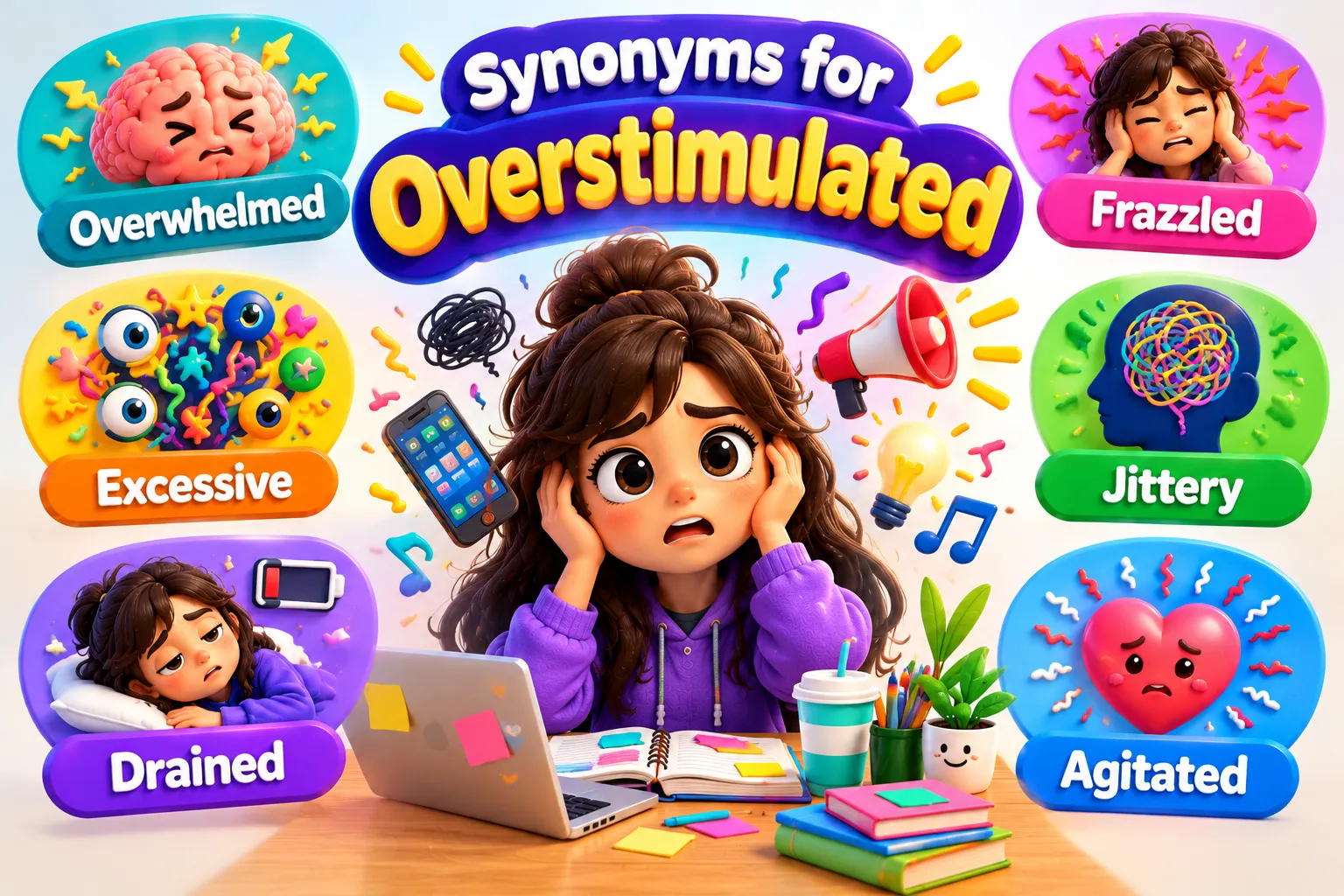
Overstimulated means feeling overwhelmed by too much noise, activity, information, or sensory input. Common synonyms and related alternatives include overwhelmed, overloaded, overexcited, agitated, and overwhelmed by sensory input. The best word depends on the situation. Overwhelmed describes having too much to handle, while overexcited suggests too much excitement. Agitated describes feeling upset or restless. Learning these alternatives helps you explain feelings more clearly in everyday conversations, personal writing, and articles about stress, emotions, and sensory experiences.
Overstimulated means receiving more sensory input, information, or activity than you can comfortably handle. Imagine sitting in a busy shopping mall with loud music, bright lights, crowds, and constant phone alerts. After a while, you may feel tired, restless, or unable to focus. You might describe this feeling as being overstimulated.
The word is often used when talking about busy environments, stress, children’s behavior, and sensory experiences. Learning synonyms for overstimulated helps English learners describe these feelings with greater accuracy. It also helps students and content writers avoid repeating the same word. However, each alternative has a slightly different meaning. Overwhelmed focuses on having too much to manage, while agitated describes an unsettled emotional state. This guide explores the meaning, pronunciation, history, word forms, synonyms, and antonyms of overstimulated, with clear examples to help you choose the right expression.
Meaning of Overstimulated
Definition
Overstimulated (Adjective): Feeling affected by too much sensory input, activity, excitement, or information to remain comfortable, calm, or focused.
It can also be the past-tense or past-participle form of the verb overstimulate.
Examples
- After hours in the noisy shopping mall, I felt overstimulated and needed a quiet place.
- The bright lights, loud music, and busy crowd left the child overstimulated.
Connotative Meaning
Connotation is the feeling or idea a word suggests beyond its basic meaning.
- Positive tone: In some contexts, overstimulation may be linked to intense excitement, energy, or a highly engaging experience, though the word itself is not usually positive.
- Negative tone: It often suggests discomfort, stress, irritability, tiredness, or difficulty focusing.
- Neutral tone: In psychology and discussions of the senses, it can describe a response to a high level of sensory input without judging the person or situation.
Etymology of Overstimulated
The word overstimulated is formed from the prefix over-, the verb stimulate, and the ending -ed.
- Old English (450–1100): The complete word overstimulated did not exist in Old English. The prefix over- comes from Old English ofer, meaning “above,” “beyond,” or “too much.”
- Middle English (1100–1500): The prefix over- continued to be used to express excess. The word stimulate entered English later through Latin and French influences, so the complete modern word should not be attributed to Middle English without specific historical evidence.
- Modern English (1500–Present): Stimulate comes from Latin stimulare, meaning “to urge” or “to spur on.” The modern word overstimulated combines the idea of excessive stimulation with the adjective-forming or past-participle ending -ed.
Today, overstimulated commonly describes a person, animal, or system receiving more stimulation than it can comfortably manage.
Pronunciation (IPA)
- IPA: /ˌoʊvərˈstɪmjəleɪtɪd/ (American English; pronunciation may vary by accent)
- Syllables: o-ver-stim-u-lat-ed (5 syllables)
- Word stress: The main stress falls on LA in stimulated.
Affixation Pattern of Overstimulated
- Root: stimulate, from Latin stimulare, meaning “to urge” or “to spur on.”
- Prefix: over-, meaning “too much” or “beyond a usual limit.”
- Suffix: -ed, which forms the past tense and past participle of regular verbs and can form adjectives.
- Word formation: over- + stimulate + -ed = overstimulated.
Word Formation Table
| Word | Part of Speech | Meaning |
| Stimulate | Verb | To encourage activity or a response |
| Stimulated | Adjective / past participle | Made more active or responsive |
| Stimulating | Adjective / present participle | Causing interest, activity, or excitement |
| Stimulation | Noun | The act or process of causing a response |
| Stimulator | Noun | A person or thing that causes stimulation |
| Stimulative | Adjective | Causing or encouraging activity; uncommon |
| Overstimulate | Verb | To stimulate too much |
| Overstimulates | Verb | Stimulates too much |
| Overstimulated | Adjective / past participle | Affected by excessive stimulation |
| Overstimulating | Adjective / present participle | Causing excessive stimulation |
| Overstimulation | Noun | The state or process of receiving too much stimulation |
| Understimulated | Adjective | Not receiving enough stimulation |
29 Synonyms for Overstimulated With Meaning & Examples
The word overstimulated has no 30 exact one-word synonyms that fit every context. The alternatives below include close synonyms and related expressions. Some describe the cause, while others describe the feelings or effects of excessive stimulation.
1. Overwhelmed (Adjective)
Meaning: Feeling unable to manage the amount of activity, information, or emotion around you.
Examples:
- I felt overwhelmed by the noise and crowds at the concert.
- She became overwhelmed after a long day of meetings and phone calls.
2. Overloaded (Adjective)
Meaning: Having more input, tasks, or demands than can be handled comfortably.
Examples:
- My mind felt overloaded after hours of studying.
- The busy classroom left some students feeling overloaded.
3. Overexcited (Adjective)
Meaning: More excited or energetic than is comfortable or easy to control.
Examples:
- The children became overexcited during the birthday party.
- He felt overexcited after spending hours at the amusement park.
4. Agitated (Adjective)
Meaning: Feeling upset, restless, or unable to remain calm.
Examples:
- The loud music made her feel agitated.
- He became agitated when several people spoke to him at once.
5. Overwhelmed by Sensory Input (Phrase)
Meaning: Affected by more sounds, sights, smells, or other sensations than you can comfortably process.
Examples:
- I felt overwhelmed by sensory input in the crowded store.
- She was overwhelmed by sensory input and moved to a quiet room.
6. Overstimulated by Noise (Phrase)
Meaning: Made uncomfortable by excessive or intense sound.
Examples:
- I felt overstimulated by noise during the busy festival.
- The constant traffic left him overstimulated by noise.
7. Frazzled (Adjective)
Meaning: Feeling mentally exhausted, tense, or worn out.
Examples:
- I felt frazzled after a day filled with calls and errands.
- The noisy office left the team frazzled by the afternoon.
8. Distracted (Adjective)
Meaning: Unable to focus because attention keeps moving to other things.
Examples:
- She felt distracted by the flashing screens around her.
- He became distracted when several people talked at once.
9. Restless (Adjective)
Meaning: Unable to relax or stay still.
Examples:
- The child became restless in the noisy waiting room.
- I felt restless after spending hours in a crowded place.
10. Irritated (Adjective)
Meaning: Feeling annoyed or bothered by something.
Examples:
- The constant beeping made me feel irritated.
- She grew irritated when the television and radio played together.
11. Tense (Adjective)
Meaning: Feeling nervous, tight, or unable to relax.
Examples:
- He felt tense in the loud and crowded hall.
- I became tense when too many people asked questions at once.
12. Stressed (Adjective)
Meaning: Feeling mental or emotional pressure.
Examples:
- I felt stressed after a day of constant noise.
- She became stressed when work messages kept arriving.
13. Anxious (Adjective)
Meaning: Feeling worried, uneasy, or nervous.
Examples:
- The crowded station made him feel anxious.
- She felt anxious when several loud sounds happened at once.
14. Fraught (Adjective)
Meaning: Filled with tension, worry, or difficulty.
Examples:
- The busy day was fraught with noise and interruptions.
- Their fraught conversation made it hard to stay calm.
15. Exhausted (Adjective)
Meaning: Very tired and low on energy.
Examples:
- I felt exhausted after hours in the crowded shopping center.
- She was exhausted by the constant noise and activity.
16. Drained (Adjective)
Meaning: Feeling that your mental or physical energy has been used up.
Examples:
- I felt drained after a noisy family gathering.
- The bright lights and constant activity left him drained.
17. Mentally Fatigued (Adjective Phrase)
Meaning: Tired in a way that makes thinking and focusing difficult.
Examples:
- I felt mentally fatigued after a long day of online meetings.
- She became mentally fatigued while trying to study in a noisy room.
18. Overstimulated Emotionally (Phrase)
Meaning: Affected by more emotional input or excitement than feels manageable.
Examples:
- He felt overstimulated emotionally after the intense discussion.
- She needed time alone because she felt overstimulated emotionally.
19. Overwhelmed by Activity (Phrase)
Meaning: Struggling to cope with too much movement, noise, or activity.
Examples:
- The toddler was overwhelmed by activity at the family gathering.
- I felt overwhelmed by activity in the busy office.
20. Overloaded with Information (Phrase)
Meaning: Receiving more information than you can process comfortably.
Examples:
- I felt overloaded with information during the training session.
- Students may feel overloaded with information before an exam.
21. Frazzled by Noise (Phrase)
Meaning: Mentally worn out or tense because of too much noise.
Examples:
- I was frazzled by noise after working beside the construction site.
- She felt frazzled by noise in the crowded cafeteria.
22. Hyperstimulated (Adjective)
Meaning: Stimulated to an unusually high level; a less common term that may be used in specific contexts.
Examples:
- After the loud event, he described himself as hyperstimulated.
- The character felt hyperstimulated by the lights and sounds of the city.
23. Hyperaroused (Adjective)
Meaning: In a state of unusually high alertness or physiological arousal.
Examples:
- She felt hyperaroused after a stressful and noisy day.
- The report discussed how some people may feel hyperaroused in stressful settings.
Usage note: Hyperaroused is a more technical term and is not interchangeable with overstimulated in every situation.
24. Overactivated (Adjective)
Meaning: Made more active than is usual or helpful.
Examples:
- He felt overactivated after hours of intense activity.
- The constant alerts left her feeling overactivated and unable to relax.
25. Agitated by Stimulation (Phrase)
Meaning: Made restless or upset by too much sensory or mental activity.
Examples:
- The child became agitated by stimulation in the busy room.
- I felt agitated by stimulation from the bright screens and loud music.
26. Sensory Overloaded (Phrase)
Meaning: Experiencing too much sensory input to process comfortably; sensory-overloaded is also used informally as a descriptive expression.
Examples:
- I felt sensory overloaded after walking through the crowded market.
- The bright lights left him sensory overloaded by the end of the day.
Usage note: Overloaded by sensory input or experiencing sensory overload is often more natural.
27. On Edge (Adjective Phrase)
Meaning: Nervous, tense, or easily upset.
Examples:
- The constant noise left me on edge.
- She felt on edge after a day of crowded meetings.
28. Overwhelmed and Restless (Adjective Phrase)
Meaning: Feeling unable to cope while also finding it hard to relax.
Examples:
- I felt overwhelmed and restless after the busy event.
- He became overwhelmed and restless when the room grew louder.
29. Unable to Focus (Phrase)
Meaning: Not able to give proper attention to a task or thought.
Examples:
- I was unable to focus because of the loud music.
- She felt unable to focus after hours of bright screens and constant alerts.
Prototype Meaning
The prototype meaning of overstimulated is a state in which a person receives more sensory, emotional, or mental input than they can comfortably manage. People may imagine a crowded room filled with loud sounds, bright lights, movement, and constant conversation. Someone in this situation may feel tense, tired, restless, irritable, or unable to focus. Overstimulation can also happen when a person receives too much information or experiences too many demands at once. The word does not mean that everyone will react in the same way. What feels overwhelming to one person may be easy for another to manage.
Prototype Categorization
The alternatives for overstimulated can be grouped by the feelings they describe and the situations in which they are used.
- Feeling overwhelmed: Overwhelmed, overloaded, overwhelmed by sensory input, overwhelmed by activity. Use these when there is too much to process or manage.
- High excitement or activity: Overexcited, hyperstimulated, overactivated. These words describe unusually high levels of excitement or activity, though their meanings are not identical.
- Stress and tension: Agitated, tense, stressed, anxious, fraught, on edge. Use these when overstimulation causes worry, tension, or emotional discomfort.
- Mental fatigue: Frazzled, exhausted, drained, mentally fatigued. These words fit situations where too much input leaves someone tired or worn out.
- Attention and focus problems: Distracted, unable to focus. Use these when stimulation makes it hard to concentrate.
- Physical or emotional restlessness: Restless, irritated, agitated by stimulation, overwhelmed and restless. These expressions describe discomfort, agitation, or difficulty settling down.
- Specific causes of overstimulation: Overstimulated by noise, overloaded with information, frazzled by noise, overwhelmed by activity. Use these when you want to name the source of the problem.
- Technical or descriptive expressions: Hyperaroused, overstimulated emotionally, experiencing sensory overload. These may fit specialist, health, or psychology-related writing, but the exact meaning depends on context.
Grouping words this way helps writers choose a term that describes the person’s actual experience. For example, use drained to emphasize tiredness, on edge to show tension, and distracted when the main problem is focus. These words are related alternatives, not exact replacements in every sentence.
Antonyms of Overstimulated
The best antonym depends on whether you want to express calmness, low stimulation, or a comfortable level of input.
| Antonym | Part of Speech | Meaning | Example |
| Calm | Adjective | Peaceful and free from strong agitation | She felt calm in the quiet room. |
| Relaxed | Adjective | Free from tension or worry | He felt relaxed after turning off his phone. |
| Settled | Adjective | Calm and emotionally steady | The child became settled after the noise stopped. |
| Unbothered | Adjective | Not upset or disturbed by something | She remained unbothered by the background noise. |
| Composed | Adjective | Calm and in control of one’s feelings | He stayed composed during the busy event. |
| Serene | Adjective | Very peaceful and calm | The serene garden helped her relax. |
| Unstimulated | Adjective | Not receiving much stimulation | The room was quiet, and the child felt unstimulated. |
| Understimulated | Adjective | Receiving less stimulation than desired or needed | He felt understimulated during the slow lesson. |
| Rested | Adjective | Refreshed after rest | I felt rested after a quiet evening. |
| Focused | Adjective | Able to direct attention to one thing | She felt focused after moving to a quiet space. |
Short Questions and Answers
What does overstimulated mean?
Overstimulated means affected by too much sensory input, excitement, activity, or information. It may leave a person feeling stressed, tired, restless, or unable to focus.
When should overstimulated be used?
Use overstimulated when a person or animal has received more stimulation than they can comfortably handle. For example, “The child felt overstimulated by the loud music and bright lights.”
Is overstimulated positive or negative?
It is usually negative or describes discomfort because it suggests that stimulation has become excessive. However, the level and type of stimulation depend on the situation and the person.
How is overstimulation different from similar words?
Overstimulation focuses on receiving too much sensory or mental input. Overwhelmed is broader and can refer to too many tasks or emotions. Overexcited focuses on excessive excitement, while agitated describes a restless or upset state.
Conclusion
Learning synonyms for overstimulated helps you describe feelings and experiences with greater accuracy. Words such as overwhelmed, overloaded, agitated, frazzled, and drained each express a different part of the experience. Some focus on too much sensory input, while others describe stress, tiredness, or difficulty focusing. Using the right word can make your writing clearer and your conversations more natural. Remember that these alternatives are not all exact synonyms, so consider the context before choosing one. Practise by writing a few sentences about noisy places, busy days, or moments when you need quiet. Daily vocabulary practice can strengthen your English, reduce repetition, and help you express your thoughts with more confidence.
Read More:
Synonyms for Existence: 30 Common Alternatives to Learn

I’m Pinki, an SEO writer at SynonymsInstant.com, specializing in synonyms, antonyms, vocabulary, word meanings, grammar, and English usage. I create accurate, well-researched, reader-friendly content that combines language expertise with SEO best practices. My goal is to make English vocabulary simple, useful, and accessible for students, writers, professionals, and English learners.