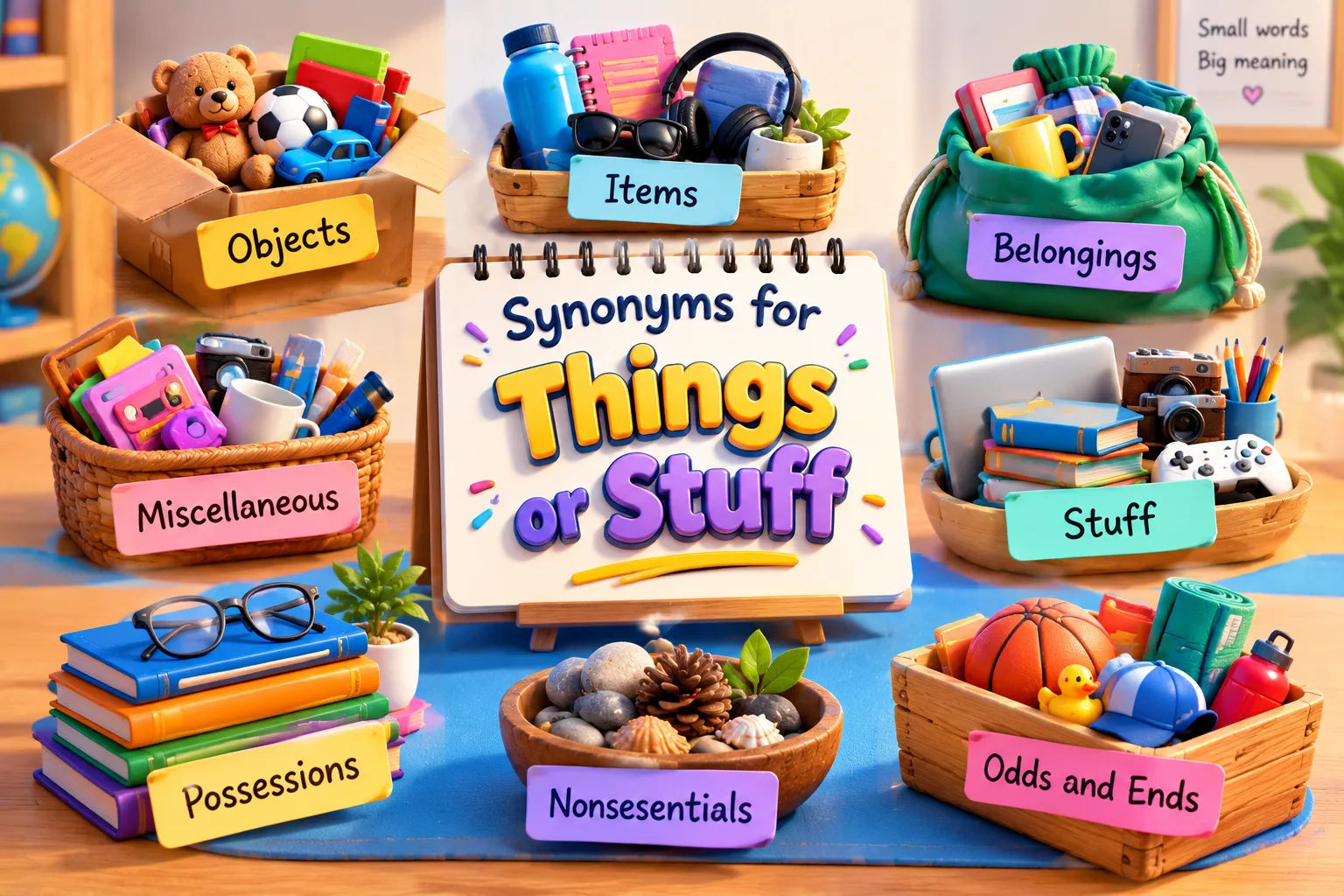
Things and stuff are common words used to talk about objects, items, materials, or matters without naming them exactly. Useful alternatives include items, objects, belongings, materials, goods, possessions, and supplies. The best synonym depends on the context. Items work well for separate objects, while belongings refers to things a person owns. Materials often means substances used to make something. Learning these alternatives helps you write more clearly, avoid repetition, and choose precise words for everyday conversations, schoolwork, and professional writing.
Things and stuff are everyday English words that refer to objects, materials, activities, or matters. Imagine packing a bag before a trip. You might say, “I need to pack my stuff.” In a more formal sentence, you could say, “I need to pack my belongings.” Both expressions make sense, but the second one is more specific. These words are common because they help us talk about something when we do not know its exact name or do not need to name it.
Learning synonyms for things or stuff can improve your English vocabulary and make your writing more precise. Students, English learners, and content writers can use alternatives to avoid repetition and express ideas clearly. This guide explains the meanings, history, pronunciation, and word forms of things and stuff. It also provides 30 useful alternatives with meanings, examples, and context-based categories to help you choose the right word.
Meaning of Things or Stuff
Definition
Thing (Noun): An object, idea, event, fact, or matter that can be discussed or referred to.
Stuff (Noun): A general word for objects, materials, belongings, or matters when their exact names are unknown or unimportant. It is usually uncountable.
Examples
- I put my things in a box before moving to a new house.
- Please move your stuff away from the door.
Connotative Meaning
Connotation is the feeling or idea a word suggests beyond its basic meaning.
- Positive tone: Things and stuff can sound warm or personal when talking about treasured belongings, such as “my favorite things.”
- Negative tone: They can sound dismissive when someone says, “I have too much stuff to do.”
- Neutral tone: Both words are often neutral in casual speech, such as “I need a few things from the store.”
Etymology of Things and Stuff
Thing
- Old English (450–1100): Thing comes from Old English þing, which could mean an affair, matter, assembly, or subject under discussion.
- Middle English (1100–1500): The word developed into thing and gradually gained its broad modern meaning of an object, matter, or idea.
- Modern English (1500–Present): Thing became a general word for objects, events, facts, ideas, and matters.
Stuff
- Old English (450–1100): The modern word stuff was not established in Old English in its current form.
- Middle English (1100–1500): Stuff entered English through Old French estoffe and related forms, referring to material, equipment, or supplies.
- Modern English (1500–Present): Stuff developed broader uses, referring to materials, belongings, objects, and various matters. It is especially common in informal speech.
Pronunciation (IPA)
| Word | IPA | Syllables |
| Thing | /θɪŋ/ | thing (1) |
| Things | /θɪŋz/ | things (1) |
| Stuff | /stʌf/ | stuff (1) |
Affixation Pattern of Things and Stuff
Thing
- Root: thing
- Prefix: None
- Suffix: No suffix in the basic word.
- Plural ending: -s in things.
Stuff
- Root: stuff
- Prefix: None
- Suffix: None in the basic word.
- Word formation: Stuff can form related words through ordinary English word-building patterns.
Word Formation Table
| Word | Part of Speech | Meaning |
| Thing | Noun | An object, idea, event, or matter |
| Things | Plural noun | More than one thing |
| Thingy | Noun, informal | A word for an object whose name is unknown or forgotten |
| Thingamajig | Noun, informal | A device or object whose name is unknown |
| Thingamabob | Noun, informal | An object whose name is not known |
| Something | Pronoun | An unspecified object, event, or matter |
| Anything | Pronoun | Any object, event, or matter |
| Everything | Pronoun | All things or matters |
| Nothing | Pronoun | Not anything |
| Stuff | Noun / verb | Materials or belongings; to fill something tightly |
| Stuffed | Adjective / past participle | Filled tightly or filled with something |
| Stuffing | Noun / verb form | Material used to fill something; the act of filling |
| Stuffed-up | Adjective | Blocked, especially when referring to the nose; informal |
| Stuffiness | Noun | A state of being stuffy or lacking fresh air |
| Stuffy | Adjective | Lacking fresh air or, informally, overly formal |
30 Synonyms for Things or Stuff With Meaning & Examples
The best synonym depends on what things or stuff refers to. Some alternatives mean physical objects, while others refer to belongings, materials, tasks, or general matters. These words are related alternatives rather than exact replacements in every sentence.
1. Items (Noun)
Meaning: Individual objects, especially when they are part of a group or list.
Examples:
- Please place all the items on the table.
- I bought several items at the grocery store.
2. Objects (Noun)
Meaning: Physical things that can usually be seen or touched.
Examples:
- The box contains several small objects.
- Keep sharp objects away from children.
3. Belongings (Noun)
Meaning: Things that a person owns.
Examples:
- She packed her belongings before leaving.
- Please keep your belongings in a safe place.
4. Possessions (Noun)
Meaning: Things that belong to someone.
Examples:
- He carried his few possessions in a backpack.
- Her books and clothes were among her most valued possessions.
5. Materials (Noun)
Meaning: Substances or items used to make, build, or create something.
Examples:
- We need more materials to finish the project.
- The artist uses recycled materials to make sculptures.
6. Goods (Noun)
Meaning: Products or items that are made, sold, or traded.
Examples:
- The shop sells household goods.
- The truck delivered goods to the local market.
7. Products (Noun)
Meaning: Items made or created for sale or use.
Examples:
- The company sells beauty products.
- These products are made from natural materials.
8. Supplies (Noun)
Meaning: Items needed for a particular task or purpose.
Examples:
- We bought school supplies before classes began.
- The hospital needs more medical supplies.
9. Equipment (Noun)
Meaning: Tools or objects needed for a specific activity.
Examples:
- The team packed its camping equipment.
- The gym has modern exercise equipment.
10. Tools (Noun)
Meaning: Objects used to perform a task or do a job.
Examples:
- Put your tools back in the box.
- The carpenter uses special tools to shape wood.
11. Gadgets (Noun)
Meaning: Small devices that perform useful tasks.
Examples:
- He keeps his electronic gadgets on the desk.
- The store sells useful kitchen gadgets.
12. Devices (Noun)
Meaning: Objects or machines designed for a particular purpose.
Examples:
- The lab uses several measuring devices.
- Turn off your electronic devices before the exam.
13. Articles (Noun)
Meaning: Individual objects or items, especially in formal descriptions.
Examples:
- The museum displayed articles from the past.
- Please list the articles you want to donate.
14. Pieces (Noun)
Meaning: Individual parts or units of something.
Examples:
- She collected a few pieces of broken glass.
- I need two pieces of paper for the activity.
15. Belongings and Personal Effects (Noun Phrase)
Meaning: Personal items owned or used by someone.
Examples:
- The hotel staff returned his personal effects.
- She gathered her belongings before checking out.
16. Possessions and Valuables (Noun Phrase)
Meaning: Items owned by someone, especially those that have financial or personal value.
Examples:
- Keep your valuables in a secure place.
- He checked his possessions before leaving the train.
17. Objects and Items (Noun Phrase)
Meaning: Physical things that can be counted or identified.
Examples:
- The teacher placed the objects and items in separate boxes.
- We sorted the objects and items by size.
18. Materials and Supplies (Noun Phrase)
Meaning: Things needed to make, repair, or complete something.
Examples:
- We gathered materials and supplies for the art class.
- The builders ordered materials and supplies for the new house.
19. Resources (Noun)
Meaning: Things that can be used to achieve a goal or meet a need.
Examples:
- The school needs more learning resources.
- The team used its available resources to complete the work.
20. Essentials (Noun)
Meaning: Things that are necessary or very important.
Examples:
- Pack the essentials before leaving for your trip.
- Food, water, and shelter are basic essentials.
21. Necessities (Noun)
Meaning: Things that are needed for daily life or a specific purpose.
Examples:
- The family bought basic necessities.
- Bring the necessities for your overnight stay.
22. Odds and Ends (Noun Phrase)
Meaning: Small, different items that do not belong to one clear group.
Examples:
- The drawer was full of odds and ends.
- She packed a few odds and ends before moving.
23. Miscellaneous Items (Noun Phrase)
Meaning: Various items that do not fit into one specific category.
Examples:
- The box contains miscellaneous items from the office.
- Put the miscellaneous items on the lower shelf.
24. Objects of Interest (Noun Phrase)
Meaning: Things that attract attention or are worth examining.
Examples:
- The display included several objects of interest.
- The researcher photographed objects of interest at the site.
25. Matters (Noun)
Meaning: Subjects, issues, or situations that need attention or discussion.
Examples:
- We discussed several important matters.
- Personal matters should be handled with care.
26. Issues (Noun)
Meaning: Topics, problems, or questions that need attention.
Examples:
- The meeting covered several important issues.
- We need to discuss a few issues before making a decision.
27. Tasks (Noun)
Meaning: Pieces of work that need to be completed.
Examples:
- I have several tasks to finish today.
- She wrote her tasks on a notebook page.
28. Activities (Noun)
Meaning: Actions or things that people do.
Examples:
- The teacher planned several classroom activities.
- Outdoor activities help children stay active.
29. Topics (Noun)
Meaning: Subjects that people talk, read, or write about.
Examples:
- We discussed several topics in class.
- Choose three topics for your presentation.
30. Stuff (Noun)
Meaning: A general, informal word for objects, materials, belongings, or matters.
Examples:
- Please put your stuff in the cupboard.
- I have a lot of stuff to do before the weekend.
Prototype Meaning
The prototype meaning of things or stuff is a general reference to objects or matters that a speaker does not want to name in detail. People often imagine everyday items such as clothes, books, bags, tools, or household objects. However, these words can also refer to ideas, tasks, events, and personal concerns. Things is countable and can refer to one or more objects, while stuff is usually an uncountable noun in this sense. Both words are useful in casual conversation, but more precise alternatives often make formal writing clearer.
Prototype Categorization
The 30 alternatives can be grouped by the type of thing they describe. These categories help you choose a word that fits your meaning and tone.
- General physical objects: items, objects, articles, pieces, objects and items. Use these words when referring to physical things that can be identified or counted.
- Personal belongings: belongings, possessions, belongings and personal effects, possessions and valuables. These terms work when talking about items owned by a person.
- Materials and practical supplies: materials, supplies, materials and supplies, equipment, tools. Use these when discussing items needed for work, building, learning, or daily tasks.
- Products and devices: goods, products, gadgets, devices. These alternatives fit commercial products, machines, and useful technology.
- Important or useful items: resources, essentials, necessities. Use these words when the items help meet a need or reach a goal.
- Mixed or unidentified objects: odds and ends, miscellaneous items, stuff. These expressions work when items are varied, small, or not named individually.
- Subjects and concerns: matters, issues, topics. Use these when things refers to ideas, problems, or subjects rather than physical objects.
- Actions and work: tasks, activities. These words fit situations where things to do means work or planned actions.
- Objects worth examining: objects of interest. Use this phrase when describing items that attract attention or need further study.
Choosing words by category helps make writing more accurate. For example, use belongings for personal property, supplies for items needed to complete a task, and issues for problems or concerns. This also helps you avoid using the vague word stuff in formal writing.
Antonyms of Things or Stuff
Things and stuff are broad nouns, so they do not have one direct antonym. The best opposite depends on the intended meaning.
| Antonym or Contrast | Part of Speech | Meaning | Example |
| Nothing | Pronoun | Not anything | There was nothing in the box. |
| Nothingness | Noun | A state in which nothing is present | The empty space seemed to stretch into nothingness. |
| Emptiness | Noun | The state of containing nothing | The emptiness of the room surprised us. |
| Void | Noun | An empty space or lack of something | A void remained where the old building stood. |
| Absence | Noun | The state of not being present | The absence of supplies delayed the work. |
| Lack | Noun | A state of not having enough of something | The lack of tools made the job harder. |
| Shortage | Noun | A situation in which there is less than needed | The town faced a shortage of clean water. |
| Nothing at all | Phrase | No object, matter, or item of any kind | I searched the drawer but found nothing at all. |
Short Questions and Answers
What do things or stuff mean?
Things and stuff are general words for objects, materials, belongings, ideas, or matters. Stuff is more informal and is usually uncountable when used to mean objects or materials.
When should things or stuff be used?
Use these words in casual conversations when the exact objects or matters do not need to be named. In formal writing, choose a more precise word such as items, materials, belongings, or issues when possible.
Are things and stuff positive or negative?
Both words are usually neutral. Their tone depends on the sentence. My favorite things sound positive, while too much stuff to manage may sound negative or frustrated.
How are things and stuff different from similar words?
Things are countable, so you can say one thing or three things. Stuff is usually uncountable, so you normally say some stuff rather than three things. Items are more precise and often more suitable for lists or formal writing.
Conclusion
Learning synonyms for things or stuff can improve your vocabulary and help you express ideas with greater clarity. Words such as items, objects, belongings, materials, and supplies make your writing more specific. Other alternatives, including matters, issues, and tasks, are useful when you are talking about ideas or work rather than physical objects. Although things and stuff are common in everyday speech, using precise words can make essays, articles, and professional messages sound more polished. Remember that not every alternative fits every situation. Practise choosing the right word when you describe objects, belongings, or tasks in your daily life. With regular practice, you can reduce repetition, write more naturally, and build confidence in English.
Read More:
Synonyms for Overstimulated: 29 Related Terms and Examples

I am Rubab content specialist focused on creating accurate, user-friendly, and search-optimized language resources. Through Synonyminstant, I help readers find synonyms, antonyms, meanings, and vocabulary with ease. Every article is carefully researched and optimized to provide reliable information, clear explanations, and an excellent user experience.