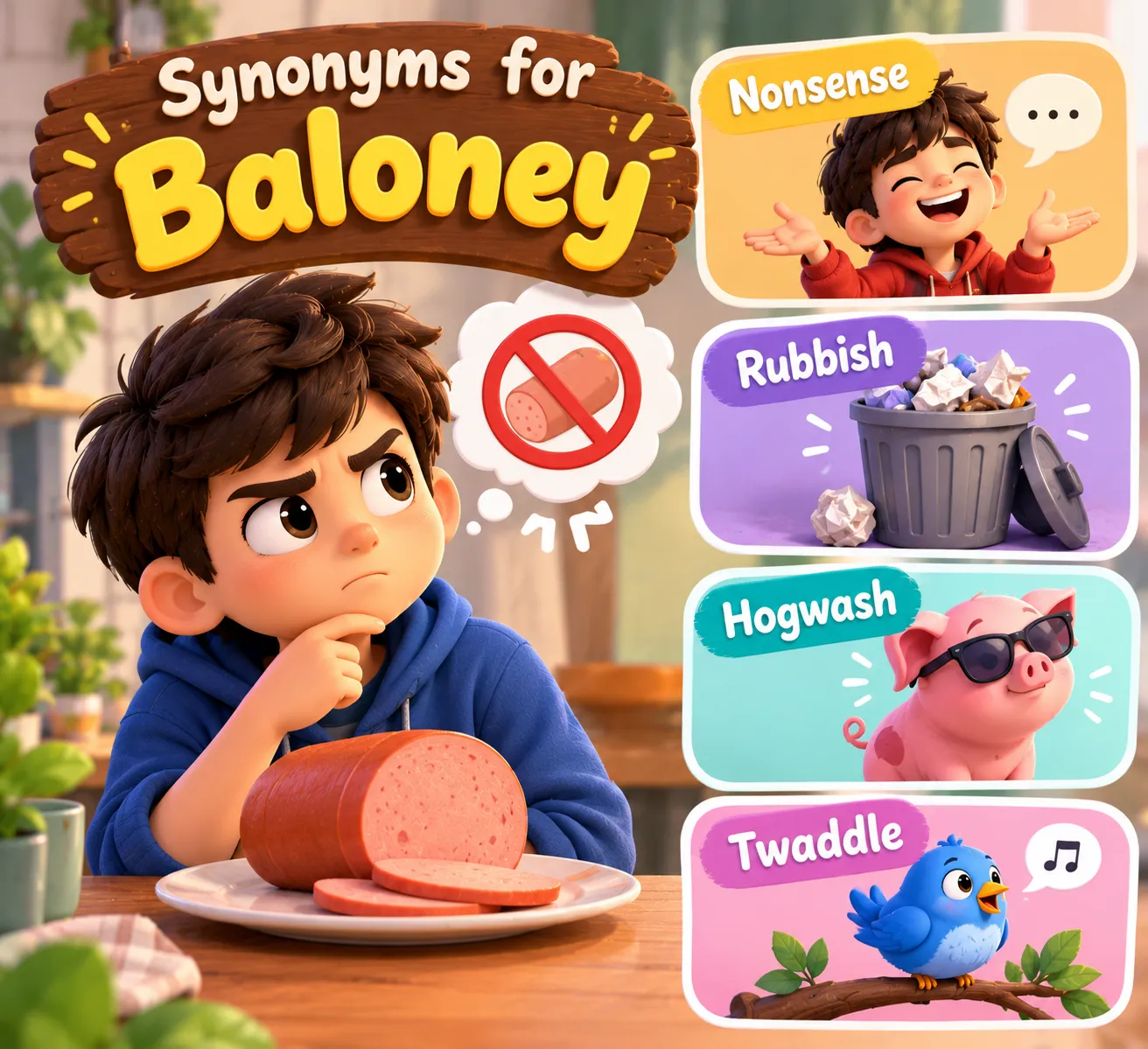
Synonyms for baloney include nonsense, rubbish, garbage, hogwash, bunk, drivel, and poppycock. These words describe ideas, claims, or statements that seem false, silly, or without value. Baloney is an informal word often used when someone does not believe what another person says. For example, you might call an unbelievable excuse “baloney.” Some alternatives are playful, while others sound rude or harsh. Learning these synonyms helps you express doubt, disagreement, and disbelief in more natural English. The best choice depends on your audience and the situation.
Baloney is an informal word that means nonsense or talk that someone believes is foolish, false, or untrue. Imagine a friend says that they can run faster than a racing car. You might laugh and say, “That is baloney!” The word is common in casual conversations, jokes, and informal writing. It can express disbelief, annoyance, or playful disagreement. However, using the same word too often can make your speech sound repetitive. Learning synonyms helps you express the same idea in different ways. In this article, you will learn 30 words and expressions related to baloney, along with their meanings and examples. You will also explore its pronunciation, word forms, history, semantic categories, and antonyms to build a stronger English vocabulary.
Meaning of Baloney
Definition
Baloney (Noun): Informal language used to describe nonsense, foolish talk, or statements that seem untrue or misleading.
The word is often used when someone doubts a claim or thinks an explanation is ridiculous.
Examples
- His excuse for missing the meeting was complete baloney.
- She said the rumor was baloney and asked everyone to check the facts.
Connotative Meaning
Connotation means the feeling or idea a word suggests beyond its basic meaning.
- Positive tone: Baloney can sound playful or humorous when friends use it to tease each other.
- Negative tone: It can sound dismissive or insulting when used to reject someone’s ideas or claims.
- Neutral tone: The word is informal and usually expresses doubt rather than a neutral judgment. In formal writing, words such as false claim or unsupported statement may be more suitable.
Etymology of Baloney
The exact history of baloney is uncertain, but it is commonly linked to bologna, the name of an Italian city and a type of sausage.
- Old English (450–1100): The word baloney was not in use during this period. English had other words for foolishness and false statements.
- Middle English (1100–1500): Baloney was not yet established in English with its modern slang meaning.
- Modern English (1500–Present): Baloney became popular in American English in the early 20th century. It is often linked to bologna, pronounced similarly in American English. Its slang meaning developed to describe nonsense or talk that people do not believe.
Today, baloney is mainly used in informal speech and writing.
Pronunciation (IPA)
- IPA: /bəˈloʊni/
- Syllables: ba-lo-ney (three syllables)
Affixation Pattern of Baloney
Root
Baloney is a complete word. It does not have a commonly recognized prefix or suffix in its modern slang meaning.
Prefix
There is no standard prefix in baloney.
Suffix
There is no standard suffix added to baloney to form its common slang meaning.
Word Formations
| Word | Grammatical Category | Meaning |
| Baloney | Noun | Nonsense or foolish talk |
| Baloney-filled | Adjective | Full of nonsense or misleading claims |
| Baloney detector | Noun phrase | A person’s ability to recognize nonsense or false claims |
Baloney-filled and baloney detector are informal compounds, not standard grammatical forms created by adding a regular prefix or suffix.
30 Synonyms for Baloney With Meanings and Examples
The following words and expressions can replace baloney in some situations. They differ in tone and meaning, so not every option fits every sentence. Some are informal slang, while others describe false claims more directly.
1. Nonsense (Noun)
Meaning: Words or ideas that seem foolish, unreasonable, or untrue.
Examples:
- He said the rumor was nonsense.
- I will not waste time listening to such nonsense.
2. Rubbish (Noun)
Meaning: Informal British English for talk or ideas considered foolish or untrue.
Examples:
- She called the story rubbish.
- That claim is rubbish because the facts do not support it.
3. Garbage (Noun)
Meaning: Informal language for ideas or statements considered worthless or false.
Examples:
- He said the advertisement was full of garbage.
- Stop spreading garbage about your classmates.
4. Hogwash (Noun)
Meaning: Silly or untrue talk that should not be taken seriously.
Examples:
- His explanation sounded like hogwash.
- She called the claim hogwash and asked for proof.
5. Bunk (Noun)
Meaning: Informal language for false or foolish statements.
Examples:
- He said the story about the hidden treasure was bunk.
- The scientist rejected the claim as bunk.
6. Poppycock (Noun)
Meaning: Foolish or untrue talk, often expressed in a humorous way.
Examples:
- That idea about never needing sleep is poppycock.
- Grandpa laughed and called the rumor poppycock.
7. Drivel (Noun)
Meaning: Talk or writing that seems silly, pointless, or lacking in sense.
Examples:
- The article was full of drivel.
- I stopped reading the drivel in the online comments.
8. Balderdash (Noun)
Meaning: Foolish or unbelievable talk.
Examples:
- He called the strange story balderdash.
- The claim that the moon is made of cheese is balderdash.
9. Twaddle (Noun)
Meaning: Silly talk or writing that has little value.
Examples:
- She thought the speech was empty twaddle.
- The book contained more twaddle than useful advice.
10. Claptrap (Noun)
Meaning: Foolish or exaggerated talk meant to impress or mislead people.
Examples:
- The politician’s promise sounded like claptrap.
- He ignored the salesman’s claptrap.
11. Codswallop (Noun)
Meaning: Informal British English for complete nonsense.
Examples:
- She said the rumor was codswallop.
- His claim that he never makes mistakes is codswallop.
12. Bull (Noun, Informal)
Meaning: Rude informal language for talk that someone believes is false or misleading.
Examples:
- He said the excuse was bull.
- I do not believe that story; it sounds like bull.
13. Bullshit (Noun, Vulgar Slang)
Meaning: Very informal and offensive language for dishonest, foolish, or misleading talk.
Examples:
- She said the sales pitch was bullshit.
- He was tired of hearing bullshit from people who made empty promises.
Usage note: This word is vulgar. Avoid it in formal writing, professional settings, and polite conversation.
14. Baloney Talk (Noun Phrase)
Meaning: Informal talk that sounds foolish, exaggerated, or untrue.
Examples:
- The audience was tired of his baloney talk.
- She ignored the baloney talk and focused on the facts.
15. Hot Air (Noun Phrase)
Meaning: Talk that sounds impressive but lacks real meaning or action.
Examples:
- His promise to fix every problem was just hot air.
- We need real results, not hot air.
16. Empty Talk (Noun Phrase)
Meaning: Words that offer little useful information or action.
Examples:
- The team wanted a plan, not empty talk.
- His speech was full of empty talk and vague promises.
17. Foolishness (Noun)
Meaning: Behavior or ideas that show poor judgment or a lack of sense.
Examples:
- She refused to take part in such foolishness.
- His claim that he could fly without equipment was pure foolishness.
18. Gibberish (Noun)
Meaning: Speech or writing that is difficult to understand or seems meaningless.
Examples:
- The instructions looked like gibberish to me.
- He dismissed the confusing explanation as gibberish.
19. Trash (Noun)
Meaning: Informal language for something considered worthless, poor, or untrue.
Examples:
- He called the rumor trash.
- The review said the movie’s dialogue was trash.
20. Rot (Noun, Informal)
Meaning: British informal language for talk or ideas considered foolish or untrue.
Examples:
- She told him to stop talking rot.
- He said the rumor was complete rot.
21. Malarkey (Noun)
Meaning: Informal language for nonsense or misleading talk.
Examples:
- The salesman promised instant success, but I knew it was malarkey.
- She laughed at the malarkey in the advertisement.
22. Hogwash and Poppycock (Noun Phrase)
Meaning: A humorous expression used to dismiss an idea as complete nonsense.
Examples:
- His wild explanation was nothing but hogwash and poppycock.
- She called the unbelievable story hogwash and poppycock.
23. Fabrication (Noun)
Meaning: A made-up story or claim presented as if it were true.
Examples:
- The newspaper exposed the story as a fabrication.
- His claim about winning the award was a fabrication.
24. Falsehood (Noun)
Meaning: A statement that is not true.
Examples:
- The report contained a serious falsehood.
- She corrected the falsehood before it spread further.
25. Lie (Noun)
Meaning: A statement someone makes while knowing it is untrue.
Examples:
- He admitted that the story was a lie.
- Telling a lie can damage trust between friends.
26. Deception (Noun)
Meaning: The act of misleading someone or making them believe something false.
Examples:
- The investigation revealed a pattern of deception.
- The advertisement relied on deception to attract buyers.
27. Hooey (Noun)
Meaning: Informal language for talk or claims that seem foolish or untrue.
Examples:
- He said the rumor about the school was hooey.
- She refused to believe the hooey she read online.
28. Balderdash and Bunk (Noun Phrase)
Meaning: A playful expression for statements considered complete nonsense.
Examples:
- He called the unbelievable excuse balderdash and bunk.
- The audience laughed when she dismissed the rumor as balderdash and bunk.
29. Rubbish Talk (Noun Phrase)
Meaning: Informal speech that a listener considers foolish or untrue.
Examples:
- The coach told the players to stop the rubbish talk.
- I ignored the rubbish talk and checked the facts.
30. Unsupported Claim (Noun Phrase)
Meaning: A statement that lacks enough evidence to prove it is true.
Examples:
- The report made an unsupported claim about the new policy.
- We should not accept an unsupported claim without checking the evidence.
Important distinction: Fabrication and lie suggest falsehood, while nonsense, hogwash, and poppycock can express disbelief or dismissal without proving that a statement is false. Gibberish usually means language that is hard to understand. Choose a synonym based on what you want to communicate.
Prototype Meaning of Baloney
The most common meaning of baloney is nonsense or talk that a person thinks is foolish, exaggerated, or untrue. When people hear this word, they often imagine someone rejecting a claim with humor, doubt, or annoyance. For example, if a person makes an unbelievable excuse, another person may say, “That is baloney!” The word does not always prove that a statement is false. It shows that the speaker does not believe it or considers it unreasonable. Because baloney is informal, it works best in casual conversations, jokes, and relaxed writing rather than formal reports or academic essays.
Prototype Categorization
The synonyms for baloney can be grouped by meaning and tone. These categories help you select the right word for each situation.
- Everyday nonsense: Nonsense, rubbish, garbage, trash, and rot describe ideas or statements that seem foolish or worthless.
- Playful or humorous expressions: Hogwash, poppycock, balderdash, twaddle, codswallop, malarkey, and hooey often sound funny or old-fashioned.
- Meaningless or foolish speech: Drivel, gibberish, claptrap, and empty talk describe speech or writing that lacks sense, value, or substance.
- Rude or vulgar slang: Bull and bullshit express strong disbelief but may offend people.
- False statements and dishonesty: Fabrication, falsehood, lie, and deception relate more directly to untruth or misleading behavior.
- Claims without evidence: Unsupported claim describes a statement that lacks enough proof, without automatically showing that it is false.
- Informal expressions: Baloney talk, hot air, and rubbish talk are phrases that dismiss speech as empty, exaggerated, or foolish.
These groups help writers choose words with the right tone. For a lighthearted conversation, poppycock may work well. For a serious discussion about facts, falsehood or unsupported claim is more precise.
Antonyms of Baloney
The best antonym depends on whether baloney means nonsense, a false statement, or empty talk.
| Antonym | Part of Speech | Meaning |
| Truth | Noun | What is real or correct |
| Fact | Noun | Something that can be shown to be true |
| Truthfulness | Noun | The quality of being honest and accurate |
| Honesty | Noun | The quality of telling the truth |
| Accuracy | Noun | The quality of being correct |
| Reality | Noun | The real state of things |
| Sense | Noun | Reasonable thought or meaning |
| Logic | Noun | Reasoning based on clear principles |
| Evidence | Noun | Information that helps show whether a claim is true |
| Validity | Noun | The quality of being sound or well-founded |
| Credibility | Noun | The quality of being believable or trustworthy |
| Fact-based statement | Noun Phrase | A statement supported by facts |
| Reliable information | Noun Phrase | Information that can be trusted |
| Sound reasoning | Noun Phrase | Thinking that follows clear and reasonable steps |
| Accurate account | Noun Phrase | A description that correctly reports what happened |
Short Questions and Answers
1. What does baloney mean?
Baloney is an informal noun that means nonsense, foolish talk, or a statement that someone believes is false or misleading.
2. When should baloney be used?
Use baloney in casual conversations when you want to express disbelief or dismiss an idea as nonsense. Avoid it in formal writing unless you are discussing informal language or quoting someone.
3. Is baloney positive or negative?
Baloney usually has a negative or dismissive tone. However, friends may use it playfully when joking with one another.
4. How is baloney different from similar words?
Baloney is a casual word for nonsense. Poppycock and hogwash often sound humorous or old-fashioned. Lie means a statement someone knowingly makes that is untrue, while falsehood means an untrue statement. Unsupported claim means a statement lacks enough evidence, but it may still be true.
Conclusion
Learning synonyms for baloney helps you express disbelief, disagreement, and doubt in more natural English. Words such as nonsense, hogwash, malarkey, drivel, and poppycock can make casual speech more varied and engaging. Other terms, such as falsehood, fabrication, and unsupported claim, are useful when discussing facts and evidence. Each word has its own meaning and tone, so it is important to choose one that fits your situation. Some expressions are humorous, while others are rude or formal. To improve your vocabulary, learn a few alternatives each day and use them in your own sentences. With regular practice, you can reduce repetition, write more clearly, and speak with greater confidence.
Read More:
Synonyms for Helping Others: 26 Useful Words to Learn

I’m Falak Naaz, an SEO writer at SynonymsInstant.com focused on creating clear, engaging, and search-friendly English content. I specialize in vocabulary, synonyms, antonyms, word usage, and language guides. I combine careful research with practical writing to deliver trustworthy content that helps readers choose the right words and improve their English with confidence.