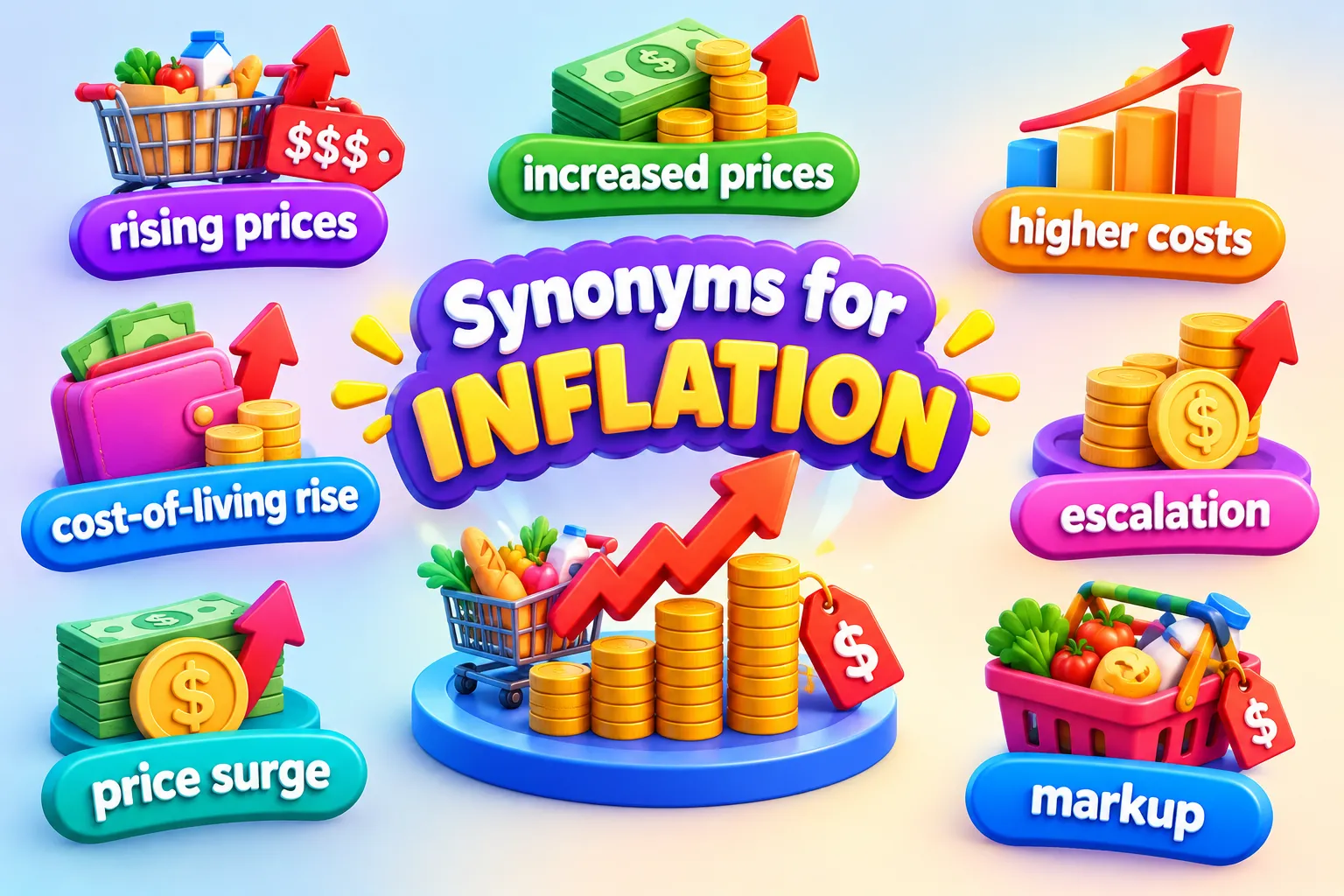
Common synonyms and related terms include price rise, price increase, cost increase, rising prices, price growth, monetary expansion, currency depreciation, and loss of purchasing power. However, these terms are not always exact synonyms because inflation can have different causes and forms. For example, “High inflation has made everyday goods more expensive.” Learning these alternatives helps English learners and writers explain economic ideas clearly, avoid repetition, and choose words that fit different financial contexts.
Inflation means a general increase in the prices of goods and services over time. Imagine going to a shop where a basket of groceries that once cost $50 now costs $60. This change can be linked to inflation. The word is common in news reports, business discussions, government statements, and everyday conversations about money. Learning synonyms and related terms for inflation helps English learners understand economic topics and express ideas with greater variety. It also helps content writers avoid repeating the same word in financial articles. However, not every alternative has exactly the same meaning. Some describe rising prices, while others focus on money losing value or the causes of inflation. This guide explores the meaning, history, pronunciation, word formation, synonyms, semantic categories, antonyms, and practical examples of inflation.
Meaning of Inflation
Definition
Inflation (Noun): A general rise in the prices of goods and services over time, which causes money to buy fewer things.
Examples
- Inflation has made food and fuel more expensive.
- High inflation can reduce the purchasing power of families.
Connotative Meaning
Connotation means the feelings or ideas associated with a word beyond its basic meaning.
- Positive tone: Inflation may sometimes be discussed neutrally when describing a healthy economy with modest price growth.
- Negative tone: High inflation often suggests financial pressure, rising costs, and reduced purchasing power.
- Neutral tone: In economics, inflation can simply describe a measurable change in the general price level.
Etymology
The word inflation comes from Latin inflatio, meaning “a blowing up” or “swelling.” It developed through French before entering English.
| Period | Development |
| Old English (450–1100) | The modern word inflation was not used in Old English. Ideas of swelling or becoming larger were expressed through other Germanic words. |
| Middle English (1100–1500) | Latin-based words related to inflate entered English through French and Latin influence. |
| Modern English (1500–Present) | Inflation developed several meanings, including expansion and, later, the economic meaning of a general rise in prices. |
Pronunciation (IPA)
- IPA: /ɪnˈfleɪʃən/
- Syllables: in-fla-tion
Affixation Pattern of Inflation
- Root: flate — related to Latin flare, meaning “to blow”
- Prefix: in- — meaning “into” or contributing to the idea of causing something to swell
- Suffix: -ion — forms a noun describing an action, process, or result
- Word formations:
- inflate — verb
- inflated — adjective/verb
- inflation — noun
- inflationary — adjective
- inflationist — noun/adjective
- deflate — verb
- deflation — noun
- deflationary — adjective
30 Synonyms of Inflation With Meaning & Examples
Note: There are only a few true synonyms for inflation. The list below includes close alternatives and economic terms that describe rising prices, reduced money value, or related economic effects.
1. Price Rise (Noun)
Meaning: An increase in the prices of goods or services.
Examples:
- The price rise has affected household budgets.
- Consumers are worried about the recent price rise.
2. Price Increase (Noun)
Meaning: A situation in which the cost of something becomes higher.
Examples:
- The company announced a price increase.
- The price increase affected food products.
3. Rising Prices (Noun Phrase)
Meaning: A continuing increase in the cost of goods and services.
Examples:
- Rising prices are hurting low-income families.
- People are concerned about rising prices.
4. Cost Increase (Noun)
Meaning: A rise in the amount of money needed to buy something.
Examples:
- The cost increase affected the business.
- Consumers noticed a cost increase in basic goods.
5. Price Growth (Noun)
Meaning: An increase in prices over a period of time.
Examples:
- Price growth slowed during the final quarter.
- The report measured price growth across the economy.
6. Price Escalation (Noun)
Meaning: A significant or continuing rise in prices.
Examples:
- Price escalation has raised construction costs.
- The industry faced rapid price escalation.
7. Cost Escalation (Noun)
Meaning: A steady or sharp increase in costs.
Examples:
- Cost escalation made the project more expensive.
- Businesses are dealing with cost escalation.
8. Price Surge (Noun)
Meaning: A sudden and often large increase in prices.
Examples:
- There was a price surge in fuel costs.
- The price surge surprised many consumers.
9. Price Spike (Noun)
Meaning: A sudden and noticeable increase in price.
Examples:
- A price spike affected cooking oil.
- The market experienced a sudden price spike.
10. Cost Surge (Noun)
Meaning: A sudden increase in the cost of goods or services.
Examples:
- The cost surge affected manufacturers.
- A cost surge can reduce business profits.
11. Cost Inflation (Noun)
Meaning: Inflation caused mainly by higher production or operating costs.
Examples:
- Higher wages contributed to cost inflation.
- The industry experienced cost inflation.
12. Demand Inflation (Noun)
Meaning: Inflation caused by strong demand for goods and services.
Examples:
- Strong consumer demand can lead to demand inflation.
- Demand inflation may occur when supply cannot keep up.
13. Cost-Push Inflation (Noun)
Meaning: Inflation caused by rising production costs.
Examples:
- Higher energy prices can cause cost-push inflation.
- The economy faced cost-push inflation after supply costs increased.
14. Demand-Pull Inflation (Noun)
Meaning: Inflation that occurs when demand grows faster than supply.
Examples:
- Strong spending can contribute to demand-pull inflation.
- Economists studied the effects of demand-pull inflation.
15. Monetary Inflation (Noun)
Meaning: Inflation associated with an increase in the money supply relative to economic output.
Examples:
- The economist discussed monetary inflation.
- Monetary inflation can affect purchasing power.
16. Currency Depreciation (Noun)
Meaning: A decline in the value of a currency compared with other currencies.
Examples:
- Currency depreciation made imported goods more expensive.
- The country experienced significant currency depreciation.
17. Currency Devaluation (Noun)
Meaning: An official reduction in the value of a currency under a fixed or managed exchange system.
Examples:
- The government announced a currency devaluation.
- Currency devaluation affected import prices.
18. Loss of Purchasing Power (Noun Phrase)
Meaning: A reduction in what a unit of money can buy.
Examples:
- Inflation causes a loss of purchasing power.
- Workers noticed a loss of purchasing power.
19. Erosion of Purchasing Power (Noun Phrase)
Meaning: A gradual reduction in the ability of money to buy goods and services.
Examples:
- High inflation causes erosion of purchasing power.
- Savings can suffer from erosion of purchasing power.
20. Declining Money Value (Noun Phrase)
Meaning: A reduction in the amount of goods or services that money can purchase.
Examples:
- Inflation can cause declining money value.
- People worry about declining money value.
21. Monetary Erosion (Noun)
Meaning: A gradual loss in the real value of money.
Examples:
- Monetary erosion can affect long-term savings.
- The policy aimed to limit monetary erosion.
22. Economic Price Growth (Noun Phrase)
Meaning: An increase in prices across parts of an economy.
Examples:
- Economic price growth remained high.
- The report examined economic price growth.
23. General Price Increase (Noun Phrase)
Meaning: A broad rise in the prices of many goods and services.
Examples:
- A general price increase affects many households.
- The government monitored the general price increase.
24. General Price Rise (Noun Phrase)
Meaning: A broad increase in prices throughout an economy.
Examples:
- The general price rise affected consumers.
- Economists studied the general price rise.
25. Economic Overheating (Noun)
Meaning: A condition in which economic demand grows too quickly and can create inflationary pressure.
Examples:
- Rapid spending may cause economic overheating.
- The central bank wanted to prevent economic overheating.
26. Monetary Expansion (Noun)
Meaning: An increase in the amount of money or liquidity in an economy.
Examples:
- Monetary expansion can influence economic activity.
- The central bank studied the effects of monetary expansion.
27. Inflationary Pressure (Noun Phrase)
Meaning: Conditions that push prices upward.
Examples:
- Higher fuel costs created inflationary pressure.
- Wage growth can add to inflationary pressure.
28. Inflationary Growth (Noun Phrase)
Meaning: Economic growth accompanied by increasing price pressure.
Examples:
- The economy showed signs of inflationary growth.
- Policymakers monitored inflationary growth carefully.
29. Price Instability (Noun)
Meaning: A condition in which prices change in an uncertain or unpredictable way.
Examples:
- Price instability makes planning difficult.
- Businesses struggled with price instability.
30. Rising Cost of Living (Noun Phrase)
Meaning: An increase in the money needed to maintain a normal standard of living.
Examples:
- The rising cost of living concerns many families.
- Wages did not keep pace with the rising cost of living.
Prototype Meaning
The most common meaning of inflation is a broad increase in the prices of goods and services. When people hear the word, they often think about groceries, fuel, rent, electricity, and other everyday costs becoming more expensive. Inflation means that the same amount of money generally buys fewer goods and services than before.
Prototype Categorization
- General price increases: price rise, price increase, rising prices, price growth, general price increase, and general price rise focus directly on higher prices.
- Sudden price changes: price surge, price spike, price escalation, and cost surge describe faster or more noticeable increases.
- Causes and economic mechanisms: cost-push inflation, demand-pull inflation, demand inflation, cost inflation, and monetary inflation identify different forms or causes.
- Money-value effects: currency depreciation, loss of purchasing power, monetary erosion, and declining money value focus on the reduced value of money.
- Economic conditions: economic overheating, monetary expansion, and inflationary pressure describe broader economic forces connected with inflation.
- Living-cost effects: rising cost of living shows how inflation affects people’s daily lives.
This categorization helps writers choose a term based on whether they want to discuss higher prices, causes, money value, economic conditions, or everyday effects.
Antonyms of Inflation
Because inflation describes rising general prices, its strongest economic opposite is deflation. Some other terms describe stable or falling prices.
| Word | Part of Speech | Meaning |
| Deflation | Noun | A general decrease in the prices of goods and services. |
| Disinflation | Noun | A slowdown in the rate of inflation. |
| Price stability | Noun | A condition in which prices remain relatively stable. |
| Falling prices | Noun Phrase | A decrease in the prices of goods and services. |
| Price decline | Noun | A reduction in the price of something. |
| Cost reduction | Noun | A decrease in the amount needed to pay for something. |
Short Questions and Answers
What does inflation mean?
Inflation means a general increase in prices over time, which reduces the purchasing power of money.
When should inflation be used?
Use inflation when discussing a broad increase in prices across an economy rather than the price change of only one product.
Is inflation positive or negative?
Inflation is context-dependent, but high or persistent inflation is usually viewed negatively because it can reduce purchasing power and increase living costs.
How is inflation different from similar words?
Inflation describes a broad rise in the general price level. A price increase can refer to one product, while price surge often suggests a sudden increase. Deflation means prices generally fall, while disinflation means the inflation rate is slowing.
Conclusion
Learning inflation and its synonyms can improve both economic vocabulary and everyday English. Words such as price rise, price increase, price surge, and rising cost of living help explain different effects of higher prices. More specific terms such as cost-push inflation and demand-pull inflation are useful when discussing economic causes. Understanding these differences helps writers avoid repetition and communicate financial ideas more clearly. English learners can also use these terms to better understand news, business reports, and conversations about money. Regular practice with simple examples makes difficult economic vocabulary easier to remember. Try using two or three new terms each day in your own sentences. Over time, this habit can strengthen your writing, speaking, reading skills, and confidence in English.
Read More:
Synonyms for soup: 27 Tasty Alternatives

I’m Pinki, an SEO writer at SynonymsInstant.com, specializing in synonyms, antonyms, vocabulary, word meanings, grammar, and English usage. I create accurate, well-researched, reader-friendly content that combines language expertise with SEO best practices. My goal is to make English vocabulary simple, useful, and accessible for students, writers, professionals, and English learners.