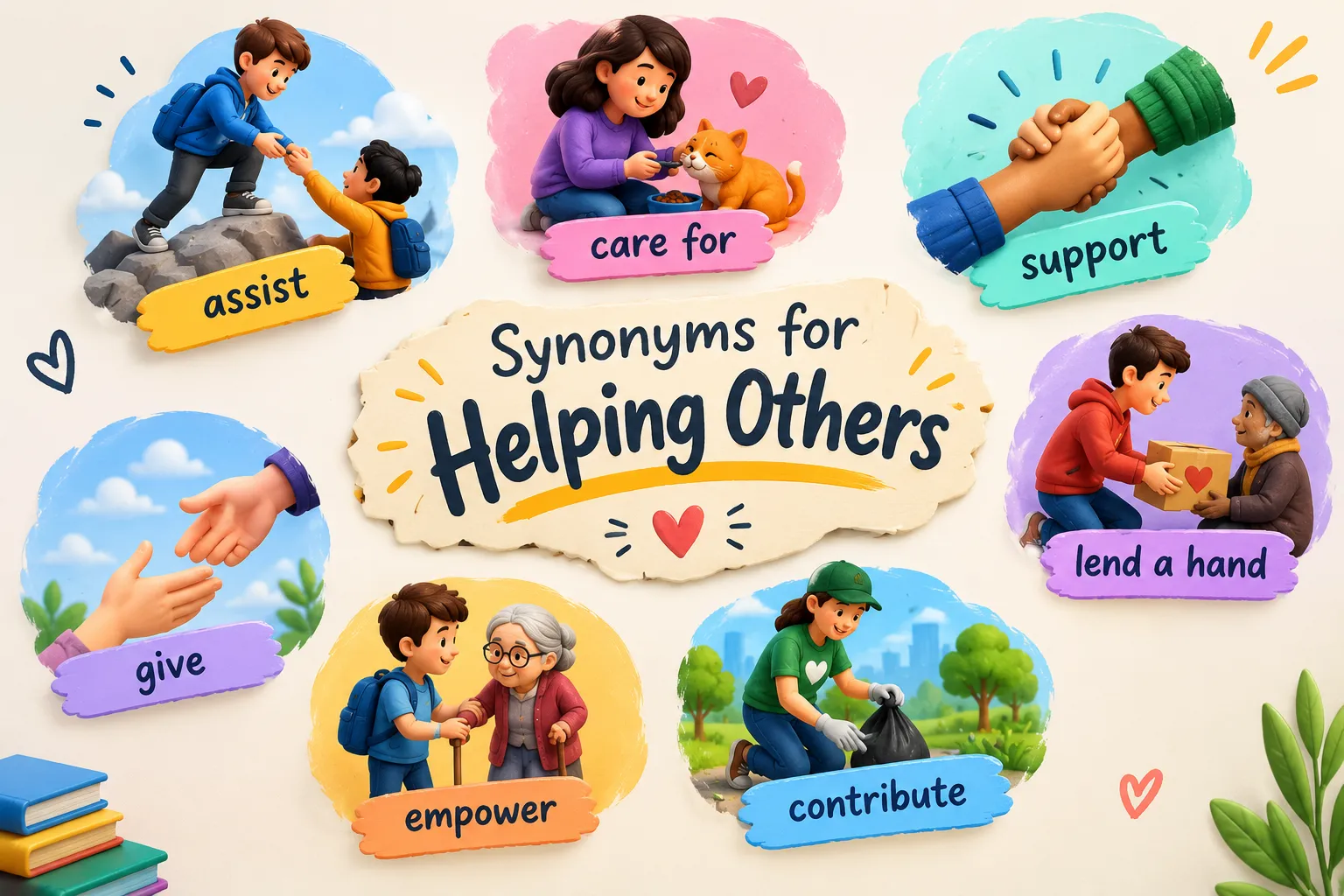
Synonyms for helping others include assisting, supporting, aiding, serving, encouraging, guiding, and caring for others. These words describe actions that make life easier for people who need help. Some focus on practical assistance, while others express kindness, emotional support, or guidance.
For example, assisting means helping someone complete a task, while encouraging means giving someone hope or confidence. Learning these alternatives helps you express kindness more clearly. Moreover, it improves your English vocabulary and makes your speaking and writing more natural.
Meaning of Helping Others
Helping others means giving support, care, or assistance to people who need it. For example, you might help a friend with homework, support a family member during a difficult time, or guide a new student at school.
These small acts can make a big difference in someone’s life. People often use the phrase helping others when discussing kindness, teamwork, community service, and personal growth.
However, repeating the same phrase too often can make writing sound repetitive. Learning synonyms gives you more ways to express your ideas. In this guide, you will discover 26 useful words and expressions related to helping others, along with simple meanings and examples. You will also learn about pronunciation, word forms, history, related categories, and antonyms to improve your English skills.
Definition of Helping Others
Helping others (verb phrase): Giving people support, care, assistance, or guidance to meet their needs, solve problems, or reach their goals.
The phrase usually describes a positive action. It can involve physical work, emotional support, advice, sharing resources, or teaching someone a skill.
Examples
- Helping others makes our community stronger.
- She enjoys helping others learn new skills.
Connotative Meaning of Helping Others
Connotation refers to the feelings or ideas that a word or phrase suggests beyond its basic meaning.
- Positive tone: Helping others can express kindness, generosity, compassion, care, and teamwork.
- Negative tone: Helping can sometimes suggest unwanted interference when someone offers advice or assistance without being asked.
- Neutral tone: The phrase can simply describe practical assistance with a task, problem, or daily need.
Therefore, the context determines how readers understand the phrase.
Etymology of Helping Others
The phrase helping others combines the word help with the plural pronoun others. The word help has Germanic roots.
- Old English (450–1100): The word appeared as helpan, meaning to aid, support, or assist.
- Middle English (1100–1500): The word developed into forms such as helpen and continued to mean giving aid or support.
- Modern English (1500–present): English speakers use help as both a verb and a noun. The phrase helping others commonly describes kindness, support, service, and cooperation.
The word others comes from other, which developed through Old English ōþer. Together, the words express the act of giving assistance to people besides oneself.
Pronunciation of Helping Others
Correct pronunciation can help you speak English more confidently.
- Helping: /ˈhɛlpɪŋ/
- Others: /ˈʌðərz/
- Helping others: /ˈhɛlpɪŋ ˈʌðərz/
- Syllables: Help-ing oth-ers (four syllables in total)
Affixation Pattern of Helping Others
Root
The main root is help, which means to give aid or support.
Prefix
The word help has no prefix in this phrase.
Suffix
The word helping uses the suffix -ing. This suffix forms the present participle of help and can also create a gerund.
Word Formations
| Word | Grammatical Category | Meaning |
|---|---|---|
| Help | Verb / Noun | To give assistance; assistance itself |
| Helps | Verb / Noun | Gives assistance; useful support |
| Helped | Verb | Gave assistance |
| Helping | Verb / Noun | Giving assistance; a serving of food |
| Helper | Noun | A person who gives assistance |
| Helpful | Adjective | Providing useful help |
| Helpfully | Adverb | In a helpful way |
| Helpfulness | Noun | The quality of being helpful |
| Unhelpful | Adjective | Not providing useful help |
| Unhelpfully | Adverb | In a way that does not help |
| Unhelpfulness | Noun | The quality of not being helpful |
Others is the plural form of other when used as a pronoun. It does not share the same word root as help.
26 Synonyms for Helping Others With Meanings and Examples
The following words and expressions describe different ways of helping people. Some are close synonyms, while others apply to specific situations, such as giving advice, offering comfort, or providing resources.
1. Assisting (Verb)
Meaning: Giving someone practical help with a task or problem.
Examples:
- She is assisting her teacher with the class project.
- He spent the afternoon assisting an older adult neighbor.
2. Aiding (Verb)
Meaning: Providing help to someone who needs it.
Examples:
- Volunteers are aiding families after the flood.
- The charity is aiding children in disadvantaged communities.
3. Supporting (Verb)
Meaning: Giving someone help, encouragement, or resources.
Examples:
- Her parents are supporting her education.
- We should support people during difficult times.
4. Helping (Verb)
Meaning: Making a task easier or helping someone meet a need.
Examples:
- He is helping his friend prepare for the exam.
- Helping others can bring people closer together.
5. Serving (Verb)
Meaning: Working to meet the needs of other people or a community.
Examples:
- She spends her weekends serving people at a local shelter.
- The group is serving families who need food.
6. Caring for (Verb Phrase)
Meaning: Looking after someone and meeting their needs.
Examples:
- He is caring for his sick grandfather.
- Nurses spend their days caring for patients.
7. Assisting With (Verb Phrase)
Meaning: Giving practical help with a particular activity.
Examples:
- The students are assisting with the school event.
- She is assisting with the preparation of meals.
8. Encouraging (Verb)
Meaning: Giving someone hope, confidence, or motivation.
Examples:
- The teacher is encouraging students to keep trying.
- Her friends encouraged her after the setback.
9. Guiding (Verb)
Meaning: Showing someone the right way to act or complete a task.
Examples:
- The mentor is guiding young people toward their goals.
- She guided the new student around the school.
10. Advising (Verb)
Meaning: Giving someone suggestions about what they should do.
Examples:
- The counselor is advising students about their careers.
- My brother advised me to study a little every day.
11. Mentoring (Verb)
Meaning: Helping someone develop skills through advice, teaching, and experience.
Examples:
- She is mentoring young teachers at her school.
- Experienced workers are mentoring new employees.
12. Coaching (Verb)
Meaning: Helping someone improve a skill through instruction and practice.
Examples:
- He is coaching children in football.
- Her manager is coaching her to improve her communication skills.
13. Guiding and Supporting (Verb Phrase)
Meaning: Showing someone what to do while giving them ongoing help.
Examples:
- The teacher is guiding and supporting students through the project.
- Parents play an important role in guiding and supporting their children.
14. Caring (Verb / Adjective)
Meaning: Showing concern for another person’s needs and well-being.
Examples:
- She is caring for children at the community center.
- A caring neighbor brought food to a family in need.
15. Comforting (Verb)
Meaning: Helping someone feel better when they are sad, worried, or upset.
Examples:
- He comforted his friend after the bad news.
- Her mother stayed beside her, comforting her during a difficult time.
16. Consoling (Verb)
Meaning: Giving comfort to someone who feels sad or disappointed.
Examples:
- The coach consoled the players after the loss.
- She consoled her friend after the interview.
17. Encouragement (Noun)
Meaning: Words or actions that give someone hope and confidence.
Examples:
- A little encouragement helped him finish the task.
- Her encouragement gave the team confidence.
18. Volunteering (Verb)
Meaning: Offering time or effort to help without expecting payment.
Examples:
- He is volunteering at a local food bank.
- Many students are volunteering to clean the park.
19. Donating (Verb)
Meaning: Giving money, goods, or resources to support someone or a cause.
Examples:
- They are donating clothes to families in need.
- She donated money to help children attend school.
20. Contributing (Verb)
Meaning: Giving time, effort, money, or ideas to support a shared goal.
Examples:
- Everyone is contributing to the community project.
- He contributed useful ideas to help the team succeed.
21. Providing (Verb)
Meaning: Giving someone something they need.
Examples:
- The charity is providing food to people without homes.
- The school is providing books for students.
22. Empowering (Verb)
Meaning: Giving someone the confidence, skills, or resources to act independently.
Examples:
- The program is empowering women through education.
- Good teachers empower students to solve problems.
23. Uplifting (Verb)
Meaning: Making someone feel more hopeful, positive, or confident.
Examples:
- Her kind words uplifted everyone in the room.
- The community event is uplifting people who feel alone.
24. Befriending (Verb)
Meaning: Becoming someone’s friend and offering companionship or support.
Examples:
- She befriended a new student who felt lonely.
- The volunteers are befriending older adults in the neighborhood.
25. Protecting (Verb)
Meaning: Keeping someone safe from harm or danger.
Examples:
- Parents work hard to protect their children.
- The organization is protecting families from abuse.
26. Defending (Verb)
Meaning: Standing up for someone against unfair treatment or attack.
Examples:
- He defended his classmate when others treated him unfairly.
- The lawyer is defending a person who needs legal support.
Prototype Meaning of Helping Others
The typical meaning of helping others involves doing something useful to make another person’s life easier, safer, or better.
For example, someone might help a friend with homework, care for an older adult, share food with a family in need, or volunteer in the community. Helping can involve physical effort, money, advice, emotional support, or time.
Moreover, helping others does not always require a large act. A kind word or a small favor can also make a difference. The main idea is to respond to another person’s needs with useful action, care, or support.
Prototype Categorization
The synonyms for helping others can be grouped according to the kind of support they describe. These categories make it easier to choose a word that fits the situation.
Practical assistance: Assisting, aiding, helping, assisting with, and lending a hand describe direct help with tasks or daily needs.
Emotional support: Supporting, encouraging, comforting, consoling, caring, and uplifting focus on feelings, hope, and well-being.
Teaching and guidance: Guiding, advising, mentoring, and coaching describe help through knowledge, suggestions, and skill development.
Community service and resources: Serving, volunteering, donating, contributing, and providing describe giving time, effort, money, or useful items.
Safety and protection: Protecting, defending, and rescuing describe keeping people safe or helping them escape danger.
Independence and rights: Empowering and advocating for describe helping people gain confidence, access opportunities, or receive fair treatment.
Friendship and teamwork: Befriending and collaborating describe offering companionship or working together toward a shared goal.
Choosing words from these categories makes writing clearer. For example, use comforting when someone feels sad, donating when giving money or goods, and mentoring when helping someone develop skills over time.
Antonyms of Helping Others
Antonyms describe actions that oppose helping, supporting, or caring for others. However, the best opposite depends on the situation.
| Antonym | Part of Speech | Meaning |
|---|---|---|
| Hindering | Verb | Making it harder for someone to succeed |
| Obstructing | Verb | Blocking progress or preventing action |
| Opposing | Verb | Acting against someone’s efforts or plans |
| Ignoring | Verb | Paying no attention to someone’s needs |
| Neglecting | Verb | Failing to give needed care or attention |
| Abandoning | Verb | Leaving someone without needed support |
| Discouraging | Verb | Making someone feel less hopeful or confident |
| Undermining | Verb | Weakening someone’s efforts or confidence |
| Harming | Verb | Causing injury, damage, or distress |
| Exploiting | Verb | Taking unfair advantage of someone |
| Refusing | Verb | Saying no to a request for help |
| Withholding | Verb | Keeping back something someone needs |
| Sabotaging | Verb | Deliberately damaging someone’s efforts |
| Mistreating | Verb | Treating someone in a cruel or unfair way |
| Isolating | Verb | Separating someone from others or support |
For example, supporting means giving someone help, while undermining means weakening their efforts. Similarly, caring for someone contrasts with neglecting their needs.
Frequently Asked Questions
1. What does helping others mean?
Helping others means giving people support, care, advice, resources, or practical assistance when they need it.
2. When should I use helping others?
Use the phrase when describing actions that support people’s needs, solve their problems, or improve their well-being. It fits discussions about kindness, education, family life, teamwork, and community service.
3. Is helping others positive or negative?
Helping others usually has a positive meaning because it shows care and support. However, assistance can become unwanted when someone ignores another person’s wishes or tries to control their choices.
4. How is helping others different from similar words?
Assisting usually means giving practical help with a task. Supporting can include emotional or financial help, while guiding means showing someone what to do. In contrast, volunteering means offering time or effort without expecting payment.
Therefore, choose the word that best fits your context.
Conclusion
Learning synonyms for helping others improves your English vocabulary and helps you express ideas clearly and naturally. Words such as assisting, supporting, encouraging, mentoring, and volunteering describe different forms of help.
Each word has its own meaning, so choosing the right one makes your writing more accurate and interesting. These alternatives are useful in school assignments, essays, daily conversations, and community discussions. Moreover, they help you avoid repeating the same phrase too often.
To improve your English, learn a few new words each day and use them in your own sentences. Notice how people use these words in books, articles, and conversations. With regular practice, you can speak with more confidence, write more clearly, and describe acts of kindness in greater detail.
Read More:
Synonyms for Fearless: 30 Powerful Alternatives

I’m Ayesha Haram, an English content and SEO writer at SynonymsInstant.com. I focus on creating helpful vocabulary resources, word guides, and practical English content that readers can understand quickly. I combine language research, clear explanations, and SEO-focused writing to produce reliable content that supports learners, writers, and everyday English users.