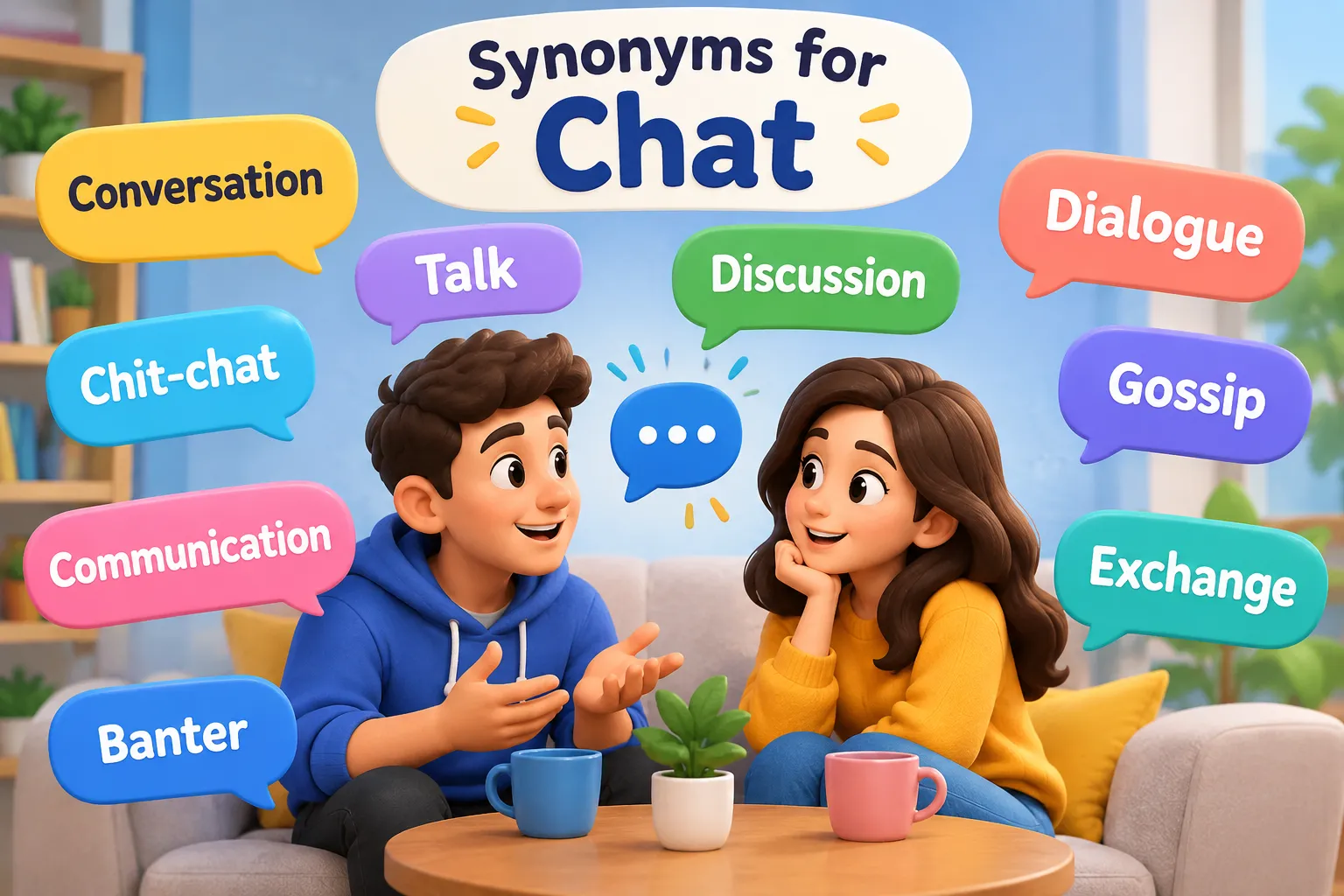
Useful synonyms include talk, converse, discuss, communicate, speak, converse, gossip, visit, banter, interact, dialogue, conversation, discussion, exchange, and communicate. The best alternative depends on the context. For example, talk is general, converse sounds more formal, gossip focuses on personal news, and banter describes playful conversation.
Chat means to talk with someone in a relaxed and friendly way. Imagine meeting a friend after school and sitting together for twenty minutes to talk about your day. You are having a chat. Today, the word is also common online, where people chat through messages, apps, websites, and social platforms. Because chat is used in both everyday speech and digital communication, it has many useful alternatives. Learning synonyms helps English learners choose words that fit different situations and helps content writers avoid repetition. Some alternatives sound formal, while others are friendly, casual, or playful. This article explores the meaning, grammar, history, pronunciation, and word formation of chat. It also provides 30 useful synonyms with examples and groups them into semantic categories.
Meaning of Chat
Definition
Chat (Noun/Verb):
Chat means to talk with someone in a friendly, informal, and relaxed way.
Examples
- I had a quick chat with my friend after class.
- We chatted about our plans for the weekend.
Connotative Meaning
The word chat usually creates a friendly and informal feeling.
- Positive tone: Friendly, relaxed, social, warm, and enjoyable.
- Negative tone: It can sometimes suggest unnecessary or unimportant talk.
- Neutral tone: A simple informal conversation.
(Connotation means the feeling or idea that a word suggests beyond its basic meaning.)
Etymology
The origin of chat is not completely certain. It is generally considered a shortened or altered form related to older words meaning talk or conversation. The word became common in English as a term for informal conversation.
| English Period | Development |
| Old English (450–1100) | The modern word chat was not established. English used other words and expressions for talking and speaking. |
| Middle English (1100–1500) | Related informal forms of speech and conversation developed, while dialectal words connected with talking appeared. |
| Modern English (1500–Present) | Chat became established as a verb and noun meaning informal conversation. In modern digital English, it also refers to online communication. |
Pronunciation (IPA)
- IPA: /tʃæt/
- Syllables: chat
Affixation Pattern of Chat
- Root: chat
- Prefix: None
- Suffix: None
- Word formations:
- Chat — noun/verb
- Chatted — verb
- Chatting — verb/noun
- Chatter — noun/verb
- Chattery — adjective
- Chatty — adjective
- Chattily — adverb
- Chattiness — noun
- Chatroom — noun
- Chatbot — noun
30 Synonyms of Chat With Meaning & Examples
1. Talk (Verb/Noun)
Meaning: To communicate with someone using spoken words.
Examples:
- I need to talk to my teacher.
- We had a long talk after dinner.
2. Converse (Verb)
Meaning: To talk with someone in a formal or thoughtful way.
Examples:
- They conversed about their plans.
- She enjoys conversing with new people.
3. Speak (Verb)
Meaning: To communicate by using words and your voice.
Examples:
- Can I speak with you?
- She spoke about her new project.
4. Communicate (Verb)
Meaning: To share information, thoughts, or feelings with someone.
Examples:
- We communicate through messages.
- Good leaders communicate clearly.
5. Discuss (Verb)
Meaning: To talk about a subject in detail.
Examples:
- We discussed the new project.
- They discussed their travel plans.
6. Converse (Verb)
Meaning: To engage in conversation with another person.
Examples:
- The guests conversed during dinner.
- He likes to converse with his colleagues.
7. Gossip (Verb/Noun)
Meaning: To talk about other people and their private lives.
Examples:
- The friends gossiped about their classmates.
- She does not enjoy office gossip.
8. Visit (Verb)
Meaning: To spend time talking socially with someone.
Examples:
- We visited with our neighbors.
- She visited with her old friend for an hour.
9. Banter (Noun/Verb)
Meaning: To exchange playful and friendly remarks.
Examples:
- The two friends enjoyed their playful banter.
- They bantered during the game.
10. Interact (Verb)
Meaning: To communicate or spend time with another person.
Examples:
- Students interact with their teachers.
- The children interacted happily at the event.
11. Dialogue (Noun/Verb)
Meaning: A conversation between two or more people.
Examples:
- The two leaders had a useful dialogue.
- The characters dialogue about their problems.
12. Conversation (Noun)
Meaning: An informal or formal talk between people.
Examples:
- We had an interesting conversation.
- Our conversation lasted for an hour.
13. Discussion (Noun)
Meaning: A talk in which people share ideas about a topic.
Examples:
- The class had a discussion about climate change.
- Our discussion helped solve the problem.
14. Exchange (Noun/Verb)
Meaning: A sharing of words, ideas, or information between people.
Examples:
- We had a brief exchange before the meeting.
- They exchanged ideas about the project.
15. Confer (Verb)
Meaning: To talk with someone in order to make a decision or share ideas.
Examples:
- The managers conferred about the problem.
- We need to confer before making a decision.
16. Communicate (Verb)
Meaning: To share thoughts or information with another person.
Examples:
- We communicate by email every day.
- The teacher communicated the instructions clearly.
17. Converse Informally (Verb Phrase)
Meaning: To talk in a relaxed and friendly manner.
Examples:
- They conversed informally after the meeting.
- I like to converse informally with my classmates.
18. Talk Over (Phrasal Verb)
Meaning: To discuss something with another person.
Examples:
- Let’s talk over the problem.
- She talked over her plans with her parents.
19. Catch Up (Phrasal Verb)
Meaning: To talk with someone about recent events after not seeing them for some time.
Examples:
- I called my friend to catch up.
- We met for coffee and caught up.
20. Socialize (Verb)
Meaning: To spend time with others in a friendly social way.
Examples:
- Students can socialize during lunch.
- She likes to socialize with her neighbors.
21. Confer With (Phrasal Verb)
Meaning: To talk with someone in order to exchange ideas or make a decision.
Examples:
- I need to confer with my manager.
- The doctors conferred with the family.
22. Parley (Verb/Noun)
Meaning: To talk with someone, especially to reach an agreement.
Examples:
- The two groups agreed to parley.
- The leaders held a parley to discuss peace.
23. Debate (Verb/Noun)
Meaning: To discuss different opinions, often with opposing views.
Examples:
- The students debated the issue.
- We had a lively debate about education.
24. Consult (Verb)
Meaning: To talk with someone to get advice or information.
Examples:
- I consulted my teacher about the assignment.
- She consulted a lawyer before signing the document.
25. Conferment (Noun)
Meaning: A formal process related to granting or discussing something.
Examples:
- The meeting focused on the conferment of awards.
- The conferment ceremony was held on Friday.
26. Correspond (Verb)
Meaning: To communicate by writing, email, or messages.
Examples:
- We correspond by email.
- She corresponded with her old classmates.
27. Dialogue (Verb)
Meaning: To communicate through an exchange of ideas or words.
Examples:
- The groups dialogued about the issue.
- The teams need to dialogue more openly.
28. Riff (Verb)
Meaning: To speak or build ideas freely and casually around a topic.
Examples:
- The speakers riffed about modern technology.
- They riffed on the idea during the meeting.
29. Chatter (Verb/Noun)
Meaning: To talk quickly and casually, often about unimportant things.
Examples:
- The children chattered during lunch.
- We heard cheerful chatter in the room.
30. Shoot the Breeze (Idiom)
Meaning: To have a relaxed conversation about ordinary topics.
Examples:
- We sat outside and shot the breeze.
- They spent the evening shooting the breeze.
Prototype Meaning
The most typical meaning of chat is a relaxed and informal conversation between people. When people hear the word, they often imagine friends sitting together and talking about daily life, hobbies, plans, or simple topics. In modern English, chat can also mean communicating online through messages or a chat platform. The central idea is easy, friendly communication without a highly formal purpose.
Prototype Categorization
The 30 synonyms can be grouped into useful semantic categories:
- Everyday conversation: talk, speak, converse, conversation, discussion. These are useful for general communication.
- Friendly and casual communication: chat, banter, visit, catch up, socialize, chatter, shoot the breeze. These work well for relaxed social situations.
- Information and idea sharing: communicate, interact, exchange, dialogue, correspond. These focus on sharing information or ideas.
- Formal or purposeful discussion: confer, consult, parley, debate, talk over, confer with. These are better when conversation has a goal or decision behind it.
- Informal or playful speech: gossip, banter, riff, chatter. These words can describe casual, playful, or sometimes unnecessary talk.
This categorization helps writers choose a synonym based on the purpose, tone, and setting of the conversation.
Antonyms of Chat
| Antonym | Part of Speech | Meaning |
| Silence | Noun/Verb | A complete lack of speech or sound. |
| Quiet | Adjective/Noun | A state with little or no talking. |
| Ignore | Verb | To deliberately avoid communicating with someone. |
| Listen | Verb | To pay attention to what someone else says. |
| Withdraw | Verb | To move away from social interaction or communication. |
| Avoid | Verb | To stay away from someone or something. |
| Mute | Verb/Adjective | To stop or prevent sound or communication. |
| Disengage | Verb | To stop taking part in communication or interaction. |
| Secrecy | Noun | The state of keeping information hidden. |
| Solitude | Noun | The state of being alone and away from social interaction. |
Short Questions and Answers
What does chat mean?
Chat means to talk with someone in a relaxed, friendly, and informal way. It can also mean an online conversation.
When should chat be used?
Use chat for casual conversations with friends, family, classmates, coworkers, or people online.
Is chat positive or negative?
Chat is usually positive or neutral because it suggests friendly and relaxed communication. However, chatter or gossip can sometimes have a negative meaning.
How is it different from similar words?
Chat is informal and friendly. Talk is more general, converse is more formal, discuss focuses on a topic, and debate usually involves different opinions.
Conclusion
Learning chat and its synonyms can make your English more natural and flexible. Words such as talk, converse, communicate, discuss, interact, banter, socialize, chatter, dialogue, and catch up allow you to describe different types of conversation. Some words are casual, while others are formal or focused on sharing ideas and making decisions. Understanding these differences helps English learners speak with greater accuracy and helps writers avoid repeating the word chat. These alternatives are useful in daily conversations, academic writing, professional communication, stories, and online content. Try using a new synonym in a sentence each day. Regular vocabulary practice will help you remember the words and understand their tone. Over time, you will build stronger vocabulary, improve your communication skills, and feel more confident when speaking and writing English.
Read More:
Synonyms for secondary source: 29 Useful Alternatives

I am Rubab content specialist focused on creating accurate, user-friendly, and search-optimized language resources. Through Synonyminstant, I help readers find synonyms, antonyms, meanings, and vocabulary with ease. Every article is carefully researched and optimized to provide reliable information, clear explanations, and an excellent user experience.