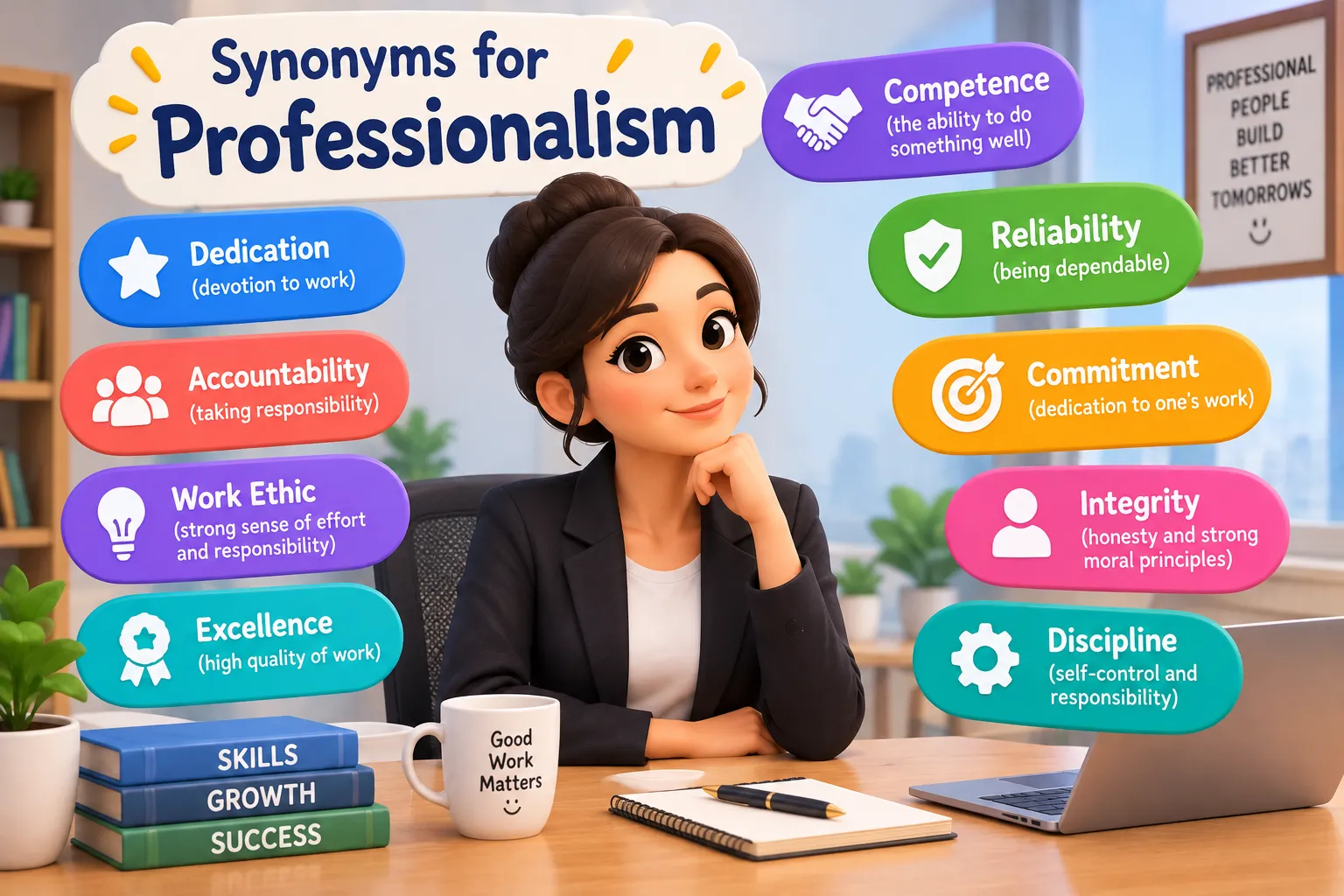
Useful synonyms include competence, expertise, courtesy, discipline, reliability, integrity, efficiency, maturity, responsibility, and dedication. The best synonym depends on the quality you want to highlight. For example, competence focuses on skill, while integrity focuses on honesty and strong moral values.
Professionalism means showing skill, good manners, responsibility, and a serious attitude at work or in other important situations. Imagine a teacher who arrives on time, speaks politely, prepares lessons well, and treats every student with respect. We would call this behavior professionalism. The word is common in workplaces, schools, business, healthcare, and customer service because good professional behavior builds trust. Learning synonyms for professionalism helps English learners express these ideas in different ways. It also helps writers avoid repeating the same word. In this article, we will explore the meaning of professionalism, its examples, pronunciation, history, word forms, and 27 useful synonyms. We will also look at their meanings, examples, antonyms, and semantic categories so you can choose the right word for each situation.
Meaning of Professionalism
Definition
Professionalism (Noun): The quality of behaving in a skilled, responsible, respectful, and appropriate way, especially at work.
Examples
- Her professionalism impressed everyone during the meeting.
- The teacher showed great professionalism when handling the difficult situation.
Connotative Meaning
Connotation: The feelings or ideas that a word suggests beyond its basic meaning.
- Positive tone: Skill, respect, trust, responsibility, confidence, and good work habits.
- Negative tone: It can sometimes suggest behavior that is too formal, distant, or overly focused on rules.
- Neutral tone: A general description of appropriate behavior in a professional setting.
Etymology
The word professionalism comes from professional, which is related to profession. Profession comes through Middle English and Old French from Latin professio, meaning “a public declaration” or “avowal.” The modern sense developed around a person’s occupation, especially one requiring skill or training. The suffix -ism was later added to form professionalism, meaning the qualities or practices connected with being professional.
| Period | Development |
| Old English (450–1100) | The modern word professionalism did not exist in Old English. Related ideas were expressed through words connected with skill, duty, work, and conduct. |
| Middle English (1100–1500) | Profession entered English through Anglo-French/Old French, linked to Latin professio, meaning a public declaration or profession of belief. |
| Modern English (1500–Present) | Professional developed in connection with trained occupations, and professionalism came to mean the qualities and behavior expected from a professional. |
Pronunciation (IPA)
- IPA: /prəˈfeʃənəlɪzəm/
- Syllables: pro-fes-sion-al-ism
Affixation Pattern of Professionalism
- Root: profession
- Prefix: None
- Suffix: -al and -ism
- Word formations:
- profession — noun
- professional — noun/adjective
- professionally — adverb
- professionalism — noun
- professionalize — verb
- professionalization — noun
- professionalized — adjective/verb form
27 Synonyms of Professionalism With Meaning & Examples
1. Competence (Noun)
Meaning: The ability to do a task well and effectively.
Examples:
- Her competence made her a valuable member of the team.
- The manager praised his technical competence.
2. Expertise (Noun)
Meaning: A high level of knowledge or skill in a particular area.
Examples:
- Her expertise in teaching is impressive.
- We need his technical expertise for this project.
3. Skill (Noun)
Meaning: The ability to perform a task well.
Examples:
- His communication skills are excellent.
- The job requires strong computer skills.
4. Proficiency (Noun)
Meaning: A good level of skill in doing something.
Examples:
- She has high proficiency in English.
- His computer proficiency helped him complete the task quickly.
5. Efficiency (Noun)
Meaning: The ability to complete work well without wasting time or resources.
Examples:
- The new system improved office efficiency.
- Her efficiency helped the team meet the deadline.
6. Competence (Noun)
Meaning: The quality of having enough ability and knowledge to perform a task successfully.
Examples:
- The company values employee competence.
- His competence was clear during the presentation.
7. Expertise (Noun)
Meaning: Specialized knowledge gained through training and experience.
Examples:
- The doctor is known for her medical expertise.
- His financial expertise helped the business grow.
8. Discipline (Noun)
Meaning: The ability to follow rules and control your actions to achieve a goal.
Examples:
- Good discipline is important in the workplace.
- Her discipline helped her finish the project on time.
9. Responsibility (Noun)
Meaning: The quality of being dependable and willing to manage duties properly.
Examples:
- He takes responsibility for his work.
- Professional employees show a strong sense of responsibility.
10. Reliability (Noun)
Meaning: The quality of being trusted to do what you promise.
Examples:
- Her reliability made her a trusted employee.
- The manager values honesty and reliability.
11. Integrity (Noun)
Meaning: The quality of being honest and following strong moral principles.
Examples:
- The leader is respected for his integrity.
- Professional behavior requires integrity.
12. Diligence (Noun)
Meaning: Careful and hardworking effort over time.
Examples:
- Her diligence helped her complete the research.
- The project succeeded because of his diligence.
13. Dedication (Noun)
Meaning: Strong commitment to a task, job, or purpose.
Examples:
- Her dedication to teaching is inspiring.
- The team’s dedication produced excellent results.
14. Commitment (Noun)
Meaning: A strong promise or willingness to continue supporting something.
Examples:
- His commitment to his students is clear.
- The company showed its commitment to quality.
15. Maturity (Noun)
Meaning: The ability to behave wisely, calmly, and responsibly.
Examples:
- She handled the complaint with great maturity.
- His maturity helped him solve the conflict.
16. Courtesy (Noun)
Meaning: Polite and respectful behavior toward others.
Examples:
- The receptionist treated every visitor with courtesy.
- Simple courtesy can improve workplace relationships.
17. Politeness (Noun)
Meaning: The quality of behaving in a respectful and well-mannered way.
Examples:
- Her politeness made customers feel welcome.
- Politeness is important during professional communication.
18. Decorum (Noun)
Meaning: Proper and respectful behavior in a particular setting.
Examples:
- Employees should maintain decorum during meetings.
- The speaker showed excellent decorum at the event.
19. Work Ethic (Noun)
Meaning: A person’s attitude toward hard work, responsibility, and doing a job well.
Examples:
- She has a strong work ethic.
- His excellent work ethic impressed his employer.
20. Professional Conduct (Noun)
Meaning: Behavior that follows accepted standards in a workplace or profession.
Examples:
- Employees must follow rules of professional conduct.
- Her professional conduct earned the client’s trust.
21. Formality (Noun)
Meaning: Behavior that follows accepted social or professional rules.
Examples:
- The meeting required a certain level of formality.
- His professional formality suited the situation.
22. Seriousness (Noun)
Meaning: A careful and focused attitude toward something important.
Examples:
- She approached the project with seriousness.
- His seriousness showed that he understood the problem.
23. Preparedness (Noun)
Meaning: The state of being ready for a task or situation.
Examples:
- Her preparedness made the presentation successful.
- Good preparedness reduces workplace mistakes.
24. Punctuality (Noun)
Meaning: The habit of arriving or completing things at the expected time.
Examples:
- Punctuality is important in professional life.
- His punctuality impressed his manager.
25. Accountability (Noun)
Meaning: The willingness to accept responsibility for actions and results.
Examples:
- Good leaders promote accountability.
- She accepted accountability for the mistake.
26. Trustworthiness (Noun)
Meaning: The quality of being honest and worthy of trust.
Examples:
- His trustworthiness made him a strong team leader.
- Customers value employee trustworthiness.
27. Dependability (Noun)
Meaning: The quality of being reliable and consistently responsible.
Examples:
- Her dependability made her essential to the team.
- Employers look for dependability in new workers.
Prototype Meaning
The most typical meaning of professionalism is the way a person behaves at work or in a professional setting. People usually imagine someone who is skilled, prepared, punctual, respectful, responsible, calm, and reliable. For example, a professional teacher arrives on time, prepares lessons, communicates clearly, and treats students fairly. This combination of good behavior and strong work standards represents professionalism.
Prototype Categorization
- Skill and ability: competence, expertise, skill, proficiency, efficiency — useful when professionalism means doing work well.
- Responsibility and reliability: responsibility, reliability, accountability, dependability, preparedness — useful for describing trustworthy workers.
- Hard work and commitment: diligence, dedication, commitment, discipline, work ethic — useful when focusing on effort and commitment.
- Honesty and character: integrity, trustworthiness, maturity — useful when professional behavior involves strong personal values.
- Polite and respectful behavior: courtesy, politeness, decorum, civility, professional conduct — useful for workplace manners and communication.
- High standards: excellence, seriousness, formality — useful when describing quality, careful behavior, or formal settings.
This categorization helps writers choose a word that matches the exact quality they want to describe instead of using professionalism repeatedly.
Antonyms of Professionalism
| Antonym | Part of Speech | Meaning |
| Unprofessionalism | Noun | Behavior that does not meet professional standards. |
| Incompetence | Noun | Lack of ability or skill to do something properly. |
| Irresponsibility | Noun | Failure to act responsibly or manage duties properly. |
| Carelessness | Noun | Lack of attention or proper care. |
| Negligence | Noun | Failure to give proper care or attention to a duty. |
| Unreliability | Noun | The quality of being difficult to trust or depend on. |
| Dishonesty | Noun | Lack of honesty or truthfulness. |
| Rudeness | Noun | Behavior that is impolite or disrespectful. |
| Indiscipline | Noun | Lack of control or failure to follow rules. |
| Amateurism | Noun | Lack of professional skill, experience, or standards. |
Short Questions and Answers
What does professionalism mean?
Professionalism means behaving in a skilled, responsible, respectful, and appropriate way, especially at work.
When should professionalism be used?
Use professionalism when talking about good workplace behavior, strong work standards, proper conduct, or the qualities expected from a professional.
Is professionalism positive or negative?
Professionalism is usually positive because it suggests skill, respect, responsibility, and reliability. However, in some contexts, it may suggest behavior that feels overly formal or distant.
How is professionalism different from similar words?
Professionalism is a broad term. Competence focuses on skill, integrity focuses on honesty, reliability focuses on dependability, and courtesy focuses on politeness.
Conclusion
Learning professionalism and its synonyms can make your English stronger and more flexible. Professionalism describes much more than simply doing a job. It can include skill, responsibility, honesty, discipline, respect, reliability, and dedication. Words such as competence, expertise, integrity, diligence, accountability, courtesy, and excellence help you describe these qualities more precisely. Using the right synonym also makes writing and speaking clearer and helps you avoid repeating the same word. English learners can build confidence by studying these words in real sentences and noticing how their meanings change with context. Content writers can use them to create natural and engaging text. Try learning a few new words each day, write your own examples, and use them in real conversations or writing. Regular practice will make professional vocabulary easier to remember and use.
Read More:
Synonyms for chat: 30 Positive Words to Boost Your Vocabulary

I’m Ayesha Haram, an English content and SEO writer at SynonymsInstant.com. I focus on creating helpful vocabulary resources, word guides, and practical English content that readers can understand quickly. I combine language research, clear explanations, and SEO-focused writing to produce reliable content that supports learners, writers, and everyday English users.