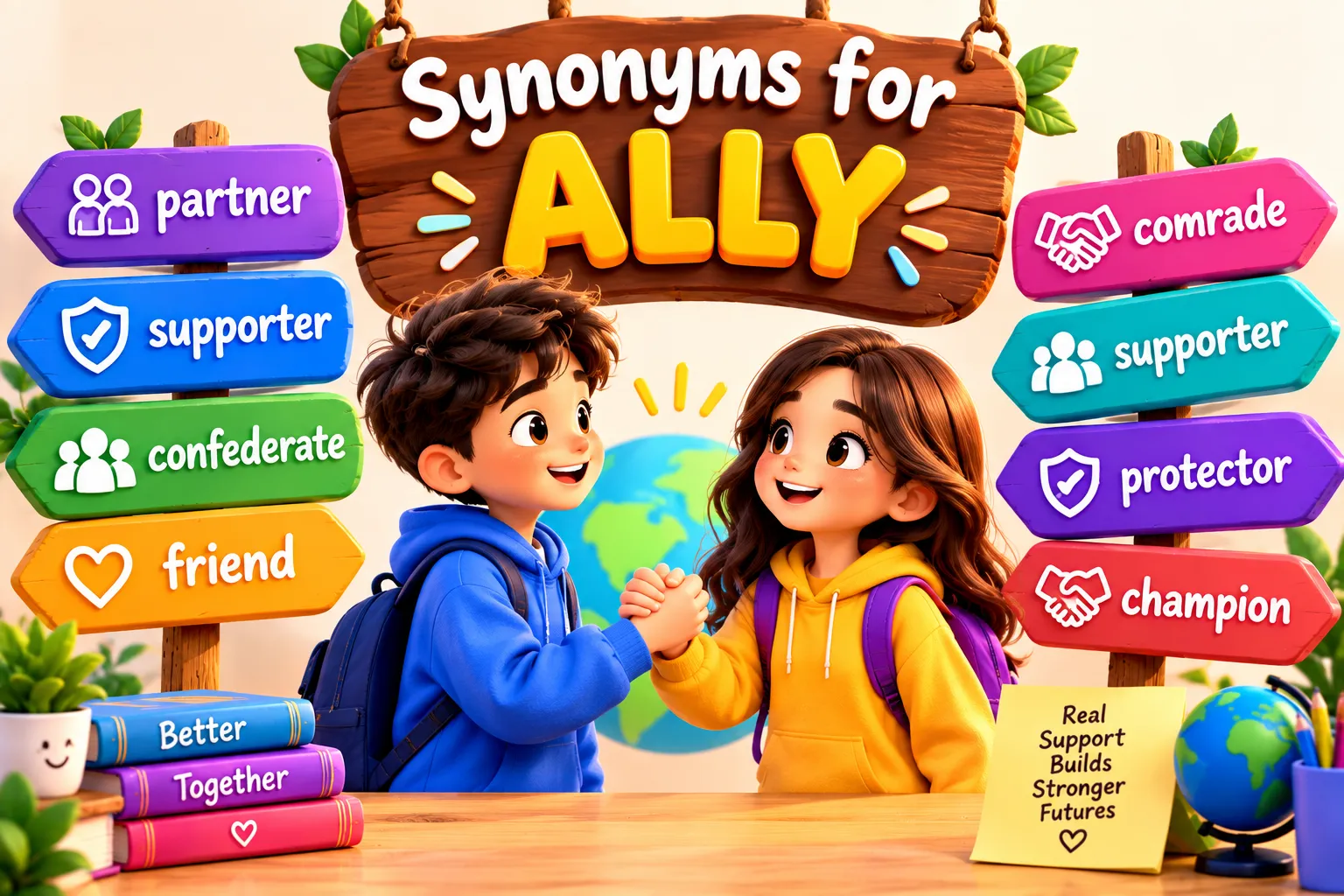
Common synonyms include friend, partner, supporter, associate, collaborator, companion, advocate, teammate, confederate, and coalition partner. The best synonym depends on the situation. For example, a partner works well in business, a supporter fits a person who gives help, and a friend is more common in personal relationships.
Ally means someone who supports you or works with you toward a shared goal. Imagine two students preparing for an important exam. They study together, share notes, and help each other understand difficult topics. In this situation, each student can be an ally to the other. The word is common in personal relationships, business, politics, teamwork, and international affairs. Learning synonyms for ally helps English learners express support and cooperation in more precise ways. It also helps content writers avoid repeating the same word and choose vocabulary that fits the context. In this article, we will explore the meaning of ally and 29 useful alternatives. We will also cover examples, grammar, history, pronunciation, word formation, connotations, semantic categories, antonyms, and practical questions.
Meaning of ally
Definition
Ally (Noun/Verb): A person, group, or country that supports another or works together with them for a shared purpose; as a verb, ally means to join or connect with another.
Examples
- Canada is a close ally of the United States.
- She found an ally in her new colleague.
- The two organizations allied to support the community.
Connotative Meaning
- Positive tone: Suggests friendship, trust, loyalty, cooperation, and mutual support.
- Negative tone: In some contexts, an ally may be viewed as someone supporting a questionable group or cause.
- Neutral tone: Can simply describe a person, group, or country that cooperates with another.
(Connotation: the feeling or idea that a word suggests beyond its basic meaning.)
Etymology
The word ally comes through Old French from Latin alligare, meaning “to bind to” or “to connect.” Its meaning developed toward people or groups joined by a shared interest or purpose.
| Period | Development |
| Old English (450–1100) | The modern word ally was not established in Old English. Ideas of friendship, support, and joining were expressed through native Germanic words. |
| Middle English (1100–1500) | Ally entered English through Old French forms related to alié, from Latin alligare, meaning “to bind” or “to join.” |
| Modern English (1500–Present) | Ally developed its current meanings for people, organizations, and nations that cooperate or support one another. |
Pronunciation (IPA)
- IPA: /ˈælaɪ/ — noun
- IPA: /əˈlaɪ/ — verb
- Syllables: al-ly
Affixation Pattern of ally
- Root: Latin ligare, meaning “to bind”
- Prefix: al-, a form of Latin ad- meaning “to” or “toward,” changed before l
- Suffix: None in the modern English form
- Word formations:
- ally — noun/verb
- allied — adjective/past participle
- allies — plural noun/third-person verb
- alliance — noun
- allied — adjective
- allying — verb form
29 Synonyms of ally With Meaning & Examples
1. Friend (Noun)
Meaning: A person who cares about you and supports you.
Examples:
- She became a trusted friend during college.
- A good friend will support you in difficult times.
2. Partner (Noun)
Meaning: A person or group that works together with another.
Examples:
- The company found a new business partner.
- My study partner helped me prepare for the exam.
3. Supporter (Noun)
Meaning: Someone who gives help, approval, or encouragement.
Examples:
- She has always been a strong supporter of the project.
- His family was his biggest supporter.
4. Associate (Noun)
Meaning: A person who works or spends time with another person or organization.
Examples:
- He is a business associate of mine.
- The manager met with several associates.
5. Collaborator (Noun)
Meaning: Someone who works with others on a shared task or project.
Examples:
- She was an important collaborator on the research project.
- We need a skilled collaborator for this task.
6. Companion (Noun)
Meaning: A person who spends time with or supports another person.
Examples:
- His dog was his loyal companion.
- She traveled with a close companion.
7. Advocate (Noun)
Meaning: A person who publicly supports an idea, cause, or person.
Examples:
- She is an advocate for equal education.
- The group became a strong advocate for the new policy.
8. Teammate (Noun)
Meaning: A person who belongs to the same team and works toward the same goal.
Examples:
- My teammate helped me finish the project.
- Every teammate contributed to the victory.
9. Colleague (Noun)
Meaning: A person who works with you.
Examples:
- My colleague helped me solve the problem.
- She discussed the idea with her colleagues.
10. Accomplice (Noun)
Meaning: A person who joins another in an activity, often an illegal or wrong one.
Examples:
- The thief was arrested with his accomplice.
- Police believed he had an accomplice.
11. Confeder ate (Noun)
Meaning: A person or group joined with another for a shared purpose.
Examples:
- The leader met with his confederates.
- Several groups became confederates in the campaign.
12. Coalition Partner (Noun Phrase)
Meaning: A person or group that works with others as part of a coalition.
Examples:
- The organization welcomed a new coalition partner.
- Each coalition partner contributed resources.
13. Associate (Noun)
Meaning: Someone connected with another person through work or a shared activity.
Examples:
- He introduced me to his business associate.
- The lawyer spoke with her associate.
14. Backer (Noun)
Meaning: A person or organization that provides support, money, or approval.
Examples:
- The project received financial support from a major backer.
- She found a powerful backer for her campaign.
15. Champion (Noun)
Meaning: A person who strongly supports a cause or person.
Examples:
- She became a champion of children’s education.
- He is a champion for environmental protection.
16. Defender (Noun)
Meaning: Someone who protects or supports a person, idea, or cause.
Examples:
- She is a strong defender of free speech.
- The lawyer acted as a defender of his client.
17. Helper (Noun)
Meaning: A person who provides assistance or support.
Examples:
- His brother was a helpful helper during the move.
- Every helper received a thank-you message.
18. Supporter (Noun)
Meaning: Someone who stands behind a person, group, or cause.
Examples:
- The candidate thanked every supporter.
- Her supporters helped organize the event.
19. Fellow (Noun)
Meaning: A person who shares an activity, group, or experience with another.
Examples:
- He discussed the issue with his fellows.
- She worked with her fellow students.
20. Cohort (Noun)
Meaning: A group of people who share a common activity, period, or purpose.
Examples:
- Her study cohort helped her stay motivated.
- The training program created a strong cohort.
21. Confidant (Noun)
Meaning: A trusted person with whom someone shares private thoughts.
Examples:
- Her closest confidant knew about the plan.
- He trusted his friend as a confidant.
22. Proponent (Noun)
Meaning: A person who supports or argues in favor of an idea.
Examples:
- She is a strong proponent of online education.
- The proponent explained the benefits of the plan.
23. Affiliated Partner (Noun Phrase)
Meaning: A person or organization connected with another through a shared purpose or relationship.
Examples:
- The program works with several affiliated partners.
- Each affiliated partner follows the same basic standards.
24. Associate Partner (Noun Phrase)
Meaning: A person or organization connected to another as a partner.
Examples:
- The firm welcomed an associate partner.
- Each associate partner helped expand the service.
25. Cooperator (Noun)
Meaning: Someone who works with others to achieve a shared goal.
Examples:
- Every cooperator helped complete the project.
- The organization thanked its international cooperators.
26. Teammate (Noun)
Meaning: A person who works alongside you as part of the same team.
Examples:
- My teammate gave me useful advice.
- She trusted her teammates during the competition.
27. Collaborator (Noun)
Meaning: Someone who joins others to create or complete something.
Examples:
- The writer worked with a talented collaborator.
- Each collaborator brought a new idea.
28. Mutual Supporter (Noun Phrase)
Meaning: A person who gives and receives support within a shared relationship.
Examples:
- The two groups became mutual supporters.
- Strong teams often have mutual supporters.
29. Strategic Partner (Noun Phrase)
Meaning: A person or organization that works with another for an important long-term goal.
Examples:
- The company chose a technology firm as its strategic partner.
- Our strategic partner helped us enter a new market.
Prototype Meaning
The most typical meaning of ally is a person, group, or country that supports another because they share an interest or goal. When people hear “ally,” they often imagine trusted partners working together against a common problem or toward a shared purpose. The relationship usually involves cooperation, support, or mutual benefit.
Prototype Categorization
- Personal support: friend, companion, confidant, fellow, helper. These words work best for personal relationships.
- Work and teamwork: partner, associate, collaborator, colleague, teammate, cohort, cooperator. These describe people working together.
- Support for a cause: supporter, advocate, champion, defender, proponent, backer. These are useful when someone actively supports an idea or cause.
- Formal cooperation: coalition partner, strategic partner, affiliated partner, associate partner. These terms fit organizations, business, and formal groups.
- Shared interests: ally, mutual supporter, fellow supporter, confederate. These focus on people or groups connected by a common purpose.
- Negative or special context: accomplice. This can describe cooperation, but it usually involves wrongdoing.
This categorization helps writers select a word that matches the situation. Friend sounds personal, partner sounds cooperative, advocate suggests active support, and strategic partner suggests a formal long-term relationship.
Antonyms of ally
| Antonym | Part of Speech | Meaning |
| Enemy | Noun | A person or group that opposes another |
| Opponent | Noun | Someone who competes against or disagrees with another |
| Adversary | Noun | A person or group that strongly opposes another |
| Rival | Noun | Someone competing for the same goal or advantage |
| Foe | Noun | An enemy or opponent |
| Competitor | Noun | A person or group competing against another |
| Antagonist | Noun | Someone who actively opposes another |
| Opponent | Noun | A person who takes the opposite side |
| Detractor | Noun | Someone who openly criticizes a person or idea |
| Traitor | Noun | Someone who betrays a person, group, or country |
Short Questions and Answers
What does ally mean?
An ally is a person, group, or country that supports or cooperates with another.
When should ally be used?
Use ally when two people, groups, or countries work together or support each other because they share a goal or interest.
Is ally positive or negative?
Ally is usually positive because it suggests support and cooperation. However, its tone can depend on the group or cause being supported.
How is ally different from similar words?
Ally focuses on support and shared interests. A friend usually suggests a personal relationship, while a partner emphasizes working together. Advocate specifically means someone who actively supports a cause or idea.
Conclusion
Learning ally and its synonyms can strengthen your English vocabulary and help you express relationships more accurately. Words such as friend, partner, supporter, collaborator, advocate, teammate, backer, champion, and strategic partner each carry a slightly different meaning. Choosing the right word makes your writing clearer and more natural. These alternatives are useful in conversations, essays, business writing, news articles, and academic work. They can also help you avoid repeating ally too often. Remember that some alternatives are broad, while others fit special situations. For example, a friend is personal, a collaborator is work-focused, and an advocate is often connected with a cause. Practice these words in your own sentences each day. Regular vocabulary practice will improve your writing, speaking, and confidence in English.
Read More:
Synonyms for enlightenment: 30 Powerful Alternatives

I am Rubab content specialist focused on creating accurate, user-friendly, and search-optimized language resources. Through Synonyminstant, I help readers find synonyms, antonyms, meanings, and vocabulary with ease. Every article is carefully researched and optimized to provide reliable information, clear explanations, and an excellent user experience.