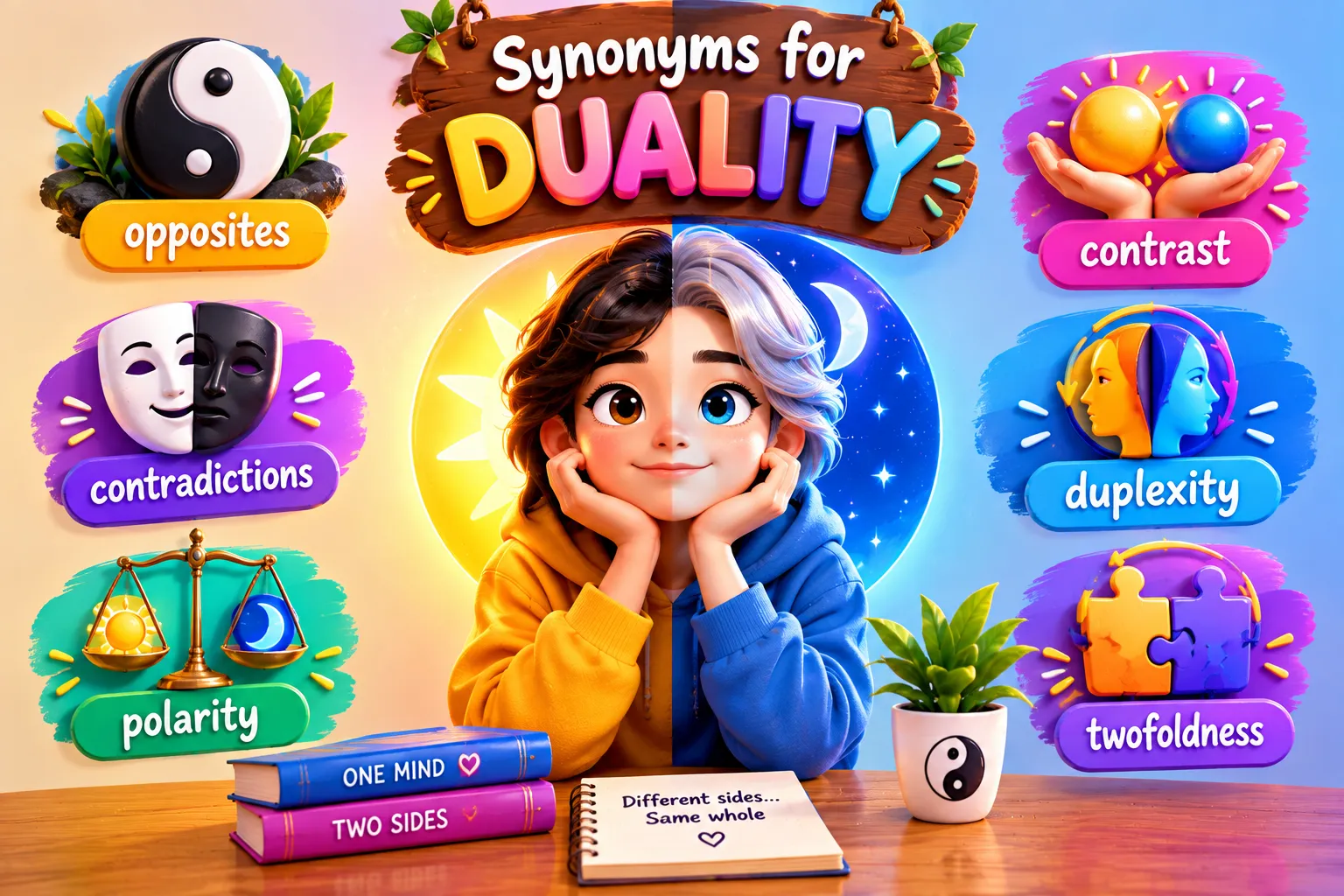
Common synonyms include dichotomy, contrast, opposition, division, polarity, dualism, twofoldness, and dichotomous nature. The best synonym depends on context. For example, duality can describe two sides of a person, two opposite ideas, or two connected forces. Learning these alternatives helps English learners and writers express contrast and complexity more clearly.
Duality means the presence of two different or opposite sides within one thing. Imagine a person who is calm at work but playful with friends. This shows a kind of duality because two different qualities exist in the same person. The word is often used in writing, philosophy, psychology, art, and everyday discussions about people or ideas. Learning synonyms for duality helps English learners choose words that match the exact meaning they want. It also helps content writers avoid repeating the same word. In this article, we will explore the meaning, examples, pronunciation, history, word formation, synonyms, antonyms, and semantic groups of duality. These examples will help you understand how each related word works in real English.
Meaning of Duality
Definition
Duality (Noun):
Duality means the state of having two different, opposite, or closely connected parts, sides, or qualities.
Examples
- The story explores the duality between good and evil.
- Her personality shows a duality of strength and kindness.
Connotative Meaning
Connotation means the feelings or ideas that a word suggests beyond its basic meaning.
- Positive tone: Duality can suggest balance, richness, complexity, or harmony between two sides.
- Negative tone: It can suggest conflict, contradiction, division, or inner struggle.
- Neutral tone: It can simply describe the existence of two distinct sides or aspects.
Etymology
The word duality comes from dual, which traces back to Latin dualis, meaning “of two.” The suffix -ity forms a noun describing a state or quality.
| Period | Development |
| Old English (450–1100) | The exact modern word duality was not used. Ideas of “two” were expressed through native words related to twēgen, meaning “two.” |
| Middle English (1100–1500) | Latin-based forms connected with dual entered learned English vocabulary through French and Latin influence. |
| Modern English (1500–Present) | Duality developed from dual + -ity and came to mean the state or quality of having two parts, sides, or aspects. |
Pronunciation (IPA)
- IPA: /duːˈælɪti/
- Syllables: du-al-i-ty
Affixation Pattern of Duality
- Root: du- / duo- — related to the idea of “two”
- Prefix: None in the modern English formation
- Suffix: -ity — forms nouns describing a state, condition, or quality
Word formations:
- dual — adjective/noun
- duality — noun
- dually — adverb
- dualistic — adjective
- dualism — noun
- dualist — noun/adjective
- dualistically — adverb
26 Synonyms of Duality With Meaning & Examples
1. Dichotomy (Noun)
Meaning: A dichotomy is a division between two strongly different or opposite things.
Examples:
- The essay discusses the dichotomy between freedom and control.
- The film presents a clear dichotomy between rich and poor.
2. Dualism (Noun)
Meaning: Dualism is the idea that something has two distinct or opposing parts.
Examples:
- The philosopher wrote about mind-body dualism.
- The theory is based on a form of dualism.
3. Polarity (Noun)
Meaning: Polarity is the existence of two opposite positions, qualities, or forces.
Examples:
- There is a strong polarity between the two political views.
- The debate created a polarity between tradition and change.
4. Contrast (Noun)
Meaning: Contrast is a clear difference between two things.
Examples:
- The contrast between light and darkness is striking.
- Her actions show a contrast between kindness and anger.
5. Opposition (Noun)
Meaning: Opposition means a state in which two ideas, forces, or sides work against each other.
Examples:
- The novel explores opposition between good and evil.
- Their opposition created tension in the story.
6. Division (Noun)
Meaning: Division means the separation of something into two or more parts.
Examples:
- The division between the groups became clear.
- The issue caused division within the community.
7. Disparity (Noun)
Meaning: Disparity means a noticeable difference between two things.
Examples:
- There is a large disparity between the two incomes.
- The study shows a disparity between the groups.
8. Disjunction (Noun)
Meaning: Disjunction means a separation or lack of connection between two things.
Examples:
- The report shows a disjunction between policy and practice.
- There is a clear disjunction between his words and actions.
9. Dichotomization (Noun)
Meaning: Dichotomization is the act of dividing something into two distinct categories.
Examples:
- The dichotomization of the data made the results easier to compare.
- The study used dichotomization to create two groups.
10. Twofoldness (Noun)
Meaning: Twofoldness means having two parts, aspects, or qualities.
Examples:
- The twofoldness of the character makes her interesting.
- The poem has a clear sense of twofoldness.
11. Ambivalence (Noun)
Meaning: Ambivalence is having two conflicting feelings or attitudes at the same time.
Examples:
- He felt ambivalence about leaving his hometown.
- Her ambivalence made the decision difficult.
12. Contradiction (Noun)
Meaning: Contradiction is a situation where two ideas or statements cannot easily agree.
Examples:
- There is a contradiction between his words and actions.
- The character lives with an inner contradiction.
13. Dual Nature (Noun Phrase)
Meaning: Dual nature means having two different sides or qualities.
Examples:
- The leader has a dual nature.
- The story focuses on the hero’s dual nature.
14. Two-Sidedness (Noun)
Meaning: Two-sidedness means having two distinct sides or viewpoints.
Examples:
- The issue has a clear two-sidedness.
- The author’s discussion recognizes the two-sidedness of the problem.
15. Bifurcation (Noun)
Meaning: Bifurcation means a division into two branches, parts, or directions.
Examples:
- The road reaches a bifurcation near the village.
- The decision caused a bifurcation in the organization.
16. Separation (Noun)
Meaning: Separation means the state of being divided or kept apart.
Examples:
- The separation between the two ideas is clear.
- The painting shows separation between opposing worlds.
17. Divergence (Noun)
Meaning: Divergence means moving or developing in different directions.
Examples:
- The two theories show a major divergence.
- Their opinions began to show divergence over time.
18. Discrimination (Noun)
Meaning: Discrimination can mean recognizing or showing a difference between two things.
Examples:
- The system allows discrimination between different categories.
- Careful discrimination helps readers understand the two ideas.
19. Antithesis (Noun)
Meaning: Antithesis is a strong contrast between two opposite ideas or things.
Examples:
- The poem presents hope as the antithesis of despair.
- The two characters are written as antitheses.
20. Counterpoint (Noun)
Meaning: Counterpoint is a contrasting element placed beside another element.
Examples:
- The character provides a counterpoint to the hero.
- Her calm attitude is a counterpoint to his anger.
21. Complementarity (Noun)
Meaning: Complementarity means two different parts that work together or complete each other.
Examples:
- The design shows complementarity between form and function.
- Their skills demonstrate strong complementarity.
22. Duality of Nature (Noun Phrase)
Meaning: Duality of nature means having two different qualities within the same person or thing.
Examples:
- The story explores the hero’s duality of nature.
- His duality of nature makes him difficult to understand.
23. Split (Noun)
Meaning: A split is a division between two sides or groups.
Examples:
- The argument caused a split within the team.
- The novel shows a split between two social groups.
24. Dichotomousness (Noun)
Meaning: Dichotomousness is the quality of being divided into two distinct categories.
Examples:
- The dichotomousness of the argument limits its depth.
- Researchers questioned the dichotomousness of the classification.
25. Bipartition (Noun)
Meaning: Bipartition means dividing something into two parts.
Examples:
- The bipartition of the group was unexpected.
- The model uses a simple bipartition of the data.
Prototype Meaning
The most typical meaning of duality is the existence of two different or opposite sides within one thing. When people hear the word, they often imagine pairs such as good and evil, light and darkness, body and mind, or strength and weakness. The two sides may conflict, but they can also work together or create balance.
Prototype Categorization
The 26 alternatives can be grouped into useful semantic categories:
- Direct two-part concepts: twofoldness, two-sidedness, dual nature, bipartition, bifurcation — useful when the main idea is simply having two parts.
- Strong contrast: dichotomy, antithesis, contrast, polarity, opposition — best when the two sides are clearly different or opposite.
- Division and separation: division, separation, split, disjunction, dichotomization — useful when something is separated into distinct groups or parts.
- Inner psychological conflict: ambivalence, contradiction, inner conflict — useful for describing mixed feelings, personality, or internal struggles.
- Different directions or views: divergence, disparity, polarity of views, dualism of thought — useful in academic, social, and argumentative writing.
- Balanced or connected opposites: complementarity, counterpoint, complementary opposition — useful when two different sides work together or enhance each other.
- Specialized academic terms: dualism, dichotomousness, bipartition, discrimination — suitable for philosophy, science, research, and formal writing.
This grouping helps writers choose a word based on context, strength of contrast, and intended meaning, rather than replacing duality with any random similar word.
Antonyms of Duality
| Antonym | Part of Speech | Meaning |
| Unity | Noun | A state of being joined as one. |
| Oneness | Noun | The state of being one or undivided. |
| Singularity | Noun | The quality of being single or unique. |
| Sameness | Noun | The state of having no important difference. |
| Uniformity | Noun | A state in which things are the same or consistent. |
| Integration | Noun | The process of combining separate parts into one whole. |
| Harmony | Noun | A pleasing state in which different parts work well together. |
| Unification | Noun | The act of bringing separate parts together as one. |
Short Questions and Answers
What does duality mean?
Duality means having two different, opposite, or connected sides, qualities, or parts.
When should duality be used?
Use duality when you want to describe two sides or aspects of one person, object, idea, or situation.
Is duality positive or negative?
Duality is neutral by itself. It can suggest balance and complexity or conflict and contradiction depending on the context.
How is it different from similar words?
Duality is a broad word for two sides or aspects. Dichotomy usually stresses a sharp division, while ambivalence focuses on conflicting feelings and polarity emphasizes opposing forces or positions.
Conclusion
Learning duality and its synonyms can make your English more precise and flexible. Words such as dichotomy, polarity, contrast, dualism, and ambivalence describe different kinds of two-sided relationships. Knowing these differences helps you choose the right word for essays, stories, conversations, and professional writing. It also reduces repetition and makes your ideas easier to understand. For English learners, studying synonyms is a useful way to build vocabulary and improve both speaking and writing. Try using one new word each day in your own sentence. With regular practice, you will become more confident in recognizing subtle differences between related words.
Read More:
Synonyms for ally: 29 Positive Words to Boost Your Vocabulary

I’m Ayesha Haram, an English content and SEO writer at SynonymsInstant.com. I focus on creating helpful vocabulary resources, word guides, and practical English content that readers can understand quickly. I combine language research, clear explanations, and SEO-focused writing to produce reliable content that supports learners, writers, and everyday English users.