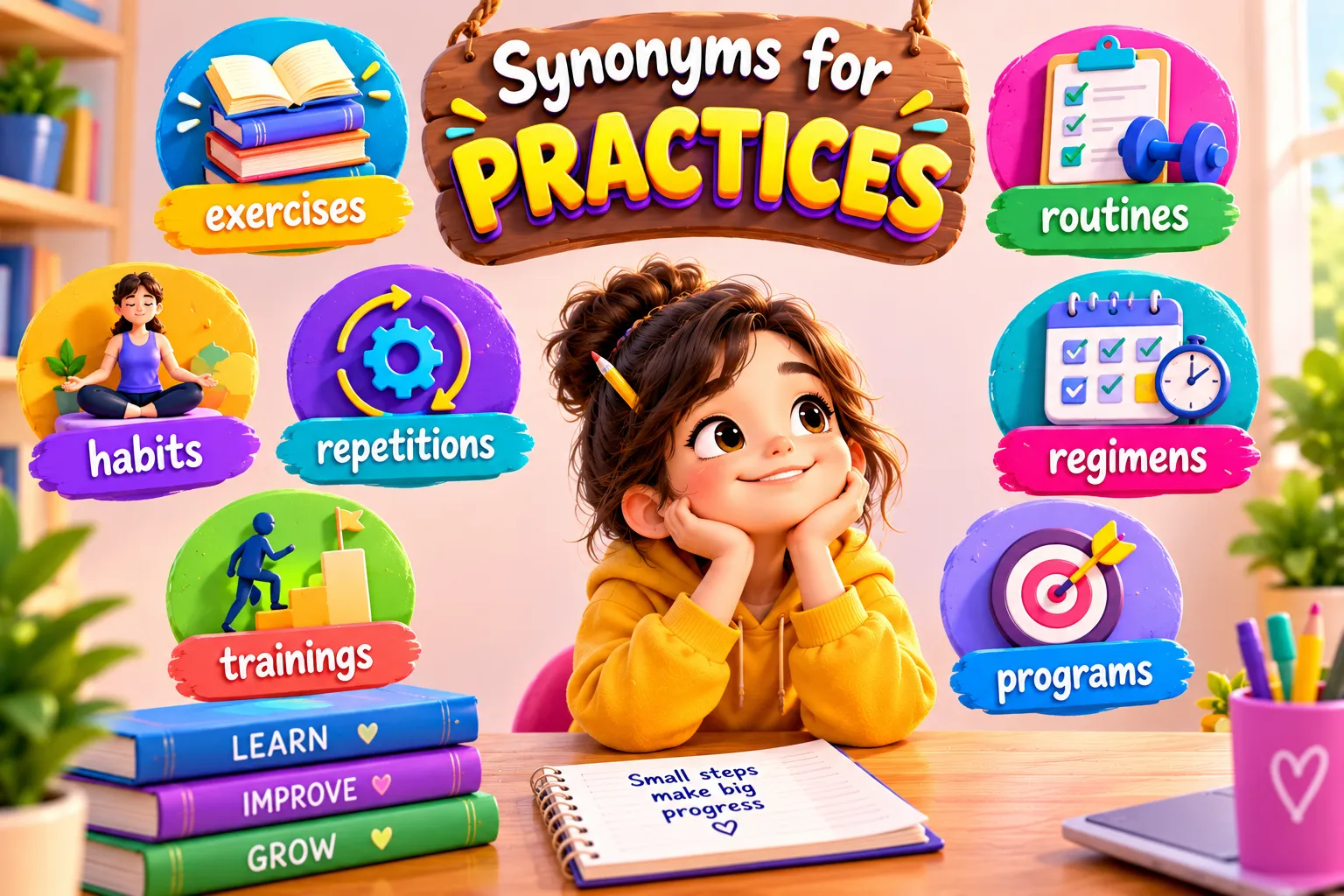
Common synonyms include methods, habits, routines, procedures, customs, traditions, techniques, approaches, exercises, and conventions. The best synonym depends on the context. For example, practices may describe workplace methods, daily habits, religious customs, or training activities.
Practices refers to actions, methods, habits, or ways of doing something that are followed regularly. For example, a student may practice good study practices by reading every day, while a company may use safe workplace practices to protect its workers. The word is common because it can describe many types of repeated actions and accepted methods. Learning synonyms for practice helps English learners use more exact words in different situations. It also helps writers avoid repeating the same word in articles, essays, and professional content. In this guide, we will explore the meaning of practices, its grammar, pronunciation, history, word formation, and 30 useful synonyms. Each synonym includes a simple meaning and examples so you can understand how to use it naturally.
Meaning of Practices
Definition
Practices (Noun/Verb):
As a noun, practices means repeated actions, methods, habits, or customs. As a verb, practice means performing or training something regularly.
Examples
- The company follows safe business practices.
- She practices the piano for one hour every day.
Connotative Meaning
Connotation means the feeling or idea that a word suggests beyond its basic meaning.
- Positive tone: Practices can suggest discipline, skill, good habits, and effective methods.
- Negative tone: Some practices may suggest harmful, unfair, or outdated behavior.
- Neutral tone: Practices can simply describe regular actions, methods, or customs.
Etymology
The noun practice came into English through Old French pratique, from Latin practicus, meaning “practical” or “active,” ultimately connected to Greek praktikos, meaning “done” or “fit for action.”
| Period | Development |
| Old English (450–1100) | The modern word practice was not yet used. Similar ideas were expressed through native words for action, work, habit, and doing. |
| Middle English (1100–1500) | Practice entered English through Anglo-French and Old French, influenced by Latin and Greek. It referred to action, use, or practical activity. |
| Modern English (1500–Present) | Practice developed meanings related to repeated activity, professional methods, customs, training, and ways of doing things. Practices is its plural noun form and third-person singular verb form. |
Pronunciation (IPA)
- IPA: /ˈpræk.tɪ.sɪz/
- Syllables: prac-ti-ces
Affixation Pattern of Practices
- Root: practic- — related to action and practical activity
- Prefix: None
- Suffix: -ice in practice; -s marks the plural noun or third-person singular verb
Word formations:
- practice — noun/verb
- practices — noun/verb
- practiced — adjective/verb
- practicing — verb/adjective
- practical — adjective
- practically — adverb
- practitioner — noun
- practicable — adjective
- practicability — noun
30 Synonyms of Practices With Meaning & Examples
1. Methods (Noun)
Meaning: Methods are ways of doing something to achieve a result.
Examples:
- The teacher uses modern teaching methods.
- These methods can improve student learning.
2. Habits (Noun)
Meaning: Habits are actions that people do regularly, often without much thought.
Examples:
- Good study habits can improve your grades.
- Reading daily is one of her best habits.
3. Routines (Noun)
Meaning: Routines are regular patterns of actions or activities.
Examples:
- Morning routines help me start the day well.
- The students follow a simple classroom routine.
4. Procedures (Noun)
Meaning: Procedures are official or organized steps for doing something.
Examples:
- The hospital follows strict safety procedures.
- Employees must follow the correct procedures.
5. Customs (Noun)
Meaning: Customs are traditional ways of behaving in a society or group.
Examples:
- Visitors should respect local customs.
- Wedding customs vary between cultures.
6. Traditions (Noun)
Meaning: Traditions are beliefs or practices passed from one generation to another.
Examples:
- The family keeps many old traditions.
- Cooking together is a holiday tradition.
7. Techniques (Noun)
Meaning: Techniques are special ways or skills used to complete a task.
Examples:
- The artist learned new painting techniques.
- Good study techniques can save time.
8. Approaches (Noun)
Meaning: Approaches are particular ways of dealing with a problem or task.
Examples:
- Teachers use different approaches to learning.
- We need a new approach to this problem.
9. Activities (Noun)
Meaning: Activities are actions or things people do for a purpose.
Examples:
- School activities help students develop social skills.
- Outdoor activities are popular in summer.
10. Exercises (Noun)
Meaning: Exercises are repeated activities used to develop a skill or ability.
Examples:
- The teacher gave us grammar exercises.
- These exercises improve your writing skills.
11. Behaviors (Noun)
Meaning: Behaviors are the ways people or animals act.
Examples:
- Healthy behaviors can improve daily life.
- The study examines student behaviors.
12. Conduct (Noun)
Meaning: Conduct means the way someone behaves or acts.
Examples:
- Professional conduct is important at work.
- His conduct showed great respect.
13. Operations (Noun)
Meaning: Operations are organized activities or processes used to perform a function.
Examples:
- The company improved its daily operations.
- Hospital operations require careful planning.
14. Processes (Noun)
Meaning: Processes are series of actions used to achieve a result.
Examples:
- The company changed its hiring processes.
- Learning is a gradual process.
15. Conventions (Noun)
Meaning: Conventions are accepted ways of behaving or doing things.
Examples:
- Writers follow certain grammar conventions.
- Social conventions differ between cultures.
16. Policies (Noun)
Meaning: Policies are rules or plans that guide actions and decisions.
Examples:
- The school has strict attendance policies.
- The company changed its safety policies.
17. Principles (Noun)
Meaning: Principles are basic rules or beliefs that guide behavior.
Examples:
- The organization follows strong ethical principles.
- Honesty is one of her main principles.
18. Customs and Rituals (Noun Phrase)
Meaning: Customs and rituals are repeated cultural or religious actions followed by a group.
Examples:
- The festival includes several old customs and rituals.
- These customs and rituals are important to the community.
19. Ways (Noun)
Meaning: Ways are particular methods or manners of doing something.
Examples:
- There are many ways to learn English.
- We should find better ways to solve the problem.
20. Applications (Noun)
Meaning: Applications are practical uses of an idea, skill, or method.
Examples:
- The course teaches applications of modern technology.
- Students studied practical applications of science.
21. Implementations (Noun)
Meaning: Implementations are the actions taken to put a plan or idea into practice.
Examples:
- The new policy needs careful implementation.
- Several implementations of the system were tested.
22. Disciplines (Noun)
Meaning: Disciplines are organized areas of study, training, or controlled practice.
Examples:
- Different academic disciplines use different methods.
- Martial arts require discipline and regular training.
23. Protocols (Noun)
Meaning: Protocols are formal rules or procedures for dealing with specific situations.
Examples:
- The laboratory follows strict safety protocols.
- Staff members learned the emergency protocols.
24. Regimens (Noun)
Meaning: Regimens are planned systems of regular activities or treatment.
Examples:
- The athlete follows a strict training regimen.
- A healthy exercise regimen can improve fitness.
25. Patterns (Noun)
Meaning: Patterns are repeated ways in which actions or events happen.
Examples:
- Researchers studied patterns of behavior.
- Her daily patterns changed after starting college.
26. Systems (Noun)
Meaning: Systems are organized sets of methods or parts that work together.
Examples:
- The school uses new systems for assessment.
- Modern systems can make work easier.
27. Applications (Noun)
Meaning: Applications can mean practical ways of using knowledge or skills.
Examples:
- The lesson showed applications of mathematics.
- Technology has many useful applications.
28. Workflows (Noun)
Meaning: Workflows are organized sequences of tasks used to complete work.
Examples:
- The team improved its digital workflows.
- Clear workflows help employees save time.
29. Strategies (Noun)
Meaning: Strategies are planned ways to achieve a goal.
Examples:
- Students need good study strategies.
- The company developed new marketing strategies.
30. Exercises in Training (Noun Phrase)
Meaning: Exercises in training are repeated activities used to build knowledge or skill.
Examples:
- The coach included several exercises in training.
- These exercises in training help beginners improve.
Prototype Meaning
The most typical meaning of practices is regular ways of doing something. When people hear this word, they may think of daily habits, professional methods, workplace rules, study routines, or cultural customs. The exact meaning depends on the sentence. In “good study practices,” it means effective habits or methods, while in “cultural practices,” it means customs followed by a group.
Prototype Categorization
- Methods and approaches: methods, approaches, techniques, ways, strategies — useful when discussing how something is done.
- Regular actions and habits: habits, routines, activities, exercises, behaviors — best for repeated personal or group actions.
- Rules and formal systems: procedures, protocols, policies, principles, systems — suitable for workplaces, schools, organizations, and institutions.
- Culture and tradition: customs, traditions, conventions, customs and rituals — useful for social, cultural, and religious contexts.
- Processes and organization: processes, operations, workflows, implementations — best for business, technology, and professional writing.
- Training and development: regimens, disciplines, exercises in training — useful for learning, fitness, sports, and skill development.
- Repeated forms or patterns: patterns, conduct — useful when describing behavior or regular ways of acting.
This categorization helps writers choose a synonym that fits the exact context instead of using practices repeatedly.
Antonyms of Practices
| Antonym | Part of Speech | Meaning |
| Neglect | Noun/Verb | Failure to give proper attention or care. |
| Inactivity | Noun | A state of doing little or nothing. |
| Inaction | Noun | Failure to take action. |
| Disuse | Noun | A state in which something is no longer used. |
| Abandonment | Noun | The act of stopping or leaving something. |
| Improvisation | Noun | Acting without a fixed method or plan. |
| Irregularity | Noun | A lack of regular or consistent action. |
| Avoidance | Noun | The act of staying away from something. |
Short Questions and Answers
What does practices mean?
Practices means regular actions, habits, methods, procedures, or customs. It can also be the verb form meaning “does something repeatedly to improve.”
When should practices be used?
Use practices when talking about repeated actions, accepted methods, professional procedures, personal habits, or cultural customs.
Is practices positive or negative?
Practices is neutral. Its meaning can become positive or negative depending on the action being described, such as good practices or harmful practices.
How is it different from similar words?
Practices is broad. Habits usually describe repeated personal actions, methods describe ways of doing something, procedures describe formal steps, and customs describe accepted cultural behavior.
Conclusion
Learning practices and its synonyms can greatly improve your English vocabulary. Words such as methods, habits, routines, procedures, techniques, and customs let you express different meanings with greater accuracy. This is useful in everyday conversations, academic writing, professional communication, and online content. Knowing these alternatives also helps you avoid repetition and makes your writing sound more natural. English learners can improve their confidence by learning one synonym at a time and using it in a real sentence. Writers can also use the semantic groups to select the best word for each situation. Practice these words regularly, compare their meanings, and notice how native speakers use them. With daily vocabulary practice, you can make your English clearer, stronger, and more flexible.
Read More:
Synonyms for duality: 26 Meaningful Alternatives to Know

I’m Falak Naaz, an SEO writer at SynonymsInstant.com focused on creating clear, engaging, and search-friendly English content. I specialize in vocabulary, synonyms, antonyms, word usage, and language guides. I combine careful research with practical writing to deliver trustworthy content that helps readers choose the right words and improve their English with confidence.