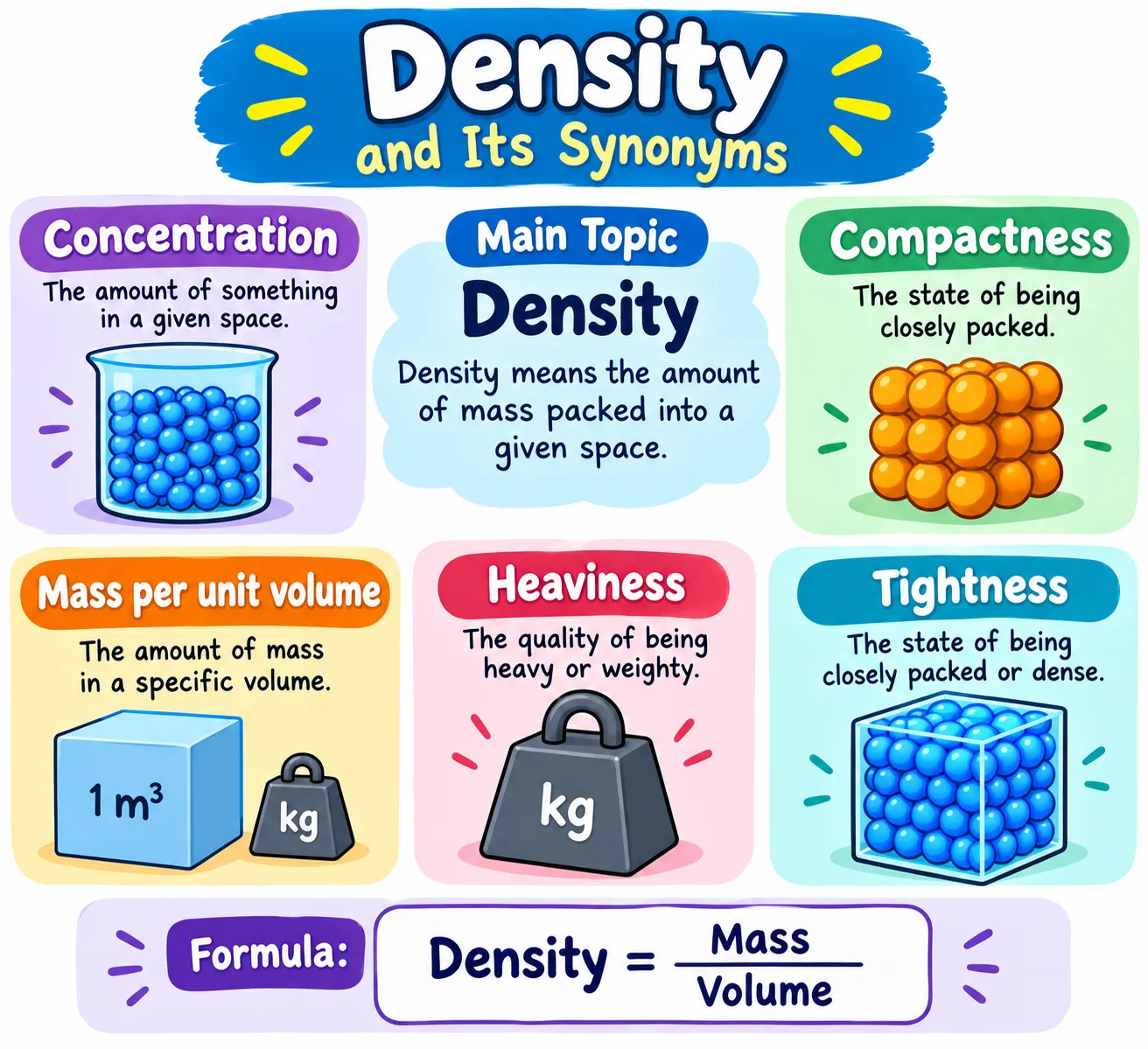
Common synonyms and related alternatives include compactness, concentration, thickness, closeness, crowding, abundance, saturation, mass, heaviness, solidity, and population concentration. The best word depends on the context. For example, population concentration works for people, while compactness can describe closely packed objects.
Density describes how closely things are packed together in a particular space. Imagine walking through a crowded city street where many people stand close together. You might say the area has a high population density. In science, density has a more exact meaning: it describes how much mass is contained in a certain volume. The word is also used in writing, forests, traffic, data, and many other fields. Learning synonyms for density helps English learners understand different ways to describe crowdedness, thickness, concentration, and compactness. It also helps writers avoid repetition and select words that fit their topic. In this guide, we will explore the meaning, examples, pronunciation, history, word formation, and 25 useful alternatives to density, along with semantic categories and antonyms.
Meaning of Density
Definition
Density (Noun):
Density means the amount of matter, people, objects, or information packed into a particular space or area.
In science, density specifically means mass per unit of volume.
Examples
- The city has a high population density.
- The density of the metal is greater than that of the wood.
Connotative Meaning
Connotation means the feeling or idea that a word suggests beyond its basic meaning.
- Positive tone: Density can suggest richness, fullness, efficiency, or a strong concentration of useful material.
- Negative tone: It can suggest overcrowding, heaviness, difficulty, or excessive complexity.
- Neutral tone: Density can simply describe how much of something exists within a given space.
Etymology
The word density comes from Latin densus, meaning “thick” or “dense.” It entered English through French and developed its modern scientific and general meanings over time.
| Period | Development |
| Old English (450–1100) | The modern word density was not commonly used. Ideas of thickness or being closely packed were expressed with native Germanic words. |
| Middle English (1100–1500) | Latin- and French-influenced vocabulary brought forms related to dense into English. |
| Modern English (1500–Present) | Density developed as the noun meaning the quality or degree of being dense. It later became important in science, geography, statistics, and everyday English. |
Pronunciation (IPA)
- IPA: /ˈden.sə.ti/
- Syllables: den-si-ty
Affixation Pattern of Density
- Root: dens- — from Latin densus, meaning “thick” or “dense”
- Prefix: None
- Suffix: -ity — forms nouns describing a quality or state
Word formations:
- dense — adjective
- density — noun
- densely — adverb
- densest — adjective
- denser — adjective
- densification — noun
- densify — verb
- densified — adjective/verb
- densifying — verb
25 Synonyms of Density With Meaning & Examples
1. Compactness (Noun)
Meaning: Compactness is the state of having things packed closely into a small space.
Examples:
- The compactness of the design saves space.
- The compactness of the material makes it easy to store.
2. Concentration (Noun)
Meaning: Concentration is the amount of something present in a particular space or area.
Examples:
- The water has a high concentration of salt.
- The concentration of people is highest in the city center.
3. Thickness (Noun)
Meaning: Thickness is the distance between two opposite surfaces of something solid.
Examples:
- The thickness of the glass makes it strong.
- We measured the thickness of the wooden board.
4. Crowding (Noun)
Meaning: Crowding is a condition in which many people or things occupy a small space.
Examples:
- Crowding is common during rush hour.
- The city is trying to reduce crowding on public transport.
5. Closeness (Noun)
Meaning: Closeness describes things that are positioned near each other.
Examples:
- The closeness of the houses makes the street look busy.
- The trees grow with remarkable closeness.
6. Solidity (Noun)
Meaning: Solidity is the quality of being firm, strong, and closely packed.
Examples:
- The solidity of the material makes it durable.
- The builder tested the wall for solidity.
7. Mass (Noun)
Meaning: Mass is the amount of matter in a physical object.
Examples:
- Scientists measured the mass of the object.
- The planet has a very large mass.
8. Heaviness (Noun)
Meaning: Heaviness is the quality of having considerable weight.
Examples:
- The heaviness of the metal surprised us.
- The stone’s heaviness made it difficult to move.
9. Fullness (Noun)
Meaning: Fullness is the state of containing a large amount of something.
Examples:
- The fullness of the room made movement difficult.
- The forest’s fullness creates a rich green view.
10. Abundance (Noun)
Meaning: Abundance means having a large amount of something.
Examples:
- The region has an abundance of trees.
- The abundance of information can be useful for researchers.
11. Saturation (Noun)
Meaning: Saturation is a state in which something contains or is filled with as much of something as possible.
Examples:
- The solution reached saturation.
- Market saturation made it harder for new companies to compete.
12. Crowdedness (Noun)
Meaning: Crowdedness is the condition of having too many people or things in a limited space.
Examples:
- The crowdedness of the train was uncomfortable.
- Tourists often complain about the crowdedness of the area.
13. Congestion (Noun)
Meaning: Congestion is a condition in which too many people, vehicles, or objects are packed into a space.
Examples:
- Traffic congestion is common in large cities.
- The road suffers from congestion every morning.
14. Proximity (Noun)
Meaning: Proximity means being physically close to something else.
Examples:
- The proximity of the buildings creates a crowded appearance.
- The school was chosen because of its proximity to the village.
15. Intensity (Noun)
Meaning: Intensity describes how strong or concentrated something is.
Examples:
- The intensity of the light was very high.
- Researchers measured the intensity of the signal.
16. Piling (Noun)
Meaning: Piling is the act or result of placing many things on top of or close to each other.
Examples:
- The piling of boxes blocked the doorway.
- The piling of snow became dangerous.
17. Accumulation (Noun)
Meaning: Accumulation is the gradual collection of a large amount of something.
Examples:
- The accumulation of dust was easy to see.
- Snow accumulation increased during the storm.
18. Clustering (Noun)
Meaning: Clustering is the grouping of people or things close together.
Examples:
- The clustering of houses is common in the village.
- Data clustering revealed several clear groups.
19. Compression (Noun)
Meaning: Compression is the act of pressing something into a smaller space.
Examples:
- Compression reduces the size of the file.
- The compression of the material increased its density.
20. Compactness of Matter (Noun Phrase)
Meaning: Compactness of matter describes how closely physical particles are packed together.
Examples:
- The compactness of matter affects its physical properties.
- Scientists studied the compactness of matter under pressure.
21. Population Concentration (Noun Phrase)
Meaning: Population concentration describes how many people live within a particular area.
Examples:
- The city has a high population concentration.
- Population concentration is greater near major roads.
22. Population Density (Noun Phrase)
Meaning: Population density is the number of people living within a specific area.
Examples:
- The country’s population density varies by region.
- High population density can increase pressure on housing.
23. Spatial Concentration (Noun Phrase)
Meaning: Spatial concentration describes how strongly people or objects are grouped within a physical area.
Examples:
- The map shows spatial concentration around the capital.
- Researchers measured the spatial concentration of businesses.
24. Degree of Crowding (Noun Phrase)
Meaning: Degree of crowding describes how full or crowded a particular space is.
Examples:
- The degree of crowding was high during the festival.
- Officials measured the degree of crowding in the station.
25. Richness (Noun)
Meaning: Richness describes the presence of a large amount or variety of something.
Examples:
- The richness of the forest supports many animals.
- The richness of the data helped researchers.
Prototype Meaning
The most typical meaning of density is the amount of something packed into a certain space. People may imagine a crowded city, a thick forest, tightly packed objects, or a heavy material. In science, density has a precise meaning based on mass and volume. In everyday language, however, it can describe how crowded, thick, full, or concentrated something appears.
Prototype Categorization
- Physical packing: compactness, thickness, solidity, compression, denseness, packedness — useful for materials, objects, and physical structures.
- Concentration: concentration, saturation, intensity, concentratedness, spatial concentration — useful for chemicals, data, activity, and information.
- Crowding: crowding, crowdedness, congestion, degree of crowding — best for people, traffic, buildings, and busy places.
- Amount or fullness: fullness, abundance, richness, accumulation, mass — useful when focusing on how much of something exists.
- Closeness or grouping: closeness, proximity, clustering, tightness — useful when describing objects or people positioned near one another.
- Population and geography: population concentration, population density — best for cities, regions, communities, and demographic writing.
- Material properties: mass, heaviness, thickness of matter, compactness of matter — useful in scientific and technical contexts.
This categorization helps writers choose the right alternative based on whether they are discussing people, space, materials, data, chemicals, or physical properties.
Antonyms of Density
| Antonym | Part of Speech | Meaning |
| Sparsity | Noun | The state of having few things spread over a space. |
| Scarcity | Noun | The state of having very little of something. |
| Emptiness | Noun | The condition of containing little or nothing. |
| Spaciousness | Noun | The quality of having plenty of open space. |
| Openness | Noun | The condition of having free or unobstructed space. |
| Dispersal | Noun | The spreading of people or things over a wider area. |
| Scatteredness | Noun | The state of being spread apart rather than closely grouped. |
| Thinness | Noun | The quality of being relatively thin or not thick. |
Short Questions and Answers
What does density mean?
Density means how much of something is contained or packed within a certain space or area.
When should density be used?
Use density when discussing how closely packed something is. In science, it is used specifically for mass per unit volume.
Is density positive or negative?
Density is neutral. It can have a positive or negative meaning depending on context, such as rich information density or uncomfortable crowd density.
How is it different from similar words?
Density is a broad term for the amount packed into a space. Concentration focuses on the amount of a substance or activity in an area, while thickness usually describes the distance between surfaces.
Conclusion
Learning density and its synonyms can make your English more accurate and flexible. Words such as compactness, concentration, thickness, crowding, and denseness can describe different forms of being closely packed. Other terms, such as population density and congestion, are better for specific situations. Understanding these differences helps English learners improve vocabulary and communicate ideas more clearly. It also helps content writers avoid repeating the same word in articles and reports. When you learn a new synonym, try writing your own sentence with it. Notice whether the word describes people, materials, space, information, or another type of concentration. Daily vocabulary practice will help you remember these words and use them naturally. Over time, this practice can strengthen your writing, speaking, and overall confidence in English.
Read More:
Synonyms for practices: 30 Useful Alternatives

I’m Pinki, an SEO writer at SynonymsInstant.com, specializing in synonyms, antonyms, vocabulary, word meanings, grammar, and English usage. I create accurate, well-researched, reader-friendly content that combines language expertise with SEO best practices. My goal is to make English vocabulary simple, useful, and accessible for students, writers, professionals, and English learners.