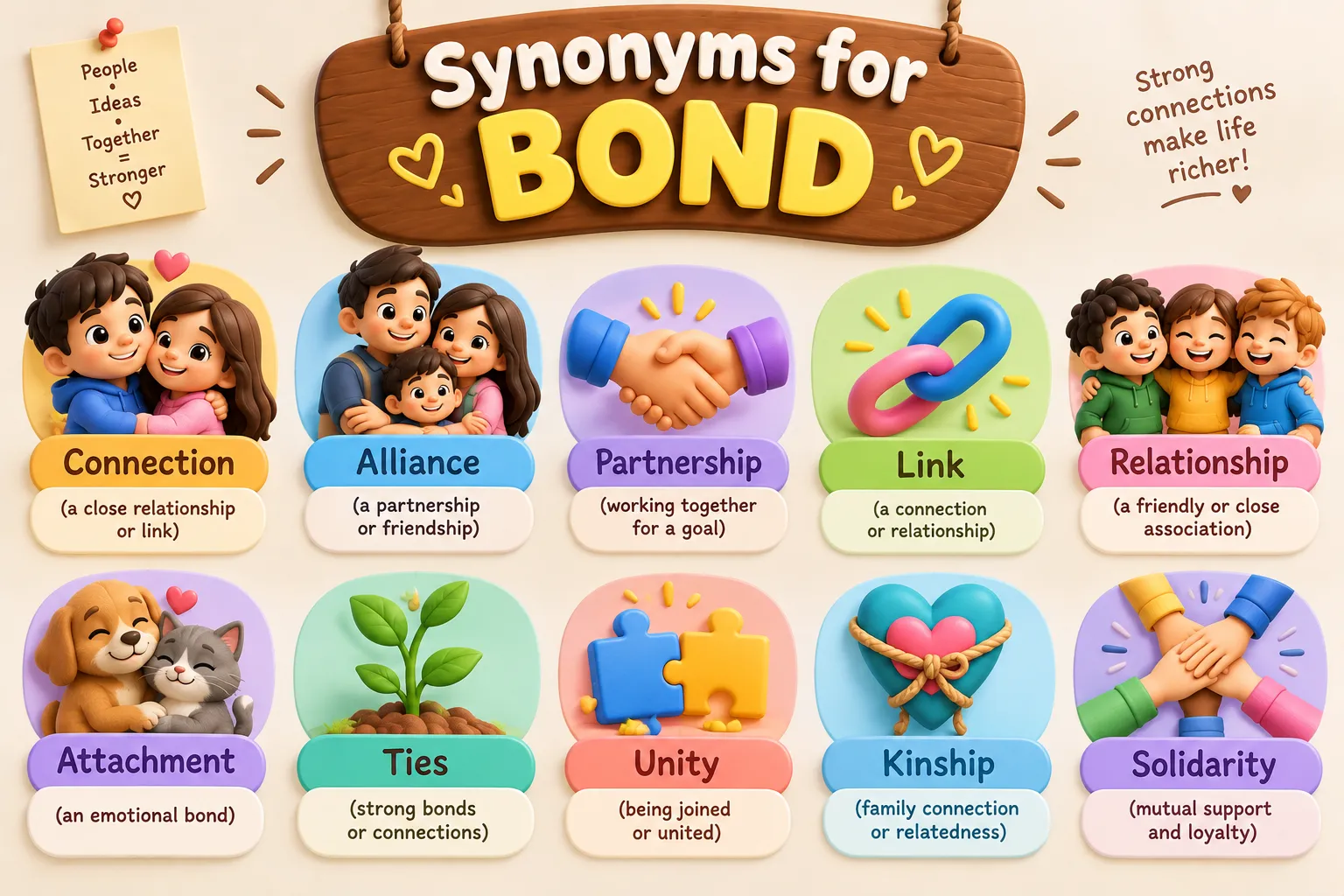
Synonyms for bond include connection, relationship, attachment, link, tie, alliance, and friendship. These words describe emotional connections between people, strong relationships, and links between things. The best synonym depends on the context in which you use the word bond.
A bond is a connection that brings people or things together. For example, two close friends may share a strong bond because they trust and support each other. Families build bonds through love, care, and shared experiences. The word also appears in business, science, and law. It can describe an agreement, a financial document, or a force that joins atoms. Since bond has several meanings, choosing the right synonym is important. Words such as connection, relationship, and alliance may fit different situations. Learning these alternatives helps English learners improve their vocabulary and helps writers avoid repeating the same word. This guide explains the meaning, history, pronunciation, and word forms of bond. It also explores 30 synonyms, their meanings, examples, and related antonyms.
Meaning of Bond
Definition
Bond (Noun / Verb):
- Noun: A connection, tie, or agreement between people, things, or groups.
- Verb: To form a close connection or join things together.
Examples
- The two sisters share a strong bond.
- The glue helps bond the broken pieces together.
Connotative Meaning
Connotation (the feeling or idea a word suggests beyond its basic meaning) depends on the context.
- Positive tone: Bond often suggests love, trust, friendship, loyalty, and unity.
- Negative tone: It can suggest a forced connection, an unwanted obligation, or a tie that is hard to escape.
- Neutral tone: In science and law, bond can describe a chemical connection or a formal financial agreement without expressing emotion.
Etymology of Bond
The word bond comes from an old Germanic word related to binding or tying something together.
| Period | Development |
| Old English (450–1100) | The related Old English word bendan meant to bend or bind. The exact modern noun bond was not used in its current form. |
| Middle English (1100–1500) | Bond developed from related Germanic forms and came to mean a tie, restraint, or obligation. |
| Modern English (1500–Present) | Bond gained wider meanings, including emotional connections, legal agreements, financial securities, and chemical links. |
Pronunciation (IPA)
- IPA: /bɒnd/ in British English; /bɑːnd/ in many American accents.
- Syllables: bond (one syllable).
Affixation Pattern of Bond
- Root: Bond
- Prefix: No prefix in the base word bond.
- Suffix: No suffix in the base word bond.
Word Formations
| Word | Part of Speech | Meaning |
| Bond | Noun / Verb | A connection or to connect |
| Bonds | Noun / Verb | Connections, agreements, or connects |
| Bonded | Verb / Adjective | Joined or connected |
| Bonding | Noun / Verb | The process of forming a connection |
| Bondage | Noun | A state of being controlled or held in captivity |
| Bondedness | Noun | The state of being bonded; uncommon usage |
| Bondholder | Noun | A person or organization that owns a financial bond |
| Bonding agent | Noun | A substance that helps materials stick together |
| Bonding time | Noun Phrase | Time spent building a close relationship |
| Bondable | Adjective | Able to form a bond or, in some contexts, qualify for a financial bond |
30 Synonyms of Bond With Meaning and Examples
Note: The word “bond” has several meanings. Some words below are close synonyms, while others are suitable only in certain contexts. Always choose a word that matches the intended meaning.
1. Connection (Noun)
Meaning: A link between people, things, or ideas.
Examples:
- The two friends have a strong connection.
- There is a clear connection between sleep and good health.
2. Link (Noun)
Meaning: Something that joins or relates two people or things.
Examples:
- Music became a link between the two generations.
- The bridge is an important link between the towns.
3. Tie (Noun)
Meaning: A relationship or connection between people, places, or groups.
Examples:
- She has close ties with her hometown.
- Their shared history created a strong tie.
4. Relationship (Noun)
Meaning: The way two or more people or things are connected.
Examples:
- The mother and daughter have a loving relationship.
- Trust is important in every healthy relationship.
5. Attachment (Noun)
Meaning: A feeling of affection or closeness toward someone or something.
Examples:
- The child has a deep attachment to her grandmother.
- He feels a strong attachment to his childhood home.
6. Affinity (Noun)
Meaning: A natural liking or connection between people or things.
Examples:
- She has a natural affinity for animals.
- The two artists share an affinity for classical music.
7. Association (Noun)
Meaning: A connection between people, groups, events, or ideas.
Examples:
- The association between exercise and health is well known.
- Their long association helped build mutual trust.
8. Alliance (Noun)
Meaning: An agreement between people or groups to work together.
Examples:
- The two countries formed an alliance.
- Their business alliance helped both companies grow.
9. Union (Noun)
Meaning: The joining of people or things to form one whole.
Examples:
- Their marriage marked the union of two families.
- The union of the two teams made the project stronger.
10. Bonding (Noun)
Meaning: The process of developing a close relationship.
Examples:
- Family bonding is important for children’s well-being.
- The group planned a trip for team bonding.
11. Closeness (Noun)
Meaning: A strong feeling of trust, affection, or connection.
Examples:
- Their closeness grew over many years.
- Regular talks helped build closeness between the friends.
12. Kinship (Noun)
Meaning: A family relationship or a feeling of being closely connected.
Examples:
- The cousins felt a strong sense of kinship.
- They felt kinship because they shared similar experiences.
13. Fellowship (Noun)
Meaning: A friendly feeling of belonging and sharing with others.
Examples:
- The club encourages fellowship among its members.
- They enjoyed the fellowship of people with similar interests.
14. Friendship (Noun)
Meaning: A close relationship based on care, trust, and support.
Examples:
- Their friendship began at school.
- Years of support made their friendship stronger.
15. Affection (Noun)
Meaning: A feeling of love or fondness for someone.
Examples:
- The child showed affection for her teacher.
- They expressed their affection through kind words.
16. Unity (Noun)
Meaning: The state of being joined together or acting as one.
Examples:
- The team showed unity during the competition.
- Unity helped the community overcome its problems.
17. Solidarity (Noun)
Meaning: Support and agreement among people with a shared interest or purpose.
Examples:
- The workers showed solidarity during the protest.
- The community stood in solidarity with the affected families.
18. Partnership (Noun)
Meaning: A relationship in which people work together toward a shared goal.
Examples:
- Their partnership helped the business succeed.
- A strong partnership depends on trust and respect.
19. Pact (Noun)
Meaning: A formal or informal agreement between people or groups.
Examples:
- The friends made a pact to support each other.
- The countries signed a pact to improve cooperation.
20. Agreement (Noun)
Meaning: A shared decision or understanding between two or more parties.
Examples:
- The two companies reached an agreement.
- Their agreement helped settle the dispute.
21. Linkage (Noun)
Meaning: A connection between people, systems, or ideas.
Examples:
- The study found a linkage between diet and health.
- Better transport improved the linkage between nearby towns.
22. Affiliation (Noun)
Meaning: A formal or informal connection with a group or organization.
Examples:
- Her affiliation with the university helped her find research partners.
- The club has an affiliation with a national sports body.
23. Tie-in (Noun)
Meaning: A connection between two things, often for a shared purpose.
Examples:
- The film had a tie-in with a popular book series.
- The company created a promotional tie-in with the event.
24. Rapport (Noun)
Meaning: A friendly and trusting relationship between people.
Examples:
- The teacher built rapport with her students.
- Good communication helped the team develop rapport.
25. Understanding (Noun)
Meaning: A shared sense of agreement, sympathy, or awareness.
Examples:
- Their mutual understanding made teamwork easier.
- Open talks helped create an understanding between the neighbors.
26. Commitment (Noun)
Meaning: A promise or strong dedication to someone or something.
Examples:
- Their commitment to each other remained strong.
- The project requires commitment from every team member.
27. Obligation (Noun)
Meaning: A duty or responsibility that a person must fulfill.
Examples:
- The contract created a legal obligation.
- He felt an obligation to help his family.
28. Restraint (Noun)
Meaning: Something that limits freedom or keeps a person from acting freely.
Examples:
- The prisoner was held under restraint.
- The rules placed restraints on how the funds could be used.
29. Chemical Link (Noun Phrase)
Meaning: A connection that holds atoms together in a chemical substance.
Examples:
- A chemical link holds the atoms together in the molecule.
- The lesson explained how a chemical link forms between atoms.
30. Bonding Relationship (Noun Phrase)
Meaning: A relationship that grows through shared experiences, trust, or care.
Examples:
- Shared activities helped the children form a bonding relationship.
- The support group created a bonding relationship among its members.
Prototype Meaning of Bond
The most common meaning of bond is a close connection between people. People often imagine family members, close friends, or partners who trust and care for one another. However, a bond can also connect groups, ideas, or physical objects. In law and finance, it may refer to an agreement or investment. In chemistry, it describes the force that holds atoms together. The exact meaning depends on the subject and the sentence.
Prototype Categorization
Grouping synonyms by meaning helps writers choose words that fit the context. A word that works for friendship may not work for a legal or scientific bond.
- Emotional connection: Attachment, affinity, closeness, affection, friendship. These words describe feelings of care, love, or personal closeness.
- General connection: Connection, link, tie, relationship, association, linkage. These words describe how people, things, or ideas relate to one another.
- Unity and shared purpose: Alliance, union, unity, solidarity, partnership, fellowship. Use these words when people or groups come together.
- Trust and mutual understanding: Rapport, understanding, kinship, bonding. These terms highlight shared feelings, trust, or a sense of belonging.
- Agreements and duties: Pact, agreement, commitment, obligation. These words suit formal promises, shared decisions, or responsibilities.
- Specialized or related meanings: Restraint, chemical link, affiliation, tie-in, bonding relationship. These terms apply to particular situations and may not replace bond in everyday sentences.
This grouping helps writers avoid errors. For example, rapport fits a trusting relationship, pact fits an agreement, and chemical link fits a science lesson. Choosing the right word makes your message more accurate.
Antonyms of Bond
An antonym is a word with an opposite or contrasting meaning. The best antonym for bond depends on whether it refers to an emotional connection, a physical joining, or a formal agreement.
| Antonym | Part of Speech | Meaning |
| Separation | Noun | The state of being apart |
| Division | Noun | The act or state of splitting into parts or groups |
| Disconnection | Noun | The state of having no link or connection |
| Detachment | Noun | A lack of emotional involvement or connection |
| Estrangement | Noun | A state of being distant or unfriendly |
| Isolation | Noun | The state of being separated from others |
| Disunion | Noun | A lack of unity among people or groups |
| Disagreement | Noun | A difference of opinion or a lack of agreement |
| Division | Noun | A split that separates people or groups |
| Unfasten | Verb | To release something that has been fastened |
| Separate | Verb | To move or keep people or things apart |
| Disconnect | Verb | To break a link or connection |
Short Questions and Answers
What does bond mean?
A bond is a connection between people, things, or groups. It can also mean an agreement, a financial document, or a chemical connection.
When should bond be used?
Use bond when describing a close relationship, a link between things, or a formal or technical connection. The surrounding sentence makes the meaning clear.
Is bond positive or negative?
Bond is often positive when it describes love, trust, or unity. It can be neutral in science and finance, or negative when it describes an unwanted tie or restraint.
How is bond different from similar words?
Bond often suggests a strong or meaningful connection. Link is more general, attachment emphasizes emotional closeness, alliance suggests cooperation, and pact refers to an agreement.
Conclusion
Learning the meaning of bond and its synonyms can strengthen your English vocabulary. Words such as connection, relationship, attachment, and alliance help describe different kinds of links between people, groups, and ideas. Some alternatives focus on feelings, while others describe agreements, duties, or scientific connections. Choosing the right word makes your writing clearer and more precise. These words are useful in essays, conversations, schoolwork, and professional writing. They also help you avoid repeating bond too often. To improve your vocabulary, practice using one synonym each day. Write a sentence, read it aloud, and check whether the word fits the meaning. With regular practice, you can communicate with greater confidence and accuracy.
Read More:
Synonyms for Educate: 26 Powerful Words for Confidence

I’m Falak Naaz, an SEO writer at SynonymsInstant.com focused on creating clear, engaging, and search-friendly English content. I specialize in vocabulary, synonyms, antonyms, word usage, and language guides. I combine careful research with practical writing to deliver trustworthy content that helps readers choose the right words and improve their English with confidence.