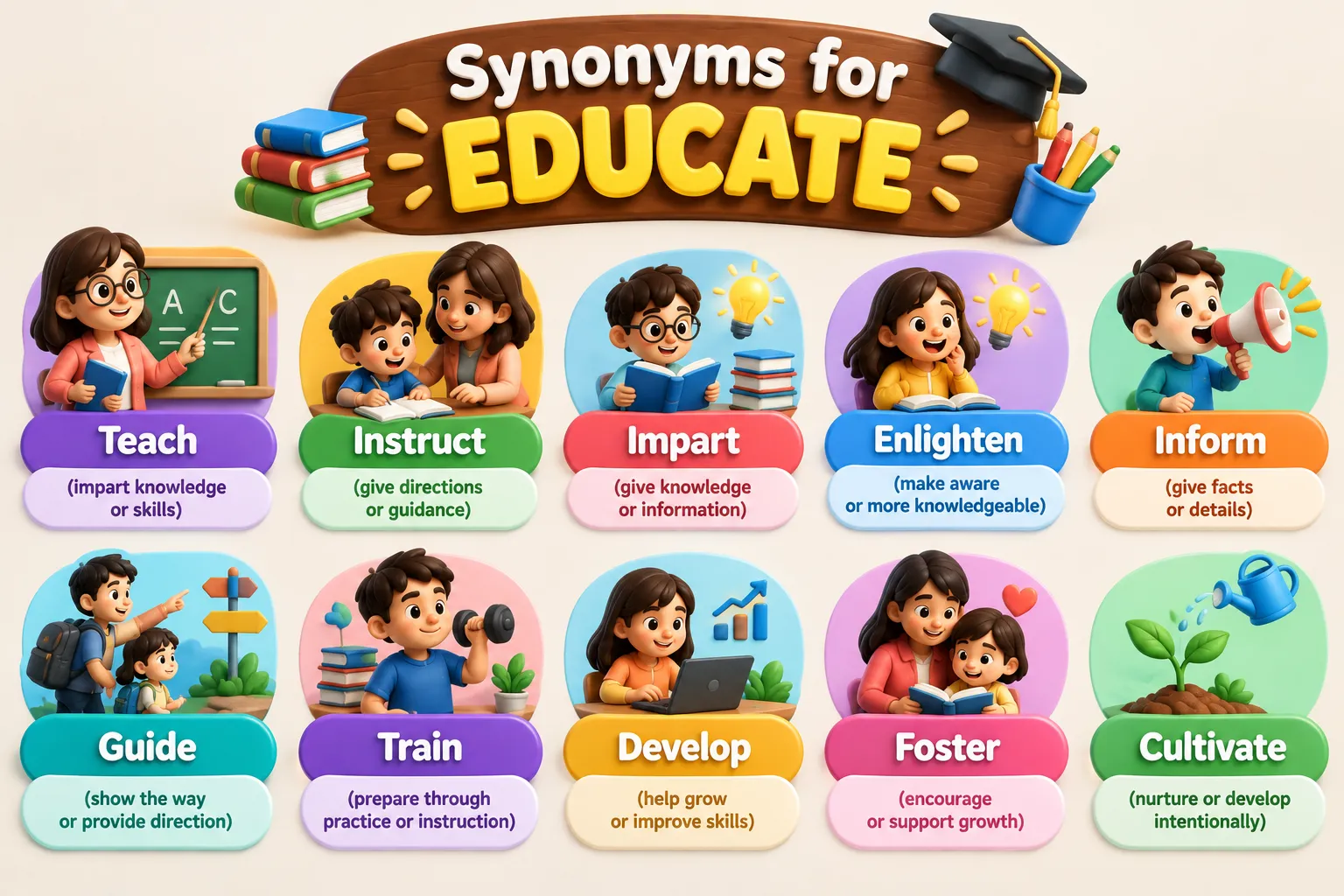
Common synonyms include teach, instruct, train, tutor, coach, guide, inform, enlighten, and school. Each word has a slightly different meaning. For example, teach is a general term, while train often focuses on practical skills. Learning these alternatives can improve your vocabulary, make your writing more engaging, and help you express ideas clearly. The best synonym depends on the person, subject, and situation.
Educate means to help someone learn new facts, skills, or ideas. For example, a teacher educates students by explaining lessons, answering questions, and giving useful tasks. Parents also educate children by teaching them good habits and life skills. The word is common in schools, workplaces, books, and daily conversations. However, using the same word again and again can make writing dull. Learning synonyms helps English learners build stronger vocabulary and express ideas in different ways. It also helps content writers create clear and engaging articles. In this guide, you will learn the meaning of educate, its pronunciation, word forms, history, and 26 synonyms with simple meanings and examples. You will also discover related words, antonyms, and tips for choosing the right word.
Meaning of Educate
Definition
Educate (verb): To teach someone or help them gain knowledge, skills, or understanding.
Examples
- Good teachers educate students by making lessons clear and interesting.
- Parents educate their children about kindness, respect, and safety.
Connotative Meaning
Connotation (the feelings or ideas linked to a word beyond its basic meaning) can change with context.
- Positive tone: Educate often suggests growth, learning, wisdom, and personal development.
- Negative tone: It can sound critical when someone says a person needs to be educated about basic facts or proper behavior.
- Neutral tone: It can simply describe the process of teaching people or sharing knowledge.
Etymology of Educate
The word educate comes from Latin and entered English through later forms of the language.
| Period | Development |
| Old English (450–1100) | The modern word educate was not used in Old English. People used other words related to teaching and learning. |
| Middle English (1100–1500) | The word developed through Latin-based forms entering English, especially in later Middle English and the transition toward Early Modern English. |
| Modern English (1500–Present) | Educate became established in English with the meaning of teaching, training, and developing knowledge or ability. |
The word comes from Latin educare, meaning “to bring up” or “to rear.” It is also linked to educere, meaning “to lead out,” although the exact historical relationship between these Latin forms is discussed by etymologists.
Pronunciation of Educate
- IPA: /ˈedʒ.ʊ.keɪt/ (British English); /ˈedʒ.ə.keɪt/ (common American pronunciation)
- Syllables: ed-u-cate (three syllables)
Affixation Pattern of Educate
- Root: Educate is derived from Latin educare.
- Prefix: No common productive prefix appears in the base word educate.
- Suffix: The ending -ate forms a verb in this word.
Word Formations
| Word | Part of Speech | Meaning |
| Educate | Verb | To teach or develop knowledge |
| Educates | Verb | Teaches someone or helps someone learn |
| Educated | Verb / Adjective | Taught or having knowledge |
| Educating | Verb / Gerund | Teaching or helping someone learn |
| Education | Noun | The process of teaching and learning |
| Educational | Adjective | Related to learning or teaching |
| Educationally | Adverb | In a way related to education |
| Educator | Noun | A person who teaches or supports learning |
| Educative | Adjective | Providing knowledge or instruction |
| Educability | Noun | The ability to be educated or taught |
26 Synonyms of Educate With Meaning and Examples
Note: Not all the words below are exact replacements for “educate.” Some are related alternatives used in specific situations. Choose the word that best fits your sentence.
1. Teach (Verb)
Meaning: To help someone learn knowledge or a skill.
Examples:
- Teachers teach children to read and write.
- My father taught me how to ride a bicycle.
2. Instruct (Verb)
Meaning: To give someone information or directions about how to do something.
Examples:
- The trainer instructed the workers on how to use the machine.
- Our teacher instructed us to complete the task carefully.
3. Train (Verb)
Meaning: To teach someone the skills needed for a particular job or activity.
Examples:
- The company trains new staff every month.
- She trained the team to use the new software.
4. Tutor (Verb)
Meaning: To teach someone, often individually or in a small group.
Examples:
- He tutors students in English after school.
- My sister tutored me before the final exam.
5. Coach (Verb)
Meaning: To guide and train someone to improve a skill or performance.
Examples:
- She coaches young players in basketball.
- The manager coached the team on communication skills.
6. School (Verb)
Meaning: To teach or train someone, often through formal education.
Examples:
- His parents schooled him at home.
- The program schooled young people in basic financial skills.
7. Enlighten (Verb)
Meaning: To help someone understand something more clearly.
Examples:
- The speaker enlightened us about climate change.
- This book may enlighten readers about local history.
8. Inform (Verb)
Meaning: To give someone facts or useful information.
Examples:
- The teacher informed students about the exam date.
- The guide informed visitors about the museum’s history.
9. Guide (Verb)
Meaning: To help someone learn or make progress by offering advice and direction.
Examples:
- Experienced teachers guide students through difficult topics.
- Her mentor guided her during her first year at work.
10. Explain (Verb)
Meaning: To make an idea or subject easier to understand.
Examples:
- The teacher explained the lesson with simple examples.
- Please explain how this machine works.
11. Demonstrate (Verb)
Meaning: To show how something works or how to do it.
Examples:
- The instructor demonstrated how to use the equipment.
- Our science teacher demonstrated a simple experiment.
12. Prepare (Verb)
Meaning: To help someone become ready for a task or situation.
Examples:
- The course prepares students for their future careers.
- Her teacher prepared her for the speaking test.
13. Develop (Verb)
Meaning: To help a skill, ability, or quality grow.
Examples:
- Reading helps children develop language skills.
- The workshop develops leadership abilities.
14. Cultivate (Verb)
Meaning: To encourage the growth of a skill, quality, or interest.
Examples:
- Good schools cultivate curiosity in young learners.
- Parents can cultivate a love of reading at home.
15. Nurture (Verb)
Meaning: To support the growth and development of a person or ability.
Examples:
- Teachers nurture students’ creativity.
- Her family nurtured her interest in science.
16. Mentor (Verb)
Meaning: To advise and support someone as they learn or grow.
Examples:
- An experienced engineer mentored the new employee.
- She mentors young writers in her community.
17. Advise (Verb)
Meaning: To give someone guidance or suggestions.
Examples:
- The counselor advised students about their study choices.
- My teacher advised me to read every day.
18. Familiarize (Verb)
Meaning: To help someone become familiar with a subject, place, or process.
Examples:
- The teacher familiarized students with the new rules.
- The guide familiarized visitors with the building.
19. Acquaint (Verb)
Meaning: To introduce someone to information, ideas, or a subject.
Examples:
- The course acquaints learners with basic computer skills.
- The teacher acquainted us with the main ideas of the book.
20. Orient (Verb)
Meaning: To help someone understand a new place, situation, or system.
Examples:
- The school orients new students during their first week.
- The company oriented workers to its safety rules.
21. Indoctrinate (Verb)
Meaning: To teach someone to accept a set of beliefs without encouraging independent thought.
Examples:
- The report accused the group of trying to indoctrinate children.
- Education should encourage questions rather than indoctrinate students.
22. Drill (Verb)
Meaning: To teach something through repeated practice.
Examples:
- The instructor drilled the class on basic spelling.
- Students drilled multiplication facts before the test.
23. Exercise (Verb)
Meaning: To give someone practice in a skill or ability.
Examples:
- The teacher exercised students in grammar through short tasks.
- The course exercises learners in clear writing.
24. School in (Verb Phrase)
Meaning: To train someone in a particular subject or skill.
Examples:
- The program schooled workers in workplace safety.
- Her experience schooled her in the value of patience.
25. Bring Up (Phrasal Verb)
Meaning: To raise a child and teach them habits, values, and behavior.
Examples:
- They brought up their children to respect others.
- He was brought up to value honesty and hard work.
26. Raise (Verb)
Meaning: To care for a child and help them grow, including teaching values and habits.
Examples:
- Her parents raised her to be kind and responsible.
- Families help raise children to understand right and wrong.
Prototype Meaning of Educate
The most common meaning of educate is to teach someone so they gain knowledge, skills, or understanding. People often picture a teacher explaining a lesson to students in a classroom. However, education can also happen at home, at work, online, or through daily life. The word can refer to formal learning, practical training, or helping people understand important issues.
Prototype Categorization
Grouping synonyms by meaning helps writers choose words that fit each situation. Some words focus on teaching facts, while others focus on practice, support, or personal growth.
- Direct teaching: Teach, instruct, tutor, school. These words work well for lessons and formal learning.
- Practical training: Train, coach, drill, demonstrate. Use these when people learn by doing or practicing.
- Sharing knowledge: Inform, explain, enlighten, acquaint, familiarize. These words fit situations where someone needs facts or a clearer understanding.
- Guidance and support: Guide, mentor, advise, orient. These words highlight help and direction.
- Growth and development: Develop, cultivate, nurture, prepare, empower. These words focus on building skills, confidence, and abilities.
- Raising and social learning: Bring up, raise, socialize. These terms are useful when discussing children, values, and behavior.
- Specialized or critical meanings: Indoctrinate, exercise, school in, raise awareness. These expressions apply to particular contexts and are not direct replacements in every sentence.
This grouping helps writers avoid choosing a synonym that changes the meaning of a sentence. For example, training is often better for job skills, while enlightenment suits a sentence about gaining a deeper understanding.
Antonyms of Educate
An antonym is a word with the opposite or contrasting meaning. Since education means to teach or help someone learn, its opposites often describe preventing learning or leaving someone without knowledge.
| Antonym | Part of Speech | Meaning |
| Mislead | Verb | To cause someone to believe something incorrect |
| Misinform | Verb | To give someone false or incorrect information |
| Confuse | Verb | To make something difficult to understand |
| Deceive | Verb | To make someone believe something that is not true |
| Obscure | Verb | To make information less clear or harder to understand |
| Ignore | Verb | To pay no attention to someone or something |
| Neglect | Verb | To fail to give someone or something needed care or attention |
| Discourage | Verb | To reduce someone’s confidence or desire to learn |
| Unteach | Verb | To help someone abandon or undo previously learned ideas or habits |
| Keep uninformed | Verb Phrase | To prevent someone from receiving important information |
Short Questions and Answers
What does educate mean?
Educate means to teach someone or help them gain knowledge, skills, or understanding.
When should educate be used?
Use education when talking about teaching, learning, training, or helping people understand a subject. It works in schools, workplaces, families, and public awareness campaigns.
Is education positive or negative?
Educate is usually positive or neutral because it relates to learning and knowledge. Its tone depends on the context in which it is used.
How is educate different from similar words?
Educate often refers to a broad process of learning. Teach is a general word for sharing knowledge, training focuses on practical skills, instruction often involves clear directions, and enlighten emphasizes deeper understanding.
Conclusion
Learning the meaning of educate and its synonyms can improve your English vocabulary and communication skills. Words such as teach, train, instruct, guide, and enlighten help you express different types of learning. Each word has its own use, so choosing the right one makes your writing clearer and more natural. These alternatives are useful for students, teachers, content writers, and English learners. They can also help you avoid repetition in essays, articles, and everyday conversations. To build confidence, practice using one new word each day. Write a sentence with it, read it aloud, and compare it with education. With regular practice, you can express your ideas more clearly and choose words that fit each situation.
Read More:
Synonyms for Spacious: 29 Roomy Alternatives

I’m Ayesha Haram, an English content and SEO writer at SynonymsInstant.com. I focus on creating helpful vocabulary resources, word guides, and practical English content that readers can understand quickly. I combine language research, clear explanations, and SEO-focused writing to produce reliable content that supports learners, writers, and everyday English users.