
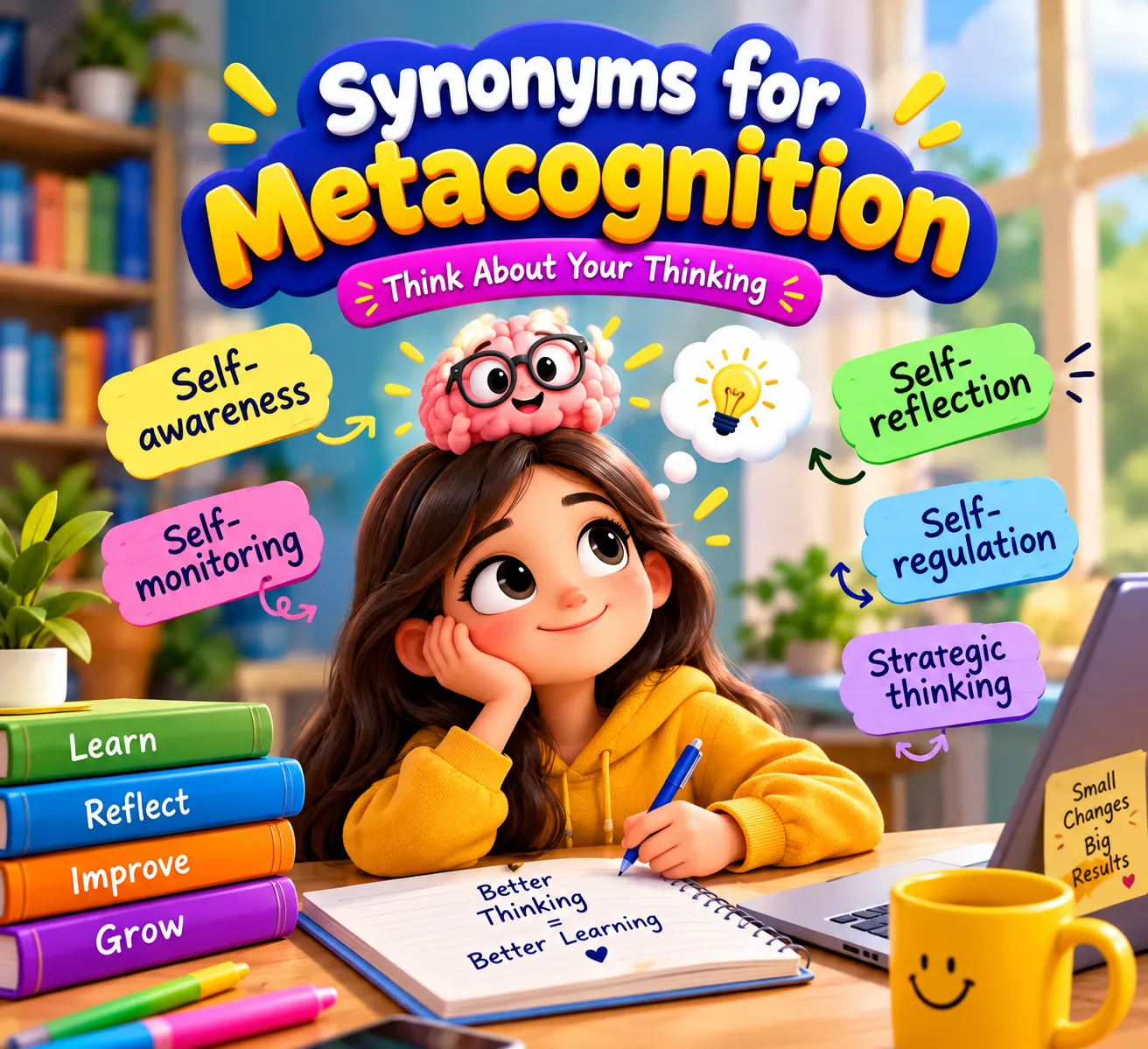
Metacognition means thinking about your own thinking and learning. Useful synonyms and related terms include self-awareness, self-monitoring, self-reflection, reflective thinking, self-regulation, self-assessment, self-evaluation, introspection, cognitive awareness, thought monitoring, cognitive monitoring, self-management, self-control, self-observation, self-knowledge, and strategic thinking. These words describe different parts of the same general idea, such as understanding your thoughts, checking your progress, reflecting on your actions, or managing your learning. In simple English, “thinking about thinking” is one of the easiest ways to explain metacognition.
Metacognition means thinking about your own thinking. Imagine a student solving a difficult math problem. The student stops and asks, “Do I understand this?” Then they choose a new method, check their answer, and think about what helped them learn. This is metacognition. The word is common in education, psychology, teaching, and learning because it describes how people understand and manage their own thinking. Learning synonyms for metacognition is useful for English learners, teachers, researchers, and content writers because it helps avoid repetition and makes writing more precise. However, not every synonym has exactly the same meaning. Some focus on self-awareness, while others focus on monitoring, reflection, or learning control. This guide explains the meaning, history, pronunciation, word formation, and 28 useful alternatives to metacognition with simple examples.
Meaning of Metacognition
Definition
Metacognition (noun):
Metacognition is the ability to think about, understand, and manage your own thinking and learning.
Examples
- Good students use metacognition to check whether they understand a lesson.
- Metacognition helps learners choose better study methods.
Connotative Meaning
Connotation means the feeling or idea connected with a word beyond its basic meaning.
- Positive tone: Metacognition often suggests awareness, control, reflection, and effective learning.
- Negative tone: The word itself is not normally negative, but too much self-analysis may suggest overthinking in some contexts.
- Neutral tone: In academic writing, metacognition is usually a neutral technical term for awareness and control of one’s thinking.
Etymology
The word metacognition is built from meta-, meaning “about,” “beyond,” or “at a higher level,” and cognition, meaning thinking or knowing. The modern psychological and educational use of metacognition is strongly associated with psychologist John Flavell, who developed the concept in the 1970s.
- Old English (450–1100): The word metacognition did not exist in Old English. Its modern technical form developed much later.
- Middle English (1100–1500): The modern word was still not in use. However, English vocabulary related to knowing and thinking developed from Latin and French sources.
- Modern English (1500–Present): Metacognition developed as a modern academic term from meta- + cognition and became especially important in psychology and education during the 20th century.
Pronunciation (IPA)
- IPA: /ˌmetəˌkɑːɡˈnɪʃən/
- Syllables: met-a-cog-ni-tion
Affixation Pattern of Metacognition
- Root: cognition
- Prefix: meta-
- Suffix: -tion
- Word formation:
- metacognition — noun
- metacognitive — adjective
- metacognitively — adverb
- cognition — noun
- cognitive — adjective
- cognitively — adverb
The prefix meta- gives the idea of thinking about thinking. The base cognition refers to mental processes such as knowing, understanding, remembering, and reasoning.
28 Synonyms of Metacognition With Meaning & Examples
1. Self-awareness (Noun)
Meaning: Awareness of your own thoughts, feelings, abilities, and actions.
Examples:
- Self-awareness helps students understand their learning habits.
- Strong self-awareness can help a learner recognize weaknesses.
2. Self-monitoring (Noun)
Meaning: The process of watching and checking your own performance or thinking.
Examples:
- Self-monitoring helps students notice mistakes while studying.
- The teacher encouraged self-monitoring during the activity.
3. Self-reflection (Noun)
Meaning: Careful thinking about your own experiences, actions, or learning.
Examples:
- Self-reflection helped the student understand why the test went poorly.
- Teachers can use self-reflection to improve their lessons.
4. Reflective thinking (Noun)
Meaning: Thinking carefully about an experience, idea, or problem.
Examples:
- Reflective thinking helps learners improve their study methods.
- The course encourages reflective thinking after each lesson.
5. Self-regulation (Noun)
Meaning: The ability to control and manage your thoughts, behavior, or learning.
Examples:
- Self-regulation helps students stay focused on their goals.
- Good self-regulation can improve study habits.
6. Self-assessment (Noun)
Meaning: The process of judging your own knowledge, skills, or performance.
Examples:
- Students completed a self-assessment after the lesson.
- Self-assessment helped her identify areas that needed more practice.
7. Self-evaluation (Noun)
Meaning: The process of evaluating your own performance or progress.
Examples:
- Self-evaluation can show students what they need to improve.
- The learner used self-evaluation after completing the project.
8. Self-observation (Noun)
Meaning: Watching and noticing your own behavior, thoughts, or actions.
Examples:
- Self-observation helped him notice when he lost focus.
- Self-observation can reveal useful learning patterns.
9. Self-management (Noun)
Meaning: The ability to organize and control your own actions and behavior.
Examples:
- Self-management is important for independent learning.
- Good self-management helped the student finish the assignment.
10. Self-control (Noun)
Meaning: The ability to control your thoughts, feelings, or actions.
Examples:
- Self-control helped the learner avoid distractions.
- Students need self-control when working independently.
11. Conscious awareness (Noun)
Meaning: Clear and deliberate awareness of something.
Examples:
- Conscious awareness of learning habits can improve study skills.
- The activity developed conscious awareness of thinking strategies.
12. Thought awareness (Noun)
Meaning: Awareness of the thoughts happening in your own mind.
Examples:
- Thought awareness can help learners recognize negative thinking patterns.
- The exercise increased students’ thought awareness.
13. Cognitive awareness (Noun)
Meaning: Awareness of your mental processes and ways of thinking.
Examples:
- Cognitive awareness helps learners understand how they solve problems.
- The lesson promoted cognitive awareness among students.
14. Learning awareness (Noun)
Meaning: Understanding how you learn and what affects your learning.
Examples:
- Learning awareness helps students select useful study techniques.
- The teacher encouraged learning awareness through regular reflection.
15. Strategic thinking (Noun)
Meaning: Planning and choosing methods to reach a particular goal.
Examples:
- Strategic thinking helped the student plan for the exam.
- Strategic thinking is useful when solving complex problems.
16. Thought monitoring (Noun)
Meaning: The process of observing and checking your own thoughts.
Examples:
- Thought monitoring helped her identify an incorrect assumption.
- Students can develop thought monitoring through reflective exercises.
17. Cognitive monitoring (Noun)
Meaning: Checking and observing your own mental processes.
Examples:
- Cognitive monitoring helps learners check their understanding.
- The activity developed cognitive monitoring skills.
18. Mental self-awareness (Noun)
Meaning: Awareness of your own mental processes and thoughts.
Examples:
- Mental self-awareness can help students understand their learning needs.
- The exercise improved mental self-awareness.
19. Learning self-awareness (Noun)
Meaning: Awareness of your own strengths, weaknesses, and habits as a learner.
Examples:
- Learning self-awareness helps students become independent learners.
- The teacher promoted learning self-awareness through journals.
20. Introspection (Noun)
Meaning: Examination of your own thoughts and feelings.
Examples:
- Introspection helped the learner understand the reason for her anxiety.
- The journal encouraged introspection after each lesson.
21. Self-knowledge (Noun)
Meaning: Knowledge and understanding of your own abilities, habits, and characteristics.
Examples:
- Self-knowledge helps students choose suitable learning methods.
- Greater self-knowledge can improve academic planning.
22. Self-understanding (Noun)
Meaning: A clear understanding of your own thoughts, abilities, and behavior.
Examples:
- Self-understanding helped the student recognize her learning style.
- Reflection can improve self-understanding.
23. Reflective awareness (Noun)
Meaning: Awareness gained by carefully thinking about your own experiences or actions.
Examples:
- Reflective awareness helped the teacher improve classroom practice.
- Students developed reflective awareness through learning journals.
24. Critical self-reflection (Noun)
Meaning: Careful examination of your own ideas, actions, and decisions.
Examples:
- Critical self-reflection helped the student find a better approach.
- Teachers can use critical self-reflection to review their teaching methods.
25. Self-directed learning (Noun)
Meaning: Learning in which a person takes responsibility for planning and managing their own learning.
Examples:
- Metacognitive skills can support self-directed learning.
- Self-directed learning requires learners to set clear goals.
26. Learning regulation (Noun)
Meaning: The process of managing and adjusting your own learning.
Examples:
- Learning regulation helps students change strategies when they face difficulties.
- Good learning regulation can make study time more effective.
27. Cognitive self-regulation (Noun)
Meaning: Managing and adjusting your own thinking processes.
Examples:
- Cognitive self-regulation helps learners change an ineffective strategy.
- The program focused on cognitive self-regulation skills.
28. Mental self-monitoring (Noun)
Meaning: Observing and checking your own mental activity.
Examples:
- Mental self-monitoring helped him notice that he was distracted.
- Students can improve mental self-monitoring through reflection.
Prototype Meaning
The prototype meaning of metacognition is awareness and management of your own thinking. When people hear the word, they usually imagine a learner who stops during a task and asks questions such as, “Do I understand this?”, “What strategy should I use?”, or “Did this method work?” Metacognition therefore involves both awareness and control. It is more specific than simply knowing yourself because it focuses strongly on mental processes, learning, problem-solving, and the strategies used to complete a task.
Prototype Categorization
The 30 alternatives can be grouped into several semantic categories. This helps writers choose a word that matches the exact context instead of treating every alternative as a perfect replacement.
- Self-awareness and self-knowledge: self-awareness, self-knowledge, self-understanding, mental self-awareness, learning self-awareness, and learning awareness. These terms focus on knowing yourself and understanding your abilities or habits.
- Monitoring and observation: self-monitoring, self-observation, thought monitoring, cognitive monitoring, and mental self-monitoring. These terms focus on watching your thoughts, actions, or learning progress.
- Reflection: self-reflection, reflective thinking, introspection, reflective awareness, critical self-reflection, and reflective learning. These terms focus on looking back at experiences and thinking carefully about them.
- Evaluation and assessment: self-assessment and self-evaluation. These terms are useful when someone judges their own knowledge, progress, or performance.
- Control and regulation: self-regulation, self-management, self-control, learning regulation, and cognitive self-regulation. These terms focus on managing or changing thoughts and behavior.
- Planning and strategy: strategic thinking and self-directed learning. These terms emphasize planning, selecting strategies, and taking responsibility for learning.
- Cognitive awareness: cognitive awareness and conscious awareness. These terms focus on being aware of mental processes.
- Simple explanations: thinking about thinking. This phrase is useful when explaining metacognition to beginners because it expresses the core idea in everyday English.
These categories help writers avoid awkward substitutions. For example, self-assessment works well when discussing tests, while self-monitoring is better when discussing the process of checking understanding during a task.
Antonyms of Metacognition
Metacognition does not have one exact opposite. However, these terms can describe ideas that contrast with awareness and management of one’s own thinking:
1. Unawareness (Noun)
Meaning: Lack of knowledge or awareness about something.
2. Thoughtlessness (Noun)
Meaning: Acting or thinking without careful consideration.
3. Impulsiveness (Noun)
Meaning: Acting quickly without carefully considering the result.
4. Mindlessness (Noun)
Meaning: Performing an action without active attention or awareness.
5. Unreflectiveness (Noun)
Meaning: Lack of careful thought about one’s own actions or experiences.
6. Automaticity (Noun)
Meaning: Performing a process automatically with little conscious attention.
Short Questions and Answers
What does metacognition mean?
Metacognition means being aware of and managing your own thinking and learning processes.
When should metacognition be used?
Use metacognition when discussing awareness of thinking, learning strategies, problem-solving, self-monitoring, or control of learning.
Is metacognition positive or negative?
Metacognition is generally a neutral academic term. Its effect depends on the context in which it is discussed.
How is it different from similar words?
Metacognition is broader than many related terms. Self-monitoring focuses on checking yourself, self-assessment focuses on judging your performance, and self-regulation focuses on managing your behavior or learning. Metacognition can include all of these processes.
Conclusion
Learning metacognition and its related terms can improve vocabulary, writing, and speaking skills. The word describes an important learning process: understanding and managing your own thinking. Its alternatives include self-awareness, self-monitoring, self-reflection, self-assessment, self-regulation, reflective thinking, cognitive monitoring, and many others. However, these words are not always exact replacements. Each one highlights a slightly different part of the idea. Knowing these differences helps writers avoid repetition and select precise words for academic, educational, and professional writing. For English learners, practicing these words in real sentences is a useful way to build confidence. Try learning a few alternatives each day, write your own examples, and use them in conversation or writing. Regular vocabulary practice makes difficult academic words easier to understand and use.
Read More:
Synonyms for researcher: 30 Useful Alternatives

I’m Ayesha Haram, an English content and SEO writer at SynonymsInstant.com. I focus on creating helpful vocabulary resources, word guides, and practical English content that readers can understand quickly. I combine language research, clear explanations, and SEO-focused writing to produce reliable content that supports learners, writers, and everyday English users.