
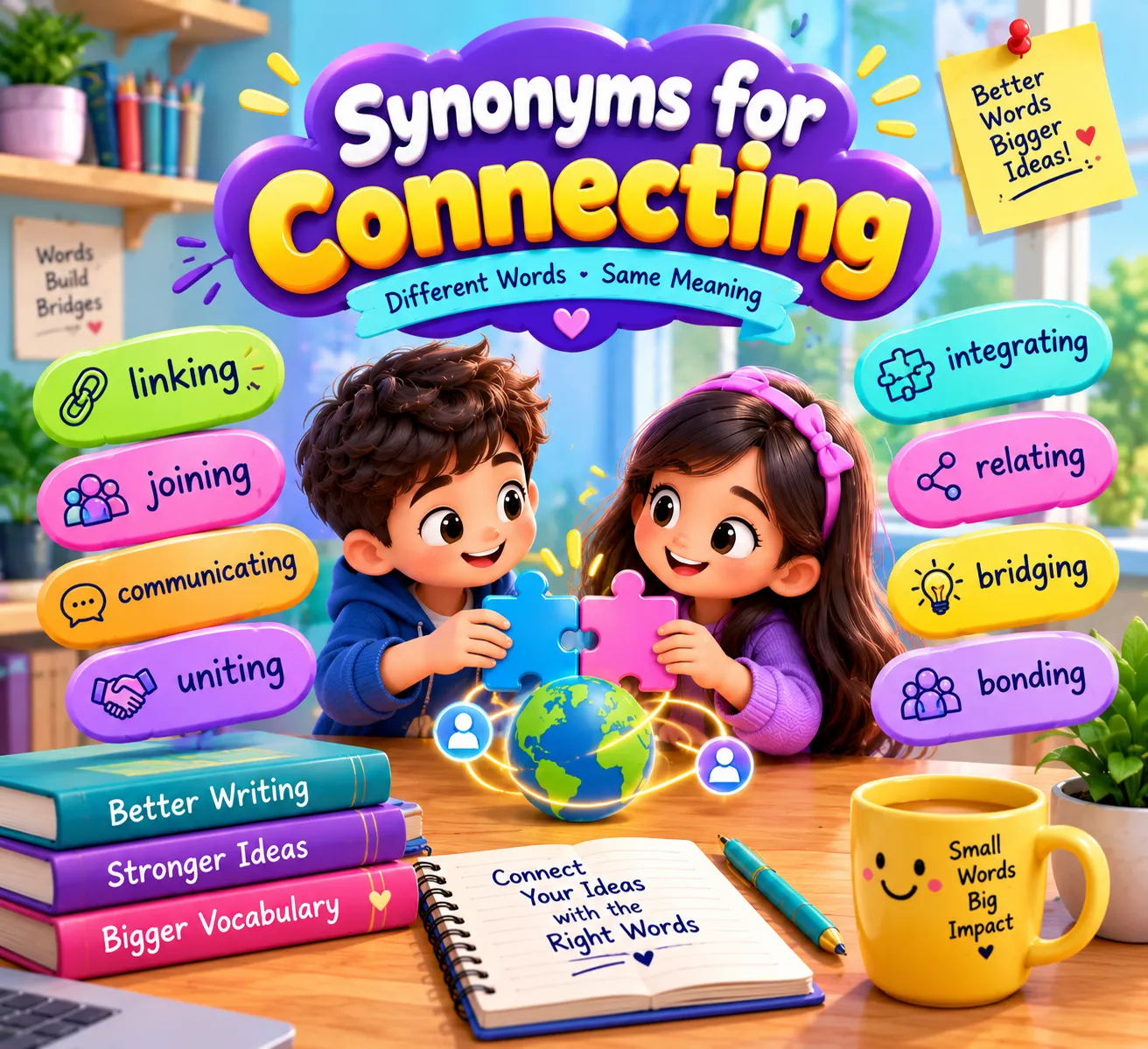
Useful synonyms include linking, joining, associating, relating, uniting, combining, integrating, merging, tying, bridging, communicating, interacting, engaging, bonding, networking, contacting, attaching, coupling, coordinating, synchronizing, reconnecting, correlating, and interweaving. The best synonym depends on the context: linking works well for things or ideas, bonding for relationships, integrating for systems or parts, communicating for sharing information, and bridging for connecting different groups or ideas.
Connecting means joining two or more people, things, ideas, or places together. For example, when you meet a new classmate and start talking, you are connecting with that person. A phone can also connect two people who are far apart. The word is common in everyday English because it can describe physical links, relationships, communication, and ideas. Learning synonyms for connecting helps English learners use more precise and natural words. It also helps writers avoid repeating the same word in articles, essays, emails, and conversations. However, the best synonym depends on the context. Words such as linking and joining often describe things, while relating and communicating can describe people or ideas. This guide explains the meaning, grammar, history, pronunciation, word formation, 29 alternatives, examples, antonyms, and semantic categories of connecting.
Meaning of Connecting
Definition
Connecting (Verb / Present Participle):
Connecting means joining, linking, bringing together, or creating a relationship between two or more people or things.
Examples
- The bridge is connecting the two villages.
- She is connecting with her new classmates.
Connotative Meaning
Connotation means the feeling or idea associated with a word beyond its basic meaning.
- Positive tone: Connecting can suggest friendship, cooperation, communication, and unity.
- Negative tone: In some contexts, connecting may suggest an unwanted link or relationship.
- Neutral tone: Connecting can simply describe joining two things or people together.
Etymology
The word connecting comes from connect, which comes from Latin connectere, meaning “to join together” or “to bind.”
- Old English (450–1100): The modern word connect was not part of Old English. English used other native words for ideas such as joining and binding.
- Middle English (1100–1500): Connect entered English through Old French from Latin connectere.
- Modern English (1500–Present): Connect became a common English verb meaning “to join or link.” Connecting is formed by adding -ing to the verb connect.
Pronunciation (IPA)
- IPA: /kəˈnektɪŋ/
- Syllables: con-nec-ting
Affixation Pattern of Connecting
- Root: connect
- Prefix: None in the modern English formation
- Suffix: -ing
- Word formations:
- connect — verb
- connecting — verb / present participle
- connection — noun
- connected — adjective / past participle
- connective — adjective / noun
- connector — noun
- connectivity — noun
- unconnected — adjective
- disconnected — adjective
- disconnection — noun
29 Synonyms of Connecting With Meaning & Examples
1. Linking (Verb)
Meaning: Joining two or more things together.
Examples:
- The road is linking the two towns.
- The website is linking readers to useful resources.
2. Joining (Verb)
Meaning: Bringing two or more things or people together.
Examples:
- She is joining the two pieces of wood.
- The new road is joining the villages.
3. Associating (Verb)
Meaning: Connecting one person, idea, or thing with another.
Examples:
- People often associate success with hard work.
- The study is associating exercise with better health.
4. Relating (Verb)
Meaning: Showing or creating a connection between things or people.
Examples:
- The lesson is relating history to modern life.
- She has difficulty relating to new people.
5. Uniting (Verb)
Meaning: Bringing people or things together as one group.
Examples:
- The event is uniting people from different communities.
- Music can help unite people.
6. Combining (Verb)
Meaning: Putting two or more things together.
Examples:
- The recipe is combining several fresh ingredients.
- The teacher is combining theory with practice.
7. Integrating (Verb)
Meaning: Combining parts so they work together as a whole.
Examples:
- The school is integrating technology into its lessons.
- The program is integrating new ideas into the system.
8. Merging (Verb)
Meaning: Joining two separate things or groups into one.
Examples:
- The two companies are merging their departments.
- The paths are merging near the bridge.
9. Tying (Verb)
Meaning: Joining or relating things closely.
Examples:
- The report is tying poor sleep to low concentration.
- The story is tying several events together.
10. Bridging (Verb)
Meaning: Creating a connection between people, groups, or ideas.
Examples:
- The program is bridging the gap between students and teachers.
- Technology is bridging distant communities.
11. Relating to (Verb)
Meaning: Having a connection with or being relevant to something.
Examples:
- This rule is relating to student safety.
- The article contains information relating to education.
12. Communicating (Verb)
Meaning: Sharing information, thoughts, or feelings with someone.
Examples:
- She is communicating with her teacher.
- Good leaders keep communicating with their teams.
13. Interacting (Verb)
Meaning: Communicating or working with another person or group.
Examples:
- Students are interacting with each other.
- The teacher enjoys interacting with learners.
14. Engaging (Verb)
Meaning: Becoming involved with a person, activity, or idea.
Examples:
- The teacher is engaging students in discussion.
- She is engaging with the online community.
15. Bonding (Verb)
Meaning: Developing a close relationship with someone.
Examples:
- The children are bonding during the school trip.
- Shared experiences can help families bond.
16. Networking (Verb)
Meaning: Building professional or social relationships.
Examples:
- She is networking with other teachers.
- Networking can help students find career opportunities.
17. Contacting (Verb)
Meaning: Communicating with someone directly.
Examples:
- I am contacting the school for more information.
- He is contacting his manager about the problem.
18. Communing (Verb)
Meaning: Sharing thoughts or feelings deeply with someone or something.
Examples:
- The group spent time communing with nature.
- They enjoyed communing with one another.
19. Attaching (Verb)
Meaning: Fastening or joining one thing to another.
Examples:
- She is attaching the file to the email.
- The worker is attaching the cable to the device.
20. Coupling (Verb)
Meaning: Joining two things so they work together.
Examples:
- The engineer is coupling the two machines.
- The system is coupling two separate processes.
21. Interconnecting (Verb)
Meaning: Connecting several things with one another.
Examples:
- The computers are interconnecting across the building.
- The roads are interconnecting several small towns.
22. Relinking (Verb)
Meaning: Connecting something again after it was separated.
Examples:
- The technician is relinking the broken network.
- The update is relinking the missing files.
23. Correlating (Verb)
Meaning: Showing that two things are related or connected.
Examples:
- The researchers are correlating exercise with better sleep.
- The report is correlating test scores with attendance.
24. Corresponding (Verb)
Meaning: Communicating with someone, usually through written messages.
Examples:
- She is corresponding with an international teacher.
- The writer is corresponding with the editor.
25. Associating (Verb)
Meaning: Linking one idea, person, or thing mentally with another.
Examples:
- Children are often associating colors with emotions.
- Many people associate this symbol with peace.
26. Synchronizing (Verb)
Meaning: Making separate things work together at the same time.
Examples:
- The devices are synchronizing their data.
- The dancers are synchronizing their movements.
27. Coordinating (Verb)
Meaning: Organizing different people or activities so they work together.
Examples:
- She is coordinating the school event.
- The teams are coordinating their efforts.
28. Reconnecting (Verb)
Meaning: Establishing a connection again after it has been lost.
Examples:
- I am reconnecting with an old friend.
- The technician is reconnecting the internet cable.
29. Interweaving (Verb)
Meaning: Combining different things closely together.
Examples:
- The novel is interweaving several stories.
- The teacher is interweaving examples into the lesson.
Prototype Meaning
The most typical meaning of connecting is joining two or more people, things, places, or ideas so that they have a relationship or can work together. When people hear “connecting,” they may imagine a bridge joining two places, a phone connecting two people, or friends forming a relationship. The exact meaning depends on context. It can describe a physical connection, communication, emotional relationship, technology, or a relationship between ideas.
Prototype Categorization
The 29 alternatives can be divided into useful semantic groups. This helps writers choose the most accurate word instead of using every synonym in the same way.
- Physical connection: linking, joining, attaching, coupling, interconnecting, and relinking. These words work well for roads, cables, machines, objects, and systems.
- People and relationships: bonding, networking, interacting, engaging, communicating, and reconnecting. These words are useful when discussing social or professional relationships.
- Ideas and concepts: relating, associating, correlating, tying, bridging, and interweaving. These words help describe relationships between thoughts, facts, topics, or concepts.
- Combining and integration: combining, integrating, merging, and uniting. These words emphasize bringing separate parts together.
- Communication: communicating, contacting, corresponding, and interacting. These terms focus on exchanging information or maintaining contact.
- Organization and coordination: coordinating and synchronizing. These words are useful when separate people, systems, or actions need to work together.
Choosing a synonym from the correct category makes writing more precise. For example, bonding is natural for relationships, attaching is better for physical objects, and integrating is useful when combining systems or ideas.
Antonyms of Connecting
1. Disconnecting (Verb)
Meaning: Separating something that was connected.
2. Separating (Verb)
Meaning: Moving people or things apart.
3. Dividing (Verb)
Meaning: Splitting something into different parts or groups.
4. Isolating (Verb)
Meaning: Keeping someone or something apart from others.
5. Detaching (Verb)
Meaning: Removing something from a connection.
6. Disconnecting socially (Verb)
Meaning: Ending or reducing social contact with others.
7. Disuniting (Verb)
Meaning: Causing people or groups to become separated.
Short Questions and Answers
What does connecting mean?
Connecting means joining, linking, or bringing people, things, places, or ideas together.
When should connecting be used?
Use connecting when you want to describe a physical link, relationship, communication, interaction, or relationship between ideas.
Is connecting positive or negative?
Connecting is usually neutral, but it often has a positive meaning when it refers to friendship, communication, cooperation, or understanding.
How is it different from similar words?
The meaning changes with the context. Linking often describes things or ideas, joining emphasizes bringing things together, bonding focuses on relationships, integrating focuses on combining systems or parts, and communicating focuses on exchanging information.
Conclusion
Learning connecting and its synonyms can make your English clearer, stronger, and more natural. The word can describe many types of relationships, from connecting two roads to connecting with another person or linking two ideas. Alternatives such as linking, joining, relating, uniting, integrating, bridging, communicating, interacting, bonding, networking, and reconnecting allow you to express these different meanings more precisely. Understanding the small differences between synonyms is especially useful for students, teachers, content writers, and English learners. It also helps you avoid repeating the same word in your writing. To improve your vocabulary, learn a few synonyms each day and use them in your own sentences. Regular practice will help you speak more naturally, write with greater variety, and feel more confident when using English.
Read More:
Synonyms for metacognition: 28 Useful Alternatives

I am Rubab content specialist focused on creating accurate, user-friendly, and search-optimized language resources. Through Synonyminstant, I help readers find synonyms, antonyms, meanings, and vocabulary with ease. Every article is carefully researched and optimized to provide reliable information, clear explanations, and an excellent user experience.