
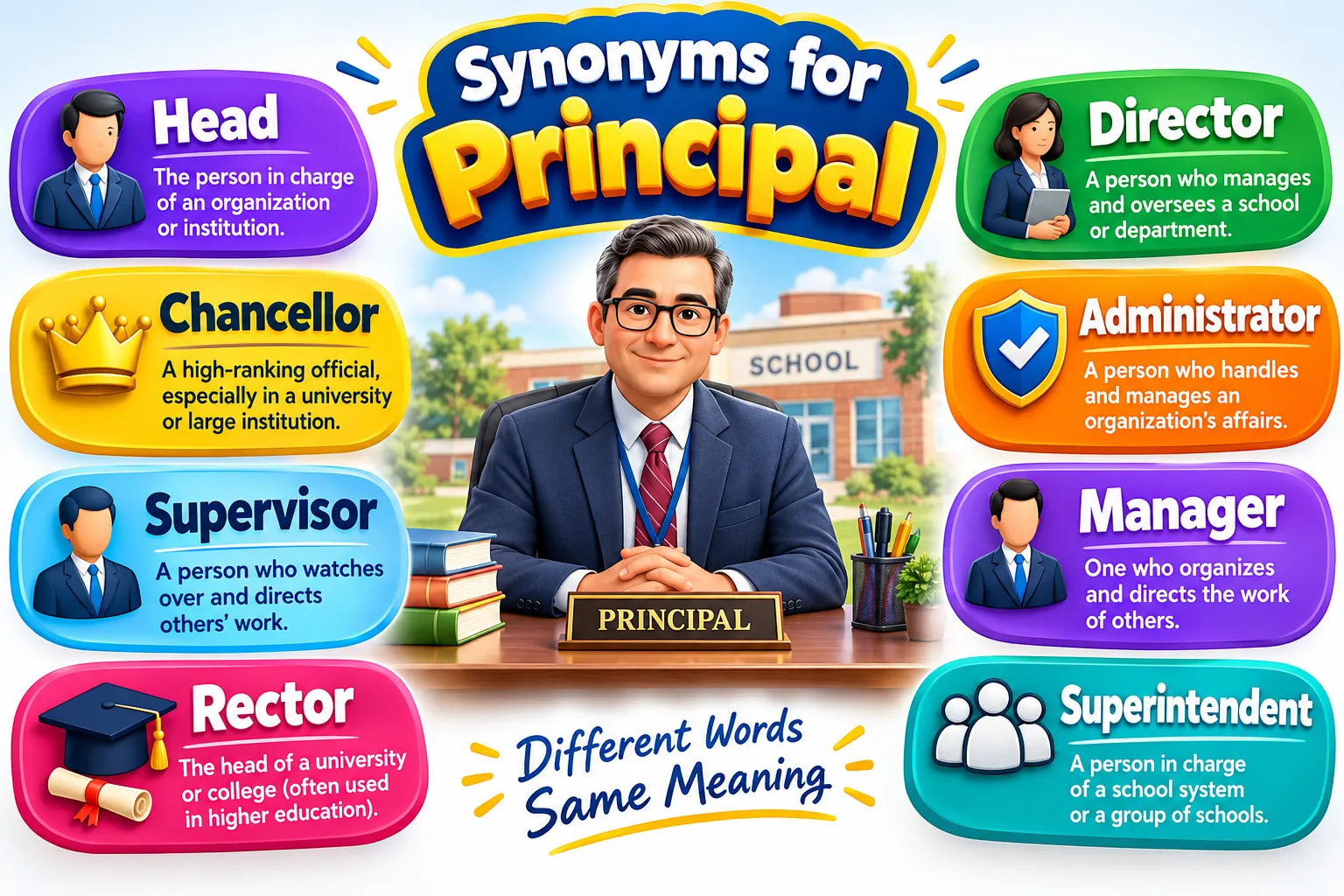
Useful synonyms include main, chief, primary, leading, foremost, paramount, central, key, essential, fundamental, crucial, important, administrator, head, director, leader, headmaster, manager, superintendent, capital, investment, and loan principal. The best synonym depends on the context—for example, main or primary for importance, head or administrator for a school leader, and original amount or loan principal for finance.
Principal is a useful English word with several meanings. It can describe the most important person or thing, the head of a school, or the main amount of money in a financial agreement. For example, a student may visit the principal to discuss a school problem. In another sentence, a company may focus on its principal goal. Because principal has different meanings, choosing the right synonym depends on the sentence. Learning synonyms for principal helps English learners build stronger vocabulary and helps writers avoid using the same word again and again. It also makes writing more exact and natural. In this guide, we will explain the meaning, examples, connotations, etymology, pronunciation, word formation, and 30 synonyms of principal. We will also explore semantic groups, antonyms, common questions, and useful examples.
Meaning of Principal
Definition
Principal (Noun / Adjective):
As a noun, principal can mean the head of a school or the main amount of money invested or borrowed. As an adjective, it means the most important or main.
Examples
- The principal spoke to the students during the morning assembly.
- Education is the principal goal of the program.
- She paid part of the loan’s principal.
Connotative Meaning
Connotation means the feeling or idea associated with a word beyond its basic meaning.
- Positive tone: Principal can suggest importance, leadership, authority, or central value.
- Negative tone: When used for a person, it may sometimes suggest authority or strict control, depending on context.
- Neutral tone: In academic, financial, and general writing, principal is often a neutral word meaning main, most important, or head.
Etymology
The word principal comes from Latin principalis, meaning “first in importance” or “chief.” It is related to Latin princeps, meaning “first” or “leader.”
- Old English (450–1100): The modern word principal was not part of Old English. Native English words such as chief and main were used for similar ideas.
- Middle English (1100–1500): Principal entered English through Old French from Latin principal / principal(e) and was used for something important or chief.
- Modern English (1500–Present): The word developed several related uses, including the head of a school and the main amount of money in a financial transaction.
Pronunciation (IPA)
- IPA: /ˈprɪnsəpəl/
- Syllables: prin-ci-pal
Note: Principal and principle sound the same in standard English, but they have different meanings and spellings.
Affixation Pattern of Principal
- Root: princip-
- Prefix: None in the modern English form
- Suffix: -al
- Word formations:
- principal — noun / adjective
- principally — adverb
- principality — noun
- principle — noun
- principled — adjective
- principally — adverb
The root is related to Latin princeps, carrying the idea of being first, chief, or foremost.
30 Synonyms of Principal With Meaning & Examples
1. Main (Adjective)
Meaning: Most important or central.
Examples:
- The main reason for the meeting was student safety.
- English is the main subject in this course.
2. Chief (Adjective / Noun)
Meaning: Most important or highest in rank.
Examples:
- Her chief concern was the safety of the children.
- The chief addressed the team.
3. Primary (Adjective)
Meaning: First or most important.
Examples:
- Our primary goal is to improve education.
- Reading is a primary skill for young learners.
4. Leading (Adjective)
Meaning: Most important, successful, or influential.
Examples:
- She is a leading expert in education.
- The company is a leading provider of online courses.
5. Foremost (Adjective)
Meaning: Most important or prominent.
Examples:
- Safety is the foremost concern.
- He is one of the foremost writers in the field.
6. Paramount (Adjective)
Meaning: More important than anything else.
Examples:
- Student safety is paramount.
- Quality is paramount in this project.
7. Preeminent (Adjective)
Meaning: Greater or more important than others.
Examples:
- She is a preeminent researcher.
- The university has a preeminent position in the field.
8. Dominant (Adjective)
Meaning: More powerful, noticeable, or important than others.
Examples:
- Technology has a dominant role in modern education.
- English is a dominant language in many international settings.
9. Central (Adjective)
Meaning: Most important or at the center of something.
Examples:
- Trust is central to a good relationship.
- Reading is central to language learning.
10. Key (Adjective)
Meaning: Very important or essential.
Examples:
- Communication is a key skill for teachers.
- Practice is a key part of learning.
11. Essential (Adjective)
Meaning: Completely necessary or very important.
Examples:
- Good planning is essential for success.
- Water is essential for life.
12. Fundamental (Adjective)
Meaning: Basic and extremely important.
Examples:
- Grammar is fundamental to learning a language.
- Trust is a fundamental part of teamwork.
13. Crucial (Adjective)
Meaning: Extremely important to the success of something.
Examples:
- Regular practice is crucial for improvement.
- Good communication is crucial in teaching.
14. Significant (Adjective)
Meaning: Important enough to have a noticeable effect.
Examples:
- The program made a significant improvement.
- Teachers play a significant role in education.
15. Important (Adjective)
Meaning: Having great value or influence.
Examples:
- Education is important for personal growth.
- Time management is important for students.
16. Administrator (Noun)
Meaning: A person who manages an organization, institution, or system.
Examples:
- The school administrator met with the teachers.
- The administrator manages the school’s daily operations.
17. Head (Noun)
Meaning: The person who leads an organization, department, or institution.
Examples:
- The head of the school welcomed the new students.
- She is the head of the English department.
18. Director (Noun)
Meaning: A person who manages or leads an organization or activity.
Examples:
- The director announced the new school policy.
- The program director spoke to the teachers.
19. Leader (Noun)
Meaning: A person who guides or manages others.
Examples:
- The school leader encouraged teachers to work together.
- A good leader listens to the team.
20. Headmaster (Noun)
Meaning: A male head of a school.
Examples:
- The headmaster addressed the students.
- The headmaster met with the parents.
21. Headmistress (Noun)
Meaning: A female head of a school.
Examples:
- The headmistress welcomed the new teachers.
- The headmistress spoke at the school ceremony.
22. Superintendent (Noun)
Meaning: An official who manages or supervises a group of schools or an organization.
Examples:
- The superintendent visited several schools.
- The superintendent discussed the education plan.
23. Manager (Noun)
Meaning: A person responsible for controlling or organizing an activity or group.
Examples:
- The manager organized the staff meeting.
- The project manager checked the team’s progress.
24. Chief Executive (Noun)
Meaning: The highest-ranking person who manages an organization.
Examples:
- The chief executive announced the new strategy.
- The chief executive met with senior staff.
25. Capital (Noun)
Meaning: Money or property used to start or operate a business or investment.
Examples:
- The company needs more capital to expand.
- Investors provided capital for the new project.
26. Investment (Noun)
Meaning: Money put into something with the expectation of gaining value or profit.
Examples:
- The investment grew over several years.
- She made a careful investment in the business.
27. Original Amount (Noun Phrase)
Meaning: The first amount of money borrowed or invested before interest or earnings.
Examples:
- The borrower must repay the original amount.
- Interest is calculated from the original amount of the loan.
28. Loan Principal (Noun)
Meaning: The original amount of money borrowed, excluding interest.
Examples:
- He made an extra payment toward the loan principal.
- Paying the loan principal can reduce future interest.
29. Source (Noun)
Meaning: The person or thing from which something comes or begins.
Examples:
- The river is the main source of water for the area.
- The document is an important source of information.
30. Foremost Person (Noun Phrase)
Meaning: A person who is especially important or prominent in a field.
Examples:
- She became a foremost person in the field of education.
- The conference invited several foremost figures in science.
Prototype Meaning
The most typical meaning of principal is the main or most important person or thing. When people hear the adjective principal, they often think of something that comes first in importance. When principal is used as a noun, many people think of a school principal, the person who leads a school. In finance, however, principal has a different meaning: it refers to the original amount of money borrowed or invested. The correct synonym therefore depends strongly on the context.
Prototype Categorization
The 30 synonyms can be divided into semantic categories based on their meaning and use.
- Importance: main, chief, primary, leading, foremost, paramount, preeminent, central, key, essential, fundamental, crucial, significant, and important. These words are useful when principal means “most important.”
- School leadership: administrator, head, director, leader, headmaster, headmistress, and superintendent. These words describe people who lead or manage educational institutions.
- Business and leadership: manager and chief executive. These terms describe people responsible for managing organizations or activities.
- Financial meaning: capital, investment, original amount, and loan principal. These words relate to the financial meaning of principal.
- Source or beginning: source can sometimes relate to the idea of something from which another thing originates, although it is not a direct synonym in every context.
This categorization helps writers choose the right word. For example, primary is useful for an important goal, administrator is suitable for a school leader, and loan principal is appropriate in financial writing.
Antonyms of Principal
1. Secondary (Adjective)
Meaning: Less important than the main thing.
2. Minor (Adjective)
Meaning: Less important, serious, or significant.
3. Unimportant (Adjective)
Meaning: Not important or valuable.
4. Subordinate (Adjective / Noun)
Meaning: Lower in rank or position.
5. Assistant (Noun)
Meaning: A person who helps someone with a higher position or responsibility.
6. Peripheral (Adjective)
Meaning: Less central or less important.
7. Insignificant (Adjective)
Meaning: Too small or unimportant to have much effect.
Short Questions and Answers
What does principal mean?
Principal can mean the most important person or thing, the head of a school, or the original amount of money borrowed or invested.
When should principal be used?
Use principal when referring to something that is most important, a school leader, or the original amount of money in a financial agreement.
Is principal positive or negative?
Principal is usually neutral. Its meaning depends on the context. It can describe importance, leadership, or a financial amount.
How is it different from similar words?
The meaning changes by context. Main, primary, chief, and key usually replace principal when it means “most important.” Administrator, head, and headmaster can describe a school principal. In finance, loan principal means the original amount borrowed.
Conclusion
Learning the synonyms of principal can improve your English vocabulary and help you communicate more clearly. The word has several meanings, so its synonyms must be chosen carefully. When principal means “most important,” words such as main, chief, primary, key, central, crucial, essential, and foremost are useful. When it means a school leader, words such as administrator, head, director, leader, headmaster, and superintendent may fit the context. In finance, principal refers to the original amount of money borrowed or invested. Understanding these differences helps writers avoid repetition and choose accurate words. Practice these synonyms in your own sentences each day. Regular vocabulary practice can strengthen your writing, speaking, reading, and overall confidence in English.
Read More:
Synonyms for connecting: 29 Useful Alternatives

I’m Falak Naaz, an SEO writer at SynonymsInstant.com focused on creating clear, engaging, and search-friendly English content. I specialize in vocabulary, synonyms, antonyms, word usage, and language guides. I combine careful research with practical writing to deliver trustworthy content that helps readers choose the right words and improve their English with confidence.