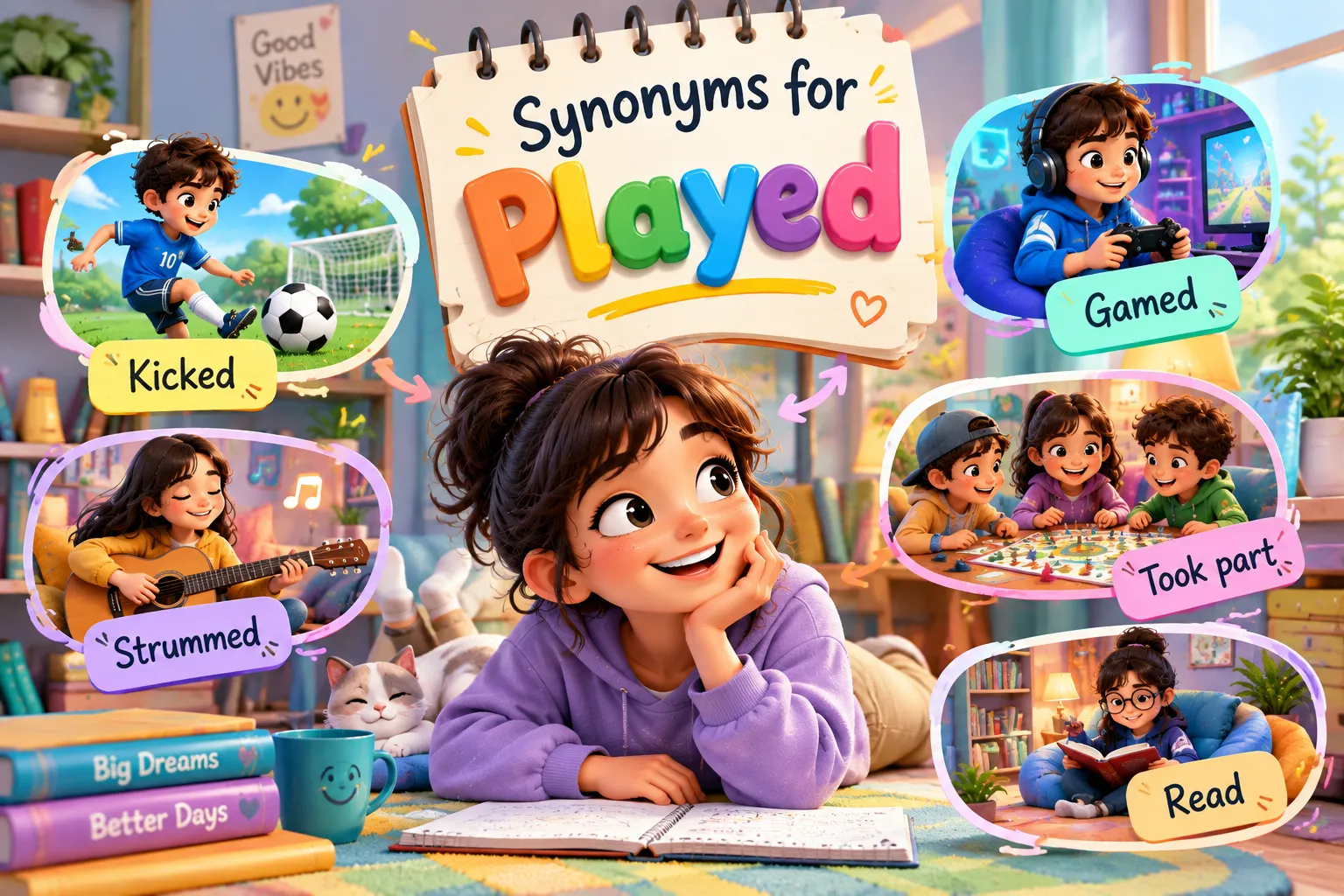
Common synonyms and related words include participated, competed, performed, acted, entertained, practiced, exercised, entered, engaged, joined, took part, battled, contended, toyed, rehearsed, pretended, frolicked, dabbled, used, handled, operated, moved, and amused oneself. The best word depends on the context—for example, competed fits sports, performed fits music or shows, practiced focuses on improving a skill, acted fits drama, and toyed suggests casual or playful activity.
Played is the past tense and past participle of play. We use it when someone took part in a game, sport, musical activity, performance, or another activity. For example, imagine a child who played football with friends after school. We also say someone played the piano, played a role in a movie, or played a part in a team. Because play has many uses, English learners and writers often need different words to make their meaning clear. Learning synonyms helps avoid repetition and makes speaking and writing more natural. In this article, we will explore the meaning of played, its common synonyms, examples, grammar, history, pronunciation, word formation, and semantic categories. These alternatives can help you choose the right word for sports, games, music, acting, entertainment, and other situations.
Meaning of Played
Definition
Played (Verb):
Played means took part in a game, sport, activity, performance, or musical activity, or used something for enjoyment or practice.
Examples
- She played football with her friends yesterday.
- He played the piano at the school event.
Connotative Meaning
Connotation means the feeling or idea connected with a word beyond its basic meaning.
- Positive tone: Played can suggest fun, skill, enjoyment, teamwork, or creativity.
- Negative tone: In some contexts, played can suggest manipulation, such as “He played me.”
- Neutral tone: Played can simply describe taking part in an activity, sport, game, or performance.
Etymology
The word played comes from the verb play.
- Old English (450–1100): Play is related to Old English plegian, meaning “to exercise, frolic, or take part in a game.”
- Middle English (1100–1500): The word developed into forms such as pleyen and gained wider meanings connected with games, entertainment, music, and performance.
- Modern English (1500–Present): Play became a common verb with many meanings, including taking part in sports, performing music, acting, using toys, and behaving in a certain way. Played is its regular past-tense and past-participle form.
Pronunciation (IPA)
- IPA: /pleɪd/
- Syllables: played (one syllable)
Affixation Pattern of Played
- Root: play
- Prefix: None
- Suffix: -ed
- Word formations:
- play — verb/noun
- plays — verb/noun
- played — verb
- playing — verb/noun
- player — noun
- playful — adjective
- playfully — adverb
- playfulness — noun
- playable — adjective
- playback — noun
- playground — noun
- playhouse — noun
26 Synonyms of Played With Meaning & Examples
1. Participated (Verb)
Meaning: Took part in an activity, event, or game.
Examples:
- She participated in the school competition.
- Many students participated in the sports day.
2. Competed (Verb)
Meaning: Took part in a contest or competition.
Examples:
- He competed in the football match.
- She competed against strong players.
3. Performed (Verb)
Meaning: Presented music, acting, or another form of entertainment.
Examples:
- The band performed at the festival.
- She performed a song for the audience.
4. Acted (Verb)
Meaning: Performed a character in a play, movie, or show.
Examples:
- He acted in a school drama.
- She acted as the main character.
5. Entertained (Verb)
Meaning: Gave people enjoyment through an activity or performance.
Examples:
- The singer entertained the crowd.
- The children entertained the guests with a show.
6. Practiced (Verb)
Meaning: Repeated an activity to improve a skill.
Examples:
- He practiced the piano every evening.
- She practiced her tennis skills after school.
7. Exercised (Verb)
Meaning: Took part in physical activity to improve health or fitness.
Examples:
- They exercised in the park.
- He exercised for an hour yesterday.
8. Competed (Verb)
Meaning: Took part in a contest against another person or team.
Examples:
- The team competed for the trophy.
- She competed in the final race.
9. Gambled (Verb)
Meaning: Took part in games or activities involving money or risk.
Examples:
- He gambled at the casino.
- They gambled on the result of the match.
10. Toyed (Verb)
Meaning: Played with something casually or without serious purpose.
Examples:
- The child toyed with the small car.
- She toyed with the idea of moving abroad.
11. Trifled (Verb)
Meaning: Treated something as unimportant or played with it without seriousness.
Examples:
- He trifled with her feelings.
- They trifled with an important opportunity.
12. Entered (Verb)
Meaning: Took part in a competition, event, or activity.
Examples:
- She entered the tennis tournament.
- He entered the school race.
13. Engaged (Verb)
Meaning: Took part in or became involved in an activity.
Examples:
- The students engaged in a fun game.
- They engaged in several sports.
14. Joined (Verb)
Meaning: Became part of a game, activity, or group.
Examples:
- I joined the children in their game.
- She joined the team last year.
15. Took Part (Verb Phrase)
Meaning: Participated in an activity or event.
Examples:
- He took part in the football match.
- She took part in the school play.
16. Battled (Verb)
Meaning: Competed strongly against another person or team.
Examples:
- The two teams battled for the championship.
- They battled hard until the final minute.
17. Contended (Verb)
Meaning: Competed against others for a prize or position.
Examples:
- Several players contended for the title.
- She contended with experienced athletes.
18. Competed Against (Verb Phrase)
Meaning: Took part in a contest against another person or group.
Examples:
- Our team competed against the champions.
- He competed against his brother.
19. Operated (Verb)
Meaning: Used or controlled a machine, device, or system.
Examples:
- He operated the game machine carefully.
- She operated the equipment during training.
20. Used (Verb)
Meaning: Handled or employed something for a purpose.
Examples:
- The children used the toys during class.
- He used the computer to play a game.
21. Handled (Verb)
Meaning: Used or managed something.
Examples:
- She handled the equipment carefully.
- He handled the ball with great skill.
22. Manipulated (Verb)
Meaning: Controlled or influenced someone or something, sometimes unfairly.
Examples:
- He manipulated the controls easily.
- She felt that he manipulated her emotions.
23. Moved (Verb)
Meaning: Changed position or caused something to move during a game or activity.
Examples:
- She moved her chess piece.
- He moved the ball across the field.
24. Entertained Oneself (Verb Phrase)
Meaning: Did something for enjoyment.
Examples:
- The children entertained themselves with toys.
- He entertained himself by playing games.
25. Rehearsed (Verb)
Meaning: Practiced a performance before presenting it publicly.
Examples:
- The actors rehearsed the play.
- The musicians rehearsed before the concert.
26. Pretended (Verb)
Meaning: Acted as if something were true when it was not.
Examples:
- The children pretended to be superheroes.
- He pretended to be a famous actor.
Prototype Meaning
The most typical meaning of played is took part in a game, sport, or activity. When people hear the word, they often imagine someone enjoying a game such as football, cricket, tennis, or chess. However, played can also describe making music, acting, using something, or behaving in a certain way.
Prototype Categorization
- Sports and competition: participated, competed, battled, contended, competed against — useful when describing games, matches, races, and contests.
- Performance and entertainment: performed, acted, entertained, rehearsed — useful for music, drama, theater, and shows.
- Practice and skill building: practiced, rehearsed, exercised — useful when someone is improving a skill or fitness.
- Casual play and enjoyment: toyed, frolicked, amused oneself, entertained oneself — useful for relaxed or playful actions.
- Participation: entered, engaged, joined, took part — useful when focusing on involvement in an event or activity.
- Handling or control: used, handled, operated, manipulated — useful when played refers to using an object, machine, instrument, or person.
- Pretense and unserious behavior: pretended, trifled, dabbled — useful when the action is not fully serious.
This categorization helps writers choose a word that gives the exact meaning they want instead of repeating played in every sentence.
Antonyms of Played
Not Participated (Verb Phrase)
- Did not take part in an activity or event.
Avoided (Verb)
- Chose not to take part in something.
Refused (Verb)
- Chose not to accept or participate.
Stopped (Verb)
- Ended an activity or stopped doing something.
Rested (Verb)
- Took a break instead of taking part in an activity.
Watched (Verb)
- Observed an activity instead of participating in it.
Short Questions and Answers
What does played mean?
Played is the past tense and past participle of play. It can mean took part in a game, sport, performance, or activity.
When should played be used?
Use played when describing an action that happened in the past, such as playing football, playing music, acting in a show, or taking part in a game.
Is played positive or negative?
Played is usually neutral or positive when it describes games, sports, music, or entertainment. It can have a negative meaning in phrases such as “played someone”, which can mean manipulated or deceived someone.
How is played different from similar words?
Played is a broad word. Competed focuses on competition, performed focuses on presenting something, practiced focuses on improving a skill, and toyed suggests casual or unserious play.
Conclusion
Learning played and its synonyms can make your English vocabulary stronger and more flexible. The word played has many meanings, so the best synonym depends on the situation. You can use competed for sports, performed for music or shows, practiced for skill development, acted for drama, and toyed for casual play. These words help you avoid repetition and make your writing more exact. They can also improve your speaking because you can describe actions in a clearer way. For English learners, learning synonyms is a useful daily habit. Try learning a few new words each day and use them in your own sentences. With regular practice, you can build confidence and express your ideas more naturally.
Read More:
Synonyms for mess with: 27 Useful Alternatives

I’m Falak Naaz, an SEO writer at SynonymsInstant.com focused on creating clear, engaging, and search-friendly English content. I specialize in vocabulary, synonyms, antonyms, word usage, and language guides. I combine careful research with practical writing to deliver trustworthy content that helps readers choose the right words and improve their English with confidence.