
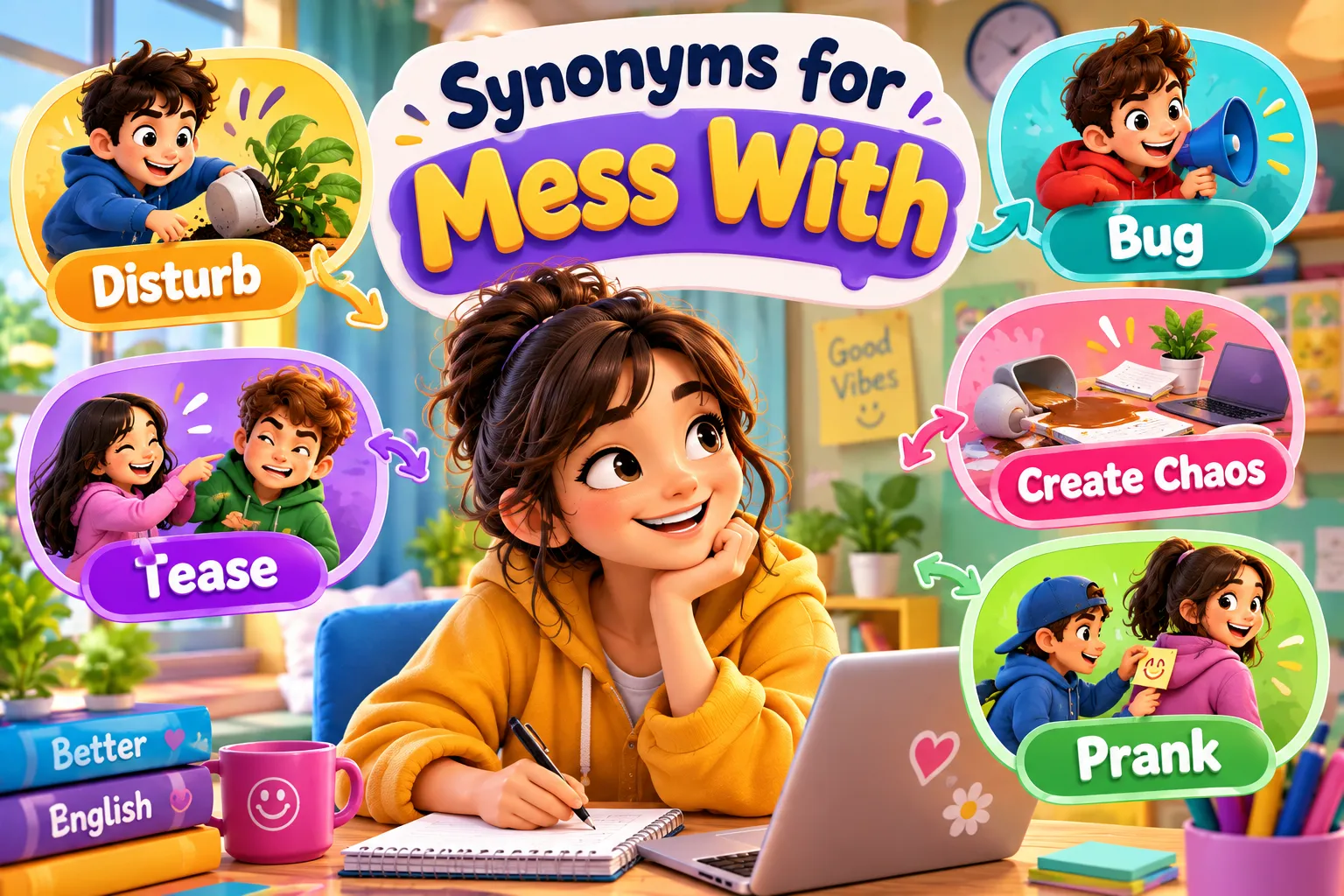
Common synonyms and related expressions include bother, annoy, tease, irritate, disturb, interfere, tamper with, toy with, play with, pester, harass, provoke, aggravate, antagonize, disrupt, meddle with, fiddle with, fool around with, play around with, manipulate, misuse, trouble, and challenge. The best choice depends on the context—for example, tease suggests playful joking, bother focuses on annoyance, interfere means getting involved unwantedly, and tamper with means making unauthorized changes.
Mess with is an informal phrasal verb that can mean to bother, annoy, tease, interfere with, or treat something carelessly. For example, if your friend keeps joking with you, you might say, “Stop messing with me.” If someone changes your computer settings without permission, you may also say, “Don’t mess with my computer.” The phrase is common in everyday English because it can express several ideas in a short and natural way. However, its exact meaning depends on the situation. Learning synonyms helps English learners choose clearer words and helps content writers avoid repetition. In this article, we will explore the meaning of mess with, its examples, connotations, history, pronunciation, word formation, and 27 useful synonyms. We will also group these words by meaning so you can choose the right word for each situation.
Meaning of Mess With
Definition
Mess with (Phrasal Verb): To bother, annoy, tease, interfere with, or handle someone or something in an unwanted way.
Examples
- Stop messing with your brother while he is studying.
- Please do not mess with the computer settings.
Connotative Meaning
Connotation: The feeling or idea that a word suggests beyond its basic meaning.
- Positive tone: It can sometimes suggest playful teasing between close friends.
- Negative tone: It can suggest annoying, disturbing, interfering, or treating something badly.
- Neutral tone: In some contexts, it simply means interacting with or changing something.
Etymology
The phrase mess with is made from the verb mess and the preposition with. The word mess developed from the idea of a portion of food or a serving, and later gained the meaning of disorder and confused activity. The phrasal verb mess with developed in modern English as an informal expression for interfering with, bothering, or playing with someone or something.
- Old English (450–1100): The modern phrase mess with was not used in Old English. The English language had other words for disorder, disturbance, and interference.
- Middle English (1100–1500): Mess entered English through Old French from Latin missum, related to something sent or served as food. Its meanings later expanded.
- Modern English (1500–Present): Mess developed meanings connected with disorder, careless handling, and troublesome activity. The phrasal verb mess with became common in informal modern English.
Pronunciation (IPA)
- IPA: /mes wɪð/ or /mes wɪθ/
- Syllables: mess with
Affixation Pattern of Mess With
- Root: mess
- Prefix: None
- Suffix: None in the basic phrase
- Word formations:
- Mess — noun
- Mess — verb
- Messy — adjective
- Messiness — noun
- Messed — verb/adjective
- Messing — verb/noun
- Mess up — phrasal verb
- Mess around — phrasal verb
- Mess with — phrasal verb
- Mess around with — phrasal verb
27 Synonyms of Mess With With Meaning & Examples
1. Bother (Verb)
Meaning: To annoy or disturb someone.
Examples:
- Please stop bothering me while I work.
- The noise bothered everyone in the room.
2. Annoy (Verb)
Meaning: To make someone feel irritated or angry.
Examples:
- His constant questions annoyed me.
- Loud music can annoy the neighbors.
3. Tease (Verb)
Meaning: To make fun of someone in a playful or sometimes unkind way.
Examples:
- My friends like to tease me.
- She teased her brother about his new haircut.
4. Irritate (Verb)
Meaning: To make someone feel annoyed or uncomfortable.
Examples:
- His rude comments irritated her.
- The constant noise irritated the workers.
5. Disturb (Verb)
Meaning: To interrupt or bother someone who wants peace or concentration.
Examples:
- Please do not disturb me while I study.
- The loud music disturbed the baby.
6. Interfere (Verb)
Meaning: To become involved in something in a way that causes problems.
Examples:
- Do not interfere with my work.
- He tried to interfere with their plans.
7. Tamper With (Phrasal Verb)
Meaning: To make unwanted or unauthorized changes to something.
Examples:
- Do not tamper with the machine.
- Someone tampered with the security system.
8. Toy With (Phrasal Verb)
Meaning: To treat something or someone casually without serious purpose.
Examples:
- Do not toy with people’s feelings.
- He was toying with the idea of moving abroad.
9. Play With (Phrasal Verb)
Meaning: To handle, use, or consider something for fun or without a serious plan.
Examples:
- Do not play with the controls.
- She is playing with the idea of starting a business.
10. Pester (Verb)
Meaning: To repeatedly bother someone with requests or questions.
Examples:
- The child kept pestering his father.
- Stop pestering me with the same question.
11. Harass (Verb)
Meaning: To repeatedly trouble, pressure, or annoy someone.
Examples:
- The workers complained that they were being harassed.
- Do not harass other students.
12. Provoke (Verb)
Meaning: To deliberately make someone angry or react.
Examples:
- He tried to provoke his opponent.
- Do not provoke the dog.
13. Aggravate (Verb)
Meaning: To make a person or problem more annoying or serious.
Examples:
- His comments aggravated the situation.
- Do not aggravate the problem further.
14. Antagonize (Verb)
Meaning: To make someone dislike or oppose you by annoying them.
Examples:
- His rude behavior antagonized his coworkers.
- She did not want to antagonize her teacher.
15. Distress (Verb)
Meaning: To cause someone worry, sadness, or emotional pain.
Examples:
- The news distressed his family.
- Do not say things that may distress others.
16. Disrupt (Verb)
Meaning: To interrupt something and prevent it from working normally.
Examples:
- The protest disrupted traffic.
- Do not disrupt the meeting.
17. Meddle With (Phrasal Verb)
Meaning: To interfere in something that does not concern you.
Examples:
- Do not meddle with other people’s affairs.
- He always meddles with his sister’s plans.
18. Interfere With (Phrasal Verb)
Meaning: To affect or change something in an unwanted way.
Examples:
- Do not interfere with the equipment.
- Stress can interfere with your sleep.
19. Fiddle With (Phrasal Verb)
Meaning: To keep touching or changing something without a clear purpose.
Examples:
- Stop fiddling with the radio.
- He kept fiddling with his phone.
20. Fool Around With (Phrasal Verb)
Meaning: To treat something without care or seriousness.
Examples:
- Do not fool around with electrical equipment.
- He was fooling around with the controls.
21. Play Around With (Phrasal Verb)
Meaning: To experiment with or change something casually.
Examples:
- I played around with the new software.
- She played around with different designs.
22. Manipulate (Verb)
Meaning: To control or change a person or situation, often unfairly.
Examples:
- He tried to manipulate his friends.
- The advertisement was designed to manipulate customers.
23. Abuse (Verb)
Meaning: To use a person, object, or system in a harmful or wrong way.
Examples:
- Do not abuse your position of authority.
- The machine was abused by careless users.
24. Misuse (Verb)
Meaning: To use something in an incorrect or harmful way.
Examples:
- Do not misuse this equipment.
- He misused the information he received.
25. Disturb (Verb)
Meaning: To interfere with someone’s peace, activity, or concentration.
Examples:
- The children disturbed the sleeping dog.
- Please do not disturb the students.
26. Challenge (Verb)
Meaning: To confront or provoke someone, sometimes in an informal way.
Examples:
- He challenged me to a race.
- Do not challenge someone just to start an argument.
27. Antagonize (Verb)
Meaning: To deliberately annoy someone and create opposition.
Examples:
- His comments antagonized the audience.
- She avoided antagonizing her coworkers.
Prototype Meaning
The most typical meaning of mess with is to bother, tease, interfere with, or handle someone or something in an unwanted way. When people hear this phrase, they often imagine someone causing trouble, joking with another person, changing something they should not change, or interfering with a situation. The exact meaning depends strongly on context and tone.
Prototype Categorization
- Bothering and annoying: bother, annoy, irritate, pester, trouble. These words work when someone is causing irritation or discomfort.
- Teasing and provoking: tease, provoke, challenge, antagonize. These are useful when someone is trying to get a reaction.
- Interfering: interfere, meddle with, interfere with, disrupt. These fit situations where someone gets involved in something unnecessarily.
- Changing or handling carelessly: tamper with, fiddle with, play with, fool around with. These are useful when someone touches, changes, or uses something without proper care.
- Controlling or using unfairly: manipulate, abuse, misuse. These stronger words fit situations involving harmful or improper treatment.
- Playing or experimenting: toy with, play around with, play with. These can describe casual experimentation or a lack of seriousness.
This grouping helps writers choose a synonym based on the exact meaning they want instead of replacing mess with with a word that may not fit the context.
Antonyms of Mess With
- Leave alone (Phrasal Verb): To avoid bothering or interfering with someone or something.
- Respect (Verb): To treat someone or something with proper care.
- Protect (Verb): To keep someone or something safe from harm.
- Ignore (Verb): To pay no attention to someone or something.
- Preserve (Verb): To keep something in its original or good condition.
- Support (Verb): To help rather than disturb or interfere.
Short Questions and Answers
What does mess with mean?
Mess with can mean to bother, tease, interfere with, tamper with, or treat someone or something carelessly.
When should mess be used?
Use mess with mainly in informal conversation. The meaning depends on the context. For formal writing, a more specific word such as interfere, annoy, tamper with, or manipulate may be clearer.
Is it a mess with positive or negative?
Mess with is usually neutral to negative. It can have a playful meaning when friends tease each other, but it can also describe unwanted interference or harmful behavior.
How is it different from similar words?
Mess with is broad and informal. Tease focuses on playful or unkind joking, bother focuses on annoyance, interfere focuses on unwanted involvement, and tampering focuses on unauthorized changes.
Conclusion
Learning synonyms for mess with helps English learners understand how one informal phrase can have several meanings. Words such as bother, tease, annoy, interfere, tamper with, meddle with, provoke, and manipulate can express more specific ideas. Choosing the right word makes your speaking and writing clearer and more natural. It also helps you avoid repeating the same phrase in conversations, essays, stories, and online content. Remember that many alternatives are not exact synonyms, so the situation and tone matter. Try learning a few new words each day and use them in your own sentences. With regular practice, you can build a stronger vocabulary, improve your writing and speaking, and feel more confident when using English in everyday situations.
Read More:
Synonyms for Gym: 30 Powerful Words to Know

I’m Ayesha Haram, an English content and SEO writer at SynonymsInstant.com. I focus on creating helpful vocabulary resources, word guides, and practical English content that readers can understand quickly. I combine language research, clear explanations, and SEO-focused writing to produce reliable content that supports learners, writers, and everyday English users.