
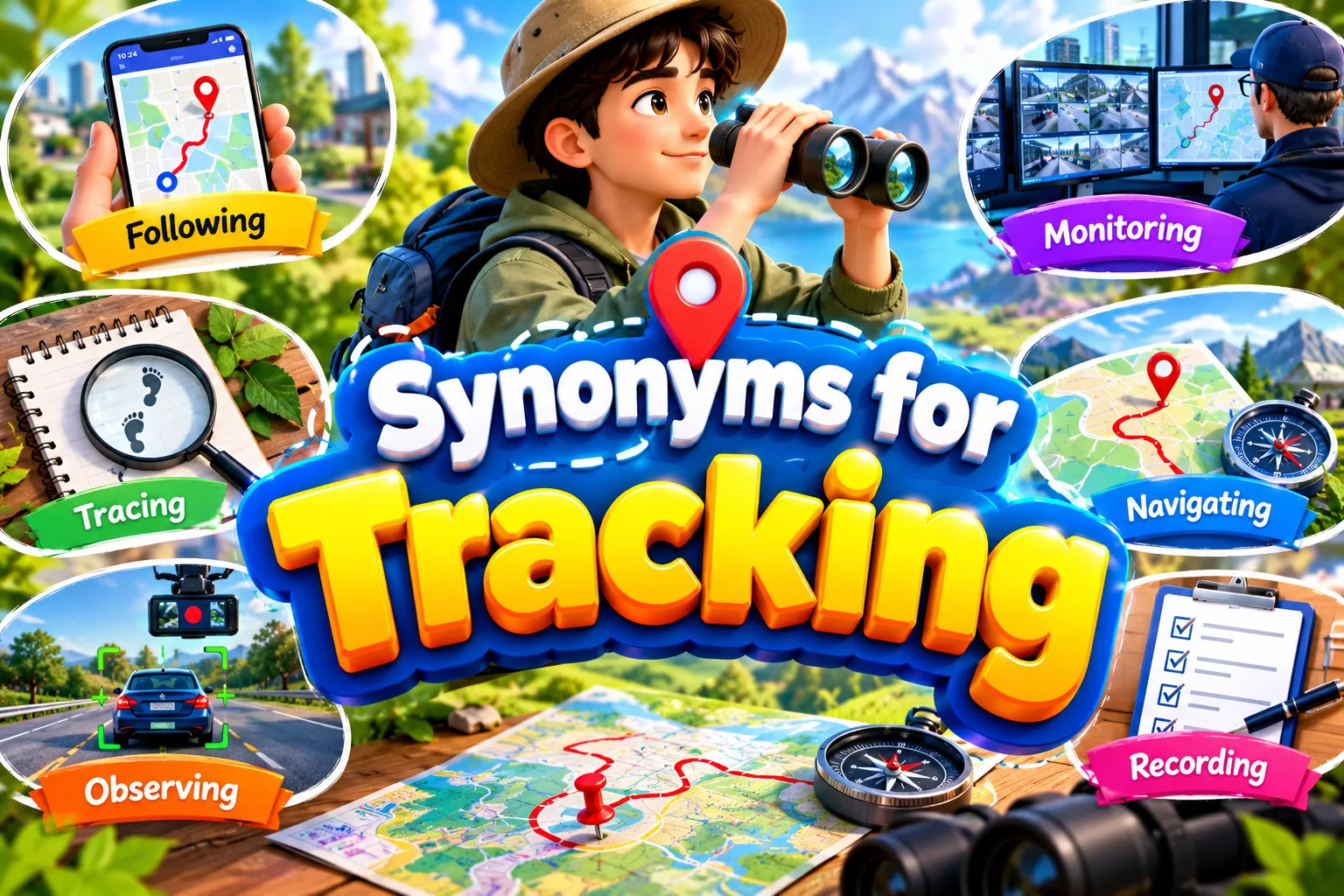
Common synonyms and related terms include following, monitoring, tracing, observing, watching, recording, logging, locating, identifying, pursuing, chasing, hunting, shadowing, surveillance, supervision, checking, reviewing, measuring, assessing, keeping tabs on, keeping track of, mapping, navigating, guiding, progress monitoring, data collection, and GPS monitoring. The best word depends on the context—for example, monitoring focuses on watching, tracing focuses on finding a path or source, locating focuses on finding a position, and recording focuses on saving information.
Tracking means following, watching, or recording the movement, progress, or location of someone or something. For example, when you order a package online, you may use a tracking number to see where it is and when it will arrive. The word tracking is common in daily life, technology, business, sports, and research. Learning synonyms for tracking helps English learners use more precise words and helps writers avoid repeating the same term. Different words can show different kinds of tracking, such as watching a person, following a path, recording progress, or finding a location. In this article, we will explore the meaning of tracking, its grammar, history, pronunciation, and 29 useful synonyms and related terms. We will also organize these words into semantic groups so you can choose the right word for each situation.
Meaning of Tracking
Definition
Tracking (Noun/Gerund):
Tracking means following, watching, locating, or recording the movement or progress of someone or something.
Examples
- The company uses GPS for tracking its delivery vehicles.
- I am tracking my package online.
Connotative Meaning
Connotation means the feeling or idea that a word suggests beyond its basic meaning.
- Positive tone: Tracking can suggest safety, organization, accuracy, progress, and control.
- Negative tone: In some situations, tracking can suggest unwanted monitoring, surveillance, or loss of privacy.
- Neutral tone: Tracking can simply mean following or recording movement and progress.
Etymology
- Old English (450–1100): The modern word tracking comes from track, which is related to older Germanic words connected with a path, mark, or course.
- Middle English (1100–1500): Track developed as a word for a path, trail, or mark left by something moving. It was also connected with following someone’s trail.
- Modern English (1500–Present): Track became a verb meaning to follow a trail or movement. The form tracking developed from track + -ing and is now widely used for physical movement, progress, packages, digital activity, and location systems.
Pronunciation (IPA)
- IPA: /ˈtrækɪŋ/
- Syllables: track-ing
Affixation Pattern of Tracking
- Root: track
- Prefix: None
- Suffix: -ing — forms the present participle or gerund
- Word formations:
- track — noun/verb
- tracking — noun/verb form
- tracked — verb
- tracker — noun
- trackable — adjective
- tracking system — noun phrase
- tracking device — noun phrase
29 Synonyms of Tracking With Meaning & Examples
Note: Some words below are close synonyms, while others describe specific types or methods of tracking. The best choice depends on the context.
1. Following (Verb/Noun)
Meaning: Going after or watching the movement of someone or something.
Examples:
- The dog was following the scent.
- She is following the progress of the project.
2. Monitoring (Verb/Noun)
Meaning: Watching or checking something regularly.
Examples:
- The doctor is monitoring the patient’s progress.
- The system is monitoring website activity.
3. Tracing (Verb/Noun)
Meaning: Finding the path, source, or history of something.
Examples:
- Police are tracing the phone call.
- Researchers are tracing the source of the problem.
4. Observing (Verb/Noun)
Meaning: Watching something carefully to learn about it.
Examples:
- The scientist is observing the animals.
- We spent an hour observing their behavior.
5. Watching (Verb/Noun)
Meaning: Looking at or paying attention to something over time.
Examples:
- He is watching the security camera.
- She was watching the bird’s movement.
6. Recording (Verb/Noun)
Meaning: Keeping information about events, actions, or progress.
Examples:
- The app is recording your activity.
- We are recording the team’s results.
7. Logging (Verb/Noun)
Meaning: Keeping a written or digital record of events or activities.
Examples:
- The system is logging every login.
- The driver is logging the distance traveled.
8. Locating (Verb/Noun)
Meaning: Finding the position or place of someone or something.
Examples:
- GPS is locating the vehicle.
- We had trouble locating the missing file.
9. Identifying (Verb/Noun)
Meaning: Recognizing or finding out exactly what something or someone is.
Examples:
- The camera is identifying objects.
- Scientists are identifying the cause of the problem.
10. Pursuing (Verb/Noun)
Meaning: Following someone or something with the aim of reaching or catching it.
Examples:
- The police were pursuing the suspect.
- The hunter was pursuing the animal.
11. Chasing (Verb/Noun)
Meaning: Following someone or something quickly to catch it.
Examples:
- The dog was chasing the ball.
- The police were chasing the car.
12. Hunting (Verb/Noun)
Meaning: Searching for someone or something carefully.
Examples:
- The team is hunting for clues.
- Researchers are hunting for new evidence.
13. Shadowing (Verb/Noun)
Meaning: Following or staying close to someone, often to observe them.
Examples:
- The trainee is shadowing an experienced teacher.
- The detective was shadowing the suspect.
14. Surveillance (Noun)
Meaning: Close and careful watching of a person, place, or activity.
Examples:
- The building is under surveillance.
- Security cameras provide constant surveillance.
15. Supervision (Noun)
Meaning: Watching and guiding people or activities.
Examples:
- The children were under adult supervision.
- The project needs careful supervision.
16. Inspection (Noun)
Meaning: A careful examination to check condition or quality.
Examples:
- The engineer carried out an inspection.
- The machine needs regular inspection.
17. Checking (Verb/Noun)
Meaning: Looking at something to make sure it is correct or safe.
Examples:
- I am checking the delivery status.
- The teacher is checking the students’ work.
18. Reviewing (Verb/Noun)
Meaning: Looking at information again to understand or evaluate it.
Examples:
- The manager is reviewing the team’s progress.
- We are reviewing the project records.
19. Measuring (Verb/Noun)
Meaning: Finding the amount, size, level, or progress of something.
Examples:
- The device is measuring temperature.
- We are measuring student progress.
20. Assessing (Verb/Noun)
Meaning: Examining something to understand its quality, condition, or progress.
Examples:
- Teachers are assessing student performance.
- The company is assessing its progress.
21. Observance (Noun)
Meaning: Careful attention to a rule, condition, or activity.
Examples:
- The program requires close observance of safety rules.
- Regular observance helps maintain standards.
22. Keeping Tabs On (Phrase)
Meaning: Watching or checking something regularly.
Examples:
- I am keeping tabs on my package.
- She keeps tabs on her team’s progress.
23. Keeping Track Of (Phrase)
Meaning: Making sure you know where something is or how it is progressing.
Examples:
- I keep track of my expenses.
- The teacher keeps track of attendance.
24. Mapping (Verb/Noun)
Meaning: Showing the location, movement, or arrangement of something.
Examples:
- The researchers are mapping animal movements.
- The app is mapping the delivery route.
25. Navigating (Verb/Noun)
Meaning: Finding and following a route to a destination.
Examples:
- The driver is navigating the city.
- GPS helps us navigate unfamiliar roads.
26. Guiding (Verb/Noun)
Meaning: Helping someone or something move toward a place or goal.
Examples:
- The teacher is guiding the students.
- The system is guiding the driver.
27. Measuring Progress (Phrase)
Meaning: Checking how much someone or something has improved or advanced.
Examples:
- Tests help teachers measure progress.
- We are measuring progress every month.
28. Progress Monitoring (Noun Phrase)
Meaning: Regularly checking how something is developing or improving.
Examples:
- Progress monitoring helps teachers support students.
- The team uses progress monitoring during the project.
29. Data Collection (Noun Phrase)
Meaning: Gathering information about people, events, or activities.
Examples:
- The study involves data collection.
- Data collection helps researchers understand trends.
Prototype Meaning
The most typical meaning of tracking is following or monitoring the movement or progress of something. When people hear this word, they may imagine a GPS screen showing a vehicle’s location, a package being followed online, or a person checking the progress of a task. The exact meaning changes with context. Tracking can involve physical movement, digital information, progress, location, or behavior.
Prototype Categorization
- Following and movement: following, pursuing, chasing, shadowing, hunting. These words focus on staying behind or moving after someone or something.
- Watching and observation: monitoring, observing, watching, surveillance, supervision. These are useful when the main idea is careful observation.
- Finding and location: tracing, locating, identifying, mapping, navigating. These work well when the goal is to find a place, source, route, or object.
- Recording and information: recording, logging, data collection, keeping track of. These focus on saving information over time.
- Checking and evaluation: checking, reviewing, measuring, assessing, inspection. These are useful when tracking means checking quality or progress.
- Progress tracking: measuring progress, progress monitoring, keeping tabs on. These expressions are useful in education, business, health, and project management.
- Technology-based tracking: GPS monitoring, mapping, logging. These terms fit technology and digital systems.
This categorization helps writers choose a more precise word instead of using tracking repeatedly.
Antonyms of Tracking
There is no single perfect antonym for tracking, but these words can express opposite ideas in some contexts:
1. Ignoring (Verb)
Meaning: Choosing not to pay attention to something.
2. Neglecting (Verb)
Meaning: Failing to give proper attention or care.
3. Losing (Verb)
Meaning: No longer knowing where someone or something is.
4. Abandoning (Verb)
Meaning: Stopping the act of following or supporting something.
5. Unobserved (Adjective)
Meaning: Not watched or noticed.
Short Questions and Answers
What does tracking mean?
Tracking means following, watching, locating, or recording the movement or progress of something.
When should tracking be used?
Use tracking when you are talking about following movement, recording progress, checking information, or finding a location.
Is tracking positive or negative?
Tracking is usually neutral, but its meaning can become positive when it improves safety or organization and negative when it involves unwanted monitoring or privacy concerns.
How is tracking different from similar words?
Tracking is a broad word. Monitoring focuses on watching, tracing focuses on finding a path or source, locating focuses on finding a position, and recording focuses on saving information.
Conclusion
Learning synonyms for tracking helps you communicate with greater accuracy and variety. The word can describe following a person, watching progress, finding a location, recording data, or checking movement. Related words such as monitoring, tracing, following, observing, locating, recording, and logging each highlight a different part of the meaning. Choosing the right word can make your writing clearer and more natural. English learners can also use these words to improve speaking and reading skills. Writers benefit because they can avoid repeating tracking throughout an article. Try learning a few related words each day and use them in your own sentences. With regular practice, your vocabulary will become stronger, clearer, and more flexible.
Read More:
Synonyms for soccer: 27 Powerful Alternatives

I’m Ayesha Haram, an English content and SEO writer at SynonymsInstant.com. I focus on creating helpful vocabulary resources, word guides, and practical English content that readers can understand quickly. I combine language research, clear explanations, and SEO-focused writing to produce reliable content that supports learners, writers, and everyday English users.