
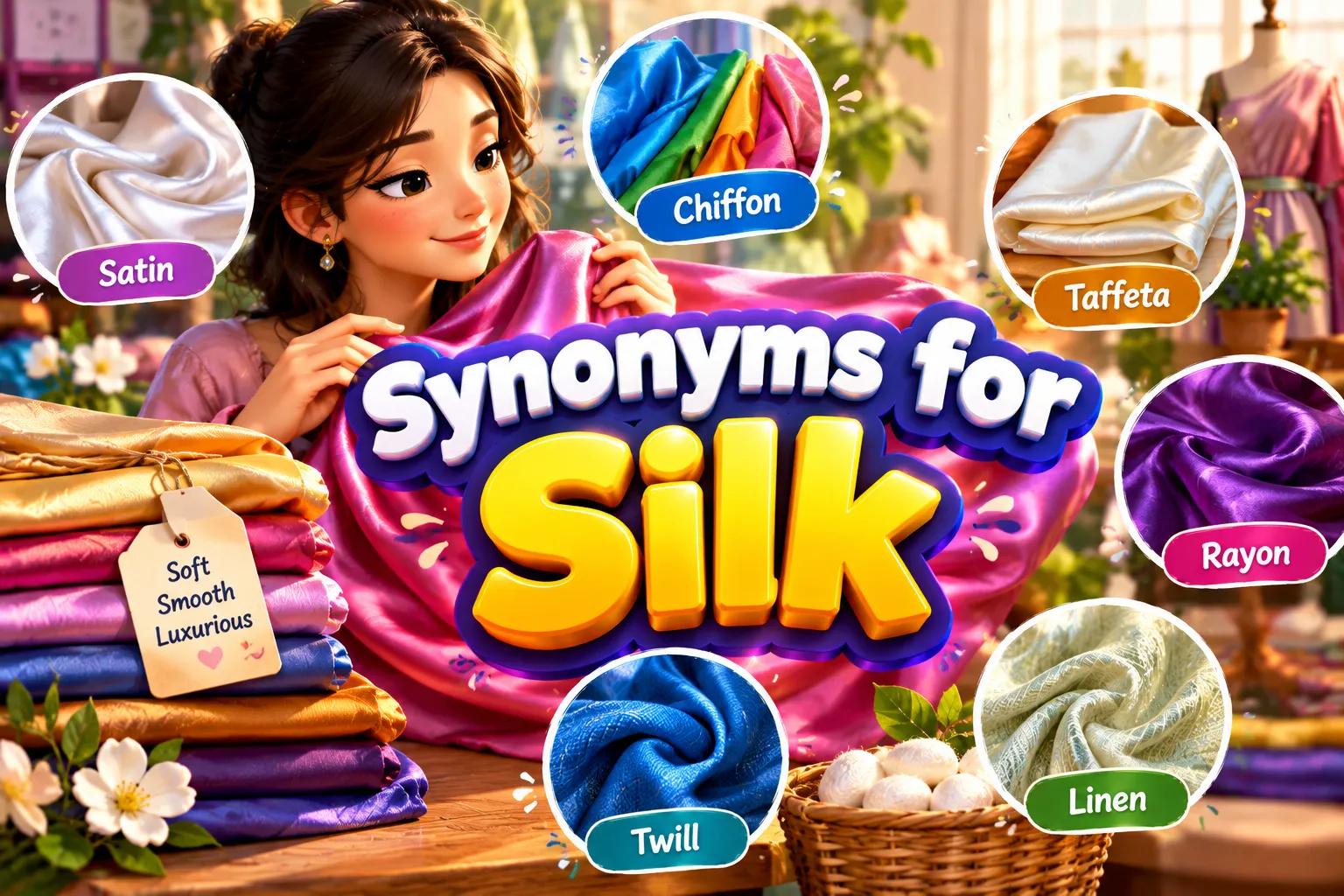
Common synonyms and related words include silken, silky, silk-like, satin, sateen, charmeuse, chiffon, organza, taffeta, crepe, velvet, rayon, viscose, polyester, nylon, smooth, lustrous, glossy, shimmering, fine fabric, luxury fabric, natural fiber, textile, fabric, cloth, material, thread, and filament. The best word depends on the context—for example, silky describes a smooth texture, lustrous describes a soft shine, satin refers to a similar-looking fabric, and silken means made of or resembling silk.
Silk is a soft, smooth, and shiny natural fiber that is mainly made by silkworms. Imagine wearing a beautiful silk scarf at a wedding. It feels light, soft, and comfortable against the skin. Silk is commonly used for clothing, scarves, ties, bedding, and other luxury items. The word also suggests beauty, softness, quality, and elegance. Learning synonyms and related words for silk can help English learners build stronger vocabulary and help writers describe fabrics without repeating the same word. However, not every fabric name is an exact synonym for silk. Some words describe fabrics that look or feel similar to silk, while others describe specific types of textiles. In this article, we will explore the meaning, history, pronunciation, grammar, and 30 useful synonyms and related fabric terms for silk, with simple examples and semantic categories.
Meaning of Silk
Definition
Silk (Noun):
Silk is a soft, strong, smooth natural fiber produced mainly by silkworms and used to make fine fabrics.
Examples
- She wore a beautiful silk dress to the wedding.
- This silk scarf feels very soft.
Connotative Meaning
Connotation means the feeling or idea that a word suggests beyond its basic meaning.
- Positive tone: Silk suggests luxury, beauty, softness, elegance, and high quality.
- Negative tone: In some contexts, silk may suggest high cost or delicate care.
- Neutral tone: Silk can simply refer to a natural fiber or fabric.
Etymology
- Old English (450–1100): The modern word silk is not originally Old English. English speakers used related forms later through contact with other European languages.
- Middle English (1100–1500): Forms such as silk and silke were used for the valuable fabric. The word came into English through Germanic and Latin-related language routes.
- Modern English (1500–Present): Silk became the standard English word for the fine natural fiber and the fabric made from it. It is now also used in compounds such as silk dress, silk thread, and silk fabric.
Pronunciation (IPA)
- IPA: /sɪlk/
- Syllables: silk
Affixation Pattern of Silk
- Root: silk
- Prefix: None
- Suffix: None
- Word formations:
- silk — noun
- silken — adjective
- silky — adjective
- silkiness — noun
- silkily — adverb
- silk-like — adjective
- silkworker — noun
- silkworm — noun
- silk-making — noun/adjective
30 Synonyms of Silk With Meaning & Examples
Important: Silk has few true synonyms because it names a specific natural fiber. The list below includes close alternatives, related textile terms, and words used to describe silk-like fabrics or qualities.
1. Silken (Adjective)
Meaning: Made of silk or having the smooth quality of silk.
Examples:
- She wore a silken dress.
- The fabric had a silken texture.
2. Silk-like (Adjective)
Meaning: Having a smooth and soft quality similar to silk.
Examples:
- The material has a silk-like finish.
- Her hair felt silk-like and smooth.
3. Silky (Adjective)
Meaning: Smooth, soft, and shiny like silk.
Examples:
- Her hair looks silky.
- The cream has a silky texture.
4. Satin (Noun)
Meaning: A smooth, shiny fabric that can look similar to silk but may be made from different fibers.
Examples:
- She bought a satin dress.
- The pillow has a smooth satin cover.
5. Sateen (Noun)
Meaning: A smooth, shiny cotton fabric with a satin-like surface.
Examples:
- The curtains are made of sateen.
- Sateen has a soft, shiny appearance.
6. Charmeuse (Noun)
Meaning: A lightweight, smooth fabric with a shiny surface, traditionally often made from silk.
Examples:
- The designer used charmeuse for the gown.
- Charmeuse gives the dress a soft shine.
7. Chiffon (Noun)
Meaning: A very light and delicate fabric that can be made from silk or synthetic fibers.
Examples:
- She wore a chiffon scarf.
- The chiffon dress moved gently in the wind.
8. Organza (Noun)
Meaning: A thin, lightweight, crisp fabric that may be made from silk or synthetic fibers.
Examples:
- The bride wore an organza veil.
- The designer used organza for the sleeves.
9. Taffeta (Noun)
Meaning: A smooth, crisp fabric that can be made from silk or other fibers.
Examples:
- The gown was made of taffeta.
- Taffeta gives the dress a firm shape.
10. Crepe (Noun)
Meaning: A fabric with a slightly rough or textured surface that can be made from silk or other fibers.
Examples:
- She chose a silk crepe dress.
- Crepe has a distinctive texture.
11. Velvet (Noun)
Meaning: A soft fabric with a thick surface and rich appearance.
Examples:
- The chair has a velvet cover.
- She wore a velvet jacket.
12. Rayon (Noun)
Meaning: A manufactured fiber that can have a soft and silk-like appearance.
Examples:
- The shirt is made from rayon.
- Rayon can have a smooth texture.
13. Viscose (Noun)
Meaning: A type of regenerated cellulose fiber often used to make soft fabrics.
Examples:
- The dress is made from viscose.
- Viscose can feel soft against the skin.
14. Polyester (Noun)
Meaning: A synthetic fiber commonly used to make many types of clothing and textiles.
Examples:
- The scarf is made from polyester.
- Polyester is easy to care for.
15. Nylon (Noun)
Meaning: A strong synthetic fiber used in clothing and many other products.
Examples:
- The fabric contains nylon.
- Nylon is known for its strength.
16. Satin-like (Adjective)
Meaning: Having a smooth and shiny surface similar to satin.
Examples:
- The material has a satin-like finish.
- Her dress had a satin-like shine.
17. Smooth (Adjective)
Meaning: Having an even surface that feels soft or pleasant.
Examples:
- The silk has a smooth surface.
- The fabric feels smooth against the skin.
18. Lustrous (Adjective)
Meaning: Having a soft, attractive shine.
Examples:
- The silk has a lustrous surface.
- Her dress looked lustrous under the lights.
19. Glossy (Adjective)
Meaning: Having a bright and shiny surface.
Examples:
- The fabric has a glossy finish.
- She chose a glossy material for the dress.
20. Shimmering (Adjective)
Meaning: Shining with a soft, changing light.
Examples:
- Her silk scarf looked shimmering.
- The shimmering fabric caught the light.
21. Fine Fabric (Noun Phrase)
Meaning: A high-quality, soft, or delicate textile.
Examples:
- Silk is considered a fine fabric.
- The shop sells many fine fabrics.
22. Luxury Fabric (Noun Phrase)
Meaning: An expensive or high-quality fabric associated with comfort and elegance.
Examples:
- Silk is a popular luxury fabric.
- The designer specializes in luxury fabrics.
23. Natural Fiber (Noun Phrase)
Meaning: A fiber that comes from a natural plant or animal source.
Examples:
- Silk is a natural fiber.
- Cotton is another common natural fiber.
24. Textile (Noun)
Meaning: A material made by weaving, knitting, or processing fibers.
Examples:
- Silk is an important textile.
- The company produces high-quality textiles.
25. Fabric (Noun)
Meaning: Material made from fibers and used to make clothes or other items.
Examples:
- This fabric feels soft.
- Silk is a popular fabric for formal clothing.
26. Cloth (Noun)
Meaning: Material made from fibers and used for clothing or other purposes.
Examples:
- The cloth was soft and light.
- She bought some beautiful cloth.
27. Material (Noun)
Meaning: A substance used to make something.
Examples:
- Silk is a valuable material.
- The designer selected a soft material.
28. Thread (Noun)
Meaning: A thin strand of fiber used for sewing or weaving.
Examples:
- The silk thread was very fine.
- She used silk thread for embroidery.
29. Filament (Noun)
Meaning: A very thin continuous fiber or strand.
Examples:
- The silk is made from fine filaments.
- The silkworm produces a long filament.
30. Soft Fabric (Noun Phrase)
Meaning: A textile that feels gentle and smooth against the skin.
Examples:
- Silk is a popular soft fabric.
- She prefers soft fabrics for scarves.
Prototype Meaning
The most typical meaning of silk is a smooth, soft, strong, and slightly shiny natural fiber made mainly by silkworms. When people hear the word silk, they often imagine elegant dresses, beautiful scarves, luxury clothing, smooth textures, and expensive fabrics. Silk is known for its softness and natural shine. It is also valued for its strength and comfortable feel.
Prototype Categorization
- Direct and silk-related forms: silken, silky, silk-like. These words directly describe silk or qualities that resemble it.
- Similar-looking fabrics: satin, sateen, charmeuse, chiffon, organza, taffeta. These fabrics can have smooth, shiny, or elegant surfaces, although they are not all made from silk.
- Other textile materials: rayon, viscose, polyester, nylon. These are different fibers that may sometimes be used to create silk-like fabrics.
- Texture and appearance words: smooth, lustrous, glossy, shimmering, satin-like. These describe qualities often associated with silk.
- General textile terms: fabric, cloth, textile, material. These are broader words that can include silk.
- Silk production terms: natural fiber, thread, filament. These describe silk as a fiber and the fine strands used to create silk textiles.
- Luxury and quality terms: fine fabric, luxury fabric. These highlight the elegant or high-quality nature often associated with silk.
This categorization helps writers choose precise words. For example, silky is useful for texture, lustrous for shine, satin for a similar fabric, and natural fiber for a broader technical description.
Antonyms of Silk
Silk does not have a true direct antonym because it is the name of a specific material. However, these terms can describe contrasting materials or qualities:
1. Rough Fabric (Noun Phrase)
Meaning: A fabric with a coarse or uneven texture.
2. Coarse Material (Noun Phrase)
Meaning: A material that feels rough rather than smooth.
3. Synthetic Fiber (Noun Phrase)
Meaning: A fiber made through chemical or industrial processes rather than obtained directly from an animal or plant.
4. Heavy Fabric (Noun Phrase)
Meaning: A thick or weighty fabric, often contrasting with lightweight silk.
5. Dull Fabric (Noun Phrase)
Meaning: A fabric that has little or no shine.
Short Questions and Answers
What does silk mean?
Silk is a soft, strong, smooth natural fiber produced mainly by silkworms and used to make fine fabrics.
When should silk be used?
Use silk when talking about the natural fiber, fabric, clothing, or products made from it.
Is silk positive or negative?
Silk usually has a positive connotation because it is associated with softness, beauty, luxury, elegance, and quality. However, it can also suggest high cost or delicate care.
How is silk different from similar words?
Silk is a specific natural fiber. Satin is a type of fabric weave and may be made from silk or synthetic fibers. Chiffon, organza, and taffeta are different fabric types. Silky is an adjective that describes something smooth or soft like silk.
Conclusion
Learning words related to silk can make your English more precise and descriptive. Silk is a special natural fiber known for its softness, strength, smooth texture, and natural shine. Words such as silken, silky, lustrous, smooth, satin, chiffon, charmeuse, and satin-like can help describe silk or similar fabrics and qualities. However, these words are not all exact synonyms, so choosing the right term is important. English learners can use these vocabulary words to describe clothing, fabrics, textures, and luxury products more clearly. Writers can also use them to avoid repeating the word silk in articles and product descriptions. Practice a few new words each day and create your own sentences. This simple habit can improve vocabulary, writing, speaking, and confidence.
Read More:
Synonyms for tracking: 29 Powerful Alternatives

I’m Falak Naaz, an SEO writer at SynonymsInstant.com focused on creating clear, engaging, and search-friendly English content. I specialize in vocabulary, synonyms, antonyms, word usage, and language guides. I combine careful research with practical writing to deliver trustworthy content that helps readers choose the right words and improve their English with confidence.