
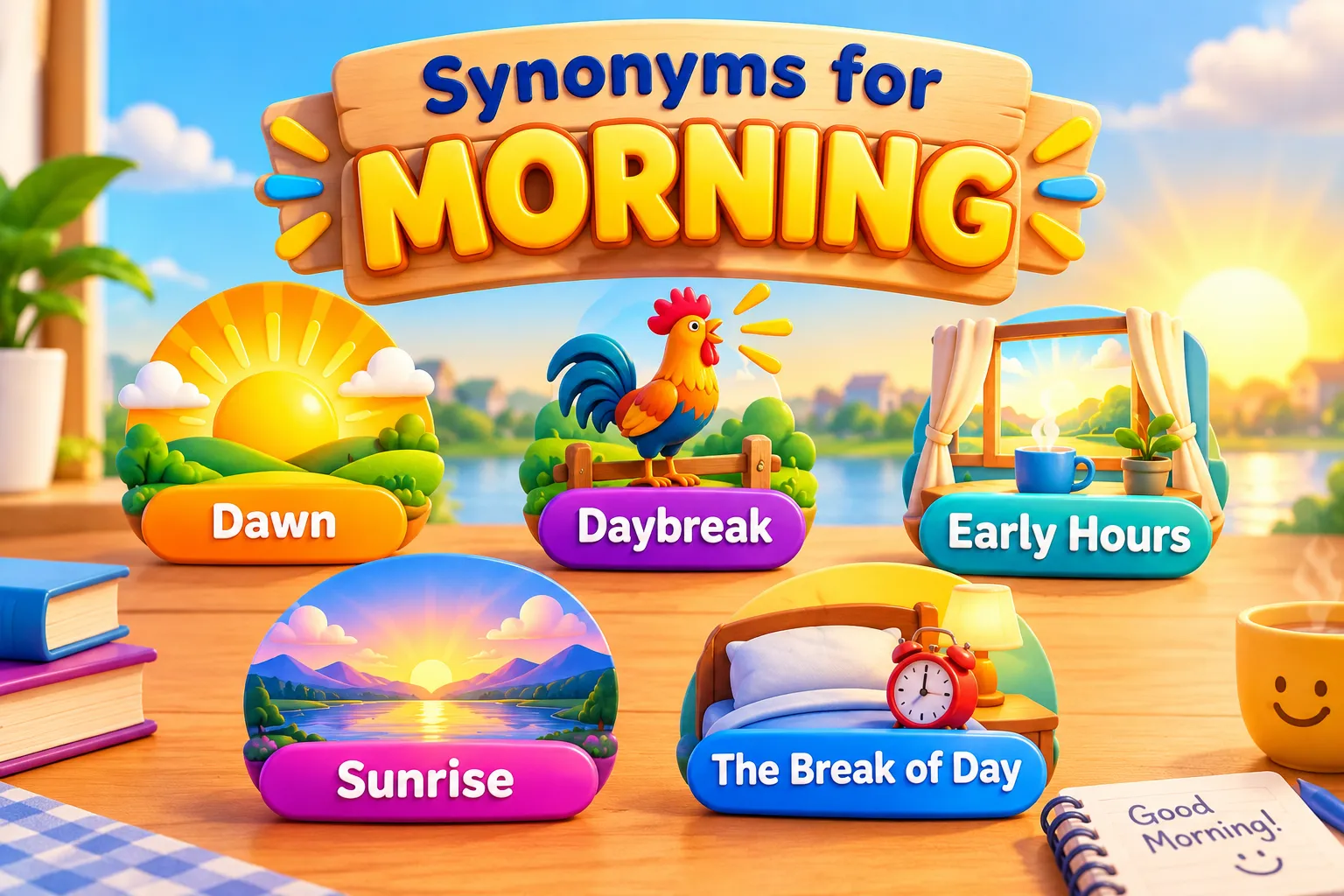
Common synonyms and related words include morn, dawn, daybreak, sunrise, sunup, first light, early morning, forenoon, daytime, and morningtime. The best word depends on the context. For example, dawn and daybreak refer to the beginning of daylight, sunrise focuses on the sun appearing, while forenoon means the period before noon. These alternatives can help English learners improve vocabulary and help writers make their sentences more varied and precise.
Morning is the part of the day that begins after midnight and usually ends around noon. Imagine waking up early, opening your window, and seeing the first light of the day. You might say, “It is a beautiful morning.” The word is very common because we use it when talking about daily routines, work, school, weather, and time. Learning synonyms for morning can help English learners build stronger vocabulary and help writers avoid repeating the same word. However, not every synonym has exactly the same meaning. Some words describe the early hours, while others refer to dawn, sunrise, or the first part of the day. This guide explains the meaning, examples, history, pronunciation, word forms, and 27 useful alternatives to morning.
Meaning of Morning
Definition
Morning (Noun): The early part of the day, from the time the day begins until about noon.
Examples
- I usually exercise in the morning.
- We have a meeting tomorrow morning.
Connotative Meaning
- Positive tone: Morning can suggest freshness, hope, peace, and a new beginning.
- Negative tone: In some contexts, morning can suggest tiredness, stress, or an early start.
- Neutral tone: It simply refers to the first part of the day.
(Connotation means the feeling or idea that a word suggests beyond its basic meaning.)
Etymology
| Period | Etymology and Meaning |
| Old English (450–1100) | Morning developed from Old English morgen, meaning “morning” or the early part of the day. |
| Middle English (1100–1500) | The word appeared in forms such as morwen and morning, referring to the early part of the day. |
| Modern English (1500–Present) | Morning became the standard English word for the period between night and midday. It is also used in phrases such as good morning, tomorrow morning, and morning time. |
Pronunciation (IPA)
- IPA: /ˈmɔːrnɪŋ/
- Syllables: morn-ing
Affixation Pattern of Morning
- Root: morn
- Prefix: None
- Suffix: -ing
- Word formations:
- morn — noun, meaning morning or early day
- morning — noun, the early part of the day
- mornings — plural noun
- morningtime — noun, the time of morning
- morning-after — adjective/noun phrase, relating to the next morning
27 Synonyms of Morning With Meaning & Examples
1. Morn (Noun)
Meaning: A poetic or literary word for morning.
Examples:
- The birds sang at morn.
- At morn, the village became quiet and bright.
2. Daybreak (Noun)
Meaning: The time when daylight first begins to appear.
Examples:
- We left home at daybreak.
- The mountains looked beautiful at daybreak.
3. Dawn (Noun)
Meaning: The time when light first appears in the sky before sunrise.
Examples:
- We watched the sky change at dawn.
- The fishermen went out before dawn.
4. Sunrise (Noun)
Meaning: The time when the sun first appears above the horizon.
Examples:
- We woke up early to see the sunrise.
- The beach was quiet at sunrise.
5. Sunup (Noun)
Meaning: An informal word for sunrise or the beginning of daylight.
Examples:
- We started working at sunup.
- The farmers were already outside by sunup.
6. Break of Day (Noun Phrase)
Meaning: The very beginning of daylight.
Examples:
- They traveled at the break of day.
- Birds began singing at the break of day.
7. First Light (Noun Phrase)
Meaning: The first natural light that appears in the morning.
Examples:
- We reached the village at first light.
- The hikers started walking at first light.
8. Early Morning (Noun Phrase)
Meaning: The first hours after the night ends.
Examples:
- I enjoy walking in the early morning.
- The train leaves in the early morning.
9. Forenoon (Noun)
Meaning: The part of the day between morning and noon.
Examples:
- The meeting will take place in the forenoon.
- We completed the work before forenoon ended.
10. A.M. (Noun)
Meaning: The time between midnight and noon.
Examples:
- The appointment is at 10 a.m.
- I usually wake up at 7 a.m.
11. Ante Meridiem (Noun)
Meaning: A Latin expression meaning “before midday.”
Examples:
- The letter was sent at 9 ante meridiem.
- The appointment is scheduled for 11 ante meridiem.
12. Sunrise Hours (Noun Phrase)
Meaning: The hours around the time the sun rises.
Examples:
- The park is peaceful during the sunrise hours.
- Photographers often work during the sunrise hours.
13. Daybreak Hours (Noun Phrase)
Meaning: The early hours when night changes into daylight.
Examples:
- The birds are active during the daybreak hours.
- We traveled during the daybreak hours.
14. Dawntime (Noun)
Meaning: The period around dawn.
Examples:
- The town was quiet at dawntime.
- They arrived around dawntime.
15. First Part of the Day (Noun Phrase)
Meaning: The part of the day before noon.
Examples:
- I am usually busy during the first part of the day.
- We finished the task in the first part of the day.
16. Early Hours (Noun Phrase)
Meaning: The first hours of a day.
Examples:
- She studies during the early hours.
- The streets are quiet in the early hours.
17. Morningtime (Noun)
Meaning: The period of the day known as morning.
Examples:
- I prefer working during morningtime.
- The garden looks fresh at morningtime.
18. Daytime (Noun)
Meaning: The period when there is daylight.
Examples:
- The park is busy during the daytime.
- We traveled during the daytime.
19. Matin (Noun)
Meaning: A literary or old-fashioned word connected with morning.
Examples:
- The poet wrote about the peaceful matin.
- The bells rang during the matin hours.
20. Matinal (Adjective)
Meaning: Relating to or occurring in the morning.
Examples:
- She enjoys her matinal walk.
- The birds were active during the matinal hours.
21. Aurora (Noun)
Meaning: A poetic word for dawn or the first light of day.
Examples:
- The poet described the aurora over the hills.
- The sky glowed beautifully at aurora.
22. Cockcrow (Noun)
Meaning: The time when a rooster traditionally crows at the beginning of the day.
Examples:
- He woke at cockcrow.
- The village became active at cockcrow.
23. Cockcrow Time (Noun Phrase)
Meaning: The very early part of the morning when roosters crow.
Examples:
- The farmers rose at cockcrow time.
- They began their journey at cockcrow time.
24. Sunrise Time (Noun Phrase)
Meaning: The period around sunrise.
Examples:
- We arrived at sunrise time.
- The lake looks beautiful at sunrise time.
25. Day’s Beginning (Noun Phrase)
Meaning: The beginning of a new day.
Examples:
- Birds sing at the day’s beginning.
- The town was peaceful at the day’s beginning.
26. New Day (Noun Phrase)
Meaning: A newly beginning day, often used in a hopeful sense.
Examples:
- Every morning brings a new day.
- She welcomed the new day with a smile.
27. First Hours (Noun Phrase)
Meaning: The first hours of the day.
Examples:
- I read during the first hours of the day.
- The workers arrived in the first hours.
Prototype Meaning
The most typical meaning of morning is the first main part of the day, beginning after midnight and continuing until around noon. When people hear morning, they usually imagine waking up, seeing daylight, having breakfast, going to school or work, and starting daily activities.
Prototype Categorization
- General morning terms: morn, morningtime, morning period, first part of the day, early day — useful when referring to morning as a whole.
- Beginning of daylight: dawn, daybreak, first light, break of day, dawntime — best when focusing on the moment daylight begins.
- Sun-related terms: sunrise, sunup, sunrise hours, sunrise time — useful when the appearance of the sun is important.
- Very early morning: early morning, early hours, first hours, cockcrow, cockcrow time — useful for the first hours of the day.
- Formal or historical terms: forenoon, ante meridiem, matin, matinal — useful in formal, literary, historical, or specialized writing.
- Broad daytime terms: daytime, new day, day’s beginning — useful when discussing daylight or the beginning of a new day.
This grouping helps writers select a word that matches the exact time, tone, and context instead of using morning repeatedly.
- Antonyms of Morning
- There is no single perfect antonym for morning, but these words describe later or opposite periods of the day:
| Antonym | Part of Speech | Meaning |
| Night | Noun | The dark period of the day when people usually sleep. |
| Evening | Noun | The period between afternoon and night. |
| Afternoon | Noun | The period after noon and before evening. |
| Midnight | Noun | The middle of the night, around 12:00 a.m. |
| Dusk | Noun | The time when daylight fades after sunset. |
Short Questions and Answers
What does morning mean?
Morning means the early part of the day, usually from the beginning of daylight until noon.
When should morning be used?
Use morning when talking about the first part of the day, daily routines, schedules, activities, or events before noon.
Is morning positive or negative?
Morning is usually neutral, but it can have a positive feeling when it suggests a fresh start or a negative feeling when someone dislikes waking up early.
How is it different from similar words?
Morning covers a broad period before noon. Dawn and daybreak refer mainly to the beginning of daylight, while sunrise specifically refers to the sun appearing above the horizon.
Conclusion
Learning morning and its synonyms can make your English vocabulary richer and more precise. Words such as dawn, daybreak, sunrise, first light, sunup, early morning, and forenoon can describe different parts or features of the morning. Some alternatives are common in everyday English, while others are literary, formal, or less common. Understanding these differences helps you choose the right word for speaking and writing. It also prevents repetition and makes your sentences more interesting. English learners can improve their vocabulary by learning a few new words each day and using them in real sentences. Regular practice will strengthen writing, speaking, reading, and overall English confidence.
Read More:
Synonyms for banner: 30 Powerful Alternatives

I am Rubab content specialist focused on creating accurate, user-friendly, and search-optimized language resources. Through Synonyminstant, I help readers find synonyms, antonyms, meanings, and vocabulary with ease. Every article is carefully researched and optimized to provide reliable information, clear explanations, and an excellent user experience.