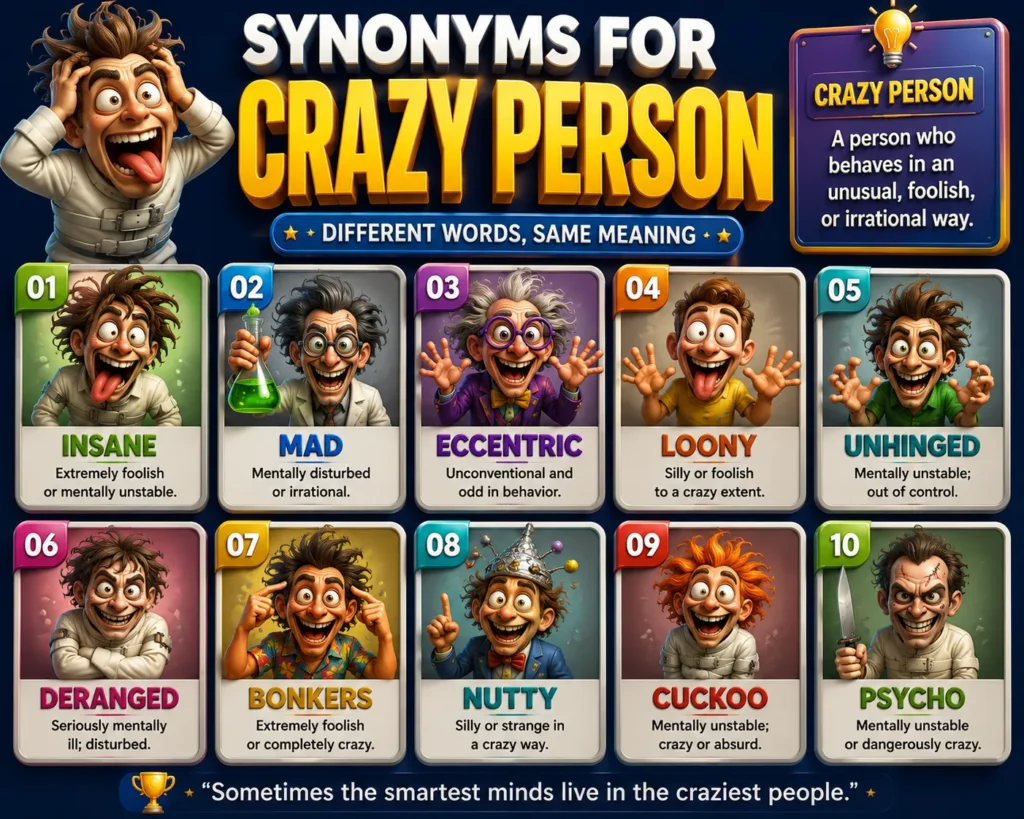
Synonyms for crazy person include lunatic, maniac, madman, madwoman, nutcase, nutjob, weirdo, oddball, eccentric, and screwball. These words describe someone who may behave in a strange, irrational, unpredictable, or unusual way.
The phrase “crazy person” is an informal expression used for someone who behaves in a very unusual, irrational, reckless, or unpredictable way. For example, if someone suddenly climbs onto a table and starts dancing during a quiet meeting, a friend might jokingly call them a “crazy person.” The phrase is common in everyday speech, but it can sound rude or insensitive when used to describe someone with a mental health condition. Learning synonyms for crazy person helps English learners and writers choose words that better match the situation, tone, and meaning. Some alternatives are humorous, some describe unusual behavior, and others suggest danger or emotional instability. This guide explores the meaning, history, pronunciation, grammar, and semantic categories of 30 alternatives, with clear examples to help you use each word naturally.
Meaning of “crazy person”
Definition
Crazy person (noun phrase): An informal expression for a person who behaves in an extremely unusual, irrational, unpredictable, or reckless way.
Examples
- Everyone thought he was a crazy person after he ran into the rain wearing a costume.
- She called her brother a crazy person for attempting such a risky stunt.
Connotative Meaning
Connotation (the feeling or idea associated with a word beyond its basic meaning) varies with context.
- Positive tone: It can jokingly suggest someone is adventurous, energetic, bold, or wildly creative.
- Negative tone: It can suggest that someone is irrational, dangerous, unstable, or difficult to control.
- Neutral tone: In some casual contexts, it simply describes behavior that seems unusual or unexpected.
When discussing mental health, more respectful terms such as person experiencing a mental health condition are usually preferable.
Etymology
The phrase “crazy person” combines the adjective crazy with the noun person.
- Old English (450–1100): Crazy does not come directly from Old English. Its history begins later through French and English forms related to craze.
- Middle English (1100–1500): Craze developed with senses connected to breaking, cracking, or becoming damaged. The idea later extended to a damaged or weakened mental state.
- Modern English (1500–Present): Crazy developed several meanings, including mentally disturbed, wildly enthusiastic, irrational, unusual, or extreme. Person comes through Middle English and Old French from Latin persona, meaning a person, character, or role.
The modern phrase “crazy person” therefore developed from the adjective crazy + the noun person rather than from one single historical word.
Pronunciation (IPA)
- IPA: /ˈkreɪzi ˈpɜːrsən/ (General American: /ˈkreɪzi ˈpɝːsən/)
- Syllables: cra-zy per-son
Affixation Pattern of “crazy person”
Because “crazy person” is a two-word noun phrase, it does not have one shared root, prefix, or suffix.
- Root: craze + person
- Prefix: None
- Suffix: -y in crazy functions as a word-forming suffix.
- Word formations:
- craze — noun/verb
- crazy — adjective
- crazily — adverb
- craziness — noun
- person — noun
- personal — adjective
- personally — adverb
- personality — noun
- personify — verb
30 Synonyms of “crazy person” With Meaning & Examples
1. Madman (Noun)
Meaning: An informal term for a man who behaves in a wildly irrational or uncontrolled way.
Examples:
- The driver was acting like a madman on the highway.
- Everyone moved away from the shouting madman.
2. Madwoman (Noun)
Meaning: An informal term for a woman behaving in a wildly irrational or uncontrolled manner.
Examples:
- She rushed around the room like a madwoman.
- The character is portrayed as a mysterious madwoman.
3. Lunatic (Noun)
Meaning: An old-fashioned and often offensive term for someone considered mentally unstable or irrational.
Examples:
- The novel describes him as a dangerous lunatic.
- Calling someone a lunatic can sound insulting in modern English.
4. Maniac (Noun)
Meaning: An informal word for someone who behaves with extreme energy, violence, or lack of control.
Examples:
- The man drove like a maniac.
- Fans screamed like maniacs during the concert.
5. Nutcase (Noun)
Meaning: A slang term for a person viewed as extremely strange or irrational.
Examples:
- He joked that his friend was a complete nutcase.
- The movie features a funny nutcase who causes trouble.
6. Nut (Noun)
Meaning: Informal slang for an eccentric or strange person.
Examples:
- My uncle is a bit of a nut, but everyone loves him.
- That guy is a real nut when it comes to extreme sports.
7. Nutjob (Noun)
Meaning: Informal and insulting slang for a person believed to behave irrationally.
Examples:
- The character is portrayed as a dangerous nutjob.
- Calling someone a nutjob can be offensive.
8. Screwball (Noun)
Meaning: An informal word for a very eccentric or unconventional person.
Examples:
- That screwball always comes up with strange ideas.
- The comedy centers on a lovable screwball.
9. Eccentric (Noun)
Meaning: A person whose behavior, ideas, or habits are noticeably unusual.
Examples:
- The eccentric lived in a house full of unusual objects.
- Everyone knew the artist as an eccentric.
10. Oddball (Noun)
Meaning: An informal word for someone who behaves in a strange or unconventional way.
Examples:
- He is an oddball who enjoys unusual hobbies.
- The office oddball always wears colorful hats.
11. Weirdo (Noun)
Meaning: An informal term for someone whose behavior seems strange or unusual.
Examples:
- The character is presented as a harmless weirdo.
- Calling a stranger a weirdo may sound rude.
12. Strange person (Noun Phrase)
Meaning: A neutral phrase for someone whose behavior seems unusual.
Examples:
- A strange person was standing outside the store.
- He seemed like a strange person at first.
13. Eccentric person (Noun Phrase)
Meaning: A person who has unusual habits, ideas, or behavior.
Examples:
- The professor was known as an eccentric person.
- She is an eccentric person with a unique sense of style.
14. Wild card (Noun)
Meaning: A person whose behavior is unpredictable and difficult to anticipate.
Examples:
- Jake is the team’s wild card.
- You never know what that wild card will do next.
15. Loose cannon (Noun)
Meaning: A person who acts unpredictably and may cause problems because they ignore normal limits.
Examples:
- The manager considered him a loose cannon.
- A loose cannon can create serious problems for a team.
16. Hothead (Noun)
Meaning: A person who becomes angry or excited very quickly.
Examples:
- The coach warned the hothead to stay calm.
- He can be a hothead during competitive games.
17. Firebrand (Noun)
Meaning: A passionate and energetic person who strongly challenges accepted ideas.
Examples:
- The young activist became a political firebrand.
- She was known as a firebrand who spoke boldly.
18. Daredevil (Noun)
Meaning: A person who enjoys taking dangerous or highly risky actions.
Examples:
- The daredevil jumped from one building to another.
- Everyone admired the daredevil’s courage.
19. Risk-taker (Noun)
Meaning: A person who willingly accepts risk to achieve something.
Examples:
- She is a natural risk-taker who loves adventure.
- Every successful risk-taker must understand the possible consequences.
20. Wild one (Noun Phrase)
Meaning: An informal expression for someone who behaves energetically, unpredictably, or unusually.
Examples:
- Their youngest child is a wild one.
- He’s a wild one who never sits still.
21. Unpredictable person (Noun Phrase)
Meaning: A person whose actions are difficult to predict.
Examples:
- He is an unpredictable person.
- Working with an unpredictable person can be challenging.
22. Unhinged person (Noun Phrase)
Meaning: An informal expression for someone whose behavior appears extremely irrational or uncontrolled.
Examples:
- The villain is shown as an unhinged person.
- His unhinged behavior frightened everyone.
23. Deranged person (Noun Phrase)
Meaning: A strong and negative expression for someone perceived as severely irrational or disturbed.
Examples:
- The thriller features a deranged person as its villain.
- The newspaper avoided labeling the suspect a deranged person without evidence.
24. Disturbed person (Noun Phrase)
Meaning: A person whose behavior or emotional state appears deeply troubled.
Examples:
- The novel presents him as a deeply disturbed person.
- The detective believed the suspect was emotionally disturbed.
25. Unstable person (Noun Phrase)
Meaning: An informal description of someone whose behavior or emotions seem unpredictable or uncontrolled.
Examples:
- The character is portrayed as an unstable person.
- His behavior seemed increasingly unstable.
26. Psychopath (Noun)
Meaning: A person described in psychology using traits associated with severe lack of empathy, remorse, and antisocial behavior; it is not a general synonym for “crazy person.”
Examples:
- The film portrays the villain as a psychopath.
- A psychopath is not simply someone who behaves strangely.
27. Antisocial person (Noun Phrase)
Meaning: In everyday speech, a person who avoids social contact; in clinical contexts, the term has a different meaning.
Examples:
- He is an antisocial person who prefers to work alone.
- The character appears antisocial and rarely speaks to others.
28. Eccentric soul (Noun Phrase)
Meaning: A light or literary expression for a person with unusual habits or ideas.
Examples:
- The artist was an eccentric soul with a colorful personality.
- Everyone remembered her as a kind but eccentric soul.
29. Crazy character (Noun Phrase)
Meaning: An informal phrase for a fictional or real person who behaves in an extreme or unusual way.
Examples:
- The movie has a crazy character who creates chaos.
- That crazy character makes the story more exciting.
30. Unconventional person (Noun Phrase)
Meaning: A person who does things differently from what is considered normal or traditional.
Examples:
- She is an unconventional person who follows her own path.
- The unconventional person challenged traditional ideas.
Prototype Meaning
The prototype meaning of “crazy person” is a person who behaves in a way that seems extremely unusual, irrational, unpredictable, or uncontrolled. When people hear the phrase, they may imagine someone acting wildly, making strange choices, taking extreme risks, or ignoring normal social expectations. However, the exact meaning depends strongly on context. It can be playful when describing an adventurous friend, but it can also be insulting when aimed at someone because of a mental health condition.
Prototype Categorization
The 30 alternatives can be grouped by their closest meaning and tone:
- Mental or emotional disturbance: lunatic, deranged person, disturbed person, unhinged person, unstable person. These are strong expressions and should be used carefully.
- Strangeness or eccentricity: eccentric, oddball, weirdo, nut, nutcase, nutjob, screwball. These are mostly informal and can be humorous or insulting.
- Unpredictable behavior: wild card, loose cannon, unpredictable person, wild one. These focus on behavior rather than mental health.
- Anger or intense energy: maniac, hothead, firebrand. These describe specific types of intense behavior.
- Risk and adventure: daredevil, risk-taker. These can have a positive meaning when someone enjoys challenges or danger.
- Neutral alternatives: strange person, eccentric person, unconventional person. These are often better choices when you want to describe unusual behavior without making a judgment about someone’s mental health.
- Gendered or fictional terms: madman, madwoman, crazy character. These work best in specific literary, historical, or fictional contexts.
This categorization helps writers select a word based on meaning, tone, intensity, and context instead of treating every synonym as interchangeable.
Antonyms of “crazy person”
1. Sane person (Noun Phrase)
A person who behaves rationally and shows sound judgment.
2. Rational person (Noun Phrase)
A person who thinks logically and makes reasonable decisions.
3. Sensible person (Noun Phrase)
A person who makes practical and wise choices.
4. Calm person (Noun Phrase)
A person who remains relaxed and controlled.
5. Level-headed person (Noun Phrase)
A person who stays calm and thinks clearly, especially under pressure.
6. Reasonable person (Noun Phrase)
A person who uses good judgment and behaves fairly.
7. Responsible person (Noun Phrase)
A person who acts carefully and accepts responsibility for their actions.
Short Questions and Answers
What does “crazy person” mean?
“Crazy person” is an informal expression for someone whose behavior appears extremely unusual, irrational, unpredictable, or uncontrolled.
When should “crazy person” be used?
Use it mainly in casual, humorous, or fictional contexts. Avoid using it as a label for someone with a mental health condition because it can sound insensitive or offensive.
Is “crazy person” positive or negative?
It depends on context. It can jokingly describe someone adventurous or energetic, but it can also have a strongly negative meaning.
How is it different from similar words?
Each alternative emphasizes something different. Eccentric focuses on unusual habits, daredevil focuses on risk-taking, hothead focuses on anger, and loose cannon focuses on unpredictable behavior.
Conclusion
Learning synonyms for crazy person gives writers more precise ways to describe unusual, unpredictable, energetic, or irrational behavior. Words such as eccentric, oddball, daredevil, risk-taker, and loose cannon can communicate different shades of meaning. However, not every synonym is appropriate in every situation. Some terms, including lunatic, nutjob, and deranged, can sound insulting or stigmatizing. Choosing respectful and accurate vocabulary improves both writing and speaking. For English learners, studying synonyms also reduces repetition, expands vocabulary, and builds confidence. Practice these words in short sentences and pay attention to their tone. The more you compare meaning and context, the easier it becomes to choose the right word for the right situation.
Read More:
Synonyms for Hypocrisy: 30 Powerful Alternatives

I’m Ayesha Haram, an English content and SEO writer at SynonymsInstant.com. I focus on creating helpful vocabulary resources, word guides, and practical English content that readers can understand quickly. I combine language research, clear explanations, and SEO-focused writing to produce reliable content that supports learners, writers, and everyday English users.