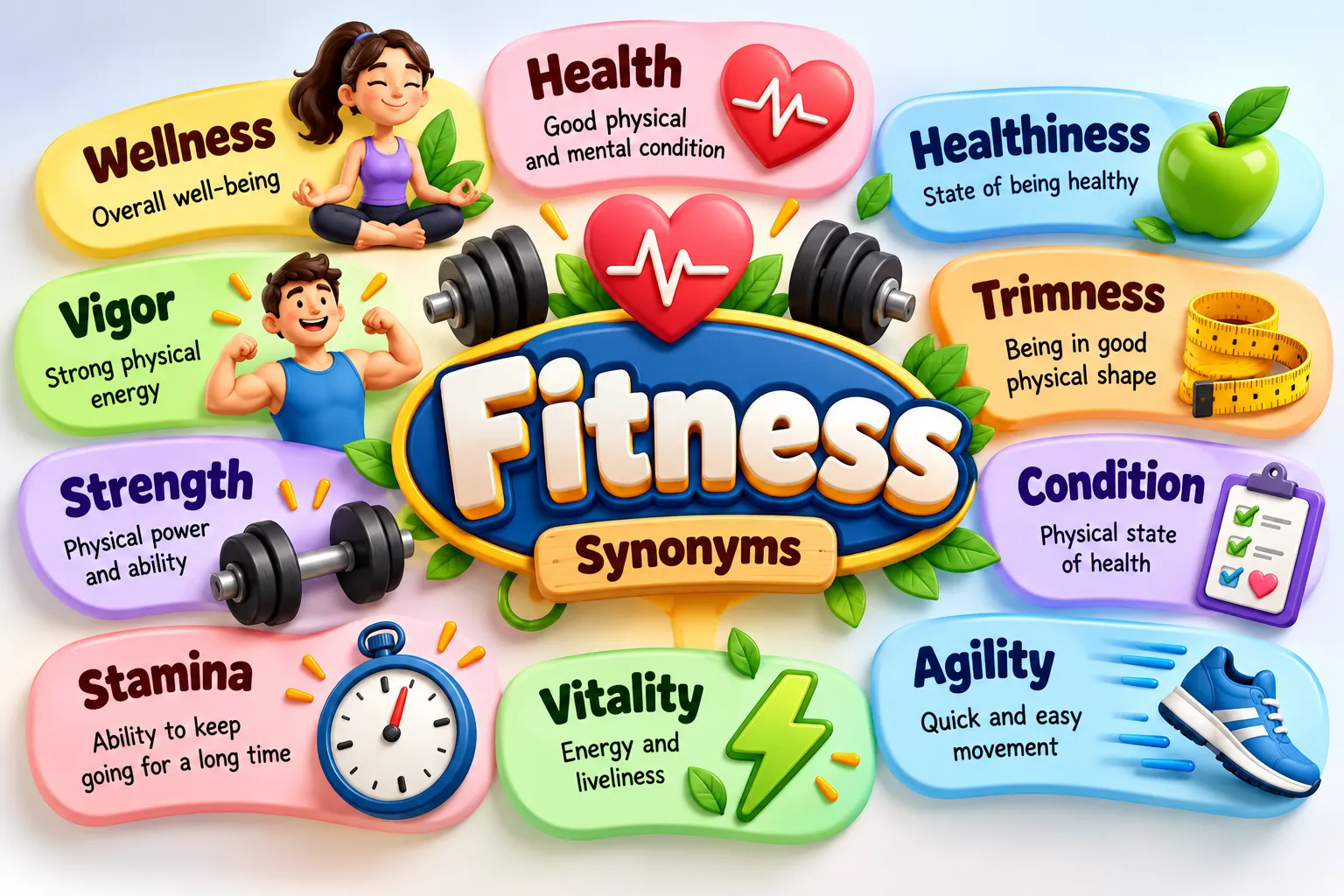
Fitness means being healthy, strong, and able to do daily tasks with ease. Common synonyms for fitness include health, wellness, strength, stamina, vitality, and physical condition. Some words focus on the body, while others describe overall health or the ability to perform well. For example, stamina means the ability to keep going, while strength means the ability to use force. The best synonym depends on the context. Learning these alternatives can help you write clearly, speak naturally, and build a stronger English vocabulary.
Fitness means being healthy and strong enough to handle daily activities. For example, a person who walks every day, eats healthy food, and exercises often may have good physical fitness. Fitness is a common word in health, sports, exercise, and daily life. It can also describe how well someone is suited for a task or role, as in “fitness for the job.”
Learning synonyms for fitness helps English learners express ideas in different ways. It also helps students, bloggers, and content writers avoid using the same word too often. However, not every synonym has the same meaning. Some words focus on health, while others describe strength, energy, or endurance. This guide explains the meaning, history, pronunciation, word forms, and 26 useful alternatives to fitness. Each word includes a simple meaning and examples to help you use it correctly.
Meaning of Fitness
Definition
Fitness (noun): Fitness is the state of being healthy, strong, and able to perform physical activities. It can also mean being suitable for a particular purpose or role.
Examples
- Regular exercise can improve your physical fitness.
- The coach checks each player’s fitness before the match.
Connotative Meaning
Connotation is the feeling or idea that a word suggests beyond its basic meaning.
- Positive tone: Fitness often suggests health, energy, strength, and an active lifestyle.
- Negative tone: Fitness may be discussed negatively when someone has poor fitness or struggles with physical tasks.
- Neutral tone: Fitness can simply describe someone’s physical condition or suitability for a role.
Etymology of Fitness
The word fitness comes from the adjective fit and the suffix -ness, which forms nouns describing a state or quality.
- Old English (450–1100): The word fit in its modern sense developed later. Older English had related words, but the modern noun fitness was not used in the same way.
- Middle English (1100–1500): Fit developed meanings linked to being suitable or proper.
- Modern English (1500–Present): Fitness came to describe suitability and, later, physical health, strength, and the ability to exercise or perform physical tasks.
Pronunciation (IPA)
- IPA: /ˈfɪt.nəs/
- Syllables: fit-ness
- Part of speech: Noun
Affixation Pattern of Fitness
- Root: Fit
- Prefix: None
- Suffix: -ness, which turns the adjective fit into the noun fitness
Word Formations
| Word | Part of Speech | Meaning |
| Fit | Adjective | Healthy, suitable, or in good condition |
| Fit | Verb | To be the right size or to suit a purpose |
| Fitness | Noun | The state of being fit or suitable |
| Fitter | Noun/adjective | A person who fits parts; or someone more fit |
| Fittest | Adjective | In the best physical condition or most suitable |
| Fitting | Adjective | Suitable or appropriate |
| Fitly | Adverb | In a suitable or proper way; uncommon |
| Unfit | Adjective | Not healthy or not suitable |
| Unfitness | Noun | The state of being unfit |
| Fitfully | Adverb | In an irregular or interrupted way; not a direct fitness-related form |
Note: Some words in this table relate to physical fitness, while others relate to suitability or use the same root in a different sense.
26 Synonyms for Fitness With Meanings and Examples
Fitness has several meanings, so these alternatives are not all exact substitutes. Some describe health, others describe physical ability, and a few relate to suitability. Choose the word that matches your intended meaning.
1. Health (Noun)
Meaning: The state of being free from illness and feeling well.
Examples:
- Regular exercise can improve your health.
- Good health helps children learn and play.
2. Wellness (Noun)
Meaning: The overall state of being healthy in body and mind.
Examples:
- Sleep is an important part of wellness.
- The school runs a wellness program for its students.
3. Well-being (Noun)
Meaning: The state of being comfortable, healthy, and happy.
Examples:
- Exercise can support your physical well-being.
- The company cares about the well-being of its workers.
4. Strength (Noun)
Meaning: The ability to use physical force or lift heavy objects.
Examples:
- Weight training can build muscle strength.
- Her strength helped her finish the race.
5. Stamina (Noun)
Meaning: The ability to keep doing something for a long time without getting too tired.
Examples:
- Walking each day can improve your stamina.
- The runner had enough stamina to finish the race.
6. Endurance (Noun)
Meaning: The ability to continue physical activity or face difficulty for a long time.
Examples:
- Cycling helps build endurance.
- The long hike tested our endurance.
7. Vitality (Noun)
Meaning: The feeling or quality of being full of energy and life.
Examples:
- She has the vitality to stay active all day.
- Good sleep can help restore your vitality.
8. Vigor (Noun)
Meaning: Physical or mental energy and strength.
Examples:
- He returned to training with renewed vigor.
- The team played with vigor and focus.
9. Energy (Noun)
Meaning: The power needed to move, work, or stay active.
Examples:
- A healthy breakfast gives me energy.
- She had enough energy for an evening walk.
10. Conditioning (Noun)
Meaning: Training that improves physical strength, endurance, or performance.
Examples:
- The team does conditioning drills every morning.
- Good conditioning helps athletes perform better.
11. Physical Condition (Noun Phrase)
Meaning: The current state of a person’s body and physical health.
Examples:
- The doctor checked his physical condition.
- Her physical condition improved after regular exercise.
12. Physical Health (Noun Phrase)
Meaning: The health of the body and its ability to function well.
Examples:
- Swimming is good for physical health.
- Daily movement can support your physical health.
13. Robustness (Noun)
Meaning: The quality of being strong and able to withstand stress or difficulty.
Examples:
- The training plan helped improve his physical robustness.
- Robustness can help the body handle demanding activity.
14. Resilience (Noun)
Meaning: The ability to recover after stress, difficulty, or illness.
Examples:
- Gentle exercise can support recovery and resilience.
- Her resilience helped her return to training after an injury.
15. Agility (Noun)
Meaning: The ability to move quickly and easily.
Examples:
- Basketball players need speed and agility.
- The drills helped improve his agility.
16. Flexibility (Noun)
Meaning: The ability to bend or move joints through a range of motion.
Examples:
- Stretching can improve flexibility.
- Yoga helped her gain more flexibility.
17. Mobility (Noun)
Meaning: The ability to move freely and easily.
Examples:
- Walking helps older adults maintain mobility.
- The therapist gave him exercises to improve his mobility.
18. Coordination (Noun)
Meaning: The ability to use different body parts together smoothly.
Examples:
- Dancing can improve body coordination.
- The young player showed good hand-eye coordination.
19. Speed (Noun)
Meaning: The ability to move or act quickly.
Examples:
- Sprint training helped improve her speed.
- The coach measured each runner’s speed.
20. Power (Noun)
Meaning: The ability to use strength quickly or forcefully.
Examples:
- Jump training can help athletes develop power.
- The boxer used his power carefully.
21. Athleticism (Noun)
Meaning: The ability to perform physical activities well, especially in sports.
Examples:
- Her athleticism made her a strong team player.
- The competition tests speed, balance, and athleticism.
22. Physical Prowess (Noun Phrase)
Meaning: Great skill or ability in physical activities.
Examples:
- The gymnast showed impressive physical prowess.
- His physical prowess helped him excel in the competition.
23. Physical Capability (Noun Phrase)
Meaning: The ability to perform physical tasks.
Examples:
- The job requires a high level of physical capability.
- The trainer assessed the athlete’s physical capability.
24. Physical Ability (Noun Phrase)
Meaning: The power or skill needed to perform physical actions.
Examples:
- Regular practice can improve physical ability.
- The test measures each player’s physical ability.
25. Capacity (Noun)
Meaning: The ability or power to do something.
Examples:
- Training can increase your capacity for exercise.
- The coach assessed the team’s capacity to handle longer sessions.
26. Performance (Noun)
Meaning: How well a person carries out an activity or task.
Examples:
- Better sleep may improve athletic performance.
- The coach tracks performance during each session.
Prototype Meaning of Fitness
The most common meaning of fitness is the state of being physically healthy and able to perform daily tasks or exercise. People often imagine someone who moves with ease, has enough energy for daily activities, and can take part in sports or exercise without becoming tired too quickly. Fitness may involve strength, stamina, flexibility, balance, and endurance. However, fitness does not look the same for everyone. A person’s age, health, goals, and abilities can affect what fitness means for them. The word can also describe suitability, as in fitness for a job or fitness for a purpose.
Prototype Categorization of Fitness Synonyms
The 26 alternatives above fit into several groups. Knowing these groups helps you choose a word that matches your meaning instead of replacing fitness with a word that does not quite fit.
- Health and overall well-being: health, wellness, well-being, and physical health. Use these words when discussing general health and a healthy lifestyle.
- Strength and endurance: strength, stamina, endurance, vigor, and energy. These words describe force, lasting effort, or the ability to stay active.
- Movement skills: agility, flexibility, mobility, coordination, and speed. Use these when discussing how well someone moves.
- Physical condition and training: conditioning, physical condition, robustness, and physical capability. These words are useful in exercise plans, sports, and health discussions.
- Athletic ability and results: athleticism, physical prowess, physical ability, power, and performance. These terms often appear in sports and training.
- Ability and preparation: capacity, preparedness, readiness, and aptitude. These words describe the ability or preparation needed for an activity.
- Suitability: suitability. Use this word when fitness means being right for a job, task, or purpose.
- Recovery and adaptation: resilience. Use it when discussing the ability to recover from stress or difficulty.
Some words overlap across groups. For example, capacity can refer to exercise tolerance, while readiness may describe preparation for a competition. Always consider the sentence and intended meaning before choosing a synonym.
Antonyms of Fitness
There is no single opposite for every meaning of fitness. The best antonym depends on whether you mean physical health, strength, or suitability.
| Antonym | Part of Speech | Meaning |
| Unfitness | Noun | The state of being physically unfit or unsuitable |
| Ill health | Noun phrase | A state of poor health |
| Weakness | Noun | A lack of physical strength |
| Frailty | Noun | A condition of being weak or easily harmed |
| Inactivity | Noun | A lack of physical activity |
| Sedentariness | Noun | The habit of sitting or being inactive for long periods |
| Debility | Noun | A state of weakness or reduced strength |
| Unsuitability | Noun | The state of not being right for a purpose |
| Inadequacy | Noun | A lack of the ability or quality needed |
| Incapacity | Noun | The inability to perform a task or function |
Short Questions and Answers
1. What does fitness mean?
Fitness usually means being healthy and physically able to perform daily activities or exercise. It can also mean being suitable for a job or purpose.
2. When should fitness be used?
Use fitness when talking about physical health, exercise, sports, or suitability. For example, “Physical fitness is important for runners” and “The test checks her fitness for the role.”
3. Is fitness positive or negative?
Fitness usually has a positive meaning because it suggests health, strength, and ability. However, the word itself is neutral. Its meaning depends on the context.
4. How is fitness different from similar words?
Fitness is a broad term for physical condition or suitability. Strength refers to the ability to use force, stamina means the ability to keep going, and flexibility means the ability to bend or move freely. These words describe different parts of fitness rather than the whole idea.
Conclusion
Learning synonyms for fitness can improve your English vocabulary and help you express ideas with greater care. Words such as health, stamina, strength, and wellness are useful, but each has a slightly different meaning. Choosing the right word makes your writing clearer and helps you avoid repetition. These alternatives are useful in schoolwork, blogs, health articles, sports reports, and everyday conversations. Remember that some words describe physical health, while others focus on movement, endurance, performance, or suitability. Try learning a few new words each day and writing your own sentences with them. With regular practice, you can improve your speaking, strengthen your writing, and feel more confident using English.
Read More:
Synonyms for the Best: 30 Excellent Alternatives

I am Rubab content specialist focused on creating accurate, user-friendly, and search-optimized language resources. Through Synonyminstant, I help readers find synonyms, antonyms, meanings, and vocabulary with ease. Every article is carefully researched and optimized to provide reliable information, clear explanations, and an excellent user experience.