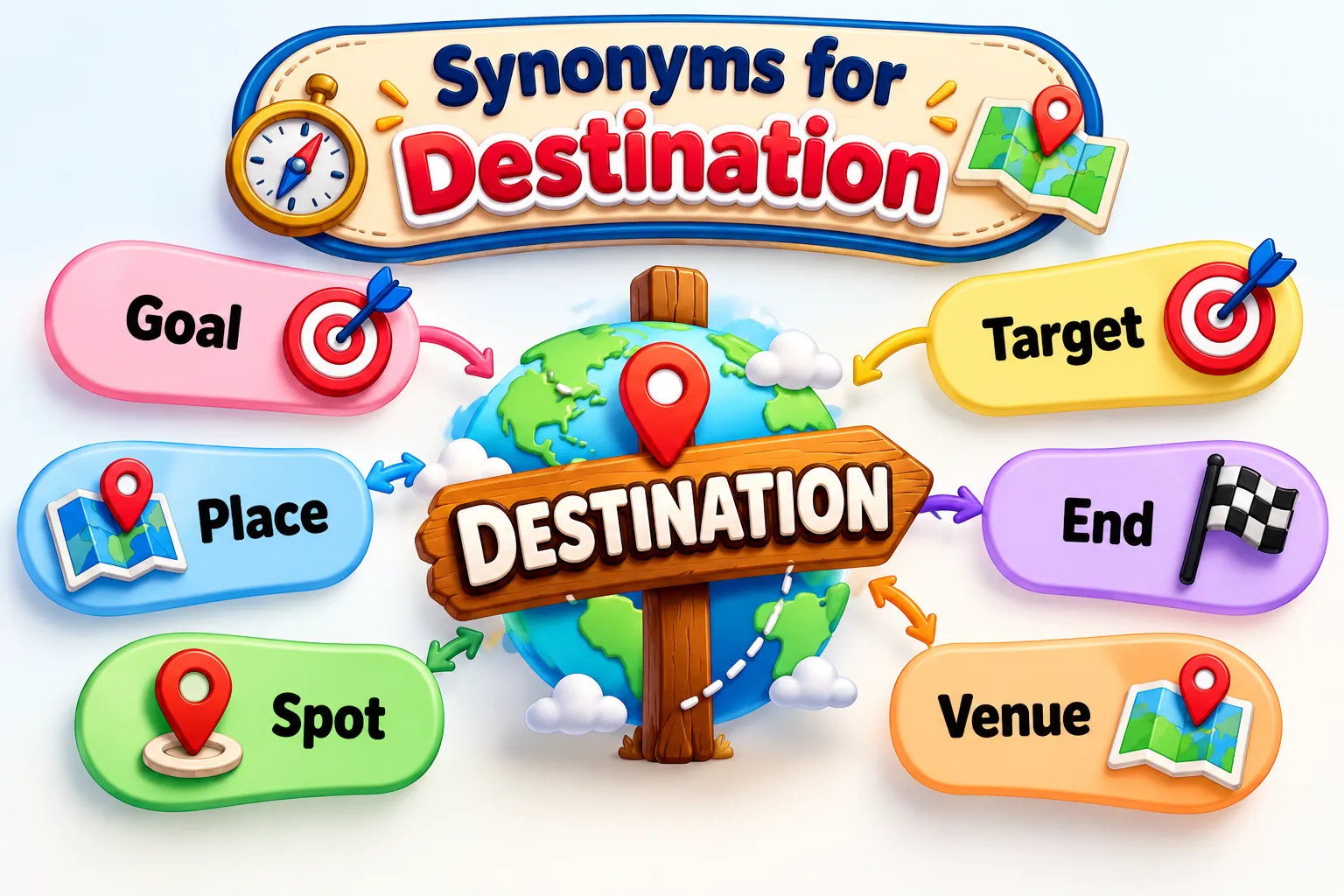
A destination is a place where someone is going or where a journey ends. Common synonyms for destination include goal, endpoint, end point, target, arrival point, final stop, and terminus. Some words describe a physical place, while others refer to a result or aim. For example, terminus often means the end of a transport route, while goal refers to something a person wants to achieve. The best synonym depends on the context. Learning these alternatives can help you write clearly, avoid repetition, and improve your English vocabulary.
A destination is the place where someone wants to go or where a journey ends. For example, when a family plans a trip to the mountains, the mountains are their destination. The word is common in travel, transport, business, and daily conversation. It can also have a figurative meaning. A person may describe success as the destination of years of hard work.
Learning synonyms for destination helps English learners and content writers express ideas in different ways. However, not all alternatives mean exactly the same thing. Some refer to a physical place, while others describe an endpoint, purpose, or desired result. Choosing the right word makes writing clearer and more natural. This guide explains the meaning, pronunciation, history, and word forms of destination. It also explores 30 related words with simple meanings and examples, along with semantic categories, antonyms, and useful answers to common questions.
Meaning of Destination
Definition
Destination (noun): A destination is the place someone is traveling to or the point where a journey ends. It can also mean a final aim or desired result.
Examples
- Our final destination is a small village near the sea.
- She worked hard because success was her destination.
Connotative Meaning
Connotation is the feeling or idea a word suggests beyond its basic meaning.
- Positive tone: Destination can suggest adventure, hope, success, or an exciting journey.
- Negative tone: It may suggest an unwanted endpoint when someone is forced to go somewhere or reaches a bad outcome.
- Neutral tone: It can simply name the place where a person or vehicle is going.
Etymology of Destination
The word destination entered English through French and Latin. It is linked to the Latin verb destinare, meaning “to determine,” “to establish,” or “to make firm.”
- Old English (450–1100): The modern word destination was not part of ordinary Old English. English used other words to describe places, directions, and the ends of journeys.
- Middle English (1100–1500): The word entered English through French and Latin influence, with early uses linked to assigning, determining, or directing something toward an end.
- Modern English (1500–Present): Destination developed its familiar meaning of a place someone is traveling to. It can also describe a final point, purpose, or desired outcome.
Pronunciation (IPA)
- IPA: /ˌdɛstɪˈneɪʃən/
- Syllables: des-ti-NA-tion
- Part of speech: Noun
Affixation Pattern of Destination
- Root: destin- — linked to the idea of determining or directing toward an end.
- Prefix: No separate productive prefix in the modern English word.
- Suffix: -ation — a noun-forming suffix found in words that describe an action, process, or result.
- Word formation: Destination is related to destine, destined, and destining.
Word Formations
| Word | Part of Speech | Meaning |
| Destine | Verb | To intend or determine that something will happen |
| Destined | Verb/adjective | Intended or expected to reach a particular result |
| Destining | Verb form | The act of intending or directing toward an outcome; uncommon |
| Destination | Noun | A place someone is going to or a final aim |
| Destinations | Plural noun | More than one destination |
| Predestine | Verb | To determine something in advance |
| Predestined | Verb/adjective | Decided or believed to be decided in advance |
Note: These words share a historical word family, but they do not all mean “destination.”
30 Synonyms for Destination With Meanings and Examples
The best synonym for destination depends on the sentence. Some words refer to the place where a journey ends, while others describe an aim or result. The following alternatives include close synonyms and related expressions used in specific contexts.
1. Endpoint (Noun)
Meaning: The point where something ends.
Examples:
- The station is the endpoint of this train route.
- We reached the endpoint of the walking trail.
2. End Point (Noun)
Meaning: The final point of a route, process, or activity.
Examples:
- The bridge marks the end point of the road.
- The bus will stop at its end point downtown.
3. Terminus (Noun)
Meaning: The final station or stopping point of a transport route.
Examples:
- The train arrived at its terminus late at night.
- This bus route ends at the central terminus.
4. Final Stop (Noun Phrase)
Meaning: The last place where a vehicle stops on its route.
Examples:
- Our final stop is the airport.
- The driver announced the final stop before the bus arrived.
5. Arrival Point (Noun Phrase)
Meaning: The place where someone or something arrives.
Examples:
- The guide waited at the agreed arrival point.
- Check the map to find your arrival point.
6. Goal (Noun)
Meaning: The result or place someone hopes to reach.
Examples:
- Their goal was to reach the mountain village.
- She saw the city as the goal of her long journey.
7. Target (Noun)
Meaning: A result, place, or level that someone aims to reach.
Examples:
- The team reached its target destination before sunset.
- Our target is to arrive before noon.
8. Objective (Noun)
Meaning: A result that someone plans or works to achieve.
Examples:
- Completing the journey safely was our main objective.
- The first objective was to reach the nearest town.
9. Aim (Noun)
Meaning: Something a person intends or hopes to achieve.
Examples:
- Their aim was to reach the coast by evening.
- The trip had a clear aim: to visit every major museum.
10. End Goal (Noun Phrase)
Meaning: The final result someone wants to achieve.
Examples:
- Becoming a doctor was her end goal.
- The end goal of the expedition was to reach the summit.
11. Final Point (Noun Phrase)
Meaning: The last point in a route, sequence, or process.
Examples:
- The final point on the map is the old lighthouse.
- We marked the final point of our route.
12. Destination Point (Noun Phrase)
Meaning: The specific place that someone or something is meant to reach.
Examples:
- The driver entered the destination point into the navigation system.
- The delivery team checked the destination point before leaving.
13. Stopping Place (Noun Phrase)
Meaning: A place where someone pauses or ends a part of a journey.
Examples:
- The inn was our stopping place for the night.
- We chose a quiet stopping place along the road.
14. Waypoint (Noun)
Meaning: A marked place along a route that helps guide a journey.
Examples:
- The hikers used the lake as a waypoint.
- Add a waypoint to your navigation app.
15. Port of Call (Noun Phrase)
Meaning: A place where a ship stops during a journey.
Examples:
- The island was the ship’s first port of call.
- Our cruise included three ports of call.
16. Resort (Noun)
Meaning: A place people visit for holidays, rest, or recreation.
Examples:
- The seaside resort was our holiday destination.
- Many tourists visit the resort during summer.
17. Locale (Noun)
Meaning: A particular place or area where something happens.
Examples:
- The film’s final scene takes place in a remote locale.
- They chose a peaceful locale for the retreat.
18. Venue (Noun)
Meaning: A place where an event or activity takes place.
Examples:
- The concert venue was our destination for the evening.
- We reached the wedding venue before the guests arrived.
19. Location (Noun)
Meaning: A particular place or position.
Examples:
- Please share your destination location with the driver.
- The location was easy to find using the map.
20. Place (Noun)
Meaning: A particular area, building, town, or other position.
Examples:
- This place is our final destination.
- We reached the place just before dark.
21. Site (Noun)
Meaning: A particular place where something is located or happens.
Examples:
- The historic site was our main destination.
- The group arrived at the campsite before sunset.
22. Stopover (Noun)
Meaning: A short stop made during a longer journey.
Examples:
- We had a stopover in Dubai before flying to London.
- The stopover gave us time to rest.
23. Way Station (Noun Phrase)
Meaning: A place where travelers stop briefly before continuing their journey.
Examples:
- The old inn once served as a way station for travelers.
- We used the village as a way station on our trip.
24. Terminus Station (Noun Phrase)
Meaning: A railway or transport station at the end of a route.
Examples:
- The train pulled into the terminus station.
- Passengers left the train at the terminus station.
25. Finish Line (Noun Phrase)
Meaning: The marked line where a race ends.
Examples:
- The runners hurried toward the finish line.
- She crossed the finish line with a smile.
26. Conclusion (Noun)
Meaning: The end or final part of an event, process, or discussion.
Examples:
- The long journey reached its conclusion at sunset.
- Their adventure came to a happy conclusion.
27. Culmination (Noun)
Meaning: The final result or highest point of a process or series of events.
Examples:
- The award was the culmination of years of hard work.
- Reaching the summit was the culmination of their expedition.
28. Outcome (Noun)
Meaning: The final result of an action or event.
Examples:
- A safe return was the desired outcome of the trip.
- Their hard work led to a successful outcome.
29. Final Destination (Noun Phrase)
Meaning: The last place someone intends to reach on a journey.
Examples:
- The airport is not our final destination; we are going to the coast.
- Please confirm your final destination before booking the ticket.
30. Ultimate Aim (Noun Phrase)
Meaning: The most important or final result someone hopes to achieve.
Examples:
- Their ultimate aim was to reach the summit together.
- Education was the ultimate aim of her journey abroad.
Prototype Meaning of Destination
The most common meaning of destination is the place a person plans to reach. People often imagine a town, airport, hotel, beach, or another location at the end of a trip. A destination may be close by or far away. It can also be a place reached by car, bus, train, plane, or on foot. In a broader sense, the word can describe a goal or final result. For example, someone may call success the destination of years of effort. The exact meaning depends on the context, so it is important to choose a synonym that matches the intended idea.
Prototype Categorization of Destination Synonyms
Grouping synonyms by meaning helps you select the right word for your sentence. Not every alternative can replace a destination in every context.
- Final points and endpoints: endpoint, end point, terminus, final stop, final point, and terminus station. These work best when describing the end of a route or transport line.
- Goals and desired results: goal, target, objective, aim, end goal, and ultimate aim. Use these when destination refers to something a person wants to achieve.
- Places and locations: place, location, locale, and site. These refer to physical areas or specific positions.
- Travel stops and route markers: arrival point, stopping place, waypoint, stopover, and way station. These are useful when describing travel routes and places along a journey.
- Special-purpose destinations: port of call, resort, and venue. Use these for ship journeys, holidays, or events.
- Final stages and results: conclusion, culmination, and outcome. These are more figurative and describe the end or result of a process rather than a physical place.
- Race or journey endings: finish line and final destination. These can describe a specific endpoint, though the finish line is mainly used for races and competitions.
This grouping helps writers avoid awkward word choices. For example, terminus suits a train route, resort suits a holiday, and goal suits a personal ambition.
Antonyms of Destination
A destination is a place to reach or an endpoint. It has no single direct antonym, but these words express opposite ideas in certain contexts.
| Antonym or Opposing Term | Part of Speech | Meaning |
| Starting point | Noun phrase | The place where a journey begins |
| Origin | Noun | The place or source from which something begins |
| Departure point | Noun phrase | The place where a journey starts |
| Beginning | Noun | The start of something |
| Source | Noun | The place or point from which something comes |
| Departure | Noun | The act of leaving a place |
| Route | Noun | The path taken to reach a destination; not a direct antonym |
| Journey | Noun | The act of traveling from one place to another; related rather than opposite |
Short Questions and Answers
1. What does destination mean?
A destination is the place someone is traveling to or the point where a journey ends. It can also refer to a goal or final result.
2. When should destination be used?
Use destination when naming the place someone intends to reach. It can also describe a final goal, such as a career destination or the destination of a long-term plan.
3. Is the destination positive or negative?
The word is usually neutral. It can feel positive when linked to a holiday, adventure, or success, but it can also describe an unwanted place or outcome.
4. How is destination different from similar words?
Destination usually means the place someone wants to reach. Endpoint stresses the end of a route, terminus often refers to a transport route’s final station, and goal usually means a result someone hopes to achieve.
Conclusion
Learning synonyms for destinations can improve your vocabulary and make your writing more varied. Words such as endpoint, terminus, location, and goal can all relate to destination, but they suit different situations. Some describe a physical place, while others focus on the end of a route or a result someone wants to achieve. Choosing the right word helps you communicate clearly in travel writing, schoolwork, blogs, and everyday conversation. It also helps you avoid repeating the same word too often. To build confidence, learn a few alternatives each day and use them in your own sentences. With regular practice, you can improve both your speaking and writing skills.
Read More:
Synonyms for Fitness: 26 Everyday Terms to Know

I’m Ayesha Haram, an English content and SEO writer at SynonymsInstant.com. I focus on creating helpful vocabulary resources, word guides, and practical English content that readers can understand quickly. I combine language research, clear explanations, and SEO-focused writing to produce reliable content that supports learners, writers, and everyday English users.