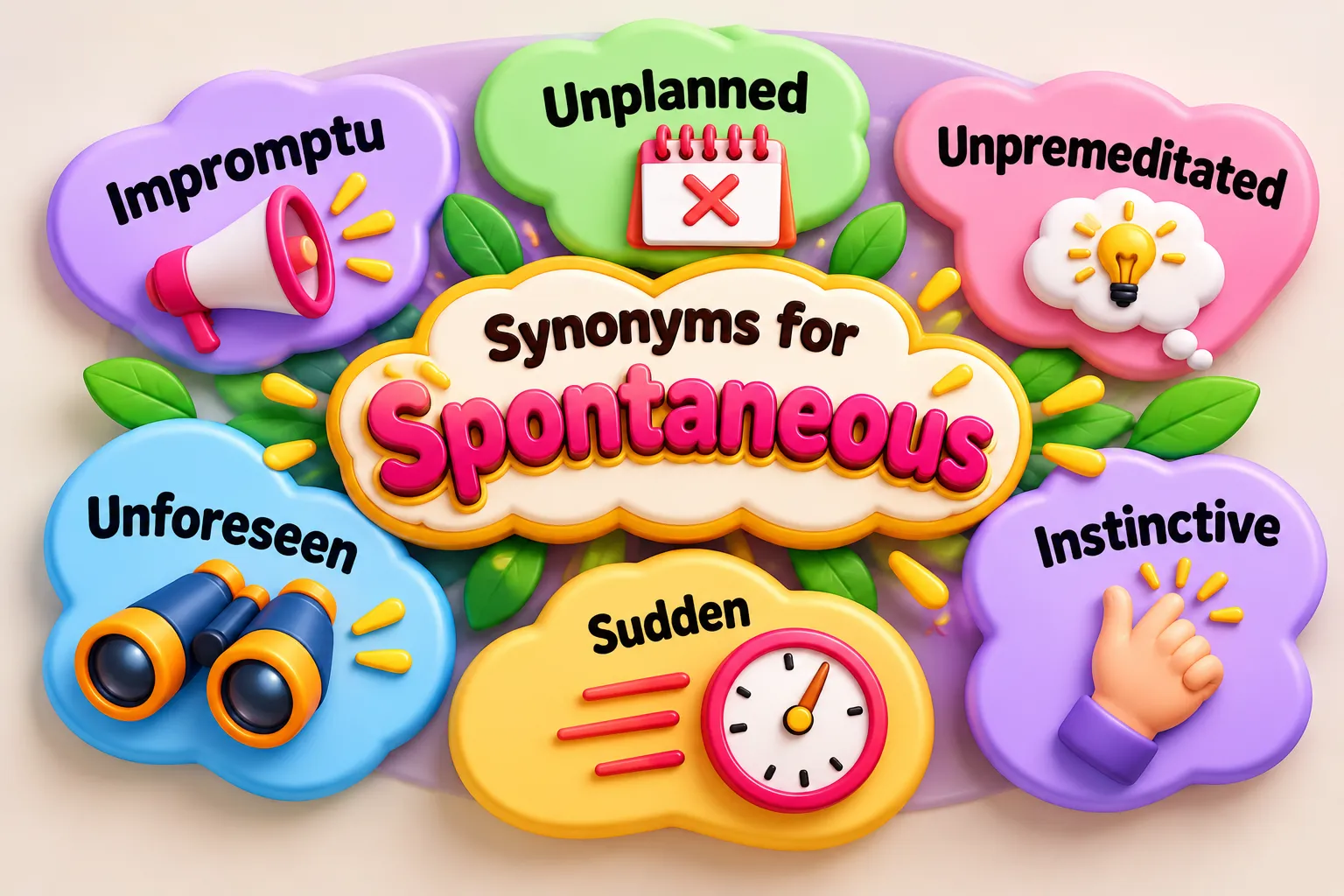
Spontaneous means happening naturally, without being planned or forced. Common synonyms for spontaneous include unplanned, impulsive, instinctive, natural, sudden, unrehearsed, and unprompted. These words describe actions, feelings, or events that happen without much preparation. However, each word has a slightly different meaning. For example, unplanned means not arranged in advance, while impulsive suggests acting quickly without thinking about the results. Learning synonyms for spontaneous helps you express ideas clearly, avoid repetition, and improve your English vocabulary.
Spontaneous describes something that happens naturally, without a plan or much thought. For example, you may make a spontaneous decision to visit a nearby beach after lunch. No one planned the trip, but everyone feels excited to go. The word is common in daily conversations, stories, social media, and writing because it describes natural actions and sudden choices.
Learning synonyms for spontaneous helps English learners and content writers express ideas in more precise ways. Some alternatives describe actions that happen without planning, while others suggest natural feelings or quick decisions. These words are related, but they are not always interchangeable. In this guide, you will learn the meaning, history, pronunciation, and word forms of spontaneous. You will also explore 25 useful synonyms, their meanings, example sentences, semantic groups, and antonyms to build a stronger English vocabulary.
Meaning of Spontaneous
Definition
Spontaneous (adjective): Happening naturally, without being planned, forced, or carefully prepared in advance.
Examples
- We had a spontaneous picnic after the rain stopped.
- Her spontaneous smile made everyone feel welcome.
Connotative Meaning
Connotation is the feeling or idea that a word suggests beyond its basic meaning.
- Positive tone: Spontaneous can suggest joy, creativity, honesty, or natural warmth.
- Negative tone: It can suggest careless or impulsive behavior when someone acts without thinking.
- Neutral tone: It can simply describe an action or event that happens without planning.
Etymology of Spontaneous
The word spontaneous comes from Latin spontaneus, meaning “of one’s own accord” or “voluntary.” It entered English through Late Latin and French influence.
- Old English (450–1100): The modern word spontaneous was not used in Old English. People expressed similar ideas with words meaning willing, natural, or freely chosen.
- Middle English (1100–1500): The word was not common in early Middle English. Related ideas were expressed through words describing free will or actions done willingly.
- Modern English (1500–Present): Spontaneous entered English through Latin and French forms. It developed the familiar meaning of happening naturally or without prior planning.
Pronunciation (IPA)
- IPA: /spɒnˈteɪ.ni.əs/ (British English); /spɑːnˈteɪ.ni.əs/ (American English)
- Syllables: spon-ta-ne-ous
- Part of speech: Adjective
Affixation Pattern of Spontaneous
- Root: spontane- — related to the Latin idea of acting voluntarily or of one’s own accord.
- Prefix: None in the modern English word.
- Suffix: -ous — an adjective-forming suffix.
- Related forms: spontaneously and spontaneity.
Word Formations
| Word | Part of Speech | Meaning |
| Spontaneous | Adjective | Happening naturally or without planning |
| Spontaneously | Adverb | In a natural or unplanned way |
| Spontaneity | Noun | The quality of acting naturally or without planning |
| Spontaneousness | Noun | The state or quality of being spontaneous; less common |
| Unplanned | Adjective | Not arranged in advance |
| Impulsive | Adjective | Acting suddenly without careful thought |
Note: The last two words are related in meaning, but they are not formed from the root of spontaneous.
25 Synonyms for Spontaneous With Meaning and Examples
The best synonym for spontaneous depends on the context. Some words describe a lack of planning, while others focus on natural behavior, sudden action, or an immediate response. The following list includes close synonyms and context-specific alternatives.
1. Unplanned (Adjective)
Meaning: Happening without being arranged in advance.
Examples:
- We took an unplanned trip to the countryside.
- Their unplanned visit brought a smile to my face.
2. Impulsive (Adjective)
Meaning: Acting suddenly without thinking carefully about the results.
Examples:
- He made an impulsive choice to buy the guitar.
- Her impulsive decision surprised her family.
3. Instinctive (Adjective)
Meaning: Happening naturally in response to a feeling or situation, without conscious thought.
Examples:
- Her instinctive reaction was to help the child.
- He made an instinctive move to catch the ball.
4. Natural (Adjective)
Meaning: Happening or behaving in a way that is not forced or artificial.
Examples:
- She has a natural way of making people laugh.
- His natural response showed how happy he was.
5. Unrehearsed (Adjective)
Meaning: Done without being practiced or prepared beforehand.
Examples:
- The actor gave an unrehearsed speech.
- Their unrehearsed performance felt honest and fresh.
6. Unprompted (Adjective)
Meaning: Done without another person asking or encouraging someone to do it.
Examples:
- She gave an unprompted apology.
- His unprompted offer of help was kind.
7. Unpremeditated (Adjective)
Meaning: Done without being planned or considered beforehand.
Examples:
- It was an unpremeditated act of kindness.
- The judge considered whether the action was unpremeditated.
8. Instinctual (Adjective)
Meaning: Based on natural instincts rather than careful thought.
Examples:
- The animal made an instinctual move to protect its young.
- Her instinctual response was to step back.
9. Unscripted (Adjective)
Meaning: Happening or spoken without a prepared script.
Examples:
- The interview included an unscripted moment.
- Their unscripted conversation was more interesting than the planned speech.
10. Unrehearsed (Adjective)
Meaning: Not practiced or prepared before being performed.
Examples:
- The singer gave an unrehearsed performance.
- Their unrehearsed exchange made the audience laugh.
11. Involuntary (Adjective)
Meaning: Happening without conscious control or deliberate choice.
Examples:
- His involuntary smile showed his surprise.
- Blinking is often an involuntary action.
12. Unforced (Adjective)
Meaning: Natural and not caused by pressure or effort.
Examples:
- Her unforced laughter filled the room.
- The conversation had an unforced, friendly tone.
13. Unstudied (Adjective)
Meaning: Natural and not carefully planned to create an effect.
Examples:
- She had an unstudied charm that people liked.
- His unstudied manner made him easy to talk to.
14. Offhand (Adjective/Adverb)
Meaning: Said or done casually, without much preparation or thought.
Examples:
- He made an offhand remark about the weather.
- She gave an offhand answer to the simple question.
15. Ad-libbed (Adjective/Verb)
Meaning: Spoken or performed without a prepared script.
Examples:
- The comedian ad-libbed a funny line.
- His ad-libbed speech made the event feel more personal.
16. Improvised (Adjective/Verb)
Meaning: Created or performed without preparation, often using what is available.
Examples:
- We improvised a meal with the food in the fridge.
- The musicians improvised a short melody.
17. Abrupt (Adjective)
Meaning: Happening suddenly and often without warning.
Examples:
- The meeting came to an abrupt end.
- His abrupt departure surprised everyone.
Note: Abrupt emphasizes suddenness and may sound negative; it does not always mean spontaneous.
18. Sudden (Adjective)
Meaning: Happening quickly and without warning.
Examples:
- A sudden idea changed our plans.
- Their sudden visit made the evening more exciting.
19. Unforeseen (Adjective)
Meaning: Not expected or predicted in advance.
Examples:
- An unforeseen problem delayed our trip.
- The team handled the unforeseen change well.
Note: Unforeseen describes something unexpected, not necessarily something done naturally or without planning.
20. Unexpected (Adjective)
Meaning: Happening when no one expects it.
Examples:
- We received an unexpected invitation.
- Her unexpected visit made the day special.
21. Unanticipated (Adjective)
Meaning: Not expected or planned for in advance.
Examples:
- The unanticipated result surprised the researchers.
- An unanticipated guest joined us for dinner.
22. Immediate (Adjective)
Meaning: Happening or done without delay.
Examples:
- She gave an immediate response to the question.
- His immediate reaction was to laugh.
Note: Immediate means without delay, not always without planning.
23. Instantly (Adverb)
Meaning: Happening at once or without delay.
Examples:
- She instantly recognized her old friend.
- The room instantly became quiet.
Note: Instantly is an adverb, so it cannot directly replace the adjective spontaneous in every sentence.
24. Automatic (Adjective)
Meaning: Happening without conscious thought or direct control.
Examples:
- His automatic response was to say thank you.
- She gave an automatic smile when she saw the camera.
25. Unconscious (Adjective)
Meaning: Done without being fully aware of the action or thought.
Examples:
- He made an unconscious movement with his hand.
- Her unconscious reaction revealed her surprise.
Prototype Meaning of Spontaneous
The most common meaning of spontaneous is doing something naturally without planning it first. People may imagine a surprise road trip, an honest laugh, a sudden offer of help, or a quick decision to try something new. A spontaneous action often feels fresh and genuine because it is not carefully prepared. However, the word does not always mean acting without thinking. It can also describe a natural response or an event that happens on its own. The exact meaning depends on the context. For example, a spontaneous smile may show a real feeling, while an impulsive purchase may suggest poor judgement.
Prototype Categorization of Spontaneous Synonyms
Grouping these words by meaning helps you choose the best alternative for your sentence. Several words overlap, but each has its own use.
- Lack of planning: unplanned, unpremeditated, unrehearsed, unscripted, and off-the-cuff. Use these when an action or event was not prepared in advance.
- Quick or sudden action: impulsive, sudden, abrupt, immediate, and instantly. These emphasize speed or lack of warning. Some do not mean spontaneous in every context.
- Natural behavior or instinct: natural, instinctive, instinctual, unforced, and automatic. Use these when an action seems to happen naturally or without conscious effort.
- Free expression: unprompted, unstudied, offhand, unrestrained, and free-flowing. These describe actions, speech, or feelings that are not forced or tightly controlled.
- Unexpected events: unexpected, unforeseen, and unanticipated. These words focus on surprise rather than on whether an action was planned.
- Creative action without preparation: improvised, ad-libbed, and ex tempore. These are useful for speeches, performances, music, and problem-solving.
- Actions outside conscious awareness: involuntary and unconscious. These describe actions that happen without deliberate control, although they are not always interchangeable with spontaneous.
- Informal situations: casual. Use this when an event or conversation is relaxed, but remember that casual activities may still be planned.
Choosing words by category makes writing more precise. For example, unplanned suits a trip, instinctive suits a quick reaction, and improvised suits a speech or performance created without preparation.
Antonyms of Spontaneous
The best antonym depends on the intended meaning. Some opposites describe planning, while others describe careful thought or controlled behavior.
| Antonym | Part of Speech | Meaning |
| Planned | Adjective | Arranged or decided in advance |
| Preplanned | Adjective | Prepared before an event takes place |
| Deliberate | Adjective | Done on purpose after thought |
| Intentional | Adjective | Done with a clear purpose |
| Premeditated | Adjective | Planned or considered before an action |
| Rehearsed | Adjective | Practiced before being performed |
| Scripted | Adjective | Written or prepared in advance |
| Calculated | Adjective | Carefully planned to achieve a result |
| Methodical | Adjective | Done in an orderly and planned way |
| Considered | Adjective | Thought about carefully before deciding |
| Controlled | Adjective | Managed or kept within limits |
| Restrained | Adjective | Held back or kept under control |
| Prepared | Adjective | Made ready in advance |
| Scheduled | Adjective | Planned for a particular time |
Short Questions and Answers
1. What does spontaneous mean?
Spontaneous means happening naturally, without being planned or prepared in advance. It can describe actions, feelings, decisions, or events.
2. When should spontaneous be used?
Use spontaneous when an action or event happens naturally without a prior plan. For example, “We made a spontaneous decision to go for a walk.”
3. Is spontaneous positive or negative?
It can be either, depending on the situation. A spontaneous act of kindness is positive, while a spontaneous decision that causes trouble may have a negative result.
4. How is spontaneous different from similar words?
Spontaneous describes something that happens naturally without planning. Unplanned focuses on the lack of preparation, while impulsive often suggests acting without considering the consequences. Instinctive describes a response based on natural instinct.
Conclusion
Learning synonyms for spontaneous can improve your vocabulary and make your writing more precise. Words such as unplanned, instinctive, improvised, and unprompted can express different shades of meaning. Some describe actions that happen without preparation, while others focus on natural feelings, quick reactions, or creative choices. Using the right alternative helps you avoid repetition and express your ideas clearly. These words can be useful in stories, essays, blogs, and daily conversations. Try learning a few synonyms each day and use them in your own sentences. Pay attention to how each word changes the meaning of a sentence. With regular practice, you can strengthen your English skills and speak with greater confidence.
Read More:
Synonyms for Destination: 30 Best Alternatives to Know

I’m Falak Naaz, an SEO writer at SynonymsInstant.com focused on creating clear, engaging, and search-friendly English content. I specialize in vocabulary, synonyms, antonyms, word usage, and language guides. I combine careful research with practical writing to deliver trustworthy content that helps readers choose the right words and improve their English with confidence.