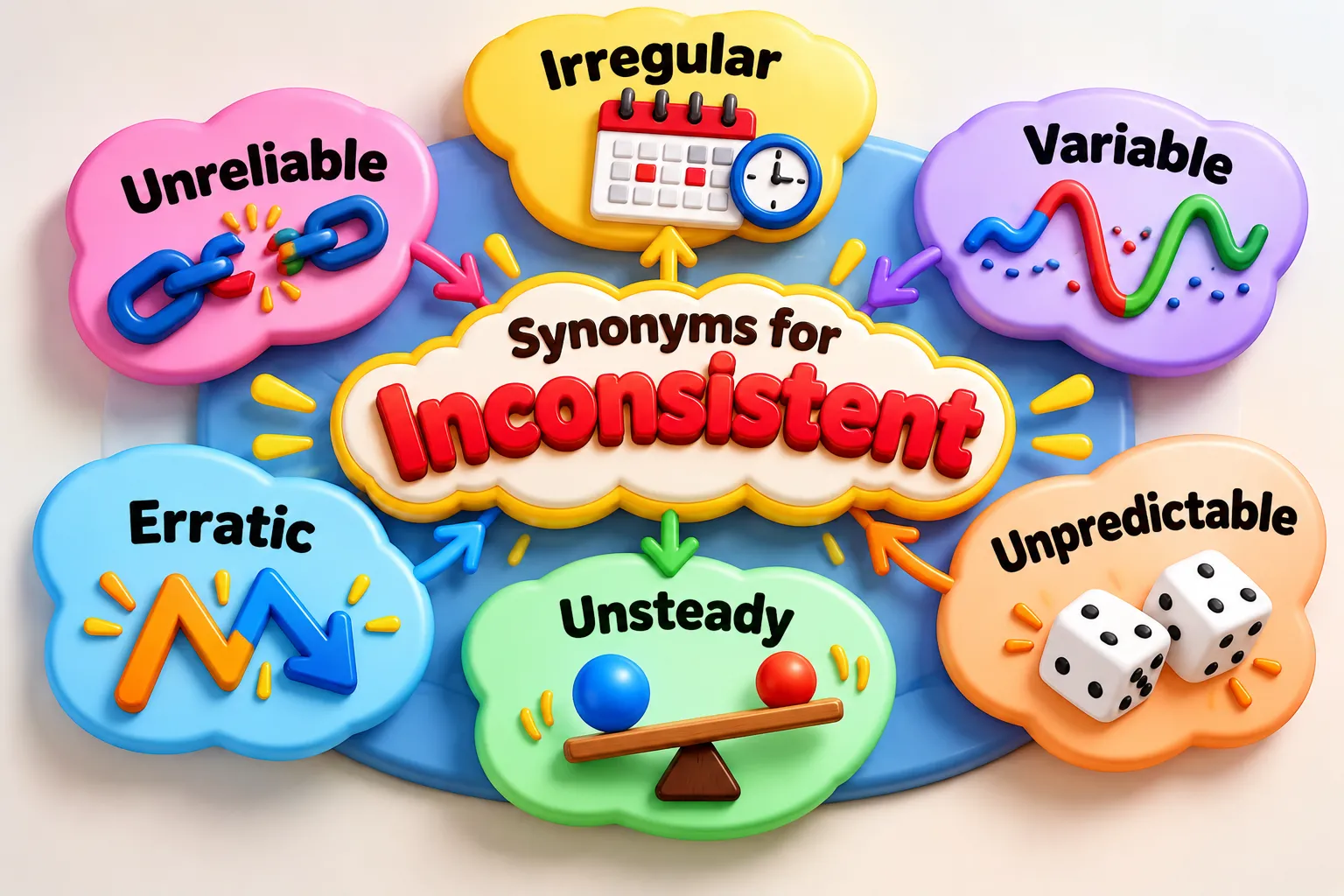
Inconsistent means not staying the same or not acting in a steady, reliable way. Common synonyms for inconsistent include irregular, uneven, variable, erratic, unreliable, contradictory, and changeable. The best word depends on the context. For example, irregular describes something that does not follow a fixed pattern, while unreliable describes someone or something that cannot be trusted to perform as expected. Learning these synonyms can help you express changes, mixed results, and unreliable behavior more clearly. It can also improve your English vocabulary and make your writing more precise.
Inconsistent means not staying the same in behaviour, quality, results, or pattern. For example, a student may study hard one week but skip lessons the next. Their study habits are inconsistent because they do not follow a steady pattern. The word is common in daily conversations, schoolwork, business, and writing. People use it to describe changing results, unreliable actions, or statements that do not agree.
Learning synonyms for inconsistent helps English learners and content writers explain these ideas with greater care. Words such as irregular, erratic, and unreliable are related, but they do not always mean the same thing. Some describe changes, while others focus on trust or logical agreement. This guide explains the meaning, pronunciation, history, and word forms of inconsistent. It also presents 30 useful alternatives with simple meanings, examples, semantic groups, and antonyms to help you use each word correctly.
Meaning of Inconsistent
Definition
Inconsistent (adjective): Not staying the same in behavior, quality, pattern, or results; sometimes also describing statements or facts that do not agree with each other.
Examples
- His work is inconsistent because its quality changes from day to day.
- The witness gave two inconsistent statements about the event.
Connotative Meaning
Connotation is the feeling or idea that a word suggests beyond its basic meaning.
- Positive tone: Inconsistent is rarely positive by itself, but changing methods may sometimes show flexibility or a willingness to adapt.
- Negative tone: It often suggests unreliability, poor performance, or a lack of agreement.
- Neutral tone: It can simply describe data, patterns, or results that vary over time.
Etymology of Inconsistent
The word inconsistent combines the negative prefix in- with consistent. Consistent comes through Latin consistens, related to consistere, meaning “to stand firm” or “to remain in place.”
- Old English (450–1100): The modern word inconsistent was not used in Old English. Similar ideas were expressed through words meaning unsteady, changing, or not firm.
- Middle English (1100–1500): English adopted more words from French and Latin. The word consistent and related forms developed through learned vocabulary influenced by Latin.
- Modern English (1500–Present): Inconsistent developed as a word for something that does not remain steady or agree with something else. Today, it describes changing behavior, uneven quality, unreliable results, and conflicting statements.
Pronunciation (IPA)
- IPA: /ˌɪn.kənˈsɪs.tənt/
- Syllables: in-con-sis-tent
- Part of speech: Adjective
Affixation Pattern of Inconsistent
- Root: sist — related to the Latin idea of standing or remaining firm.
- Prefix: in- — means “not” in this word.
- Suffix: -ent — forms adjectives in words such as consistent and different.
- Related form: consistency is the noun, consistently is the adverb, and inconsistency is the noun form of inconsistent.
Word Formations
| Word | Part of Speech | Meaning |
| Consist | Verb | To be made up of certain parts |
| Consistent | Adjective | Staying the same or agreeing with something |
| Consistently | Adverb | In a steady or regular way |
| Consistency | Noun | The quality of being steady or uniform |
| Inconsistent | Adjective | Not steady or not in agreement |
| Inconsistently | Adverb | In an unsteady or changing way |
| Inconsistency | Noun | A lack of steadiness or agreement |
| Inconsistencies | Plural noun | Instances of a lack of agreement or steadiness |
30 Synonyms for Inconsistent With Meanings and Examples
The best synonym for inconsistent depends on what is changing or failing to agree. Some words describe irregular patterns, others describe unreliable behavior, and some refer to conflicting facts or statements.
1. Irregular (Adjective)
Meaning: Not following a fixed or usual pattern.
Examples:
- His attendance has been irregular this month.
- The plant grew in an irregular pattern.
2. Uneven (Adjective)
Meaning: Not equal, steady, or consistent throughout.
Examples:
- The team gave an uneven performance.
- Her writing quality was uneven across the report.
3. Variable (Adjective)
Meaning: Likely to change in amount, level, or form.
Examples:
- The weather is variable in spring.
- The results were variable across the different tests.
4. Erratic (Adjective)
Meaning: Changing suddenly and unpredictably.
Examples:
- The car moved in an erratic way.
- His erratic attendance made planning difficult.
5. Unreliable (Adjective)
Meaning: Not able to be trusted to work well or behave as expected.
Examples:
- The old bus service is unreliable.
- His unreliable work habits upset the team.
6. Changeable (Adjective)
Meaning: Likely to change often.
Examples:
- Her mood can be changeable after a long day.
- The region has changeable weather.
7. Unsteady (Adjective)
Meaning: Not firm, stable, or regular.
Examples:
- His unsteady progress worried the coach.
- The machine made an unsteady noise.
8. Fluctuating (Adjective)
Meaning: Rising and falling or changing over time.
Examples:
- The company reported fluctuating sales.
- Her energy levels were fluctuating throughout the day.
9. Unpredictable (Adjective)
Meaning: Difficult to know or predict in advance.
Examples:
- The team’s unpredictable results surprised its fans.
- His unpredictable schedule made meetings hard to arrange.
10. Unstable (Adjective)
Meaning: Not steady, secure, or likely to remain the same.
Examples:
- The market has been unstable this year.
- The table was unstable on the uneven floor.
11. Variable in Quality (Adjective Phrase)
Meaning: Having a quality that changes from one example or occasion to another.
Examples:
- The products were variable in quality.
- The service was variable in quality during the busy season.
12. Disparate (Adjective)
Meaning: Very different from one another.
Examples:
- The report combined disparate findings.
- The two groups had disparate views on the issue.
Note: Disparate means different, not necessarily inconsistent. It fits when the differences create a lack of unity or agreement.
13. Conflicting (Adjective)
Meaning: Opposing or not agreeing with something else.
Examples:
- The witnesses gave conflicting accounts.
- We received conflicting information about the event.
14. Contradictory (Adjective)
Meaning: Containing statements or ideas that oppose each other.
Examples:
- His explanation was contradictory.
- The report included contradictory figures.
15. Incongruous (Adjective)
Meaning: Not fitting or matching the surrounding situation.
Examples:
- His casual clothes seemed incongruous at the formal dinner.
- The bright sign looked incongruous in the old building.
16. Incompatible (Adjective)
Meaning: Unable to exist, work, or agree well together.
Examples:
- Their accounts were incompatible.
- The two devices use incompatible systems.
17. Discrepant (Adjective)
Meaning: Different in a way that suggests a mismatch or lack of agreement.
Examples:
- The report showed discrepant figures.
- We found discrepant details in the two records.
18. Divergent (Adjective)
Meaning: Moving apart or developing in different directions.
Examples:
- The researchers reached divergent conclusions.
- Their plans became divergent over time.
19. Uncoordinated (Adjective)
Meaning: Not organized or working together in a smooth way.
Examples:
- The departments followed an uncoordinated plan.
- Their uncoordinated efforts led to delays.
20. Sporadic (Adjective)
Meaning: Happening sometimes, with gaps between events.
Examples:
- The area received sporadic rain.
- His sporadic practice made progress slow.
21. Intermittent (Adjective)
Meaning: Starting and stopping at intervals rather than continuing steadily.
Examples:
- We experienced intermittent internet access.
- The machine made an intermittent clicking sound.
22. Patchy (Adjective)
Meaning: Uneven or incomplete in different places or at different times.
Examples:
- The internet connection was patchy.
- Her knowledge of the subject was patchy.
23. Fitful (Adjective)
Meaning: Happening in short, irregular periods rather than steadily.
Examples:
- He had a fitful night’s sleep.
- The engine made fitful attempts to start.
24. Haphazard (Adjective)
Meaning: Done without a clear plan or order.
Examples:
- The files were stored in a haphazard way.
- A haphazard study routine can make learning harder.
25. Disordered (Adjective)
Meaning: Lacking order or a clear arrangement.
Examples:
- The notes were disordered and hard to follow.
- The process became disordered after the manager left.
26. Inconstant (Adjective)
Meaning: Not remaining steady in feelings, behavior, or purpose.
Examples:
- His inconstant interest made the project difficult.
- The character was known for inconstant loyalties.
27. Fickle (Adjective)
Meaning: Changing opinions, feelings, or choices often.
Examples:
- The fickle customer changed her mind several times.
- Public opinion can be fickle.
28. Unfaithful (Adjective)
Meaning: Not loyal or true to a person, promise, or belief.
Examples:
- The character was unfaithful to his promise.
- The copy was unfaithful to the original text.
Note: Unfaithful is suitable when inconsistency involves loyalty or accuracy, not for every kind of changing pattern.
29. Unsystematic (Adjective)
Meaning: Not done according to a clear or organized method.
Examples:
- The research was unsystematic.
- An unsystematic approach made the task harder.
30. Incoherent (Adjective)
Meaning: Not clear or logically connected.
Examples:
- His explanation became incoherent.
- The essay felt incoherent because its ideas did not connect.
Note: Incoherent describes a lack of clear connection or sense, rather than ordinary variation.
Prototype Meaning of Inconsistent
The most common meaning of inconsistent is failing to remain steady or to agree with something else. People may think of a student whose grades change from week to week, a service that is sometimes good and sometimes poor, or a person whose words do not match their actions. The word can also describe facts or statements that conflict with one another. For example, two reports may give different dates for the same event. In each case, something lacks steadiness, reliability, or agreement. The exact meaning depends on context, so choosing a close synonym helps make the message more precise.
Prototype Categorization of Inconsistent Synonyms
Grouping these synonyms by meaning helps you choose the right word for each situation.
- Irregular patterns: irregular, uneven, sporadic, intermittent, patchy, and fitful. Use these for actions, events, or results that do not occur in a steady pattern.
- Frequent or unpredictable change: variable, erratic, changeable, fluctuating, unpredictable, and inconstant. These describe things that change in ways that may be hard to predict.
- Lack of stability or reliability: unreliable, unsteady, and unstable. Use these when something cannot be trusted to remain steady or work as expected.
- Lack of agreement: conflicting, contradictory, discrepant, incompatible, and divergent. These words are useful when facts, reports, views, or statements do not match.
- Lack of order or coordination: haphazard, disordered, unsystematic, and uncoordinated. Use these for methods, plans, or systems that lack a clear structure.
- Lack of fit or clarity: incongruous, disparate, and incoherent. These describe things that do not fit together well or ideas that lack clear connections.
- Changing loyalty or commitment: fickle and unfaithful. Use these when a person’s choices, feelings, or loyalty change or fail to match a promise.
This grouping helps writers avoid using every synonym in the same way. For example, erratic suits unpredictable changes, contradictory suits opposing statements, and unreliable suits someone or something that cannot be trusted.
Antonyms of Inconsistent
The best antonym depends on whether inconsistent describes changing patterns, unreliable behavior, or conflicting statements.
| Antonym | Part of Speech | Meaning |
| Consistent | Adjective | Staying the same or following a steady pattern |
| Steady | Adjective | Firm, regular, and not changing suddenly |
| Reliable | Adjective | Able to be trusted to work or behave as expected |
| Stable | Adjective | Firm or unlikely to change suddenly |
| Uniform | Adjective | The same or similar throughout |
| Constant | Adjective | Remaining the same over time |
| Regular | Adjective | Following a usual or fixed pattern |
| Predictable | Adjective | Able to be expected or forecast |
| Coherent | Adjective | Clear and logically connected |
| Compatible | Adjective | Able to exist or work well together |
| Agreeing | Adjective | Sharing the same view or matching in details |
| Systematic | Adjective | Done according to an organized method |
| Dependable | Adjective | Trustworthy and likely to perform as expected |
| Unchanging | Adjective | Not changing over time |
Short Questions and Answers
1. What does inconsistent mean?
Inconsistent means not staying the same or not agreeing with something else. It can describe changing behavior, uneven quality, or conflicting information.
2. When should inconsistent be used?
Use inconsistent when something lacks steadiness, reliability, or agreement. For example, you can describe inconsistent attendance, inconsistent results, or inconsistent statements.
3. Is inconsistent positive or negative?
It is usually negative because it often suggests poor reliability or a lack of agreement. In some cases, it can neutrally describe data or results that vary.
4. How is inconsistent different from similar words?
Inconsistent is a broad term. Irregular focuses on a pattern that is not steady, unreliable focuses on trust, erratic suggests unpredictable changes, and contradictory means that statements or ideas oppose one another.
Conclusion
Learning synonyms for inconsistent can help you express changes, differences, and a lack of reliability more clearly. Words such as irregular, erratic, unreliable, and contradictory are useful, but each has a different focus. Some describe changing patterns, while others refer to trust, stability, or disagreement. Choosing the right word can improve your writing, make your meaning clearer, and reduce repetition. These alternatives are helpful in essays, reports, blogs, schoolwork, and daily conversation. Try learning a few synonyms each day and writing your own examples. With regular practice, you can build a stronger vocabulary, improve your speaking and writing, and feel more confident using English.
Read More:
Synonyms for Spontaneous: 25 Words and Their Meanings

I’m Pinki, an SEO writer at SynonymsInstant.com, specializing in synonyms, antonyms, vocabulary, word meanings, grammar, and English usage. I create accurate, well-researched, reader-friendly content that combines language expertise with SEO best practices. My goal is to make English vocabulary simple, useful, and accessible for students, writers, professionals, and English learners.