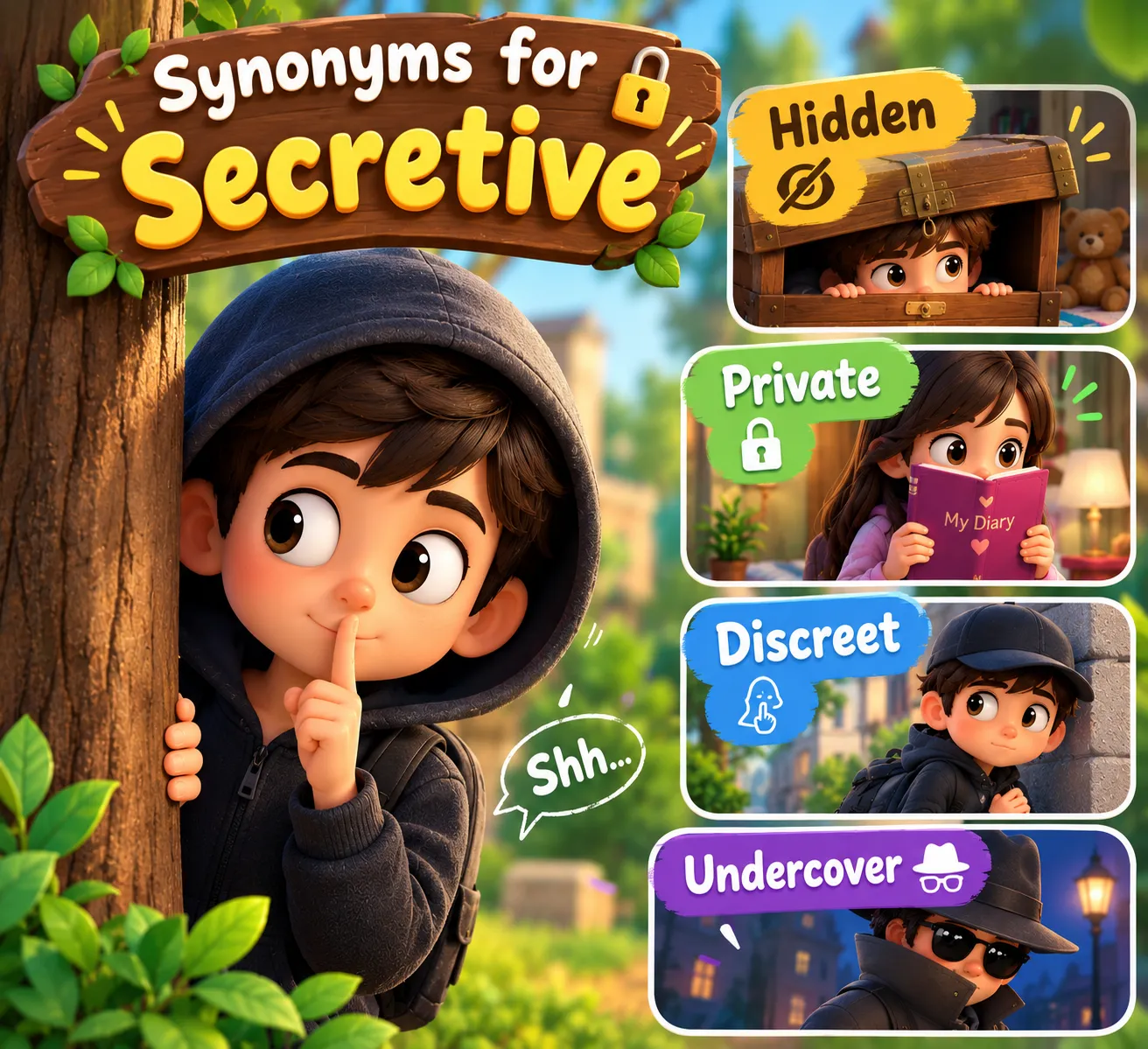
The word secretive describes someone who keeps information, feelings, or plans hidden from others. Common synonyms include private, discreet, guarded, mysterious, tight-lipped, and reticent. Although these words have similar meanings, each expresses a slightly different idea.
For example, discreet suggests being careful with private information. In contrast, tight-lipped describes someone who refuses to reveal details. Similarly, guarded refers to a person who is cautious about sharing thoughts or feelings.
Learning synonyms for secretive can expand your English vocabulary and improve your writing. Moreover, these alternatives help you describe people’s behavior more accurately. In this guide, you will explore 30 synonyms with simple meanings and examples. You will also learn about pronunciation, word forms, antonyms, and the differences between related words.
Meaning of Secretive
Definition
Secretive (adjective): Tending to keep information, feelings, actions, or plans hidden from other people.
A secretive person usually prefers not to share certain details. For example, a friend might keep a surprise birthday party secret to protect the surprise. However, someone who regularly avoids questions may also appear secretive.
Examples of Secretive in Sentences
Here are two examples that show how to use the word naturally.
- My brother is secretive about his plans for the weekend.
- The manager was secretive about the company’s new project.
In both examples, someone chooses not to share information. Depending on the situation, this behavior may protect privacy or create suspicion.
Connotative Meaning of Secretive
Connotation refers to the feelings or ideas a word suggests beyond its basic definition. The word secretive can have positive, negative, or neutral associations.
- Positive tone: Secretive behavior may protect someone’s privacy or keep a pleasant surprise hidden. For example, a secretive plan can make a birthday celebration more exciting.
- Negative tone: The word may suggest dishonesty or suspicion when someone hides important facts. For instance, a secretive manager might make employees worry about upcoming changes.
- Neutral tone: It can simply describe someone who prefers not to share personal information.
Therefore, the meaning depends on the person’s intentions and the surrounding situation. Keeping a surprise secret is different from hiding information that others have a right to know.
Etymology of Secretive
The word secretive comes from secret combined with the suffix -ive, which helps form adjectives. The word secret entered English through French and ultimately comes from the Latin secretus, meaning “hidden,” “separate,” or “set apart.”
Over time, the word developed its modern meaning.
- Old English (450–1100): The modern word secretive was not used in Old English. Instead, people used other words to express ideas related to hiding or keeping something private.
- Middle English (1100–1500): The word secret entered English through French and Latin influences. It referred to something hidden or kept from public knowledge.
- Modern English (1500–present): Secretive developed to describe people who tend to hide information or avoid sharing their thoughts and actions.
Today, the word appears in everyday conversations, news reports, stories, and descriptions of human behavior.
Pronunciation of Secretive
Correct pronunciation can help you use the word confidently in conversation.
- IPA: /ˈsiː.krə.tɪv/
- Syllables: Se-cre-tive
- Syllable count: 3
- Part of speech: Adjective
- Word stress: The first syllable receives the main stress.
To practise, say the word slowly before using it in a complete sentence. For example, “She became secretive about her plans.”
Affixation Pattern of Secretive
Understanding the word’s structure can help you learn related vocabulary.
- Root: Secret — something kept hidden or private.
- Prefix: None.
- Suffix: -ive — a suffix that helps form adjectives describing a quality or tendency.
- Related forms: Secret, secretly, secrecy, and secretiveness.
For example, secretive describes a person’s tendency to hide information. Meanwhile, secretiveness names that quality, and secretly describes an action performed without others knowing.
Word Forms of Secretive
Learning related word forms helps you understand how the word changes according to its role in a sentence.
| Word | Part of Speech | Meaning |
|---|---|---|
| Secret | Noun | Information kept hidden from others |
| Secret | Adjective | Hidden or not known to everyone |
| Secretive | Adjective | Tending to hide information |
| Secretively | Adverb | In a way that keeps things hidden |
| Secretiveness | Noun | The quality or habit of being secretive |
| Secrecy | Noun | The state of keeping something hidden |
| Secretly | Adverb | In a hidden or private way |
| Secrete | Verb | To produce and release a substance, as a gland does |
| Secreted | Verb form | Produced and released a substance |
| Secreting | Verb form | Producing and releasing a substance |
Important distinction: The verb secrete has a biological meaning. For example, glands secrete hormones. It does not mean keeping information secret.
30 Synonyms for Secretive With Meanings and Examples
The following words relate to secrecy, privacy, or limited communication. However, they are not all exact synonyms. Some describe people who avoid sharing information, while others refer to hidden activities or difficult-to-understand messages.
1. Private (Adjective)
Meaning: Not intended to be shared with everyone.
Examples:
- She keeps her personal life private.
- The family had a private discussion at home.
When to use it: Use private when information or activities are meant for a limited audience. Unlike secretive, it does not necessarily suggest suspicious behavior.
2. Discreet (Adjective)
Meaning: Careful about what you say or do to avoid revealing private information.
Examples:
- Please be discreet about the surprise party.
- He was discreet when discussing the client’s problem.
When to use it: Choose discreet when someone handles sensitive information carefully. It often has a positive meaning because it suggests respect for privacy.
3. Guarded (Adjective)
Meaning: Careful about sharing thoughts, feelings, or information.
Examples:
- She gave a guarded answer to the question.
- He remained guarded during the interview.
When to use it: Use guarded when someone is cautious about what they reveal. For example, a person may give guarded answers when discussing a sensitive subject.
4. Mysterious (Adjective)
Meaning: Difficult to understand or explain because little is known.
Examples:
- The stranger had a mysterious past.
- She received a mysterious message late at night.
When to use it: Choose mysterious when a person, event, or situation is difficult to understand. Unlike secretive, it does not always describe someone’s deliberate behavior.
5. Tight-Lipped (Adjective)
Meaning: Unwilling to talk about something or reveal information.
Examples:
- The witness remained tight-lipped about the case.
- My sister was tight-lipped about her new job.
When to use it: Use tight-lipped when someone refuses to discuss a particular matter. It is especially useful in informal conversations and news writing.
6. Reticent (Adjective)
Meaning: Unwilling to speak freely about thoughts or feelings.
Examples:
- He was reticent about his family problems.
- The student remained reticent during the discussion.
When to use it: Choose reticent when someone is reluctant to speak. It is more formal than many everyday alternatives.
7. Reserved (Adjective)
Meaning: Quiet and not quick to share feelings or opinions.
Examples:
- She is reserved around new people.
- His reserved manner made him difficult to know.
When to use it: Use reserved when describing someone who does not express emotions or opinions openly. However, a reserved person may simply be shy rather than secretive.
8. Closemouthed (Adjective)
Meaning: Unwilling to talk about private matters or reveal information.
Examples:
- The manager was closemouthed about the changes.
- They remained closemouthed about their plans.
When to use it: Choose closemouthed when someone deliberately avoids discussing a subject. It is similar to tight-lipped.
9. Taciturn (Adjective)
Meaning: Usually quiet and speaking very little.
Examples:
- The taciturn farmer rarely spoke to visitors.
- Her taciturn nature made the meeting quiet.
When to use it: Use taciturn to describe someone who habitually speaks very little. However, being quiet does not necessarily mean that someone is hiding information.
10. Cautious (Adjective)
Meaning: Careful to avoid risks or unwanted results.
Examples:
- He was cautious about sharing his address online.
- She gave a cautious reply to the reporter.
When to use it: Choose cautious when someone carefully considers what to say or do. It relates to secrecy when a person wants to protect sensitive information.
11. Dissembling (Adjective)
Meaning: Hiding one’s true feelings, intentions, or beliefs.
Examples:
- His dissembling manner made people doubt his honesty.
- The character was dissembling about his real plans.
When to use it: Use dissembling when someone conceals their true intentions, often to mislead others. The word generally carries a negative tone.
12. Evasive (Adjective)
Meaning: Avoiding a clear answer or direct statement.
Examples:
- The politician gave an evasive answer.
- His evasive reply raised more questions.
When to use it: Choose evasive when someone avoids answering a question directly. Unlike private, it often suggests that the person is deliberately avoiding an issue.
13. Concealing (Adjective or Verb Form)
Meaning: Hiding something or trying to keep it from being seen or known.
Examples:
- The concealing cover hid the damaged surface.
- He was concealing important details from the team.
When to use it: Use concealing when describing an action or something that hides another object. However, it is not usually a direct substitute for secretive when describing a person’s general personality.
14. Cryptic (Adjective)
Meaning: Difficult to understand because the meaning is hidden or unclear.
Examples:
- He left a cryptic note on the desk.
- Her cryptic message confused everyone.
When to use it: Choose cryptic when a message or statement is unclear. It focuses on the information being difficult to interpret rather than on the person keeping a secret.
15. Enigmatic (Adjective)
Meaning: Mysterious and difficult to understand.
Examples:
- The writer had an enigmatic personality.
- His enigmatic smile made us curious.
When to use it: Use enigmatic when describing someone or something that is hard to interpret. It often sounds more literary than mysterious.
16. Secret (Adjective)
Meaning: Kept hidden from people who are not meant to know about it.
Examples:
- They held a secret meeting after work.
- The team made a secret plan.
When to use it: Choose secret when describing information, plans, or activities that are deliberately hidden. In contrast, secretive describes a tendency to keep things hidden.
17. Confidential (Adjective)
Meaning: Intended to remain private and shared only with authorized people.
Examples:
- The lawyer handled confidential records.
- Please keep this confidential information safe.
When to use it: Use confidential for sensitive information, documents, or discussions. It is common in legal, business, and professional settings.
18. Covert (Adjective)
Meaning: Hidden or carried out without being openly shown.
Examples:
- The group carried out a covert operation.
- They held covert talks about the deal.
When to use it: Choose covert when describing an activity that is deliberately kept hidden. It is especially common in security, intelligence, and political contexts.
19. Disguised (Adjective)
Meaning: Changed in appearance or form to hide the true identity or nature of something.
Examples:
- He entered the building in a disguise.
- Her disguised voice made her difficult to recognize.
When to use it: Use disguised when someone or something hides its identity or appearance. However, it does not describe a general habit of keeping information private.
20. Hidden (Adjective)
Meaning: Kept out of sight or not made known.
Examples:
- They found a hidden room behind the wall.
- He kept his feelings hidden from his friends.
When to use it: Choose hidden when describing something that cannot easily be seen or discovered. It can refer to physical objects, emotions, or information.
21. Concealed (Adjective)
Meaning: Deliberately kept out of sight or knowledge.
Examples:
- The documents were concealed in a drawer.
- She concealed the gift until his birthday.
When to use it: Use concealed when someone intentionally hides an object, fact, or feeling. Compared with hidden, it more clearly suggests a deliberate action.
22. Undercover (Adjective)
Meaning: Working or acting secretly, often to discover information.
Examples:
- The undercover officer gathered evidence.
- The reporter worked undercover for the investigation.
When to use it: Choose undercover when someone hides their identity while carrying out a particular task. It is commonly used in investigations and law enforcement.
23. Sly (Adjective)
Meaning: Acting in a secretive or clever way, often to gain an advantage.
Examples:
- He gave a sly smile before leaving.
- She made a sly attempt to change the subject.
When to use it: Use sly when someone’s behavior suggests clever concealment or hidden motives. The word often has a negative or playful tone.
24. Clandestine (Adjective)
Meaning: Done secretly, often because it is meant to remain unknown.
Examples:
- They arranged a clandestine meeting.
- The group held clandestine talks at night.
When to use it: Choose clandestine when describing secret activities or meetings. It is more formal than secret and often suggests that secrecy is necessary.
25. Stealthy (Adjective)
Meaning: Moving or acting quietly to avoid being noticed.
Examples:
- The cat made a stealthy approach toward the bird.
- He took stealthy steps through the hallway.
When to use it: Use stealthy when someone moves or acts without attracting attention. It focuses on avoiding detection rather than simply keeping information private.
26. Uncommunicative (Adjective)
Meaning: Not willing to talk or share information with others.
Examples:
- He became uncommunicative after the meeting.
- The uncommunicative guest answered with only a few words.
When to use it: Choose uncommunicative when someone provides little information or rarely participates in conversation. However, this behavior may result from shyness or discomfort rather than secrecy.
27. Noncommittal (Adjective)
Meaning: Not giving a clear opinion, decision, or promise.
Examples:
- She gave a noncommittal answer about the offer.
- His noncommittal response left us unsure.
When to use it: Use noncommittal when someone avoids taking a clear position. Unlike secretive, it does not necessarily mean the person is hiding a secret.
28. Cagey (Adjective)
Meaning: Careful about what you reveal, often to avoid giving information away.
Examples:
- He was cagey about his plans for the weekend.
- The player remained cagey about the team’s strategy.
When to use it: Choose cagey when someone carefully avoids revealing details. It is an informal word commonly used in conversation and journalism.
29. Tight (Adjective)
Meaning: In informal expressions, keeping information closely guarded.
Examples:
- The team kept tight control over the details.
- They kept the surprise under wraps until the last moment.
When to use it: The word tight can suggest secrecy in certain expressions, but it is not a general synonym for secretive. In most situations, tight-lipped or closemouthed is more natural.
30. Unforthcoming (Adjective)
Meaning: Unwilling to provide information or answer questions.
Examples:
- The company was unforthcoming about the delay.
- He was unforthcoming when asked about the missing files.
When to use it: Choose unforthcoming when someone fails or refuses to provide the information requested. It is useful in formal writing, reports, and news articles.
Core Meaning of Secretive
The central meaning of secretive is keeping information hidden rather than sharing it openly. A secretive person may avoid questions, protect personal details, or keep plans to themselves.
For example, someone who refuses to discuss an upcoming project may appear secretive. Similarly, a friend who hides plans for a surprise party is keeping information private.
However, secrecy does not always indicate dishonesty. People may have good reasons to protect their privacy. In contrast, hiding important facts can create suspicion and damage trust.
Therefore, consider the person’s intentions and the surrounding situation before deciding whether secretive is positive or negative.
Categories of Secretive Synonyms
Grouping synonyms by meaning makes it easier to select the right word. Each category highlights a different type of secrecy or communication.
1. Privacy and Confidentiality
Examples: Private, discreet, confidential, and secret.
These words relate to information that should not be shared freely. For instance, confidential is suitable for sensitive business records, while discreet describes someone who handles private information carefully.
2. Careful or Limited Communication
Examples: Guarded, tight-lipped, reticent, reserved, closemouthed, taciturn, and uncommunicative.
These words describe people who share little information or rarely express their thoughts. However, taciturn mainly means habitually quiet, whereas tight-lipped specifically suggests refusing to reveal details.
3. Avoiding Direct Answers
Examples: Evasive, noncommittal, cagey, and unforthcoming.
Use these words when someone avoids explaining something clearly. For example, an evasive response avoids a direct answer, while a noncommittal response avoids expressing a firm opinion.
4. Mystery and Unclear Meaning
Examples: Mysterious, cryptic, and enigmatic.
These words describe people, messages, or situations that are difficult to understand. Nevertheless, cryptic usually refers to unclear communication, while enigmatic often describes a puzzling person or quality.
5. Hidden Actions and Operations
Examples: Covert, clandestine, undercover, and stealthy.
These terms describe activities carried out without attracting attention or becoming publicly known. For example, undercover often describes a person hiding their identity during an investigation.
6. Hiding Identity, Appearance, or Facts
Examples: Concealing, concealed, hidden, and disguised.
These words focus on something being kept from view or knowledge. However, disguised emphasizes a changed appearance or identity, while concealed emphasizes deliberate hiding.
7. Caution and Hidden Motives
Examples: Cautious, sly, and dissembling.
These words may suggest careful behavior or concealed intentions. In particular, dissembling often implies dishonesty, while cautious can simply describe someone who wants to avoid unnecessary risks.
By understanding these categories, you can avoid using every synonym in the same way. For example, discreet often sounds respectful, evasive suggests avoidance, and clandestine usually describes a secret activity.
Antonyms of Secretive
Antonyms describe the opposite of a word. In this case, they refer to openness, honesty, and a willingness to share information.
| Antonym | Part of Speech | Meaning |
|---|---|---|
| Open | Adjective | Willing to share thoughts or information |
| Frank | Adjective | Honest and direct in speech |
| Honest | Adjective | Truthful and not trying to mislead |
| Candid | Adjective | Open and sincere about opinions or feelings |
| Outspoken | Adjective | Willing to express opinions openly |
| Communicative | Adjective | Willing to talk and share information |
| Transparent | Adjective | Open about actions, plans, or decisions |
| Frank-spoken | Adjective | Speaking honestly and directly |
| Unreserved | Adjective | Open and not holding back feelings or opinions |
| Revealing | Adjective | Giving information that was previously unknown |
| Forthcoming | Adjective | Willing to provide information or answer questions |
| Expressive | Adjective | Showing thoughts and feelings clearly |
For example, an open person is usually willing to discuss their thoughts, while a secretive person tends to keep certain details private. Similarly, a forthcoming employee answers questions and provides requested information.
However, being private does not mean being dishonest. A person can protect personal information while remaining honest and trustworthy.
Frequently Asked Questions About Secretive
1. What does secretive mean?
Secretive means tending to hide information, feelings, or plans instead of sharing them openly. For example, someone who avoids discussing personal plans may be described as secretive.
2. When should I use secretive?
Use secretive to describe someone who often keeps information private or avoids sharing details. For instance, “He is secretive about his work.”
3. Is secretive positive or negative?
The meaning depends on the context. It can be positive when someone protects privacy or plans a surprise. However, it can be negative when someone hides important facts or avoids honest communication.
4. How is secretive different from similar words?
Secretive describes a general tendency to keep things hidden. In comparison, discreet suggests careful handling of private information, evasive means avoiding a direct answer, and mysterious describes something difficult to understand.
5. What are the most common synonyms for secretive?
Common alternatives include private, discreet, guarded, mysterious, tight-lipped, and reticent. Nevertheless, the best choice depends on the sentence and the intended meaning.
6. What is the opposite of secretive?
Common antonyms include open, candid, frank, communicative, and forthcoming. These words describe people who are more willing to share information or express their thoughts.
Conclusion
Learning synonyms for secretive helps you describe privacy, hidden information, and human behavior more accurately. Words such as discreet, guarded, evasive, and mysterious share related meanings, but each expresses a different idea.
For example, discreet suggests respect for privacy, whereas evasive implies avoiding a direct answer. Similarly, tight-lipped describes someone who refuses to reveal details, while reticent emphasizes reluctance to speak.
Read more;
Synonyms for Farm: 29 Essential Words to Know

I’m Ayesha Haram, an English content and SEO writer at SynonymsInstant.com. I focus on creating helpful vocabulary resources, word guides, and practical English content that readers can understand quickly. I combine language research, clear explanations, and SEO-focused writing to produce reliable content that supports learners, writers, and everyday English users.