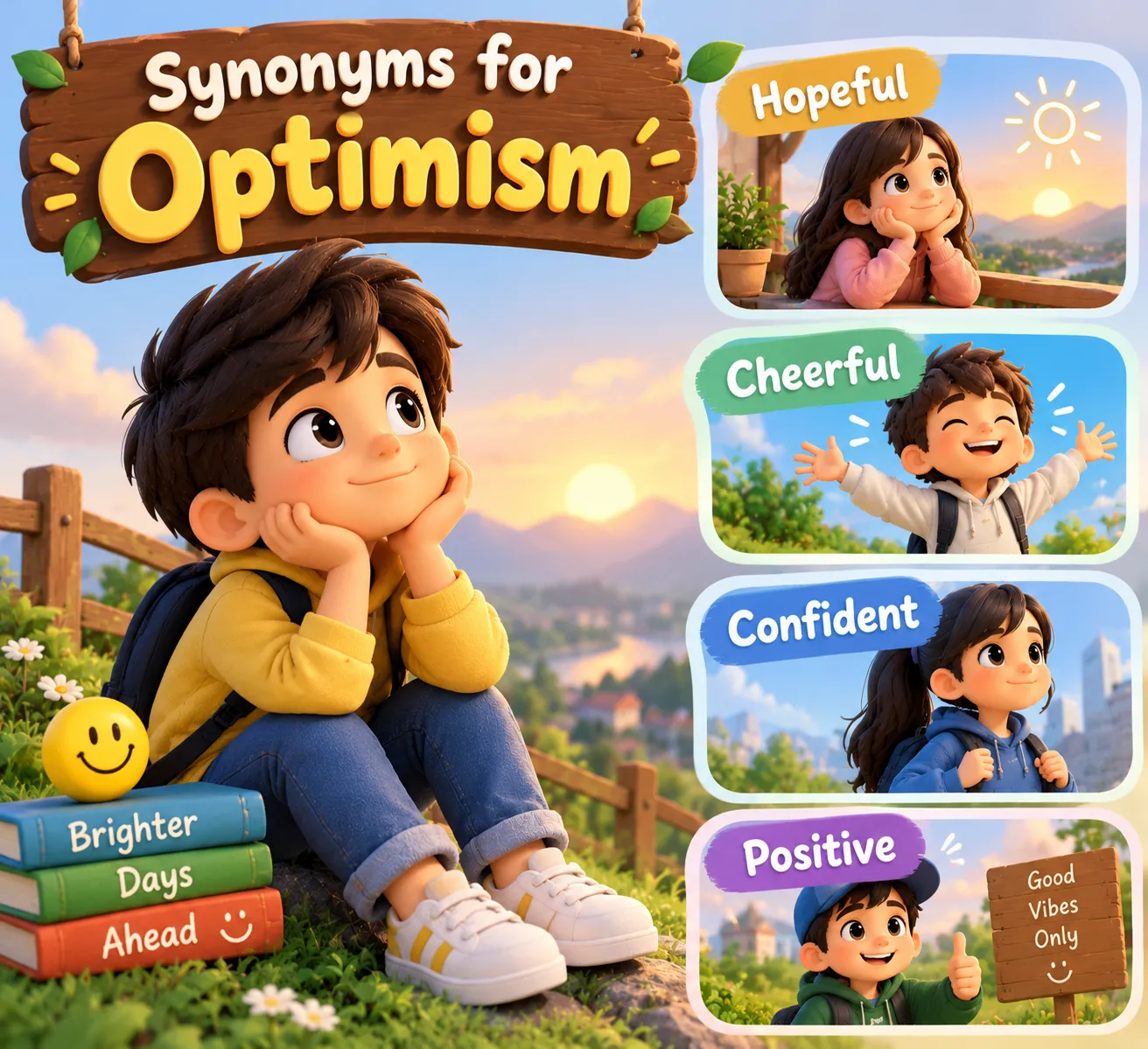
Optimism means having hope and expecting good things to happen. Common synonyms for optimism include hopefulness, positivity, confidence, faith, and enthusiasm. These words express a positive view of life and the future. However, each word has a slightly different meaning. For example, hopefulness shows a desire for a good outcome, while confidence suggests trust in success. Learning these alternatives can improve your English vocabulary and help you express positive thoughts in speaking and writing.
Optimism means expecting good things to happen, even when life is hard. For example, a student who fails an exam but believes they can improve shows optimism. This positive way of thinking can help people face problems, set goals, and keep trying. The word is common in daily talks, books, schoolwork, and personal growth articles. Learning synonyms for optimism helps English learners express hope in different ways. It also helps writers avoid using the same word too often. Some alternatives show hope, while others express confidence, positive thinking, or trust in the future. In this guide, you will learn the meaning, pronunciation, history, word forms, and 27 synonyms for optimism, along with simple meanings and examples to help you choose the right word.
Meaning of Optimism
Definition
Optimism (noun): The belief that good things are likely to happen or that a situation can improve.
Examples
- Her optimism helped her stay calm during a difficult time.
- Despite the challenges, he showed optimism about his future.
Connotative Meaning
Connotation (the feeling or idea a word suggests beyond its basic meaning) describes the emotional tone of a word.
- Positive tone: Optimism usually suggests hope, courage, confidence, and a positive outlook.
- Negative tone: In some situations, optimism may suggest unrealistic hope or a failure to notice risks.
- Neutral tone: Optimism can simply describe someone’s general expectation that things will turn out well.
Etymology of Optimism
The word optimism comes from the French word optimisme, which is based on the Latin word optimus, meaning “best.”
- Old English (450–1100): The modern word optimism was not used in Old English. Related ideas of hope and confidence were expressed through other words.
- Middle English (1100–1500): The word optimism was not yet established in English during most of this period. Words related to hope and trust expressed similar ideas.
- Modern English (1500–Present): Optimism entered English in the 18th century through French. It became associated with the belief that things are good or can turn out well.
Pronunciation of Optimism (IPA)
- IPA: /ˈɒp.tɪ.mɪ.zəm/ (British English); /ˈɑːp.tə.mɪ.zəm/ (American English)
- Syllables: op-ti-mism (4 syllables)
Affixation Pattern of Optimism
- Root: Optim- comes from Latin optimus, meaning “best.”
- Prefix: No productive prefix is used in the modern word optimism.
- Suffix: -ism forms nouns that often refer to beliefs, ideas, or systems.
Word Formations
| Word | Part of Speech | Meaning |
| Optimism | Noun | A belief that good things may happen |
| Optimist | Noun | A person who expects good outcomes |
| Optimistic | Adjective | Hopeful about the future |
| Optimistically | Adverb | In a hopeful or positive way |
| Optimist’s | Possessive noun form | Belonging to an optimist |
| Pessimism | Noun | A tendency to expect bad outcomes |
| Pessimist | Noun | A person who expects negative outcomes |
| Pessimistic | Adjective | Expecting poor results |
| Pessimistically | Adverb | In a negative or doubtful way |
Note: “Optimist’s” is a possessive form, not a separate word derived by adding a new suffix.
27 Synonyms for Optimism With Meanings and Examples
Not every word below has exactly the same meaning as optimism. Some express hope, confidence, positive thinking, or a related feeling. Choose the word that best fits your sentence.
1. Hopefulness (Noun)
Meaning: The feeling that something good may happen.
Examples:
- Her hopefulness helped her face the challenge.
- He spoke with hopefulness about his new job.
2. Positivity (Noun)
Meaning: A positive way of thinking or looking at life.
Examples:
- Her positivity made the team feel better.
- Positivity can help people deal with daily stress.
3. Confidence (Noun)
Meaning: A strong belief in yourself or the chance of success.
Examples:
- She showed confidence before the exam.
- His confidence helped him speak in public.
4. Hope (Noun)
Meaning: A feeling that something good can happen.
Examples:
- There is hope for a better future.
- She never lost hope during the hard times.
5. Faith (Noun)
Meaning: Strong trust that something will work out or be true.
Examples:
- He had faith in his team’s ability.
- Her faith in the future kept her going.
6. Cheerfulness (Noun)
Meaning: A happy and positive state of mind.
Examples:
- Her cheerfulness brightened the room.
- He greeted everyone with cheerfulness.
7. Enthusiasm (Noun)
Meaning: Strong excitement and interest in something.
Examples:
- She showed enthusiasm for the new project.
- His enthusiasm encouraged the other students.
8. Encouragement (Noun)
Meaning: Support that gives someone hope or confidence.
Examples:
- Her teacher’s encouragement helped her keep trying.
- A few kind words gave him encouragement.
9. Assurance (Noun)
Meaning: A feeling of certainty or confidence that something is true or will happen.
Examples:
- He spoke with assurance about the plan.
- Her assurance helped calm the worried team.
10. Trust (Noun)
Meaning: A belief that someone or something is reliable.
Examples:
- She had trust in her own skills.
- Their trust in the plan helped them move forward.
11. Expectation (Noun)
Meaning: A belief about what is likely to happen.
Examples:
- His expectation of success kept him focused.
- They had positive expectations for the year ahead.
12. Bright outlook (Noun phrase)
Meaning: A hopeful view of the future.
Examples:
- She has a bright outlook on life.
- His bright outlook helped him face change.
13. Positive thinking (Noun phrase)
Meaning: The habit of focusing on helpful or hopeful thoughts.
Examples:
- Positive thinking helped him stay calm.
- She used positive thinking to face her fears.
14. High spirits (Noun phrase)
Meaning: A cheerful and lively mood.
Examples:
- The team remained in high spirits after the match.
- She was in high spirits on her birthday.
15. Buoyancy (Noun)
Meaning: A cheerful ability to recover from trouble or sadness.
Examples:
- Her buoyancy helped her recover after a setback.
- He faced the changes with surprising buoyancy.
16. Resilience (Noun)
Meaning: The ability to recover after difficulty.
Examples:
- Her resilience helped her start again.
- Resilience gave him the strength to keep going.
17. Courage (Noun)
Meaning: The ability to face fear or difficulty.
Examples:
- He showed courage when he tried again.
- Her courage inspired the whole group.
18. Determination (Noun)
Meaning: A firm decision to keep working toward a goal.
Examples:
- Her determination helped her finish the course.
- He faced each problem with determination.
19. Motivation (Noun)
Meaning: The desire or reason to take action.
Examples:
- His motivation grew after he saw progress.
- Her goals gave her motivation to study.
20. Aspiration (Noun)
Meaning: A strong hope or desire to achieve something.
Examples:
- Her aspiration is to become a doctor.
- He worked hard to reach his aspirations.
21. Idealism (Noun)
Meaning: The belief that things can or should be better.
Examples:
- Her idealism led her to help others.
- His idealism inspired him to seek change.
22. Confidence in the future (Noun phrase)
Meaning: A belief that future events are likely to turn out well.
Examples:
- She has confidence in the future.
- Their confidence in the future grew after the good news.
23. Expectation of success (Noun phrase)
Meaning: The belief that an effort will lead to a good result.
Examples:
- His expectation of success kept him focused.
- The team shared an expectation of success.
24. Positive outlook (Noun phrase)
Meaning: A hopeful way of viewing life or a situation.
Examples:
- Her positive outlook helped her manage stress.
- A positive outlook can make challenges feel easier.
25. Hopeful attitude (Noun phrase)
Meaning: A way of thinking that expects improvement or a good result.
Examples:
- He kept a hopeful attitude during treatment.
- Her hopeful attitude encouraged her friends.
26. Sanguinity (Noun)
Meaning: A hopeful and confident view of events, especially when facing difficulty.
Examples:
- His sanguinity helped him face the uncertain future.
- She showed sanguinity during a difficult year.
27. Exuberance (Noun)
Meaning: Great energy, excitement, and happiness.
Examples:
- The children showed exuberance on the first day of school.
- His exuberance made the celebration lively.
Prototype Meaning of Optimism
The typical meaning of optimism is a hopeful belief that life can improve and that good results are possible. When people hear this word, they often imagine someone who stays positive during hard times, looks for solutions, and believes that effort can make a difference. An optimistic person does not have to ignore problems. Instead, they recognize challenges while believing that things can get better. Optimism is often linked to hope, confidence, and a positive outlook.
Prototype Categorization of Optimism Synonyms
The synonyms and related expressions above can be grouped by the main idea they express. These categories help writers choose a word that fits the situation instead of replacing optimism with a word that has a different meaning.
- Hope and positive expectations: Hopefulness, hope, expectation, bright outlook, confidence in the future, expectation of success, and confidence in success. These are useful when discussing a good result that may happen.
- Positive thinking and attitude: Positivity, positive thinking, positive outlook, and hopeful attitude. Use these when describing how someone views life or a problem.
- Trust and certainty: Confidence, faith, assurance, and trust. These words focus on belief, reliability, or certainty.
- Happiness and excitement: Cheerfulness, enthusiasm, high spirits, exuberance, and eagerness. These describe positive moods or strong interest, rather than optimism itself.
- Strength during hard times: Buoyancy, resilience, and courage. These words show the ability to face problems or recover from setbacks.
- Goals and action: Encouragement, determination, motivation, and aspiration. These relate to support, effort, and the desire to achieve something.
- Beliefs and potential: Idealism, sanguinity, and promise. These suggest a belief in better possibilities, a hopeful outlook, or signs of future success.
Antonyms of Optimism
Antonyms express meanings that contrast with optimism. Some refer to negative expectations, while others describe doubt or a lack of hope.
| Antonym | Part of Speech | Meaning |
| Pessimism | Noun | The belief that bad outcomes are more likely |
| Hopelessness | Noun | A feeling that nothing will improve |
| Despair | Noun | A deep loss of hope |
| Doubt | Noun | A lack of certainty or trust |
| Negativity | Noun | A tendency to focus on bad aspects |
| Discouragement | Noun | A loss of confidence or motivation |
| Gloom | Noun | A state of sadness or low hope |
| Cynicism | Noun | Distrust of people’s motives or claims |
| Defeatism | Noun | The belief that failure is unavoidable |
| Despondency | Noun | A state of low spirits and little hope |
| Worry | Noun | Unease about possible problems |
| Uncertainty | Noun | A lack of confidence about what will happen |
Short Questions and Answers
1. What does optimism mean?
Optimism means expecting good things to happen or believing that a difficult situation can improve.
2. When should optimism be used?
Use optimism when describing a hopeful view of the future, a positive attitude during difficulty, or a belief that a situation can improve.
3. Is optimism positive or negative?
Optimism is usually positive because it expresses hope and confidence. However, it can be unrealistic if someone ignores serious risks or facts.
4. How is optimism different from similar words?
Optimism is a general belief that things may turn out well. Hope is a wish for a good outcome, while confidence is a strong belief in one’s ability or the likelihood of success. Positivity describes a broader positive attitude.
Conclusion
Learning synonyms for optimism can improve your English vocabulary and help you express hope in clear, natural ways. Words such as hopefulness, confidence, and positivity have related meanings, but each fits a different context. Choosing the right word can make your writing more precise and your speech more engaging. These alternatives are useful in essays, conversations, stories, and personal messages. They also help you avoid repeating the same word. Remember that some expressions describe optimism directly, while others refer to related feelings, attitudes, or strengths. Read the examples, make your own sentences, and practice using a new word each day. With regular practice, you can build stronger vocabulary and feel more confident when speaking and writing in English.
Read More:
30 Synonyms for Secretive With Meanings and Examples

I’m Falak Naaz, an SEO writer at SynonymsInstant.com focused on creating clear, engaging, and search-friendly English content. I specialize in vocabulary, synonyms, antonyms, word usage, and language guides. I combine careful research with practical writing to deliver trustworthy content that helps readers choose the right words and improve their English with confidence.