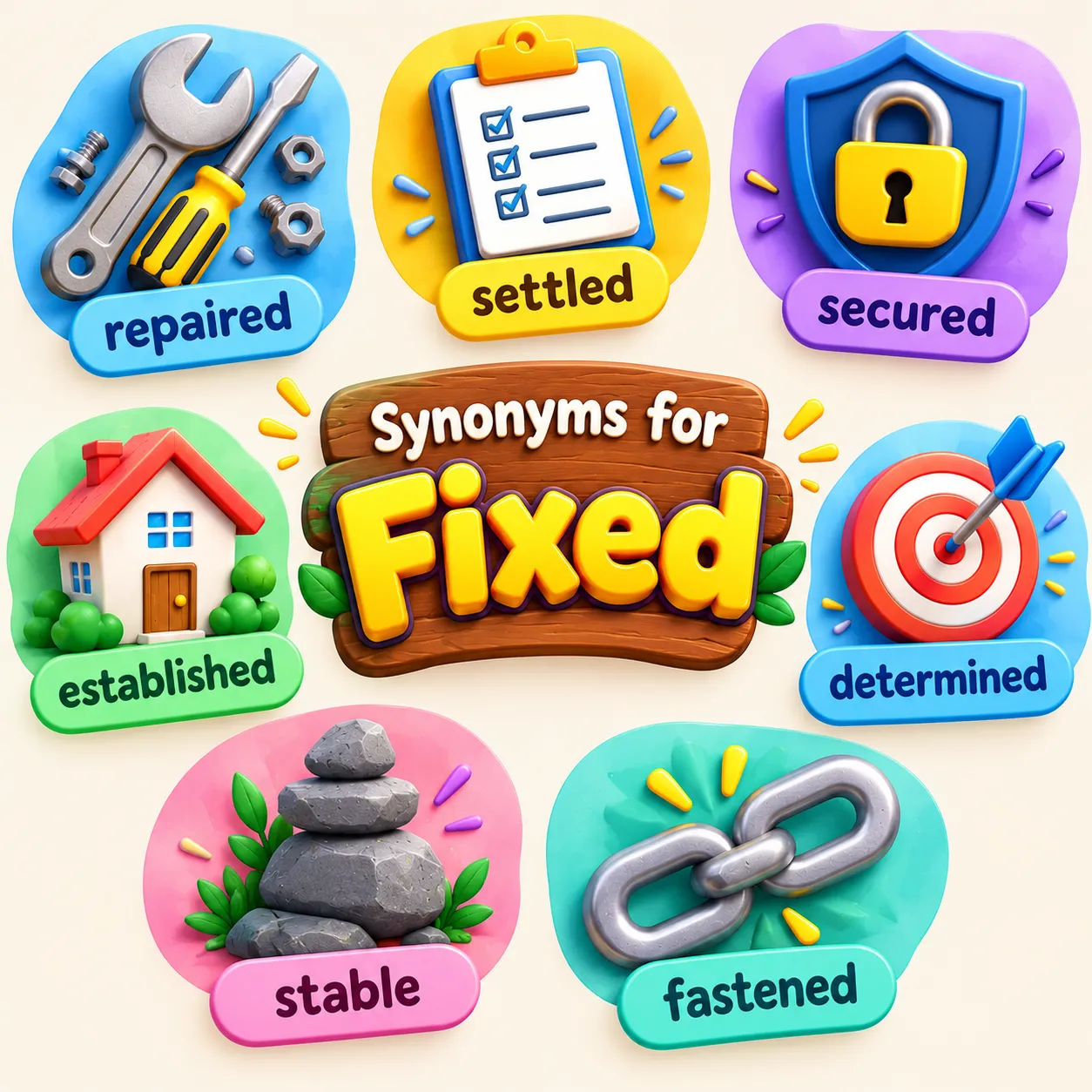
The word fixed has several meanings in English. It can mean repaired, attached firmly, arranged in advance, or kept unchanged. Common synonyms include repaired, secured, attached, settled, established, and adjusted.
For example, a mechanic fixes a broken car. Similarly, a manager sets a fixed meeting date. However, these two uses have different meanings. In the first sentence, fixed means repaired. In the second, it means arranged in advance.
Learning synonyms for fixed can improve your vocabulary and make your writing more interesting. Moreover, these alternatives help you avoid repeating the same word in essays, emails, and everyday conversations.
In this guide, you will discover 30 synonyms for fixed, along with their meanings and examples. Additionally, you will learn about pronunciation, word forms, antonyms, and the differences between related words.
Meaning of Fixed
Definition
Fixed (adjective or verb): The word fixed describes something that someone has repaired, attached firmly, arranged, or kept unchanged. It also serves as the past tense and past participle of the verb fix.
The meaning depends on the context. For instance, a mechanic fixes a broken car. Meanwhile, a company may set a fixed price that customers cannot easily change.
Examples of Fixed in Sentences
Here are three simple examples:
- The mechanic fixed my car yesterday.
- We chose a fixed date for the meeting.
- The worker fixed the shelf to the wall.
Each sentence uses fixed differently. In the first example, it means repaired. In the second, it refers to a date arranged in advance. Finally, the third example describes an action that attaches something firmly.
Connotative Meaning of Fixed
Connotation refers to the feelings or ideas that a word suggests beyond its basic meaning. Depending on the context, fixed can carry positive, negative, or neutral associations.
- Positive meaning: The word can suggest a successful repair. For example, the technician fixed my computer, so I can use it again.
- Negative meaning: It can suggest unfair control. For instance, someone might fix a competition to ensure a particular person wins.
- Neutral meaning: It can describe a set arrangement. For example, we agreed on a fixed meeting time.
Therefore, consider the context before interpreting the word. A fixed computer usually suggests a successful repair, whereas a fixed competition may suggest dishonesty.
Etymology of Fixed
The word fixed comes from the verb fix. English adopted fix through French from the Latin word fixus, meaning firmly attached or established.
Over time, English speakers developed several uses for the word. Today, fix can mean repair, secure, arrange, or settle something.
- Historical roots: The Latin word fixus expressed the idea of setting something firmly in place.
- Development in English: The verb fix gained meanings related to repairing objects and establishing arrangements.
- Modern usage: Today, people use fixed to describe repaired items, set prices, established dates, and unchanging conditions.
As a result, the word now appears in many different situations, from everyday conversations to professional writing.
Pronunciation of Fixed
Correct pronunciation helps you speak English more confidently.
- IPA: /fɪkst/
- Syllables: One
- Part of speech: Adjective or verb form
To pronounce fixed, say “fikst” as one syllable. The ending -ed sounds like /t/, not an extra syllable.
For example, say: “The mechanic fixed the engine.”
Affixation Pattern of Fixed
Understanding word structure can help you recognize related forms.
- Root: Fix — to repair, set, or make firm.
- Prefix: None.
- Suffix: -ed — forms the past tense and past participle of the regular verb fix.
For example, fix becomes fixed when someone completes a repair. Similarly, fixing describes the act of repairing or arranging something.
Word Forms of Fixed
| Word | Part of Speech | Meaning |
|---|---|---|
| Fix | Verb / Noun | Repair something; a solution |
| Fixed | Adjective / Verb | Repaired, secured, or set |
| Fixes | Verb / Noun | Repairs something; solutions |
| Fixing | Verb / Noun | Repairing or arranging something |
| Fixable | Adjective | Able to be repaired |
| Fixer | Noun | A person who repairs or arranges things |
| Fixation | Noun | A strong focus on something |
| Fixative | Noun / Adjective | A substance that helps hold something in place |
| Unfixed | Adjective | Not set or secured |
| Fixture | Noun | An object attached in a particular place |
Notice that related words can have different meanings. For example, fixation refers to a strong focus, while fixture describes an object attached in place.
30 Synonyms for Fixed With Meanings and Examples
The best synonym for fixed depends on the meaning you want to express. Some words describe repairs, while others refer to attachment, planning, or stability.
The following list explains 30 alternatives and shows how to use each one naturally.
1. Repaired
Meaning: Made something work again after damage or a fault.
Examples:
- The mechanic repaired my car.
- She repaired the broken chair.
When to use it: Choose repaired when someone restores a damaged object to working condition. For example, you can repair a computer, a phone, or a broken machine.
2. Mended
Meaning: Repaired something broken, torn, or damaged.
Examples:
- He mended the hole in his shirt.
- She mended the torn curtain.
When to use it: Use mended when someone repairs clothing, fabric, or a damaged object. However, repaired works better for many machines and electronic devices.
3. Restored
Meaning: Brought something back to its former condition.
Examples:
- The workers restored the old building.
- The technician restored my computer to working order.
When to use it: Choose restored when someone returns an object, place, or system to an earlier condition. Similarly, people restore historic buildings and damaged artwork.
4. Corrected
Meaning: Made something right by removing an error.
Examples:
- The teacher corrected my spelling mistakes.
- She corrected the figures in the report.
When to use it: Use corrected for mistakes, errors, and inaccurate information. In contrast, repaired usually refers to damaged objects.
5. Adjusted
Meaning: Changed something slightly to improve its position, fit, or performance.
Examples:
- The technician adjusted the screen settings.
- I adjusted the chair to the right height.
When to use it: Choose adjusted when a small change makes something work or fit better. For example, you can adjust a temperature, a chair, or a machine setting.
6. Rectified
Meaning: Corrected a mistake or solved a problem.
Examples:
- The team rectified the error in the report.
- The manager rectified the billing problem.
When to use it: Use rectified in formal or professional writing. It works particularly well when someone corrects an error or resolves an issue.
7. Secured
Meaning: Made something safe or held it firmly in place.
Examples:
- He secured the ladder against the wall.
- The workers secured the loose equipment.
When to use it: Choose secured when someone prevents an object from moving or protects it from danger. For instance, workers secure equipment before transporting it.
8. Fastened
Meaning: Attached or closed something firmly.
Examples:
- She fastened the belt around her waist.
- He fastened the gate with a strong lock.
When to use it: Use fastened for belts, buttons, straps, gates, and similar objects. It emphasizes the action of joining or closing something.
9. Attached
Meaning: Connected one thing to another.
Examples:
- He attached the label to the box.
- She attached the shelf to the wall.
When to use it: Choose attached when someone connects two objects. Similarly, you can attach a document to an email.
10. Anchored
Meaning: Held something firmly in place.
Examples:
- The crew anchored the boat near the shore.
- They anchored the tent to the ground.
When to use it: Use anchored when someone keeps something from moving. It commonly describes boats, tents, and structures.
11. Firm
Meaning: Strong, steady, or difficult to move.
Examples:
- The table stands on a firm base.
- She gave a firm answer to the question.
When to use it: Choose firm when describing stability or a strong decision. However, it does not always mean that someone has repaired or attached something.
12. Stable
Meaning: Steady and unlikely to change suddenly.
Examples:
- The ladder stands on a stable surface.
- The company maintains a stable financial position.
When to use it: Use stable when something remains steady or secure. Similarly, people describe reliable systems and balanced situations as stable.
13. Secure
Meaning: Safe, protected, or firmly held in place.
Examples:
- The guard keeps the building secure.
- Please make sure the window stays secure.
When to use it: Choose secure when describing safety or stability. In contrast, secured often emphasizes the action someone took to make something safe.
14. Set
Meaning: Established a time, position, level, or arrangement.
Examples:
- We set the meeting for Monday.
- The manager set a clear deadline.
When to use it: Use set when someone establishes a date, time, limit, or position. For example, a fixed deadline can also be called a set deadline.
15. Established
Meaning: Created or put something firmly in place.
Examples:
- The company established a clear policy.
- Our family follows an established routine.
When to use it: Choose established when describing rules, systems, routines, or practices. Moreover, the word can suggest that people have followed an arrangement for a long time.
16. Settled
Meaning: Reached a decision or resolved a disagreement.
Examples:
- The two companies settled the dispute.
- We settled on a date for the trip.
When to use it: Use settled when someone resolves a problem or reaches an agreement. It works especially well for decisions, disputes, and arrangements.
17. Arranged
Meaning: Organized or planned something.
Examples:
- She arranged the meeting for Friday.
- He arranged the books on the shelf.
When to use it: Choose arranged when someone organizes an event or puts things in order. For instance, you can arrange a meeting, a schedule, or a group of objects.
18. Scheduled
Meaning: Planned an event for a particular time.
Examples:
- The assistant scheduled the appointment for noon.
- We scheduled the interview for next week.
When to use it: Use scheduled when someone chooses a time for an event. Therefore, it works well when fixed refers to an appointment or meeting date.
19. Predetermined
Meaning: Decided something before it happens.
Examples:
- The organizers chose a predetermined route.
- Each student received a predetermined amount of time.
When to use it: Choose predetermined when someone decides a rule, amount, or condition in advance. It often appears in formal, academic, and technical writing.
20. Unchanging
Meaning: Remaining the same over time.
Examples:
- The basic rules remain unchanging.
- Her commitment to learning is unchanging.
When to use it: Use unchanging when something does not change. Similarly, you can describe a lasting principle or quality as unchanging.
21. Constant
Meaning: Continuing steadily without much change.
Examples:
- The machine needs a constant supply of power.
- His constant support helped the team succeed.
When to use it: Choose constant when something continues without interruption or major variation. However, it does not always mean permanently fixed.
22. Permanent
Meaning: Intended to last for a long time rather than remain temporary.
Examples:
- The company offered her a permanent position.
- They made a permanent change to the system.
When to use it: Use permanent when an arrangement or condition should last. In contrast, temporary describes something that lasts only for a limited period.
23. Rigid
Meaning: Stiff or unwilling to allow change.
Examples:
- The school follows a rigid timetable.
- The rigid frame supports the structure.
When to use it: Choose rigid when describing something stiff or inflexible. However, the word can sound negative when rules prevent people from making reasonable changes.
24. Immutable
Meaning: Unable to change.
Examples:
- The team follows a few immutable principles.
- Some people consider this rule immutable.
When to use it: Use immutable when something cannot change. It sounds more formal than unchanging and often appears in academic or technical discussions.
25. Unalterable
Meaning: Impossible or not allowed to change.
Examples:
- The contract sets an unalterable deadline.
- The judge described the decision as unalterable.
When to use it: Choose unalterable when a decision, rule, or condition cannot change. Similarly, it can describe a requirement that nobody may modify.
26. Firmly Established
Meaning: Set in place or accepted in a lasting way.
Examples:
- The company follows a firmly established policy.
- They maintain a firmly established daily routine.
When to use it: Use this phrase when a rule, habit, or system has become well established. It provides more detail than the single word fixed.
27. Prearranged
Meaning: Planned or agreed upon in advance.
Examples:
- We met at a prearranged location.
- The guests followed a prearranged plan.
When to use it: Choose prearranged when people agree on a plan or location beforehand. For example, travelers often arrange meeting points before a trip.
28. Resolved
Meaning: Solved a problem or settled a disagreement.
Examples:
- The manager resolved the issue quickly.
- The team resolved the problem before the meeting.
When to use it: Use resolved when someone solves a problem or ends a dispute. Therefore, it can replace fixed when you discuss problems rather than physical objects.
29. Locked
Meaning: Fastened something with a lock or secured it against access.
Examples:
- She locked the cabinet before leaving.
- The guard locked the gate at night.
When to use it: Choose locked when someone secures a door, gate, cabinet, or other object. However, it does not mean repaired or corrected.
30. Stationary
Meaning: Remaining in one place without moving.
Examples:
- The driver kept the vehicle stationary.
- The machine must remain stationary during the test.
When to use it: Use stationary when something does not move. It can replace fixed when the sentence emphasizes position, but it does not mean repaired.
Core Meaning of Fixed
The word fixed can describe several different situations. It may refer to a repaired object, a secure attachment, an arranged event, or a condition that cannot change.
For example, a mechanic fixes a broken phone. In this case, fixed means repaired. However, a manager may set a fixed deadline that employees must follow.
Similarly, a worker can secure a shelf to a wall. Meanwhile, a company may establish a permanent policy.
To choose the right synonym, first identify the intended meaning. Then select a word that expresses that meaning clearly. For instance, use repaired for a broken device, scheduled for an appointment, and immutable for something that cannot change.
Categories of Fixed Synonyms
Grouping synonyms by meaning makes vocabulary easier to understand. Moreover, these categories help you choose the right word for each situation.
1. Repair and Correction
Examples: Repaired, mended, restored, corrected, adjusted, and rectified.
These words describe actions that repair damage or correct mistakes. For example, a technician repairs a computer, while a teacher corrects a spelling error.
2. Attachment and Security
Examples: Secured, fastened, attached, anchored, firm, secure, and locked.
These alternatives describe objects that someone holds safely in place. For instance, a worker secures equipment, while a sailor anchors a boat.
3. Planning and Arrangement
Examples: Set, established, settled, arranged, scheduled, predetermined, and prearranged.
Use these words when someone plans an event, establishes a rule, or makes a decision. Similarly, a meeting can have a scheduled time and a prearranged location.
4. Stability and Permanence
Examples: Stable, unchanging, constant, permanent, rigid, immutable, and unalterable.
These words describe something that stays the same or resists change. However, stable suggests steadiness, while immutable means impossible to change.
5. Problem-Solving
Examples: Resolved, corrected, rectified, restored, and adjusted.
These alternatives help you describe solutions to problems. For example, a manager resolves a disagreement, while a technician adjusts a machine setting.
How to Choose the Right Synonym
First, identify what fixed means in your sentence. Does it describe a repair, an attachment, a planned event, or an unchanging condition?
Next, select the word that communicates your meaning most clearly.
- Repaired: The technician repaired my laptop.
- Scheduled: The assistant scheduled the appointment.
- Secured: The workers secured the equipment.
- Permanent: The company made a permanent change.
- Resolved: The manager resolved the problem.
As a result, your writing will sound more natural and precise. You will also avoid using the same word repeatedly.
Antonyms of Fixed
Antonyms express the opposite meaning of a word. Since fixed has several meanings, its opposites also vary according to context.
| Antonym | Part of Speech | Meaning |
|---|---|---|
| Broken | Adjective | Damaged or not working |
| Damaged | Adjective | Harmed or made less useful |
| Unrepaired | Adjective | Not yet repaired |
| Loose | Adjective | Not firmly attached |
| Unfastened | Adjective | Not securely attached or closed |
| Unsecured | Adjective | Not safely held or protected |
| Unstable | Adjective | Not steady or firmly supported |
| Flexible | Adjective | Able to change or bend |
| Changeable | Adjective | Able to change |
| Variable | Adjective | Able to differ or vary |
| Temporary | Adjective | Lasting for a limited time |
| Unsettled | Adjective | Not decided or resolved |
| Unscheduled | Adjective | Not planned for a particular time |
| Adjustable | Adjective | Able to change to meet a need |
| Movable | Adjective | Able to move from one place to another |
For example, broken contrasts with fixed when the word means repaired. In contrast, flexible provides the opposite meaning when fixed describes a rigid schedule.
Therefore, choose an antonym that matches the context rather than using the same opposite in every sentence.
Frequently Asked Questions About Fixed
1. What does fixed mean?
Fixed can mean repaired, secured, arranged, or kept unchanged. The sentence determines its exact meaning.
2. When should I use fixed?
Use fixed when someone repairs an object, attaches something firmly, arranges an event, or establishes an unchanging condition.
For example, “The mechanic fixed my car” means the mechanic repaired it. Meanwhile, “We have a fixed schedule” means the schedule follows set times.
3. Is fixed positive or negative?
The word usually carries a neutral meaning. It sounds positive when someone repairs an object or secures something safely. However, it can sound negative when someone unfairly controls an outcome.
4. How does fixed differ from similar words?
Each synonym emphasizes a different meaning. Repaired describes restoration, secured emphasizes safety, scheduled refers to timing, and permanent describes something intended to last.
Therefore, choose the word that best fits your sentence.
5. What are the most common synonyms for fixed?
Common synonyms include repaired, secured, attached, set, adjusted, and settled. However, the best choice depends on the context.
6. What is the opposite of fixed?
Common antonyms include broken, loose, flexible, changeable, and movable. For example, broken contrasts with a repaired object, while flexible contrasts with an unchanging arrangement.
Conclusion
Learning synonyms for fixed helps you express ideas more clearly in everyday conversations, academic writing, and professional communication. Words such as repaired, secured, scheduled, and permanent offer different ways to describe repairs, attachments, plans, and lasting conditions.
For example, use repaired when someone restores a broken object. Similarly, choose scheduled when discussing an appointment and immutable when describing something that cannot change.
Understanding these differences improves your vocabulary and reduces repetition. Moreover, it helps you choose words that match your intended meaning.
To practise, write a few sentences using different synonyms each day. Over time, you will develop a stronger vocabulary and communicate more confidently in English.
Read More:
Synonyms for Optimism: 27 Positive Words

I’m Pinki, an SEO writer at SynonymsInstant.com, specializing in synonyms, antonyms, vocabulary, word meanings, grammar, and English usage. I create accurate, well-researched, reader-friendly content that combines language expertise with SEO best practices. My goal is to make English vocabulary simple, useful, and accessible for students, writers, professionals, and English learners.