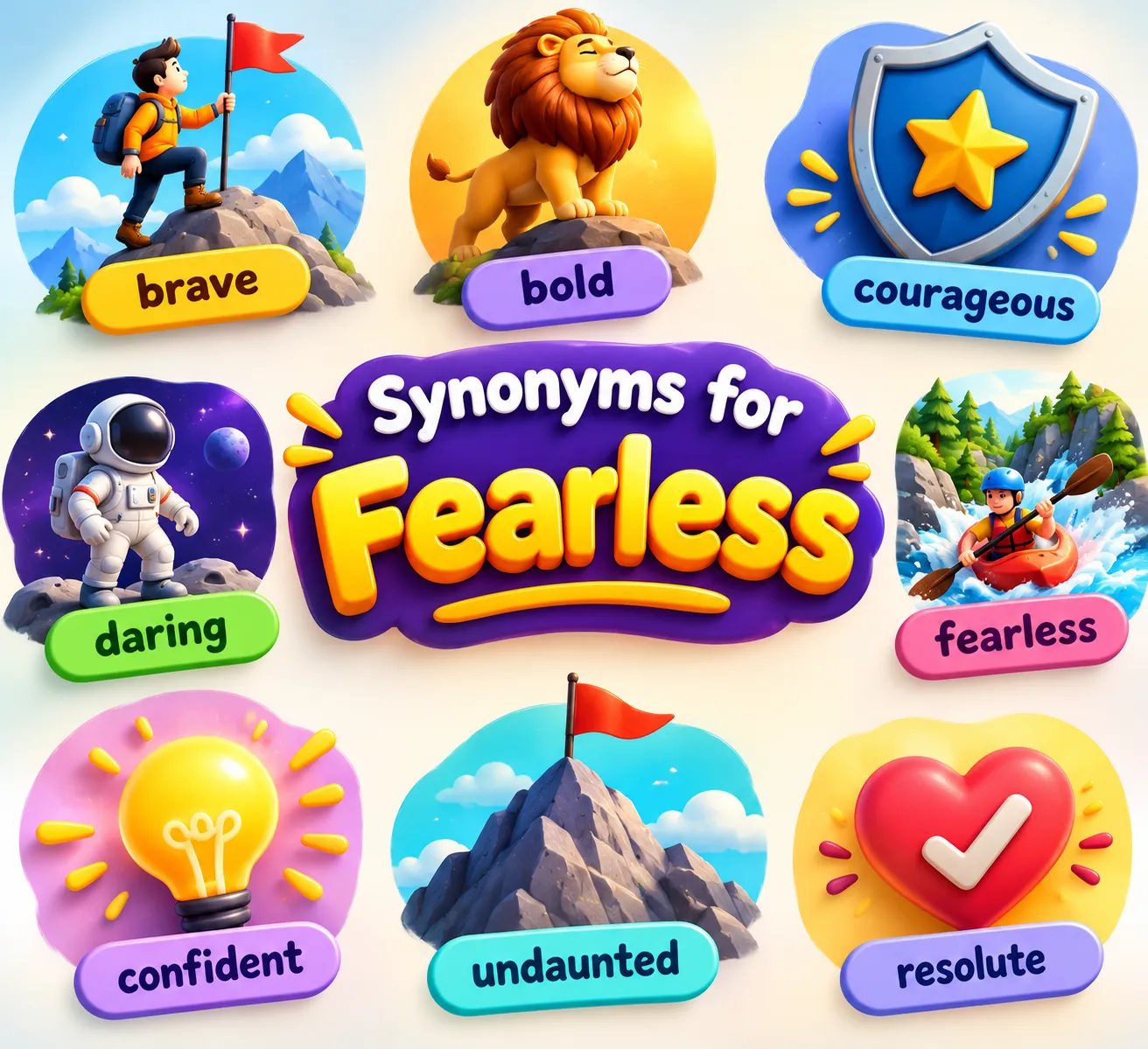
Fearless means having no fear or being willing to face danger, risk, or difficulty. Common synonyms for fearless include brave, courageous, bold, daring, valiant, and intrepid. These words describe people who face challenges with strength and confidence. However, each word has a slightly different meaning. For example, bold suggests confidence, while intrepid describes someone who faces danger without fear. Learning synonyms for fearless helps you improve your vocabulary and express courage more clearly in speaking and writing.
Fearless means being brave and ready to face danger or difficult situations. Imagine a firefighter entering a burning building to rescue someone. Their actions show a fearless attitude because they face danger to help others. This word is often used in stories, news reports, speeches, and daily conversations to describe people who show courage. Learning synonyms for fearless helps English learners build a stronger vocabulary and avoid repeating the same word. It also helps writers express different types of courage, from quiet bravery to bold action. Some words focus on facing danger, while others describe confidence or a willingness to take risks. In this guide, you will learn the meaning, history, pronunciation, and word forms of fearless, along with 30 synonyms, simple definitions, and useful examples.
Meaning of Fearless
Definition
Fearless (Adjective): Not afraid of danger, risk, or difficult situations; showing great courage.
Examples
- The fearless firefighter rescued the child from the building.
- She gave a fearless speech in front of the crowd.
Connotative Meaning
Connotation (the feeling or idea a word suggests beyond its basic meaning) explains the emotional tone of fearless.
- Positive tone: It often suggests bravery, confidence, strength, and courage.
- Negative tone: In some contexts, it may suggest recklessness or a failure to consider danger.
- Neutral tone: It can simply describe someone who is not easily frightened.
Etymology of Fearless
The word fearless is formed from fear and the suffix -less, meaning “without.”
- Old English (450–1100): Fear developed from older Germanic roots, while -less comes from Old English -lēas, meaning “without” or “lacking.”
- Middle English (1100–1500): The forms fere and fereles appeared as English spelling and word forms changed over time.
- Modern English (1500–Present): Fearless became established as an adjective meaning free from fear or showing courage.
Pronunciation of Fearless (IPA)
- IPA: /ˈfɪə.ləs/ (British English); /ˈfɪr.ləs/ (American English)
- Syllables: fear-less (2 syllables)
Affixation Pattern of Fearless
- Root: Fear, meaning an unpleasant feeling caused by danger or threat.
- Prefix: None.
- Suffix: -less, meaning “without” or “lacking.”
Word Formations
| Word | Part of Speech | Meaning |
| Fear | Noun / Verb | An unpleasant feeling caused by danger; to feel afraid |
| Fearful | Adjective | Feeling or showing fear |
| Fearfully | Adverb | In a fearful way |
| Fearfulness | Noun | The state of being afraid |
| Fearless | Adjective | Not afraid; showing courage |
| Fearlessly | Adverb | In a brave way |
| Fearlessness | Noun | The quality of being fearless |
| Fear-inducing | Adjective | Causing fear |
| Fearsome | Adjective | Causing fear or great respect |
30 Synonyms for Fearless With Meanings and Examples
The following words share ideas of courage, confidence, or willingness to face danger. They are not all exact substitutes for fearless, so choose the word that best fits your sentence.
1. Brave (Adjective)
Meaning: Ready to face danger or difficulty without giving in to fear.
Examples:
- The brave soldier protected his team.
- She was brave enough to speak the truth.
2. Courageous (Adjective)
Meaning: Showing the strength to face danger, pain, or difficulty.
Examples:
- The courageous nurse helped the injured man.
- He made a courageous choice during the crisis.
3. Bold (Adjective)
Meaning: Confident and willing to take action despite possible risks.
Examples:
- She made a bold move in the competition.
- His bold ideas changed the way the team worked.
4. Daring (Adjective)
Meaning: Willing to do something risky or difficult.
Examples:
- The daring climber reached the mountain’s peak.
- It was a daring plan, but it worked.
5. Valiant (Adjective)
Meaning: Showing great courage, especially in a dangerous situation.
Examples:
- The valiant rescuers worked through the night.
- She made a valiant effort to save the project.
6. Intrepid (Adjective)
Meaning: Fearless and willing to face dangerous or difficult situations.
Examples:
- The intrepid explorer crossed the desert.
- An intrepid reporter traveled to the remote area.
7. Dauntless (Adjective)
Meaning: Not easily frightened or discouraged by danger.
Examples:
- The dauntless leader stood up for her team.
- He remained dauntless during the difficult journey.
8. Audacious (Adjective)
Meaning: Willing to take bold risks or do something surprising.
Examples:
- The company made an audacious business move.
- Her audacious plan caught everyone’s attention.
9. Undaunted (Adjective)
Meaning: Not discouraged or frightened by problems.
Examples:
- Undaunted by failure, he tried again.
- She remained undaunted by the tough challenge.
10. Unafraid (Adjective)
Meaning: Not feeling fear about a person, event, or situation.
Examples:
- She was unafraid to ask difficult questions.
- He remained unafraid during the storm.
11. Fearless-hearted (Adjective)
Meaning: Showing a brave and courageous spirit.
Examples:
- The story describes a fearless-hearted hero.
- Her fearless-hearted attitude inspired the group.
Note: This is an uncommon, creative expression rather than a standard everyday synonym.
12. Gallant (Adjective)
Meaning: Brave and noble, especially when facing danger or helping others.
Examples:
- The gallant firefighter entered the building.
- The knight was remembered for his gallant deeds.
13. Heroic (Adjective)
Meaning: Showing great courage or performing an act of bravery.
Examples:
- The lifeguard made a heroic rescue.
- Her heroic actions saved several lives.
14. Doughty (Adjective)
Meaning: Brave, determined, and strong when facing opposition.
Examples:
- The doughty captain led the team through trouble.
- The doughty defender refused to give up.
15. Stouthearted (Adjective)
Meaning: Brave and strong in spirit during hardship.
Examples:
- The stouthearted volunteer continued helping others.
- She remained stouthearted in the face of loss.
16. Adventurous (Adjective)
Meaning: Willing to try new, exciting, or risky experiences.
Examples:
- His adventurous nature led him to explore new places.
- She chose an adventurous route through the hills.
17. Enterprising (Adjective)
Meaning: Ready to take action and use new ideas to reach a goal.
Examples:
- The enterprising student started a small business.
- An enterprising worker found a better way to solve the problem.
18. Resolute (Adjective)
Meaning: Firm in purpose and determined not to give up.
Examples:
- She remained resolute during the crisis.
- The resolute leader continued working toward change.
19. Determined (Adjective)
Meaning: Strongly committed to doing something despite difficulties.
Examples:
- He was determined to finish the race.
- The determined student studied every day.
20. Confident (Adjective)
Meaning: Believing in your abilities or feeling sure about an action.
Examples:
- She felt confident before her presentation.
- The confident speaker answered each question clearly.
21. Fear-defying (Adjective)
Meaning: Involving an action that challenges or overcomes fear.
Examples:
- The stunt was a fear-defying display of skill.
- His fear-defying act amazed the audience.
Note: This is a descriptive expression, not a common one-word synonym.
22. Unflinching (Adjective)
Meaning: Not showing fear, hesitation, or weakness when facing something difficult.
Examples:
- She showed unflinching courage during the emergency.
- He gave an unflinching account of the event.
23. Indomitable (Adjective)
Meaning: Impossible or very difficult to defeat or discourage.
Examples:
- Her indomitable spirit helped her recover.
- The team showed indomitable determination.
24. Invincible (Adjective)
Meaning: Seemingly impossible to defeat or overcome.
Examples:
- The champion seemed invincible in the ring.
- Their strong teamwork made them feel invincible.
25. Unshaken (Adjective)
Meaning: Not upset, frightened, or weakened by a difficult event.
Examples:
- She remained unshaken by the criticism.
- His belief in the plan was unshaken.
26. Plucky (Adjective)
Meaning: Brave and determined, especially in a difficult situation.
Examples:
- The plucky child stood up for his friend.
- A plucky young athlete surprised the crowd.
27. Spunky (Adjective)
Meaning: Showing lively courage, energy, and determination.
Examples:
- The spunky girl spoke up for herself.
- His spunky attitude helped him face the challenge.
28. Hardy (Adjective)
Meaning: Strong enough to endure difficult conditions.
Examples:
- The hardy hikers continued through the cold.
- Hardy workers finished the job in harsh weather.
29. Unintimidated (Adjective)
Meaning: Not frightened or discouraged by someone or something powerful.
Examples:
- She remained unintimidated by the angry crowd.
- The young player was unintimidated by the famous opponent.
30. Bold-spirited (Adjective)
Meaning: Having a confident and courageous nature.
Examples:
- The bold-spirited leader encouraged the team.
- His bold-spirited approach helped him face new challenges.
Note: This is an uncommon descriptive expression. In most writing, “bold” or “courageous” sounds more natural.
Prototype Meaning of Fearless
The typical meaning of fearless is being brave when facing danger, risk, or uncertainty. People often imagine a firefighter entering a burning building, a rescuer helping someone in danger, or a person speaking up for what is right. A fearless person may still feel fear but chooses to act despite it. The word usually suggests courage, confidence, and inner strength. However, being fearless does not mean ignoring every risk. True courage often involves understanding the danger and still choosing to do what is necessary.
Prototype Categorization of Fearless Synonyms
The synonyms can be grouped by the kind of courage or strength they describe. These categories help writers choose the most accurate word for each situation.
- Direct lack of fear: Unafraid, intrepid, dauntless, and fearless-hearted. These words suggest that someone is not easily frightened.
- Courage in danger: Brave, courageous, valiant, gallant, heroic, doughty, and stouthearted. Use these for people who face danger or act to protect others.
- Risk-taking and adventure: Bold, daring, audacious, adventurous, and fear-defying. These words fit actions that involve risk or uncertainty.
- Determination under pressure: Undaunted, resolute, determined, unflinching, indomitable, unshaken, and unintimidated. These describe people who continue despite fear, setbacks, or opposition.
- Confidence and strong character: Confident, enterprising, plucky, spunky, hardy, invincible, and bold-spirited. These words focus on confidence, energy, endurance, or strength.
Choosing words by category makes writing more precise. For example, heroic suits a brave act, audacious suits a risky plan, and resolute suits someone who refuses to give up.
Antonyms of Fearless
Antonyms are words with opposite or contrasting meanings. The best antonym depends on whether fearless describes a lack of fear, a brave action, or a strong attitude.
| Antonym | Part of Speech | Meaning |
| Afraid | Adjective | Feeling fear |
| Fearful | Adjective | Feeling or showing fear |
| Frightened | Adjective | Scared by a person, event, or situation |
| Scared | Adjective | Feeling fear or alarm |
| Timid | Adjective | Shy and lacking confidence |
| Cowardly | Adjective | Showing a lack of courage |
| Fainthearted | Adjective | Lacking courage or confidence |
| Spineless | Adjective | Lacking courage to stand up for oneself |
| Apprehensive | Adjective | Worried that something bad may happen |
| Nervous | Adjective | Worried or uneasy |
| Hesitant | Adjective | Slow to act because of doubt or fear |
| Intimidated | Adjective | Made to feel afraid or less confident |
| Daunted | Adjective | Discouraged or frightened by a challenge |
| Cautious | Adjective | Careful to avoid danger or risk |
| Anxious | Adjective | Worried or uneasy about what may happen |
Short Questions and Answers
1. What does fearless mean?
Fearless means not being afraid of danger, risk, or difficult situations. It describes someone who shows courage when facing challenges.
2. When should fearless be used?
Use fearless when describing someone who faces danger, speaks up despite pressure, or takes action in a difficult situation. For example, “The fearless reporter asked tough questions.”
3. Is fearless positive or negative?
Fearless is usually positive because it suggests courage and strength. However, it may sound negative when someone takes needless risks or ignores serious danger.
4. How is fearless different from similar words?
Brave means ready to face fear or danger. Bold focuses on confidence and taking action. Daring suggests a willingness to take risks, while undaunted means not discouraged by difficulty. Fearless is a broad term for being free from fear or showing great courage.
Conclusion
Learning synonyms for fearless can strengthen your English vocabulary and help you describe courage in different ways. Words such as brave, bold, intrepid, and undaunted share a connection with fearlessness, but each has its own meaning. Some describe courage in danger, while others focus on confidence, risk-taking, or determination. Choosing the right synonym makes your writing clearer and more engaging. These words are useful in essays, stories, speeches, and everyday conversations. To improve your vocabulary, read the examples and make your own sentences with each word. Practice a few words every day, and soon you will be able to express courage and confidence with greater accuracy.
Read More:
30 Synonyms for Fixed With Meanings and Examples

I am Rubab content specialist focused on creating accurate, user-friendly, and search-optimized language resources. Through Synonyminstant, I help readers find synonyms, antonyms, meanings, and vocabulary with ease. Every article is carefully researched and optimized to provide reliable information, clear explanations, and an excellent user experience.