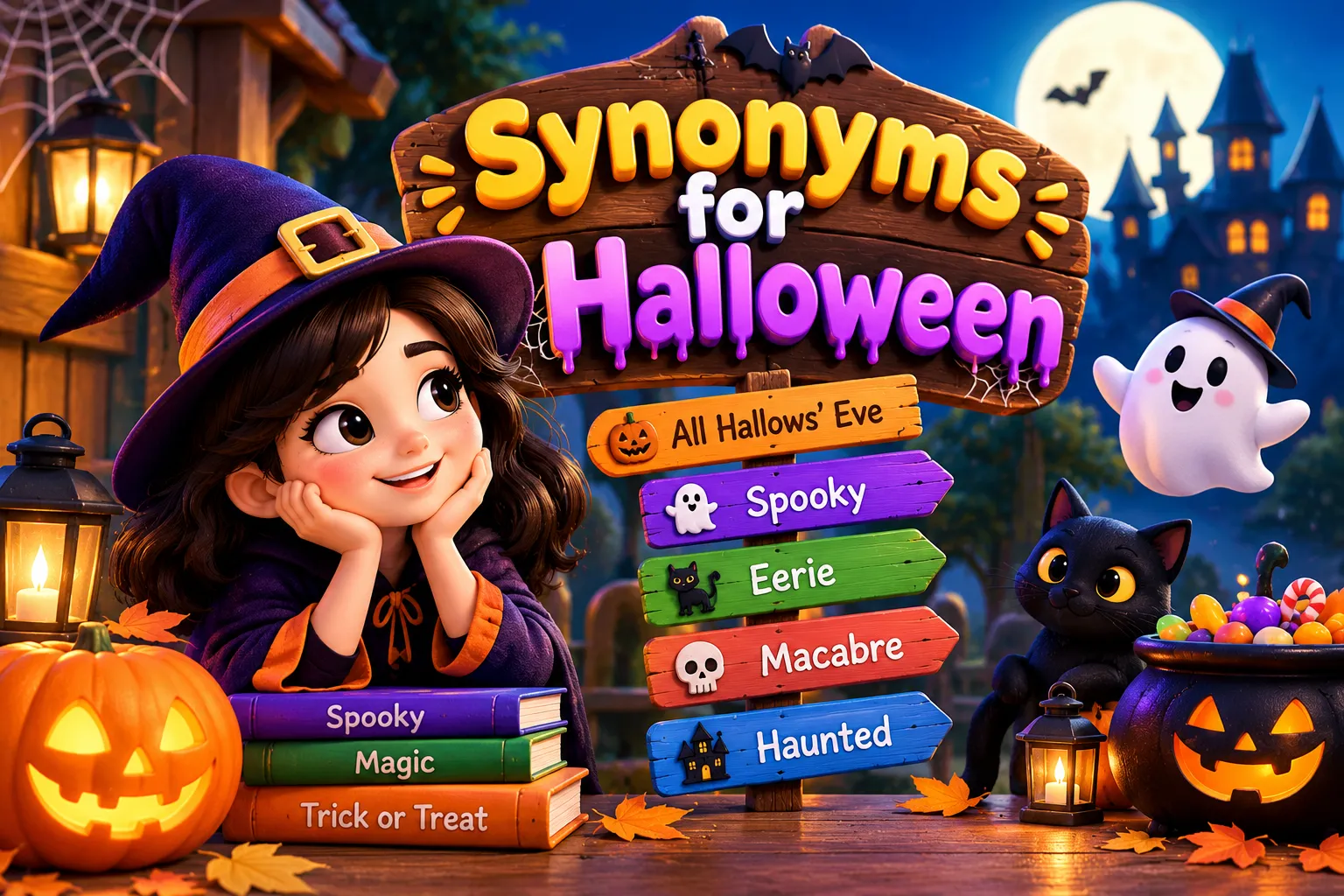
Related synonyms include All Hallows’ Eve, Hallowe’en, spooky night, costume night, and trick-or-treat night.Other words, such as haunted, eerie, creepy, and ghostly, describe Halloween’s mood.These alternatives can make your writing more vivid and interesting.The best choice depends on whether you are describing the holiday, its traditions, or its spooky atmosphere.
Halloween is a holiday celebrated on October 31. People enjoy wearing costumes, carving pumpkins, decorating their homes, and going trick-or-treating. Imagine a child dressed as a ghost, carrying a pumpkin-shaped bucket while visiting neighbors for candy. This fun scene captures the spirit of Halloween. The holiday is popular in many countries and appears in stories, films, games, and social media posts. Learning synonyms and related expressions for Halloween can help English learners build vocabulary and help content writers create engaging articles. However, Halloween has no exact synonym because it is the name of a particular holiday. Words such as spooky, eerie, and ghostly describe its atmosphere, while phrases such as All Hallows’ Eve refer to the holiday itself. This guide explores the word’s meaning, history, pronunciation, related terms, and useful examples.
Meaning of Halloween
Definition
Halloween (Noun): A holiday celebrated on October 31, often with costumes, pumpkin decorations, spooky activities, and trick-or-treating.
Examples
- The children wore scary costumes for Halloween.
- We decorated our house with pumpkins and ghosts for Halloween.
Connotative Meaning
- Positive tone: Halloween can suggest fun, creativity, parties, candy, and exciting costumes.
- Negative tone: It can suggest fear, ghosts, monsters, and frightening experiences.
- Neutral tone: It can simply refer to the holiday celebrated on October 31.
(Connotation: the feelings or ideas that a word suggests beyond its basic meaning.)
Etymology
The word Halloween comes from the expression All Hallows’ Eve, meaning the evening before All Hallows’ Day, also called All Saints’ Day.
| English Period | Development |
| Old English (450–1100) | Hālig meant “holy,” and ǣfen meant “evening” or “eve.” These words help explain the expression’s historical roots. |
| Middle English (1100–1500) | The expression All Hallows’ Even or similar forms referred to the evening before All Hallows’ Day. The name gradually became shorter. |
| Modern English (1500–Present) | Halloween became the common spelling. Today, it refers to the October 31 holiday and its customs, including costumes, pumpkins, and trick-or-treating. |
Pronunciation (IPA)
- IPA: /ˌhæl.əʊˈiːn/ (British English)
- IPA: /ˌhæl.oʊˈiːn/ (American English)
- Syllables: Hal-low-een
Affixation Pattern of Halloween
| Element | Explanation |
| Root | Hallow, meaning a holy person or saint, is part of the historical expression behind Halloween. |
| Prefix | None in the modern word. |
| Suffix | -een is not a productive suffix in modern English here; the word developed from an older expression. |
| Word formation | Halloween developed through the shortening of All Hallows’ Eve. |
Related Word Forms
| Word | Grammatical Category | Meaning |
| Halloween | Noun | The holiday celebrated on October 31. |
| Halloween-themed | Compound adjective | Related to Halloween. |
| Halloween-related | Compound adjective | Connected with Halloween. |
| Halloween-style | Compound adjective | Made or decorated in a Halloween manner. |
| Halloween party | Noun phrase | A party held to celebrate Halloween. |
| Halloween costume | Noun phrase | Clothing worn as a disguise for Halloween. |
| Halloween night | Noun phrase | The night of October 31. |
| Halloween decoration | Noun phrase | An item used to decorate for Halloween. |
29 Synonyms and Related Words for Halloween With Meanings and Examples
Note: Halloween is a proper holiday name, so most words below are related expressions, traditions, or atmosphere words rather than exact synonyms.
1. All Hallows’ Eve (Noun)
Meaning: The traditional name for the evening before All Saints’ Day.
Examples:
- Halloween comes from the expression All Hallows’ Eve.
- The story takes place on All Hallows’ Eve.
2. Hallowe’en (Noun)
Meaning: An alternative spelling of Halloween.
Examples:
- The old book used the spelling Hallowe’en.
- We read a poem about Hallowe’en in class.
3. Spooky Night (Noun Phrase)
Meaning: A night that feels strange, scary, or mysterious.
Examples:
- The children enjoyed a spooky night in the garden.
- The old house looked frightening on the spooky night.
4. Costume Night (Noun Phrase)
Meaning: An evening when people dress in costumes for fun or an event.
Examples:
- Our school held a costume night in October.
- She wore a witch costume for costume night.
5. Trick-or-Treat Night (Noun Phrase)
Meaning: An evening when children visit homes to ask for candy.
Examples:
- The children prepared their bags for trick-or-treat night.
- Our neighborhood was busy on trick-or-treat night.
6. Haunted Night (Noun Phrase)
Meaning: A night associated with ghosts or supernatural events.
Examples:
- The film showed a haunted night in an old village.
- They told ghost stories during the haunted night.
7. Ghost Night (Noun Phrase)
Meaning: An informal expression for a night focused on ghosts or ghost stories.
Examples:
- The club planned a ghost night for its members.
- We watched ghost films during ghost night.
8. Pumpkin Night (Noun Phrase)
Meaning: An informal phrase for an event featuring Halloween pumpkins.
Examples:
- The town arranged a pumpkin night for families.
- We carved pumpkins before pumpkin night began.
9. Fright Night (Noun Phrase)
Meaning: An event or evening focused on fear and scary entertainment.
Examples:
- The cinema hosted a fright night.
- My friends watched horror films during fright night.
10. Spookfest (Noun)
Meaning: An informal term for a spooky event or celebration.
Examples:
- The school organized a spookfest for students.
- Families enjoyed games and costumes at the spookfest.
11. Haunted Celebration (Noun Phrase)
Meaning: A celebration with ghostly themes and scary decorations.
Examples:
- The hotel arranged a haunted celebration.
- Guests wore dark costumes to the haunted celebration.
12. Costume Festival (Noun Phrase)
Meaning: An event where people wear costumes and take part in activities.
Examples:
- The town held a costume festival in October.
- Children showed their creative outfits at the costume festival.
13. Autumn Festival (Noun Phrase)
Meaning: A festival held in autumn, sometimes featuring seasonal decorations and activities.
Examples:
- Our school hosted an autumn festival.
- Pumpkins and leaves decorated the autumn festival.
14. Harvest Festival (Noun Phrase)
Meaning: A celebration of the harvest, often held in autumn.
Examples:
- The village organized a harvest festival.
- Families shared seasonal food at the harvest festival.
15. Ghost Festival (Noun Phrase)
Meaning: A festival or event centered on ghosts or spirits.
Examples:
- The museum arranged a ghost festival for visitors.
- The ghost festival included stories about spirits.
16. Horror Night (Noun Phrase)
Meaning: An evening devoted to scary films, stories, or activities.
Examples:
- We planned a horror night at home.
- The horror night featured three frightening movies.
17. Mystery Night (Noun Phrase)
Meaning: An event focused on puzzles, secrets, or mysterious stories.
Examples:
- The library held a mystery night for teenagers.
- Everyone tried to solve the clues during mystery night.
18. Eerie Evening (Noun Phrase)
Meaning: An evening that feels strange, unsettling, or mysterious.
Examples:
- Fog covered the street on the eerie evening.
- The empty house looked strange on that eerie evening.
19. Creepy Celebration (Noun Phrase)
Meaning: A celebration designed to feel strange or frightening.
Examples:
- The children enjoyed the creepy celebration.
- The hall had spiders and skeletons for the creepy celebration.
20. Ghostly Gathering (Noun Phrase)
Meaning: A gathering with ghost-themed costumes or decorations.
Examples:
- The friends planned a ghostly gathering.
- Everyone wore white costumes to the ghostly gathering.
21. Spooky Party (Noun Phrase)
Meaning: A party with scary costumes, decorations, or games.
Examples:
- We attended a spooky party on October 31.
- The spooky party included pumpkin carving and games.
22. Masked Party (Noun Phrase)
Meaning: A party where guests wear masks or disguises.
Examples:
- The hotel hosted a masked party.
- He wore a black mask to the masked party.
23. Costume Celebration (Noun Phrase)
Meaning: An event that celebrates dressing up in costumes.
Examples:
- The children joined a costume celebration.
- Our community held a costume celebration for families.
24. Supernatural Celebration (Noun Phrase)
Meaning: A themed event based on ghosts, magic, or other supernatural ideas.
Examples:
- The museum arranged a supernatural celebration.
- Visitors enjoyed stories at the supernatural celebration.
25. Witching Night (Noun Phrase)
Meaning: A poetic expression for a night linked with witches or magic.
Examples:
- The story begins on a mysterious witching night.
- The forest looked dark on the witching night.
26. Night of Frights (Noun Phrase)
Meaning: An evening filled with scary activities or experiences.
Examples:
- The amusement park advertised a night of frights.
- The haunted maze made it a night of frights.
27. Night of the Living Dead (Noun Phrase)
Meaning: A phrase associated with zombies and horror; it is also the title of a famous horror film.
Examples:
- The party used a Night of the Living Dead theme.
- He dressed as a zombie for the Night of the Living Dead event.
28. Day of the Dead (Noun Phrase)
Meaning: A Mexican tradition that honors deceased loved ones; it is different from Halloween.
Examples:
- The class learned about the Day of the Dead.
- Families create special displays for the Day of the Dead.
29. Samhain (Noun)
Meaning: An ancient Celtic seasonal festival that influenced some modern Halloween traditions.
Examples:
- The guide explained the history of Samhain.
- Some Halloween customs are linked to older Samhain traditions.
Prototype Meaning
The most common image people have of Halloween is a night filled with costumes, pumpkins, candy, ghosts, and spooky decorations. Children may go trick-or-treating, while adults may attend costume parties or watch horror films. The holiday can feel playful, frightening, or mysterious, depending on how people celebrate it. Because Halloween is the name of a specific holiday, related expressions describe its traditions and atmosphere rather than replace the word in every sentence.
Prototype Categorization
- Traditional names: All Hallows’ Eve, Hallowe’en, All Saints’ Eve — these expressions connect to Halloween’s name and history.
- Costumes and parties: Costume Night, Costume Festival, Masked Party, Costume Celebration, Spooky Party — use these for events where people dress up.
- Ghosts and supernatural themes: Ghost Night, Ghost Festival, Haunted Celebration, Ghostly Gathering, Supernatural Celebration — these fit ghost stories and supernatural activities.
- Fear and horror: Fright Night, Horror Night, Night of Frights, Spooky Night, Creepy Celebration, Eerie Evening — these describe frightening entertainment or moods.
- Autumn and seasonal events: Autumn Festival, Harvest Festival, Pumpkin Night — these relate to the season and its traditions, but are not exact synonyms for Halloween.
- Mystery and magic: Mystery Night, Witching Night, Spookfest, Haunted Night — these emphasize strange, magical, or mysterious themes.
- Related cultural traditions: Samhain, Day of the Dead — these have distinct cultural meanings and should not be treated as identical to Halloween.
- Trick-or-treating: Trick-or-Treat Night — this specifically describes one popular Halloween activity.
These categories help writers choose a term that matches the intended meaning. For example, use Fright Night for a horror event and All Hallows’ Eve for historical or traditional writing. Use Halloween when referring directly to the holiday.
Antonyms of Halloween
Halloween has no direct antonym because it is the name of a holiday. However, words that express the opposite of its spooky mood may work in specific contexts.
| Word or Phrase | Part of Speech | Meaning |
| Ordinary day | Noun phrase | A normal day without special celebrations. |
| Peaceful evening | Noun phrase | An evening that feels calm and relaxing. |
| Bright celebration | Noun phrase | A cheerful event with a light, happy mood. |
| Daytime event | Noun phrase | An event held during the day rather than at night. |
| Non-spooky party | Noun phrase | A party without frightening themes or decorations. |
| Calm gathering | Noun phrase | A relaxed meeting without scary activities. |
Short Questions and Answers
What does Halloween mean?
Halloween is a holiday celebrated on October 31, often with costumes, pumpkins, candy, and spooky activities.
When should Halloween be used?
Use Halloween when referring to the holiday itself, its traditions, or events held to celebrate it.
Is Halloween positive or negative?
Halloween can have a positive, playful mood or a frightening mood. Its tone depends on the celebration, story, or situation.
How is Halloween different from similar words?
Halloween is a specific holiday. All Hallows’ Eve is its historical name, while spooky night describes a mood. Samhain and the Day of the Dead are distinct traditions with their own histories and meanings.
Conclusion
Learning Halloween-related words can improve your vocabulary and make your writing more engaging. Terms such as spooky night, fright night, and costume party help describe different parts of the celebration. Historical expressions such as All Hallows’ Eve add depth to educational writing, while words like eerie and ghostly help create a clear mood. Remember that these expressions are related to Halloween but are not all exact synonyms. Choosing the right term helps you avoid repetition and explain your ideas more clearly. English learners can practice by writing short sentences about costumes, decorations, parties, and traditions. Try learning two or three new words each day. With regular practice, you can strengthen your vocabulary, improve your writing and speaking, and feel more confident using English.
Read More:
Synonyms and Antonyms for Kids: Easy Word Guide

I’m Falak Naaz, an SEO writer at SynonymsInstant.com focused on creating clear, engaging, and search-friendly English content. I specialize in vocabulary, synonyms, antonyms, word usage, and language guides. I combine careful research with practical writing to deliver trustworthy content that helps readers choose the right words and improve their English with confidence.