
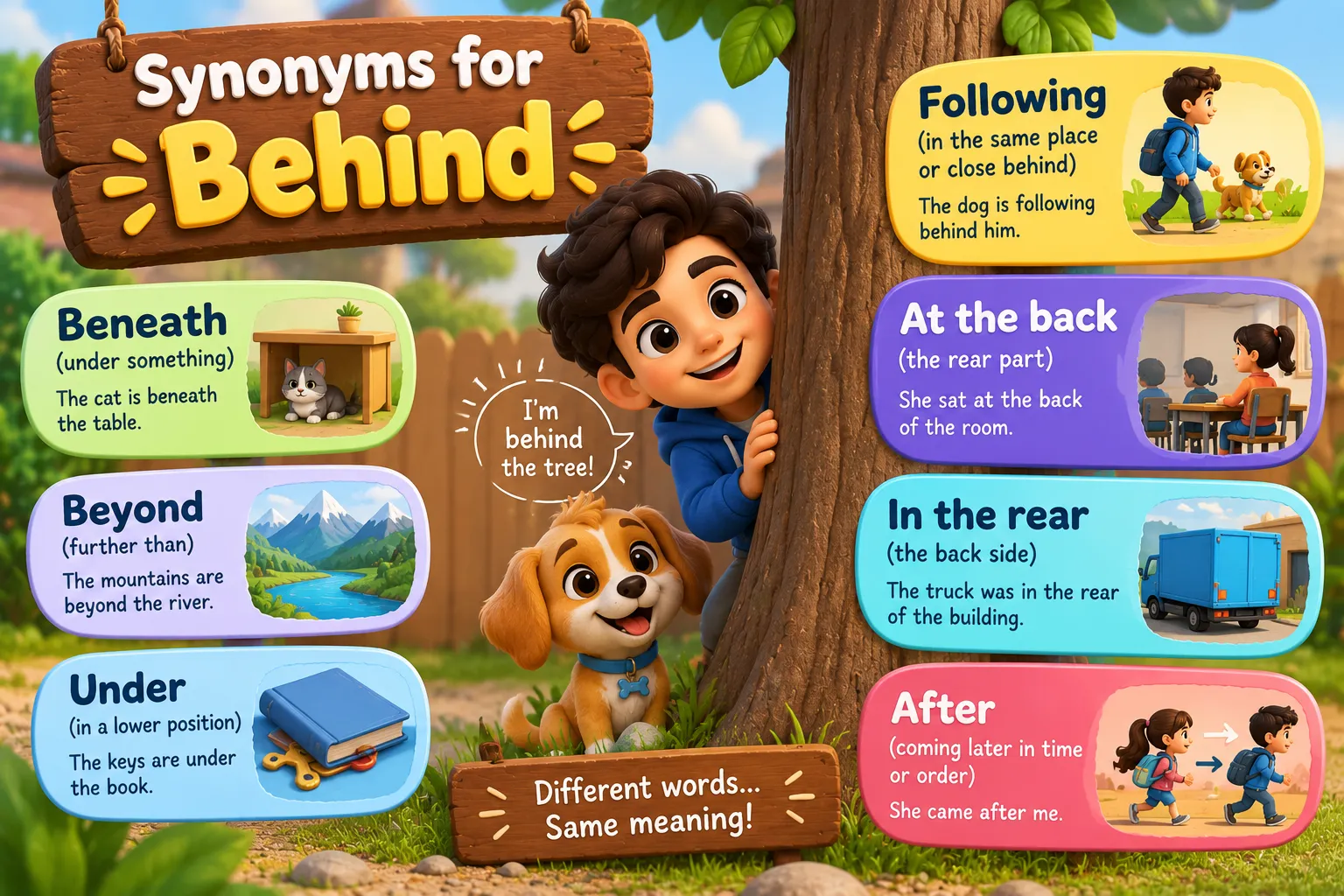
Common synonyms for behind include at the back of, at the rear of, following, trailing, lagging, delayed, overdue, and falling behind. The best alternative depends on the meaning. For example, use at the rear of to describe a location. In contrast, use lagging to describe slow progress. Learning these alternatives can improve your vocabulary and make your English clearer.
The word behind has several meanings. It can describe a place, a delay, or a lack of progress. For example, a cat may hide behind a sofa. Similarly, a student may fall behind when they do not finish their schoolwork on time.
You can also use behind to show support. For instance, when you say, “I stand behind you,” you mean that you support someone. Therefore, the meaning depends on the sentence.
Learning synonyms for behind helps you express ideas more clearly. It also helps you avoid repeating the same word. In this guide, you will learn the meaning, history, pronunciation, and word forms of behind. In addition, you will discover 30 alternatives with simple meanings and examples.
Meaning of Behind
Definition
Behind (Preposition, Adverb, or Adjective): At the back of something, later than expected, or less advanced than someone or something else.
Examples
- The cat is hiding behind the sofa.
- I am behind on my schoolwork this week.
- Our team is behind the other team in the competition.
- I stand behind my friend because I support their decision.
Connotative Meaning
Connotation means the feelings or ideas that a word suggests beyond its basic meaning.
The word behind can have positive, negative, or neutral meanings. The context helps readers understand the intended meaning.
- Positive tone: The phrase “I stand behind you” shows support and loyalty.
- Negative tone: The phrase “falling behind” can suggest slow progress or a delay.
- Neutral tone: The sentence “The car is behind the house” simply describes a location.
Therefore, consider the context before choosing a synonym.
Etymology of Behind
The word behind comes from the Old English word behindan. It meant “at the back” or “in the rear.” Over time, English speakers began using it in other ways. Today, it can describe location, time, progress, and support.
| English Period | Development |
|---|---|
| Old English (450–1100) | Behindan described something at the back or rear of another thing. |
| Middle English (1100–1500) | The word appeared in forms such as behind and continued to describe position at the back. |
| Modern English (1500–Present) | The word gained broader uses related to time, progress, responsibility, and support. Examples include “behind schedule” and “stand behind a decision.” |
Pronunciation of Behind (IPA)
- IPA: /bɪˈhaɪnd/
- Syllables: be-hind
- Number of syllables: Two
- Stress: The second syllable receives the stress: be-HIND.
Pronunciation tip: Say be first, then say hind. Join the two parts smoothly to pronounce the word correctly.
Affixation Pattern of Behind
The word behind developed from Old English behindan. In modern English, people usually treat it as a complete word rather than breaking it into a productive prefix and a root.
| Element | Explanation |
|---|---|
| Root or base | Behind is an established English word that developed from Old English behindan. |
| Prefix | The historical form includes be-, but modern speakers do not usually treat it as a separate productive prefix in everyday use. |
| Suffix | The modern word has no separate suffix. |
| Word formation | English speakers use behind as a preposition, adverb, and adjective in different contexts. |
Related Word Forms
| Word or Phrase | Grammatical Category | Meaning |
|---|---|---|
| Behind | Preposition/Adverb/Adjective | At the back, late, or less advanced. |
| Behindhand | Adjective/Adverb | Late or delayed; this form is now uncommon. |
| Behind the scenes | Adjective/Adverbial phrase | Happening out of public view. |
| Behind schedule | Phrase | Later than the planned time. |
| Fall behind | Verb phrase | To make slower progress than expected. |
| Leave behind | Verb phrase | To leave someone or something in a place or state. |
| Get behind | Verb phrase | To support someone or become late with work or payments. |
30 Synonyms for Behind With Meanings and Examples
The word behind has several meanings, so its alternatives depend on the context. Some describe location, while others refer to time, progress, or support. Therefore, check each meaning before choosing a replacement.
1. At the Back of (Prepositional Phrase)
Meaning: Located at the rear of something.
Examples:
- The garden is at the back of the house.
- She parked her car at the back of the building.
2. In Back of (Prepositional Phrase)
Meaning: Located behind something. This expression is common in American English.
Examples:
- The garage is in back of the house.
- A small tree grows in back of the school.
3. At the Rear of (Prepositional Phrase)
Meaning: Located at the back part of something.
Examples:
- The exit is at the rear of the hall.
- The bus stopped at the rear of the building.
4. To the Rear of (Prepositional Phrase)
Meaning: Positioned toward the back of something.
Examples:
- The parking area is to the rear of the store.
- A small shed stands to the rear of the house.
5. Following (Preposition/Adjective)
Meaning: Coming after someone or something.
Examples:
- The dog followed its owner along the path.
- The following car stayed behind the truck.
Usage tip: Following often means coming after someone or something. However, it does not replace behind in every sentence.
6. Trailing (Verb/Adjective)
Meaning: Moving or staying behind someone or something.
Examples:
- The runner was trailing the leader.
- A long ribbon was trailing behind her dress.
7. Lagging (Verb/Adjective)
Meaning: Making slower progress than others or than expected.
Examples:
- Our team is lagging behind in the competition.
- He is lagging in his reading skills.
8. Delayed (Adjective)
Meaning: Happening later than planned or expected.
Examples:
- The delayed train arrived an hour late.
- Bad weather delayed our project.
9. Late (Adjective/Adverb)
Meaning: Arriving or happening after the expected time.
Examples:
- I am late with my assignment.
- The train arrived late last night.
10. Overdue (Adjective)
Meaning: Not completed, returned, or paid by the expected date.
Examples:
- My library book is overdue.
- The report is two days overdue.
11. Tardy (Adjective)
Meaning: Late in arriving or doing something.
Examples:
- The student was tardy for class.
- His tardy reply caused a delay.
Usage tip: Tardy is often used in schools and formal situations. In everyday conversation, people usually say late.
12. Lagging Behind (Verb Phrase)
Meaning: Making less progress than others or than planned.
Examples:
- The team is lagging behind in the race.
- She is lagging behind in her studies.
13. Falling Behind (Verb Phrase)
Meaning: Making slower progress or failing to keep up.
Examples:
- I am falling behind on my homework.
- The company is falling behind its competitors.
14. Left Behind (Adjective/Phrase)
Meaning: Not taken along or unable to keep up with others.
Examples:
- One bag was left behind at the station.
- The slower runners were left behind.
15. Remaining (Verb/Adjective)
Meaning: Staying in a place or continuing to exist after others have left.
Examples:
- A few guests remained behind after the event.
- The remaining students cleaned the classroom.
16. Subsequent (Adjective)
Meaning: Coming after something in time or order.
Examples:
- The subsequent chapter explains the result.
- Subsequent events changed their plans.
Usage tip: Subsequent is a formal word. It means “coming later,” but it does not usually describe physical location.
17. Later (Adjective/Adverb)
Meaning: Happening after the present time or after another event.
Examples:
- We discussed the issue later.
- The later train was less crowded.
18. Inferior (Adjective)
Meaning: Lower in quality, value, or standard than something else.
Examples:
- This product is inferior to the newer model.
- The team felt that its equipment was inferior.
Usage tip: Inferior does not usually mean physically behind. Use it when comparing quality, value, or status.
19. Less Advanced (Adjective Phrase)
Meaning: Not as developed or progressed as something else.
Examples:
- The project is less advanced than we expected.
- His skills are less advanced than those of his classmates.
20. Lagging in Progress (Verb Phrase)
Meaning: Developing or moving forward more slowly than expected.
Examples:
- The construction work is lagging in progress.
- The student is making slow progress in mathematics.
21. Supporting (Verb/Adjective)
Meaning: Giving help or showing approval for someone or something.
Examples:
- Her family is supporting her decision.
- The group is supporting the new plan.
22. Backing (Noun/Verb)
Meaning: Giving help, support, or approval.
Examples:
- The project has the backing of local leaders.
- I am backing your plan.
23. Endorsing (Verb)
Meaning: Publicly showing support for a person, idea, or plan.
Examples:
- The teacher is endorsing the new program.
- Several experts are endorsing the proposal.
24. Standing By (Verb Phrase)
Meaning: Remaining ready to help or continuing to support someone.
Examples:
- Her friends are standing by her during the crisis.
- The team stood by its captain.
25. Upholding (Verb)
Meaning: Supporting or maintaining a rule, belief, or decision.
Examples:
- The court is upholding the law.
- She is upholding her family’s values.
26. Underlying (Adjective)
Meaning: Existing beneath the surface or acting as a hidden cause.
Examples:
- We need to find the underlying problem.
- The report explains the underlying reasons for the delay.
27. Concealed (Adjective/Verb)
Meaning: Hidden from view or kept secret.
Examples:
- The keys were concealed behind the painting.
- He concealed the gift behind his back.
28. Hidden (Adjective/Verb)
Meaning: Kept out of sight or not easy to find.
Examples:
- The cat was hidden behind the curtain.
- There is a hidden message behind the story.
29. In the Wake of (Prepositional Phrase)
Meaning: Following an event, often as a result of it.
Examples:
- New rules were introduced in the wake of the accident.
- The town began rebuilding in the wake of the storm.
30. In Arrears (Prepositional Phrase)
Meaning: Behind with payments that should already have been made.
Examples:
- The tenant was three months in arrears.
- The account fell into arrears after several missed payments.
Prototype Meaning of Behind
The most common meaning of behind is being at the back of something. For example, a bag may be behind a chair, or a person may stand behind a door.
However, the word also has figurative meanings. A student may fall behind in schoolwork, a project may be behind schedule, or a person may stand behind an idea. These examples show that behind can refer to space, time, progress, or support.
Therefore, always consider the sentence before choosing a synonym. The phrase at the rear of works for location, while overdue fits late work or payments. Similarly, backing expresses support.
Prototype Categorization of Behind Synonyms
You can group synonyms for behind by their meaning. This approach makes it easier to choose the right alternative.
- Physical location: At the back of, in back of, at the rear of, to the rear of, hidden, and concealed describe where something is.
- Time and delay: Delayed, late, overdue, tardy, later, and subsequent describe things that happen after a planned or expected time.
- Slow progress: Trailing, lagging, lagging behind, falling behind, less advanced, and lagging in progress describe someone or something that is not keeping up.
- Support and approval: Supporting, backing, endorsing, standing by, and upholding express help or agreement.
- Remaining or following: Following, remaining, left behind, and in the wake of refer to what comes after, stays, or remains.
- Hidden causes or payment status: Underlying, in arrears, and inferior fit specific contexts involving hidden causes, unpaid amounts, or lower quality.
For example, use at the rear of when describing a place. In contrast, use overdue for late work and backing when discussing support. Choosing the right word makes your writing clearer and more accurate.
Antonyms of Behind
The opposite of behind depends on the meaning. For location, the opposite may be in front of. For progress, it may be ahead. When discussing time, early or on time may work best.
| Antonym | Part of Speech | Meaning |
|---|---|---|
| In front of | Prepositional phrase | Located before or ahead of something. |
| Ahead of | Prepositional phrase/Adverb | In front or at a more advanced stage. |
| Leading | Adjective/Verb | Being first or ahead of others. |
| Ahead | Adverb/Adjective | In a forward position or at a more advanced stage. |
| Early | Adjective/Adverb | Before the expected time. |
| On time | Adverbial phrase | At the planned or expected time. |
| Up to date | Adjective phrase | Having completed the required work or having the latest information. |
| Advanced | Adjective | At a higher level of development or progress. |
| In the lead | Prepositional phrase | Ahead of others in a race or competition. |
Frequently Asked Questions
What does behind mean?
Behind means at the back of something, later than expected, or less advanced than someone or something else.
When should I use behind?
Use behind to describe a location, a delay, slow progress, or support for a person or idea. For example, you can say, “The cat is behind the sofa” or “I am behind on my work.”
Is behind positive or negative?
Its tone depends on the context. It is neutral when describing a location. However, it can suggest a problem when describing a delay. In contrast, the phrase “I stand behind you” expresses support.
How is behind different from similar words?
Behind has several meanings. At the rear of describes a location, while overdue describes something late. Similarly, lagging refers to slow progress, and backing means support.
Conclusion
Learning synonyms for behind can improve your vocabulary and help you express ideas clearly. Words such as at the rear of, overdue, lagging, and backing fit different situations. Therefore, choosing the right alternative makes your writing more precise and helps you avoid repetition.
However, remember that not all synonyms work in every sentence. For example, use at the rear of to describe a place, but choose falling behind when someone is making slow progress. Likewise, use backing when you mean support.
To improve your English, practise using two or three new alternatives each day. Write your own sentences and check that each word matches the meaning you want to express. With regular practice, you can build a stronger vocabulary and communicate with greater confidence.
Read More:
Synonyms for upscale: 29 Best Alternatives to Know

I’m Pinki, an SEO writer at SynonymsInstant.com, specializing in synonyms, antonyms, vocabulary, word meanings, grammar, and English usage. I create accurate, well-researched, reader-friendly content that combines language expertise with SEO best practices. My goal is to make English vocabulary simple, useful, and accessible for students, writers, professionals, and English learners.