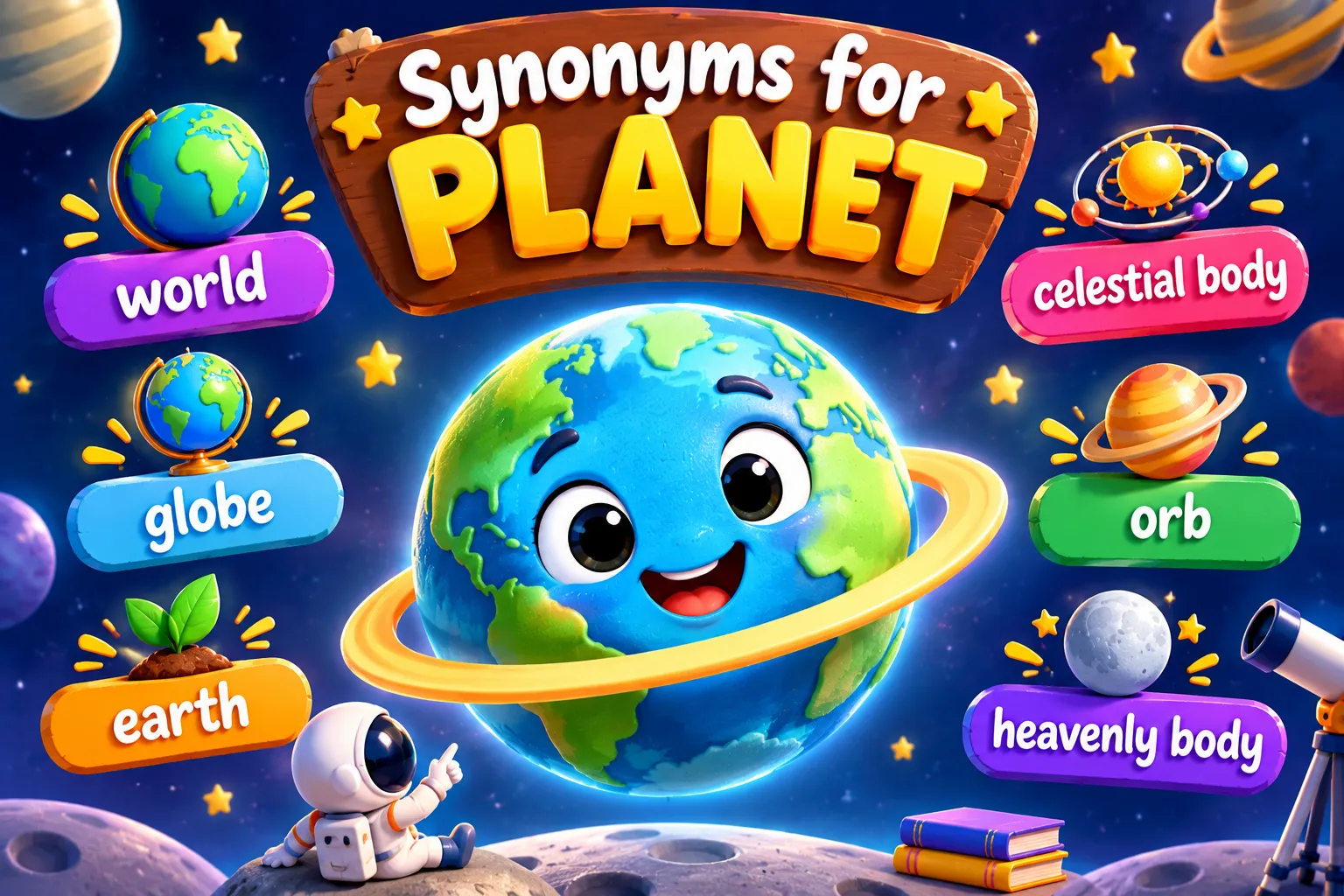
Common related words include world, celestial body, orb, sphere, globe, and heavenly body. However, not all of these are exact synonyms. The best choice depends on whether you mean a scientific planet, a world, or a round object in space.
A planet is a large object in space that travels around a star. Every day, we live on Earth, one of the planets in our solar system. When people talk about Mars, Venus, Jupiter, or Earth, the word planet is commonly used to describe these worlds. Learning synonyms for planet can help English learners and writers avoid repetition and describe space in more interesting ways. It also helps readers understand the difference between scientific terms and more general words such as world or globe. In this article, you will learn the meaning, examples, pronunciation, history, word formation, and 30 synonyms or closely related alternatives for planet. You will also see how these words fit into different semantic groups.
Meaning of Planet
Definition
Planet (Noun): A large natural object in space that moves around a star and does not produce its own light.
Examples
- Earth is the third planet from the Sun.
- Scientists are searching for planets outside our solar system.
Connotative Meaning
Positive tone: A planet may suggest beauty, discovery, wonder, and exploration.
Negative tone: The word can suggest environmental problems when discussing a damaged planet.
Neutral tone: In science, planet is usually a neutral and factual term.
(Connotation means the feeling or idea that a word suggests beyond its basic meaning.)
Etymology
The word planet comes from the Greek word planētēs, meaning “wanderer.” Ancient observers noticed that some bright objects appeared to move across the sky compared with the fixed stars.
| Period | Development |
| Old English (450–1100) | The modern English word planet was not yet commonly used in its present form. Astronomical ideas were expressed through other terms. |
| Middle English (1100–1500) | Planet entered English through Old French and Latin, ultimately from Greek planētēs, meaning “wanderer.” |
| Modern English (1500–Present) | Planet became a standard scientific term for major bodies orbiting the Sun or other stars. |
Pronunciation (IPA)
- IPA: /ˈplænɪt/
- Syllables: plan-et
Affixation Pattern of Planet
- Root: planet
- Prefix: None
- Suffix: None in the basic word
- Word formations:
- planet — noun
- planets — plural noun
- planetary — adjective
- planetarily — adverb
- planetology — noun
- planetologist — noun
- planetary system — noun phrase
- exoplanet — noun
- protoplanet — noun
- planet-like — adjective
30 Synonyms of Planet With Meaning & Examples
1. World (Noun)
Meaning: A planet or large place where living things may exist.
Examples:
- Earth is our home world.
- Scientists hope to discover another world like Earth.
2. Celestial Body (Noun)
Meaning: A natural object found in space.
Examples:
- Earth is a celestial body.
- The telescope detected a distant celestial body.
3. Heavenly Body (Noun)
Meaning: A natural object seen in the sky or outer space.
Examples:
- The Moon is a well-known heavenly body.
- Ancient people studied heavenly bodies carefully.
4. Orb (Noun)
Meaning: A round object, especially one floating or moving in space.
Examples:
- The planet appeared as a blue orb.
- A bright orb moved across the telescope’s view.
5. Sphere (Noun)
Meaning: A round, three-dimensional object.
Examples:
- Earth is nearly a perfect sphere.
- The artist drew the planet as a blue sphere.
6. Globe (Noun)
Meaning: A round model or representation of a planet.
Examples:
- The teacher showed Earth on a globe.
- A small globe stood on the student’s desk.
7. World Sphere (Noun)
Meaning: A spherical world or planetary body.
Examples:
- The spacecraft approached a distant world sphere.
- The story describes a mysterious world sphere.
8. Astronomical Body (Noun)
Meaning: A natural object located in space.
Examples:
- The astronomer studied the astronomical body.
- The object is a large astronomical body.
9. Space Object (Noun)
Meaning: An object located in outer space.
Examples:
- The telescope found a strange space object.
- Scientists tracked the space object for several days.
10. Cosmic Body (Noun)
Meaning: A natural object that exists in the universe.
Examples:
- The planet is a fascinating cosmic body.
- Researchers studied the distant cosmic body.
11. Terrestrial Body (Noun)
Meaning: A solid, Earth-like body in space.
Examples:
- Mars is a terrestrial body.
- Scientists compare terrestrial bodies with Earth.
12. Rocky World (Noun)
Meaning: A planet mainly made of solid rock.
Examples:
- Mars is a rocky world.
- The telescope discovered a small rocky world.
13. Exoplanet (Noun)
Meaning: A planet that orbits a star outside our solar system.
Examples:
- Scientists discovered a new exoplanet.
- The exoplanet may have conditions suitable for life.
14. Planetary Body (Noun)
Meaning: A natural body that belongs to a planetary system.
Examples:
- The spacecraft passed near a planetary body.
- Scientists measured the planetary body’s size.
15. Astral Body (Noun)
Meaning: A celestial object associated with outer space.
Examples:
- The astronomer observed an unusual astral body.
- The book discusses several astral bodies.
16. Star-Orbiting Body (Noun)
Meaning: A natural body that travels around a star.
Examples:
- Earth is a star-orbiting body.
- The telescope detected another star-orbiting body.
17. Orbiting Body (Noun)
Meaning: An object that moves around another object in space.
Examples:
- Earth is an orbiting body around the Sun.
- The spacecraft studied the orbiting body.
18. Solar-System Body (Noun)
Meaning: A natural object that belongs to a solar system.
Examples:
- Earth is an important solar-system body.
- Scientists studied the distant solar-system body.
19. Minor World (Noun)
Meaning: A small world or planetary object, often used in astronomy-related contexts.
Examples:
- The story describes a mysterious minor world.
- The telescope revealed a small minor world.
20. Alien World (Noun)
Meaning: A world located beyond Earth, especially one that may be unfamiliar.
Examples:
- Scientists searched for signs of life on an alien world.
- The movie shows a strange alien world.
21. Distant World (Noun)
Meaning: A planet or world located far away.
Examples:
- The telescope captured images of a distant world.
- Researchers studied the atmosphere of a distant world.
22. New World (Noun)
Meaning: A newly discovered or unfamiliar world.
Examples:
- Scientists announced the discovery of a new world.
- The explorers dreamed of finding a new world.
23. Rocky Planet (Noun)
Meaning: A planet with a solid rocky surface.
Examples:
- Earth is a rocky planet.
- Mercury is a small rocky planet.
24. Gas Giant (Noun)
Meaning: A very large planet mainly made of gases.
Examples:
- Jupiter is a gas giant.
- The gas giant has many moons.
25. Ice Giant (Noun)
Meaning: A large planet rich in icy materials and gases.
Examples:
- Neptune is an ice giant.
- The ice giant has a deep atmosphere.
26. Terrestrial Planet (Noun)
Meaning: A rocky planet similar in structure to Earth.
Examples:
- Venus is a terrestrial planet.
- Scientists study terrestrial planets for signs of habitability.
27. Protoplanet (Noun)
Meaning: A developing planetary body that forms during the early stages of a planetary system.
Examples:
- A protoplanet may eventually become a full planet.
- Scientists study how protoplanets develop.
28. Exoworld (Noun)
Meaning: A world outside our solar system.
Examples:
- The telescope detected a possible exoworld.
- Researchers are studying the atmosphere of the exoworld.
29. World Body (Noun)
Meaning: A large natural body that can be viewed as a world.
Examples:
- The fictional story features a distant world body.
- Scientists mapped the surface of the world body.
30. Planetary World (Noun)
Meaning: A world that exists as part of a planetary system.
Examples:
- The novel describes a strange planetary world.
- Scientists hope to study another planetary world someday.
Prototype Meaning
The most typical meaning of planet is a large natural body that travels around a star. When people hear the word, they usually imagine Earth, Mars, Jupiter, or another major body in the solar system. A planet is generally associated with space, astronomy, orbit, and exploration.
Prototype Categorization
- General world terms: world, distant world, new world, alien world, planetary world. These work well when writing about a planet as a place or environment.
- Scientific terms: celestial body, astronomical body, planetary body, terrestrial body, orbiting body. These are better for academic and scientific writing.
- Shape-related terms: orb, sphere, globe. These focus more on the round shape or representation of a planet.
- Planet-type terms: rocky planet, gas giant, ice giant, terrestrial planet. These describe specific types of planets.
- Beyond-the-solar-system terms: exoplanet, exoworld. These are useful when discussing planets outside our solar system.
- Formation-related terms: protoplanet. This is useful when discussing the early development of planets.
This grouping helps writers choose a word that matches the exact meaning they want instead of using every synonym in the same way.
Antonyms of Planet
There is no perfect direct antonym for planet, because planet is a scientific category rather than a quality with a simple opposite. However, these terms can express contrast.
| Antonym / Contrast | Part of Speech | Meaning |
| Star | Noun | A massive body that produces its own light and energy. |
| Moon | Noun | A natural satellite that orbits a planet or other body. |
| Asteroid | Noun | A smaller rocky body that orbits the Sun or another star. |
| Comet | Noun | An icy body that can develop a glowing tail near a star. |
| Space Dust | Noun | Tiny particles found throughout space. |
| Meteor | Noun | A streak of light caused when a space object enters an atmosphere. |
| Black Hole | Noun | A region of space with extremely strong gravity. |
| Empty Space | Noun | A region without a major celestial body. |
Short Questions and Answers
What does planet mean?
A planet is a large natural body that orbits a star and does not produce its own light.
When should planet be used?
Use planet when talking about a major celestial body that moves around a star, such as Earth or Mars.
Is planet positive or negative?
Planet is normally neutral. Its emotional meaning depends on the context.
How is it different from similar words?
Planet is a specific scientific term. Words such as world, orb, and globe can describe or represent a planet but do not always have the same scientific meaning.
Conclusion
Learning the word planet and its related synonyms can make your English vocabulary stronger and more flexible. The word usually refers to a large celestial body that orbits a star, but different alternatives can highlight different ideas. World focuses on a place, orb highlights a round shape, and exoplanet identifies a planet outside our solar system. Scientific terms such as terrestrial planet, gas giant, and ice giant provide more precise meanings. Understanding these differences helps you avoid repetition and choose better words in writing and speaking. Regular vocabulary practice also improves confidence and communication skills. Try learning a few new synonyms each day and use them in your own sentences to remember them more easily.
Read More:
Synonyms for ember: 29 Strong Words to Use

I’m Ayesha Haram, an English content and SEO writer at SynonymsInstant.com. I focus on creating helpful vocabulary resources, word guides, and practical English content that readers can understand quickly. I combine language research, clear explanations, and SEO-focused writing to produce reliable content that supports learners, writers, and everyday English users.