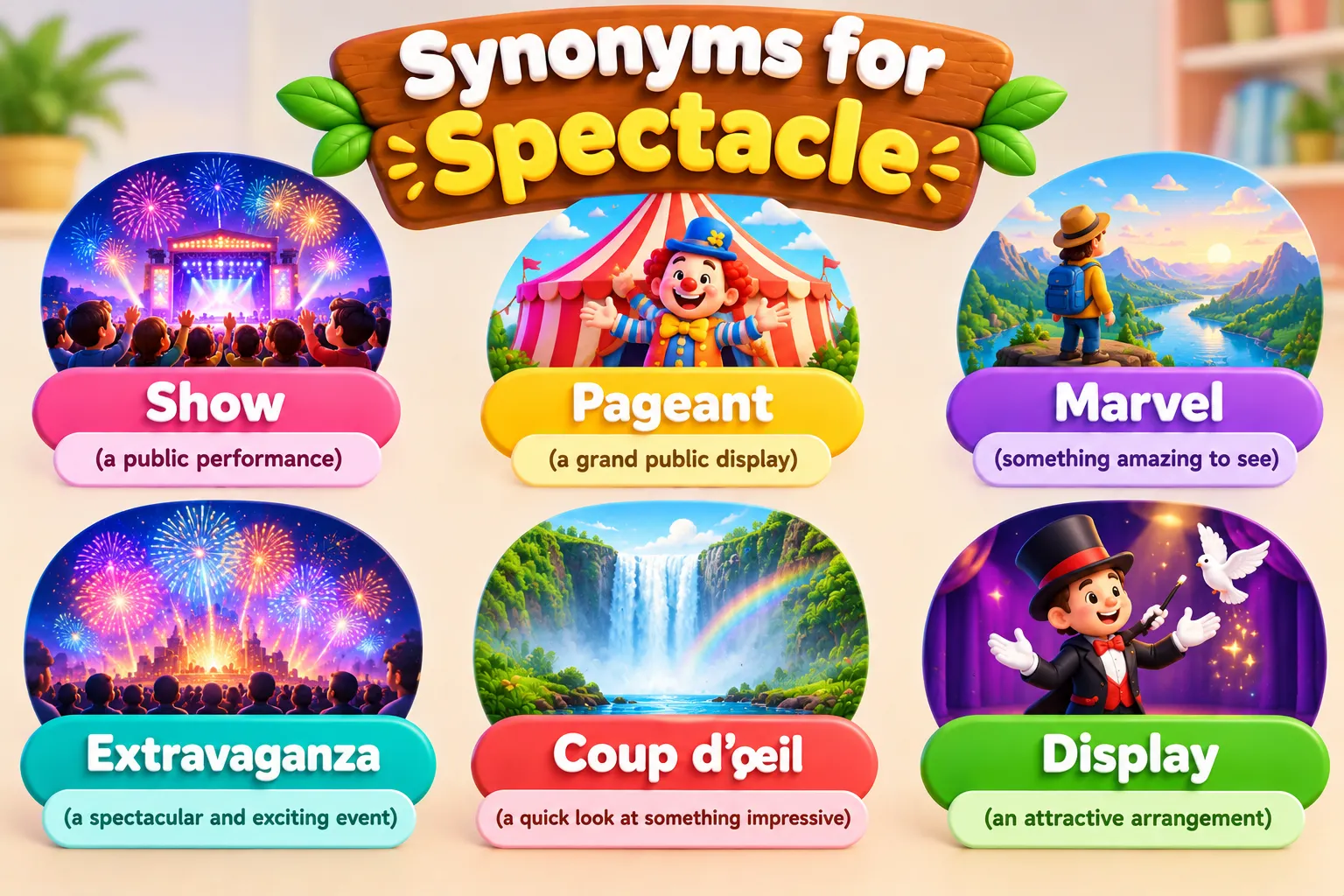
A spectacle is an impressive, unusual, or striking sight that attracts attention. Common synonyms include sight, display, show, scene, exhibition, performance, pageant, and showpiece. The best alternative depends on the context. A display presents something for people to see, while a performance involves an action shown to an audience. A scene describes what can be seen in a place or situation. Learning synonyms for spectacle helps you describe events, views, and public displays more clearly and make your English writing more engaging.
A spectacle is a sight or event that attracts attention because it is impressive, unusual, or dramatic. Imagine watching fireworks light up the night sky. The bright colors and loud sounds create a spectacle that people remember. The word can describe beautiful natural views, public events, grand performances, or even shocking scenes. It is common in stories, news reports, reviews, and everyday conversations. Learning synonyms for spectacle helps English learners describe what they see with greater detail and avoid repeating the same word. It also helps content writers choose words that match the mood and meaning of a scene. In this guide, you will learn the meaning, pronunciation, history, and word forms of spectacle. You will also explore 30 synonyms and related alternatives with examples, semantic groups, antonyms, and practical usage tips.
Meaning of Spectacle
Definition
Spectacle (Noun): An impressive, unusual, or striking sight or event that attracts people’s attention. It can also mean a public display that people watch, sometimes because it is embarrassing or shocking.
Examples
- The fireworks created a beautiful spectacle above the city.
- The sudden argument became an unpleasant spectacle in front of the guests.
Connotative Meaning
Connotation (the feeling or idea a word suggests beyond its basic meaning) depends on the situation.
- Positive tone: Spectacle can suggest beauty, wonder, excitement, or grandeur.
- Negative tone: It can describe a shocking, embarrassing, or unpleasant scene, as in “He made a spectacle of himself.”
- Neutral tone: It can simply refer to a public event or sight that people watch.
Etymology of Spectacle
The word spectacle comes from Latin spectaculum, meaning “a sight” or “something to watch.” It is linked to spectare, meaning “to look at” or “to watch.”
- Old English (450–1100): Spectacle was not a common inherited Old English word. English speakers used other words for sights and things worth watching.
- Middle English (1100–1500): The word entered English through Old French spectacle, which came from Latin spectaculum. It referred to a sight or public show.
- Modern English (1500–Present): Spectacle developed into a word for impressive sights, public displays, and dramatic events. It can also describe an embarrassing or shocking scene.
Pronunciation (IPA)
- IPA: /ˈspek.tə.kəl/
- Syllables: spec-ta-cle (3 syllables)
Affixation Pattern of Spectacle
- Root: Spect- — from Latin spectare, meaning “to watch” or “to look at.”
- Prefix: No prefix in spectacle.
- Suffix: -acle forms part of the word inherited from Latin; it is not a productive suffix commonly added to English roots today.
- Word formations: The following words share a root or belong to the same word family.
| Word | Part of Speech | Meaning |
| Spectacle | Noun | An impressive or striking sight |
| Spectacles | Noun, plural | A pair of glasses; also more than one spectacle |
| Spectacular | Adjective | Very impressive or striking |
| Spectacularly | Adverb | In a very impressive way |
| Spectacularity | Noun, uncommon | The quality of being spectacular |
| Spectator | Noun | A person who watches an event |
| Spectate | Verb | To watch an event |
| Spectating | Noun or verb form | The act of watching an event |
| Spectatorship | Noun | The role or experience of watching an event |
| Spectacle-like | Adjective | Resembling a spectacle |
30 Synonyms of Spectacle With Meaning and Examples
The best synonym for spectacle depends on what you want to describe. Some words refer to a sight, others to a show or performance, and some suggest drama or public attention. The alternatives below include close synonyms and related words used in specific contexts.
1. Sight (Noun)
Meaning: Something seen, especially something noticeable or impressive.
Examples:
- The snow-covered mountains were a wonderful sight.
- The rainbow was a beautiful sight after the storm.
2. Display (Noun)
Meaning: Something arranged or presented for people to see.
Examples:
- The museum held a display of ancient coins.
- The dancers gave a colorful display of skill.
3. Show (Noun)
Meaning: An event or presentation designed for people to watch.
Examples:
- The light show attracted a large crowd.
- The school organized a talent show for parents.
4. Scene (Noun)
Meaning: Something that can be seen in a place or at an event.
Examples:
- The beach at sunset was a peaceful scene.
- The busy street was a lively scene.
5. Exhibition (Noun)
Meaning: A public presentation of objects, art, or skills.
Examples:
- The art exhibition attracted many visitors.
- The science exhibition featured student projects.
6. Performance (Noun)
Meaning: An act of entertaining an audience through music, drama, dance, or another skill.
Examples:
- The singer gave an amazing performance.
- Their dance performance delighted the audience.
7. Pageant (Noun)
Meaning: A public show or event with costumes, ceremony, or a series of impressive scenes.
Examples:
- The historical pageant told the story of the town.
- The festival ended with a colorful pageant.
8. Showpiece (Noun)
Meaning: Something especially impressive that is meant to attract attention.
Examples:
- The grand hall is the show’s main showpiece.
- The garden became the showpiece of the estate.
9. Presentation (Noun)
Meaning: An organized display or explanation given to an audience.
Examples:
- The students prepared a presentation about space.
- The opening ceremony included a dramatic presentation.
10. Production (Noun)
Meaning: A planned performance, show, or work created for an audience.
Examples:
- The theater’s latest production used stunning costumes.
- The school put on a musical production.
11. Extravaganza (Noun)
Meaning: A large, exciting, and often elaborate show or event.
Examples:
- The city hosted a music extravaganza.
- The festival was an extravaganza of lights and colors.
12. Spectacular (Noun)
Meaning: An impressive show or event; this noun is less common than the adjective spectacular.
Examples:
- The opening ceremony was a spectacular.
- The televised spectacular featured music and dance.
Usage note: The noun spectacular is mainly used for a large or impressive entertainment event. In everyday writing, spectacle or spectacular show may sound more natural.
13. Pageantry (Noun)
Meaning: Grand or colorful displays used in ceremonies and public events.
Examples:
- The royal ceremony was full of pageantry.
- The parade displayed the pageantry of local culture.
14. Carnival (Noun)
Meaning: A public celebration with entertainment, music, rides, or colorful activities.
Examples:
- The town held a carnival in the main square.
- The street carnival drew visitors from nearby areas.
15. Parade (Noun)
Meaning: A public procession of people, vehicles, or performers.
Examples:
- The festival parade filled the streets with music.
- Children watched the parade from the sidewalk.
16. Ceremony (Noun)
Meaning: A formal event held for a special purpose.
Examples:
- The opening ceremony was a grand spectacle.
- The award ceremony brought the whole team together.
17. Event (Noun)
Meaning: A planned or important occurrence, often one that people attend or watch.
Examples:
- The sporting event attracted thousands of fans.
- The charity event included music and dancing.
18. Attraction (Noun)
Meaning: Something that draws people’s interest or brings visitors to a place.
Examples:
- The giant fountain is a popular attraction.
- The magic show became the main attraction at the fair.
19. Marvel (Noun)
Meaning: Something that causes great wonder or admiration.
Examples:
- The ancient bridge is a marvel of engineering.
- The northern lights were a natural marvel.
20. Wonder (Noun)
Meaning: Something that creates a feeling of amazement or surprise.
Examples:
- The waterfall was a wonder of nature.
- The children watched the magic trick in wonder.
21. Phenomenon (Noun)
Meaning: An observable event or fact that attracts interest because it is unusual or remarkable.
Examples:
- The bright meteor was a rare phenomenon.
- The sudden rise in popularity became a social phenomenon.
22. Scene-stealer (Noun)
Meaning: A person or thing that attracts more attention than others in a performance or event.
Examples:
- The young actor was the scene-stealer of the play.
- The colorful costume became the scene-stealer at the event.
23. Extravagance (Noun)
Meaning: Excessive spending or an elaborate display beyond what is needed.
Examples:
- The wedding was criticized for its extravagance.
- The hotel lobby showed a level of extravagance rarely seen in the town.
Usage note: Extravagance often suggests excess or waste, while spectacle can be positive, neutral, or negative.
24. Drama (Noun)
Meaning: An exciting, emotional, or tense event or situation.
Examples:
- The final minutes of the match were full of drama.
- The argument created unnecessary drama at dinner.
25. Sensation (Noun)
Meaning: A person, event, or thing that causes great public excitement or interest.
Examples:
- The new singer became a sensation overnight.
- The unusual discovery caused a sensation in the media.
26. Scene of activity (Noun phrase)
Meaning: A place where many actions or events are taking place.
Examples:
- The town square became a scene of activity during the festival.
- The market was a busy scene of activity before the holiday.
Usage note: This phrase describes a lively setting. It is not always interchangeable with spectacle.
27. Visual display (Noun phrase)
Meaning: A presentation designed to be seen and noticed.
Examples:
- The fireworks created a stunning visual display.
- The museum used a visual display to explain the solar system.
28. Public show (Noun phrase)
Meaning: An event or display presented for people to watch.
Examples:
- The air show was a popular public show.
- The performers prepared a public show for the festival.
29. Dramatic scene (Noun phrase)
Meaning: A striking or emotional moment that attracts attention.
Examples:
- The rescue became a dramatic scene on the river.
- The film ended with a dramatic scene.
30. Grand display (Noun phrase)
Meaning: A large or impressive presentation that attracts attention.
Examples:
- The fireworks created a grand display over the harbor.
- The palace garden featured a grand display of flowers.
Usage note: The closest alternatives to spectacle are often sight, display, show, and scene. Use pageant, performance, or extravaganza for organized entertainment. Words such as marvel and wonder emphasize amazement, while drama and extravagance add specific emotional meanings.
Prototype Meaning
The most typical meaning of spectacle is an impressive sight or event that draws people’s attention. People may imagine a fireworks show, a grand parade, a stunning natural view, or a large public performance. Such sights often stand out because they are beautiful, unusual, dramatic, or exciting. However, a spectacle does not always have a positive meaning. A public argument or embarrassing act can also become a spectacle. The surrounding words and situation help readers understand whether the spectacle is admired, simply observed, or viewed negatively.
Prototype Categorization
Grouping the synonyms by meaning helps writers choose a word that matches the event, sight, or feeling they want to describe.
- Sights and visual displays: sight, display, scene, visual display, and grand display. Use these for beautiful views, fireworks, art, and things people can see.
- Organized shows and performances: show, exhibition, performance, presentation, and production. These words fit planned events that people watch.
- Ceremonies and public celebrations: pageant, pageantry, carnival, parade, and ceremony. Use them for festivals, formal events, and colorful public gatherings.
- Large or exciting events: extravaganza, spectacular, event, and public show. These suggest an event designed to attract attention.
- Wonder and admiration: marvel, wonder, attraction, and phenomenon. These words highlight surprise, interest, or something remarkable.
- Drama and public attention: drama, sensation, scene-stealer, and dramatic scene. These are useful when something creates excitement, tension, or strong public interest.
- Grandness or excess: extravagance, showpiece, and scene of activity. These words can describe an impressive feature, a lavish display, or a lively setting.
These categories help you select a precise word instead of using spectacle in every sentence. For example, marvel emphasizes wonder, parade describes a procession, and visual display focuses on what people see. Remember that related words can differ in meaning and tone.
Antonyms of Spectacle
There is no single antonym for spectacle in every context. Depending on the meaning, its opposite may be something ordinary, unnoticed, or unimpressive.
| Antonym | Part of Speech | Meaning | Example |
| Ordinary sight | Noun phrase | Something common and unremarkable | The quiet street was an ordinary sight. |
| Commonplace | Noun or adjective | Something usual and not special | The design was commonplace rather than impressive. |
| Mundanity | Noun | The quality of being ordinary or dull | The film focused on the mundanity of daily life. |
| Dullness | Noun | A lack of excitement or interest | The dullness of the event disappointed the crowd. |
| Boredom | Noun | A feeling caused by a lack of interest | Boredom spread through the audience during the long speech. |
| Obscurity | Noun | The state of being unknown or unnoticed | The small artist remained in obscurity for years. |
| Invisibility | Noun | The state of not being seen or noticed | The simple design gave the building a sense of invisibility in the landscape. |
| Secrecy | Noun | The state of keeping something hidden | The meeting was held in secrecy rather than as a public spectacle. |
These words are contextual opposites rather than exact antonyms. Choose one based on whether you mean an ordinary sight, a boring event, or something that receives little attention.
Short Questions and Answers
What does spectacle mean?
A spectacle is an impressive, unusual, or striking sight or event that attracts attention. It may be beautiful, exciting, shocking, or embarrassing.
When should spectacle be used?
Use spectacle when describing something that stands out and attracts attention, such as a fireworks display, public ceremony, natural wonder, or dramatic incident.
Is spectacle positive or negative?
It can be either. A beautiful sunset can be a wonderful spectacle, while a public argument can be an unpleasant spectacle. The context determines the tone.
How is spectacle different from similar words?
A sight is anything seen, while a spectacle usually attracts special attention. A show is often planned entertainment, and a marvel is something that inspires wonder. A scene describes what is visible in a place or situation.
Conclusion
Learning synonyms for spectacle helps you describe sights and events with greater detail and accuracy. Words such as sight, display, and scene work well for things people can see. Terms such as performance, pageant, and extravaganza are better for organized shows and public celebrations. Words like marvel and wonder express amazement, while drama may suggest tension or strong emotion. Understanding these differences helps you avoid repetition and choose language that fits your message. It also improves your reading, writing, and speaking skills. To build your vocabulary, practise using one new synonym each day. Write a sentence about a view, event, or performance and choose the word that best describes it. With regular practice, your English will become clearer, richer, and more confident.
Read More:
Synonyms for Whereas: 25 Related Words Explained

I’m Falak Naaz, an SEO writer at SynonymsInstant.com focused on creating clear, engaging, and search-friendly English content. I specialize in vocabulary, synonyms, antonyms, word usage, and language guides. I combine careful research with practical writing to deliver trustworthy content that helps readers choose the right words and improve their English with confidence.