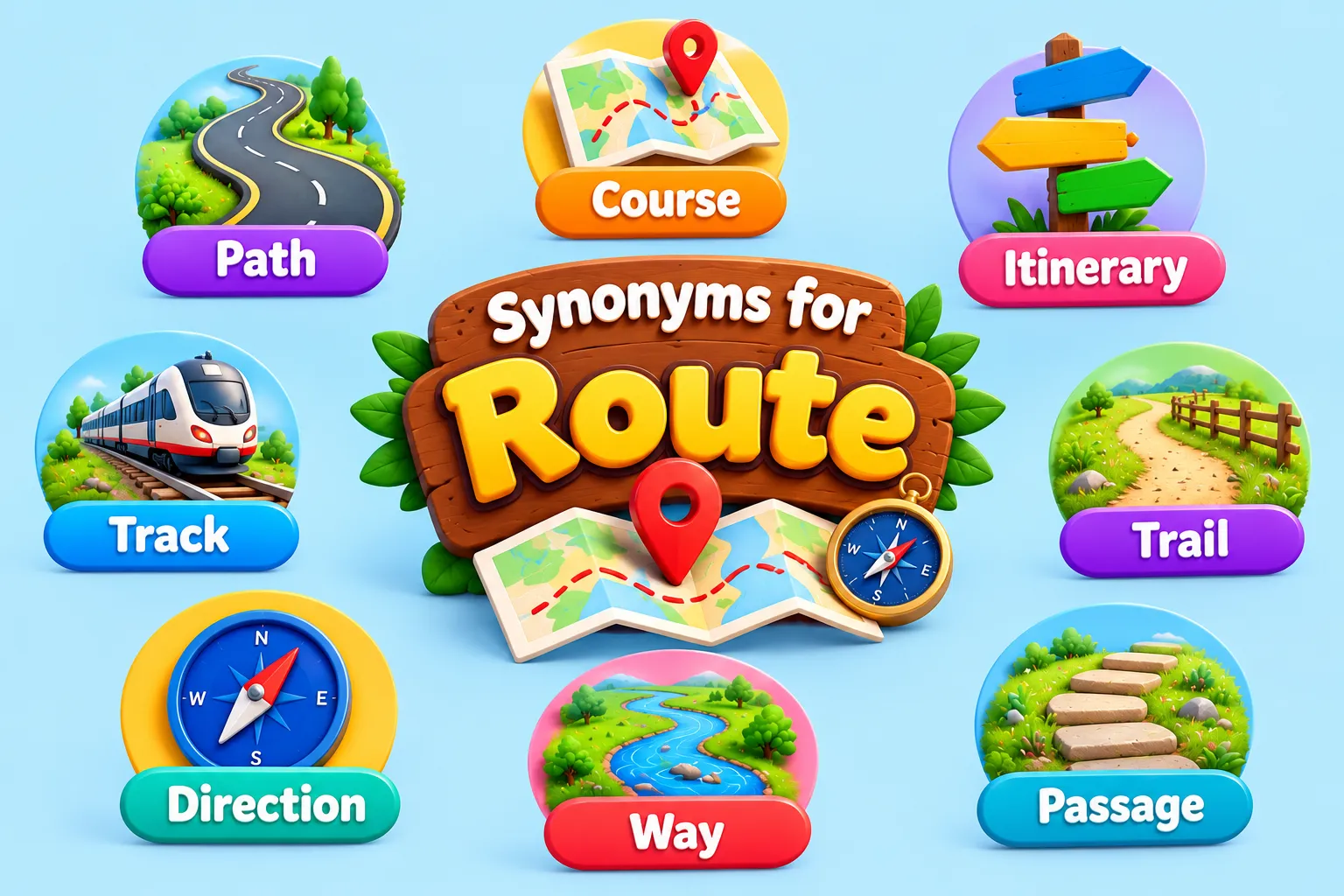
Synonyms for route include path, way, road, track, course, trail, passage, direction, and pathway. These words describe ways to travel from one place to another, though each has a slightly different meaning.
A route is a way to get from one place to another. For example, when you travel to school, you may take a road that saves time. This road is your route. We use this word when talking about travel, maps, directions, and delivery services. Learning synonyms for route helps English learners build a stronger vocabulary and express ideas in different ways. It also helps writers avoid using the same word too often. Some words describe roads, while others refer to paths, courses, or ways to reach a goal. In this article, you will learn the meaning of route, its pronunciation, history, word forms, and 30 related words with simple meanings and examples. You will also discover how to choose the best word for each situation.
Meaning of Route
Definition
Route (Noun): A way or path used to travel from one place to another.
Route (Verb): To send or direct someone or something along a particular way.
Examples
- We took a shorter route to reach the city.
- The company routes its deliveries through the main warehouse.
Connotative Meaning
Connotation means the feeling or idea that a word suggests beyond its basic meaning.
- Positive tone: A route may suggest an easy, safe, or quick way to reach a place.
- Negative tone: A route may suggest a long, difficult, or unsafe journey.
- Neutral tone: Route often refers simply to a planned way from one place to another.
Etymology of Route
The word route came into English through French. Its history is linked to the Latin word rupta, meaning a broken or beaten way.
| Period | History and Meaning |
| Old English (450–1100) | The modern word route was not commonly used in Old English. People used other words for roads and paths. |
| Middle English (1100–1500) | The word entered English through Old French route, meaning a road or way. |
| Modern English (1500–Present) | Route developed into a common word for a road, travel path, planned course, or way of sending something. |
Pronunciation (IPA)
- IPA: /ruːt/ or /raʊt/, depending on the speaker and dialect.
- Syllables: route — one syllable.
Affixation Pattern of Route
- Root: route
- Prefix: No common prefix in the base word route.
- Suffix: No suffix in the base word route.
Word Formations
- Route (noun): A way from one place to another.
- Route (verb): To direct someone or something along a path.
- Routed (verb, past tense): Sent along a chosen way.
- Routing (noun/verb): The process of choosing or directing a route.
- Router (noun): A device or person that directs something; in computing, a device that sends data between networks.
- Routable (adjective): Able to be routed, especially in a network or transport system.
30 Synonyms of Route With Meaning & Examples
Not every word below is an exact substitute for route. Some describe a physical path, while others refer to a direction, journey, or planned course.
1. Path (Noun)
Meaning: A way that people or animals use to move from one place to another.
Examples:
- We followed a narrow path through the woods.
- This path leads to the river.
2. Way (Noun)
Meaning: A direction or method used to reach a place or goal.
Examples:
- Is this the right way to the station?
- We found a better way to reach the village.
3. Road (Noun)
Meaning: A hard surface built for vehicles to travel on.
Examples:
- The road leads to the next town.
- We took the main road to the airport.
4. Track (Noun)
Meaning: A marked or worn path used for travel or movement.
Examples:
- The hikers followed a track up the hill.
- The train runs along this track.
5. Trail (Noun)
Meaning: A path through a natural area, often used for walking.
Examples:
- We walked along a forest trail.
- The trail leads to a beautiful lake.
6. Course (Noun)
Meaning: A planned direction or path followed by a person, vehicle, or activity.
Examples:
- The ship changed its course.
- We planned our course before the trip.
7. Pathway (Noun)
Meaning: A path that connects one place to another.
Examples:
- A stone pathway leads to the garden.
- Follow the pathway to the main building.
8. Passage (Noun)
Meaning: A way through or between places.
Examples:
- The narrow passage connects two streets.
- We found a passage through the mountains.
9. Direction (Noun)
Meaning: The way in which someone or something moves.
Examples:
- We walked in the direction of the station.
- The driver changed direction at the crossing.
10. Highway (Noun)
Meaning: A main public road used for travel between places.
Examples:
- We drove along the highway for two hours.
- The highway connects the two cities.
11. Byway (Noun)
Meaning: A small or less-traveled road.
Examples:
- We explored a quiet byway in the countryside.
- The byway passed through several small villages.
12. Lane (Noun)
Meaning: A narrow road or a marked part of a road.
Examples:
- Their house is at the end of a country lane.
- Stay in the left lane on the highway.
13. Street (Noun)
Meaning: A public road in a town or city, often with buildings along it.
Examples:
- Turn left at the next street.
- The street leads to the market.
14. Avenue (Noun)
Meaning: A wide road, often lined with trees or buildings.
Examples:
- We walked down a tree-lined avenue.
- The hotel is on a busy avenue.
15. Thoroughfare (Noun)
Meaning: A public road or passage that people use to travel through an area.
Examples:
- The main thoroughfare was busy all day.
- Shops line the town’s main thoroughfare.
16. Artery (Noun)
Meaning: A major road or route that carries a large amount of traffic.
Examples:
- This highway is a major traffic artery.
- The new road links two important transport arteries.
17. Corridor (Noun)
Meaning: A passage or travel zone that connects places.
Examples:
- The railway corridor links several towns.
- The trade corridor helps goods move across the region.
18. Circuit (Noun)
Meaning: A route that goes around a place or returns to its starting point.
Examples:
- We walked a short circuit around the park.
- The runners completed one circuit of the track.
19. Loop (Noun)
Meaning: A route that curves around and often returns to its starting point.
Examples:
- We took a loop around the lake.
- This cycling loop begins and ends in the village.
20. Itinerary (Noun)
Meaning: A plan that lists the places and stops for a journey.
Examples:
- Our itinerary includes three cities.
- She checked the itinerary before leaving the hotel.
21. Passageway (Noun)
Meaning: A narrow or enclosed way that connects two places.
Examples:
- The passageway leads to the courtyard.
- We walked through a passageway under the building.
22. Trackway (Noun)
Meaning: A path or track used for travel, often across land.
Examples:
- The old trackway crossed the fields.
- The team followed a trackway through the hills.
23. Access Road (Noun)
Meaning: A road that provides a way to reach a place.
Examples:
- Follow the access road to the factory.
- The access road leads to the parking area.
24. Approach (Noun)
Meaning: A way of reaching or moving toward a place.
Examples:
- The northern approach to the city was closed.
- We used the main approach to reach the building.
25. Line (Noun)
Meaning: A transport connection or route between places.
Examples:
- The bus line connects the village to the city.
- This railway line runs along the coast.
26. Connection (Noun)
Meaning: A link that allows travel or movement between places.
Examples:
- There is a direct rail connection to the airport.
- We found a bus connection to the nearby town.
27. Network (Noun)
Meaning: A group of connected roads, paths, or transport lines.
Examples:
- The city has a large road network.
- The railway network connects many regions.
28. Trek (Noun)
Meaning: A long or difficult journey, often on foot.
Examples:
- The trek through the mountains took two days.
- They planned a trek across the valley.
29. Journey (Noun)
Meaning: The act of traveling from one place to another.
Examples:
- Our journey took five hours.
- They began their journey early in the morning.
30. Track Route (Noun)
Meaning: A planned path followed during travel or an activity.
Examples:
- The guide showed us the track route on the map.
- The race track route passes through the park.
Prototype Meaning
The most common meaning of route is a way to travel from one place to another. People often imagine a road shown on a map, a path suggested by a navigation app, or a planned course followed by a bus or car. A route may be short or long, simple or complex. It can also refer to a way of sending goods, messages, or data. The exact meaning depends on the situation, but the main idea is a chosen way from a starting point to a destination.
Prototype Categorization
The synonyms and related terms for route fit into several groups. These groups help writers select words that match the exact meaning they want to express.
- General ways and paths: Path, way, pathway, and trail describe ways to move from one place to another. Use these words for walking, hiking, or general directions.
- Roads and streets: Road, highway, byway, lane, street, and avenue refer to physical roads. Choose the word that matches the road’s size and setting.
- Passages and connections: Passage, passageway, corridor, access road, and connection describe ways that link places. These words are useful in travel, buildings, and transport.
- Planned courses: Course, itinerary, direction, and approach can describe a chosen plan or direction. Use them when explaining a travel plan or the way to reach a destination.
- Routes that follow a shape: Circuit and loop describe paths that go around an area or return to the starting point.
- Large transport systems: Artery, line, and network describe major roads or connected transport links. They are useful in reports about cities and transport.
- Journeys and travel activities: Journey and trek focus more on the act or experience of traveling than on the route itself.
These categories help you avoid choosing a word that does not fit. For example, highway works for a major road, while itinerary works for a travel plan. Many of these words are related to route, but they are not exact synonyms in every sentence.
Antonyms of Route
The word route has no single direct antonym in every context. However, these words can express an opposite idea, such as having no clear way forward or blocking movement.
| Antonym or Opposing Term | Part of Speech | Meaning |
| Dead end | Noun | A road or path that has no exit at its far end. |
| Blockage | Noun | Something that stops movement along a route. |
| Obstruction | Noun | Something that blocks a path or passage. |
| Barrier | Noun | Something that prevents people or vehicles from passing. |
| Detour | Noun | A different route used when the usual route is closed; it is not a true antonym. |
| Impasse | Noun | A situation in which no way forward is possible. |
| Roadblock | Noun | A barrier that prevents travel along a road. |
| Standstill | Noun | A complete stop in movement or progress. |
Short Questions and Answers
What does route mean?
A route is a way or path used to travel from one place to another.
When should route be used?
Use route when talking about roads, directions, travel plans, delivery paths, or ways to send data.
Is route positive or negative?
Route is usually neutral. It can sound positive when it is safe or quick, or negative when it is long or difficult.
How is route different from similar words?
A route is a chosen way to reach a place. A road is a physical surface for vehicles. A path is often smaller or used by people walking. An itinerary is a plan for a journey.
Conclusion
Learning the meaning of route and its synonyms can help you improve your English vocabulary. Words such as path, road, trail, and course can make your writing clearer and more interesting. However, each word has its own meaning, so it is important to choose one that fits the context. A highway is a major road, while a pathway may be a small walking path. An itinerary is a travel plan, not a physical road. Learning these differences helps you avoid repetition and express your ideas with greater accuracy. Try using one new synonym each day in a sentence. With regular practice, you can strengthen your writing, improve your speaking, and build confidence in English.
Read More:
Synonyms for Earned: 29 Useful Alternatives

I’m Pinki, an SEO writer at SynonymsInstant.com, specializing in synonyms, antonyms, vocabulary, word meanings, grammar, and English usage. I create accurate, well-researched, reader-friendly content that combines language expertise with SEO best practices. My goal is to make English vocabulary simple, useful, and accessible for students, writers, professionals, and English learners.